





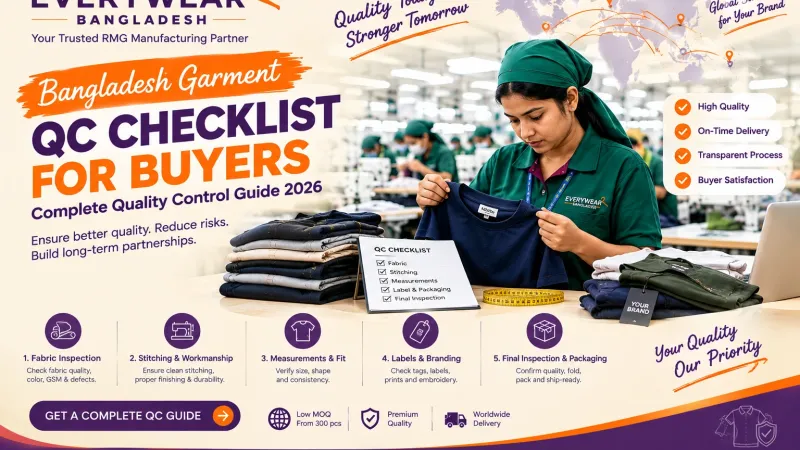
Bangladesh Garment QC Checklist for Buyers – Complete Quality Control Guide 2026
Last updated: September 17, 2026 • [Complete Guide for Clothing Brands, Amazon FBA Sellers & Importers]
Quick Answer: What Is a Garment QC Checklist and Why Do You Need One?
A garment QC checklist is a structured document used to inspect clothing at three critical stages: pre-production (before cutting), in-line (during production), and final AQL inspection (before shipment). For buyers sourcing from Bangladesh, a QC checklist is essential – clothing returns run 20-40% in some categories, and most quality issues can be caught before shipment with proper inspection. The checklist should cover: fabric quality, measurements, stitching, construction, color accuracy, branding, and packaging. Everywear Bangladesh uses a multi-stage QC process with AQL standards, plus video-call verification so you see your products before they ship. The result: fewer returns, better reviews, and a stronger brand. This guide provides a complete QC checklist you can use with any Bangladesh manufacturer – plus how Everywear ensures quality on every order.
Quality control is the difference between a successful clothing brand and a failed one. In apparel, where returns run as high as 20-40% in some categories, poor quality destroys margins, damages brand reputation, and leads to negative reviews that kill future sales.
For buyers sourcing from Bangladesh – whether you're a clothing brand, Amazon FBA seller, or boutique retailer – a structured QC checklist is your best defense against costly quality issues.
This comprehensive guide covers: why QC matters, the 3 stages of garment inspection, common defect categories, a complete printable QC checklist, how to request QC reports, and how Everywear Bangladesh ensures quality on every order.
Why Quality Control Matters for Clothing Buyers
Quality control isn't just about avoiding defects – it's about protecting your brand, your margins, and your customers' trust.
The Real Cost of Poor Quality
| Problem | Impact on Your Business |
|---|---|
| High Return Rates | 20-40% returns in apparel; each return costs you shipping, processing, and lost margin |
| Negative Reviews | Poor quality leads to 1-star reviews that kill future sales on Amazon, Shopify, and Etsy |
| Damaged Brand Reputation | One bad product experience can lose a customer forever |
| Unsellable Inventory | Defective garments tie up capital and take up storage space |
| Amazon Account Health | High return rates can lead to account suspension or removal of listings |
| Lost Repeat Business | Customers who receive poor quality don't come back |
The Benefits of a Strong QC Process
- Lower return rates – Catch issues before they reach customers
- Better reviews – Consistent quality leads to positive reviews
- Higher margins – Fewer returns and refunds mean more profit
- Brand loyalty – Quality builds trust and repeat customers
- Peace of mind – You know what you're getting before it ships
The 3 Stages of Garment Quality Control
Professional garment QC follows a three-stage inspection process. Each stage catches different types of defects – and all three are essential for consistent quality.
Stage 1: Pre-Production Inspection
When: Before cutting begins
What: Verifying fabrics, trims, and materials against your specifications
What to Check:
- Fabric quality – GSM, composition, color, hand feel, and defects
- Color accuracy – Match against Pantone or reference sample
- Fabric width and shrinkage – Critical for accurate cutting
- Trims and accessories – Zippers, buttons, labels, threads
- Lab dips – Approve color before bulk dyeing
- Approved sample – Compare against your approved sample
Why It Matters: Catching fabric issues before cutting prevents thousands of defective garments. If the fabric is wrong, everything made from it will be wrong.
Stage 2: In-Line Inspection (During Production)
When: During production, at multiple checkpoints
What: Inspecting garments as they move through production
What to Check:
- Measurement accuracy – Verify against your size chart
- Stitching quality – Stitch density, seam strength, thread tension
- Construction details – Neckline, cuffs, hem, pockets, closures
- Symmetry – Left and right sides match
- Alignment – Plaids, stripes, and patterns match at seams
- Workmanship – No loose threads, skipped stitches, or puckering
Why It Matters: In-line inspection catches issues during production – before they become widespread. It's easier and cheaper to fix problems early.
Stage 3: Final Random Inspection (AQL)
When: After production is complete, before shipment
What: Random sampling inspection using AQL (Acceptable Quality Limit) standards
What to Check:
- Measurement verification – Randomly measure garments against spec
- Visual inspection – Check for defects (see defect categories below)
- Color consistency – All garments match within approved tolerance
- Branding – Labels, tags, printing, embroidery are correct
- Packing – Poly bags, hang tags, cartons, and labeling
- Carton quality – Proper carton strength, labeling, and packing
AQL Standards: AQL is the internationally recognized standard for random sampling inspection. Common AQL levels:
| Defect Level | AQL Level | What It Means |
|---|---|---|
| Critical Defects | 0% | Safety issues, unacceptable defects – zero tolerance |
| Major Defects | 2.5 | Functional defects – acceptable limit 2.5% |
| Minor Defects | 4.0 | Cosmetic defects – acceptable limit 4.0% |
Common Garment Defect Categories in Bangladesh
Understanding common defects helps you spot them during inspection. Here are the most frequent defect categories:
1. Fabric Defects
- Shading – Color variation within the same garment or between garments
- Holes – Physical holes, snags, or tears in the fabric
- Contamination – Foreign fibers, dirt, or stains
- Fabric defects – Weaving errors, slubs, or misprints
- Shrinkage – Fabric shrinks more than specified
- Pilling – Fabric pills after washing
2. Sewing Defects
- Skipped stitches – Missing stitches in the seam
- Broken stitches – Broken thread in the seam
- Puckering – Fabric bunching or wrinkling at seams
- Seam slippage – Seams open when stretched
- Uneven stitching – Inconsistent stitch density
- Loose threads – Uncut threads visible on the garment
- Needle damage – Holes from needles in the fabric
3. Measurement Defects
- Out of tolerance – Measurements outside your specification tolerance (typically +/- 0.5" to 1")
- Inconsistent sizing – Different garments of the same size measure differently
- Grading issues – Sizes don't increase/decrease correctly across sizes
- Asymmetric measurements – Left and right sides don't match
4. Construction Defects
- Neckline issues – Uneven or wavy necklines
- Hem issues – Uneven, twisted, or distorted hems
- Cuff issues – Uneven or loose cuffs
- Pocket issues – Misaligned, uneven, or loose pockets
- Zipper issues – Stuck, misaligned, or broken zippers
- Button issues – Loose, missing, or misaligned buttons
5. Finishing Defects
- Poor pressing – Wrinkles, shine marks, or scorching
- Stains – Oil, dirt, or chemical stains
- Loose threads – Uncut threads throughout the garment
- Chalk marks – Visible chalk or marking pen
- Odor – Chemical or moldy smell
6. Branding Defects
- Label issues – Wrong label, missing label, or poorly attached label
- Printing defects – Misaligned, faded, or peeling prints
- Embroidery defects – Misaligned, puckered, or poor-quality embroidery
- Hang tag issues – Missing, wrong, or poorly attached hang tags
7. Packaging Defects
- Poly bag issues – Wrong size, missing suffocation warning, or poorly sealed
- Carton issues – Wrong carton size, weak cartons, or incorrect labeling
- Assortment errors – Wrong sizes or colors packed in cartons
- Quantity errors – Cartons don't contain the specified quantity
Complete Garment QC Checklist for Buyers
Use this printable QC checklist for every order. It covers all critical inspection points across the three QC stages.
Pre-Production Inspection Checklist
| # | Inspection Point | Yes/No | Notes |
|---|---|---|---|
| 1 | Fabric GSM matches specification | ⬜ | |
| 2 | Fabric composition matches specification | ⬜ | |
| 3 | Fabric color matches approved lab dip | ⬜ | |
| 4 | Fabric has no visible defects | ⬜ | |
| 5 | Fabric shrinkage within tolerance | ⬜ | |
| 6 | Trims (zippers, buttons, threads) match spec | ⬜ | |
| 7 | Labels and tags match specification | ⬜ | |
| 8 | Approved sample is available for reference | ⬜ |
In-Line Inspection Checklist
| # | Inspection Point | Yes/No | Notes |
|---|---|---|---|
| 1 | Measurements match size chart | ⬜ | |
| 2 | Stitching quality is consistent | ⬜ | |
| 3 | No skipped or broken stitches | ⬜ | |
| 4 | Seams are strong and secure | ⬜ | |
| 5 | Construction details match spec | ⬜ | |
| 6 | Symmetry is correct | ⬜ | |
| 7 | No needle damage or holes | ⬜ | |
| 8 | Branding is correctly applied | ⬜ |
Final AQL Inspection Checklist
| # | Inspection Point | Yes/No | Notes |
|---|---|---|---|
| 1 | Random sample selected per AQL standards | ⬜ | |
| 2 | Measurements within tolerance (+/- 0.5" to 1") | ⬜ | |
| 3 | No critical defects (0% tolerance) | ⬜ | |
| 4 | Major defects below 2.5% AQL | ⬜ | |
| 5 | Minor defects below 4.0% AQL | ⬜ | |
| 6 | Color consistency across all garments | ⬜ | |
| 7 | Branding (labels, tags) correct on all garments | ⬜ | |
| 8 | Poly bags and packaging correct | ⬜ | |
| 9 | Carton quality and labeling correct | ⬜ | |
| 10 | Assortment (sizes/colors) is correct | ⬜ | |
| 11 | Quantity matches order | ⬜ | |
| 12 | Final inspection report completed | ⬜ |
How to Request a QC Report from Your Manufacturer
A QC report documents the inspection findings and provides proof that your order meets your specifications. Here's how to request one:
What to Ask For
- Pre-production inspection report – Fabric and trim verification
- In-line inspection report – Production progress and quality checks
- Final AQL inspection report – Complete inspection with defect classification
- Measurement report – Actual measurements vs. specification
- Defect summary – Number and type of defects found
- Photos – Visual documentation of the inspection
What a Good QC Report Includes
| Section | Details |
|---|---|
| Order Information | PO number, style, quantity, colors, sizes |
| Inspection Details | Date, inspector name, inspection level, AQL standard |
| Sample Size | Number of garments inspected per AQL |
| Defect Findings | Critical, major, and minor defects found |
| Measurement Results | Actual vs. spec for key measurements |
| Photos | Visual documentation of findings |
| Conclusion | Pass/fail recommendation and next steps |
Red Flags in QC Reporting
- ❌ No photos – A QC report without photos is incomplete
- ❌ Vague findings – "Minor issues found" without specifics
- ❌ No measurements – Measurement data is essential
- ❌ No AQL standard referenced – The report should state the standard used
- ❌ Refusal to share report – A legitimate manufacturer will share QC reports
How Everywear Bangladesh Ensures Quality on Every Order
At Everywear Bangladesh, we understand that quality is the foundation of a successful clothing brand. That's why we've built a comprehensive QC process that protects your interests at every stage.
1. Multi-Stage QC Process
We inspect every order at three critical stages:
- Pre-production inspection – Fabric, trims, and materials
- In-line inspection – During production, at multiple checkpoints
- Final AQL inspection – Before shipment, using AQL standards
2. AQL Standards on Every Order
We use internationally recognized AQL standards to determine sample size and defect tolerances:
- Critical defects – 0% tolerance
- Major defects – 2.5% AQL
- Minor defects – 4.0% AQL
3. Video-Call Verification
Before your order ships, we offer a video-call inspection via WhatsApp or Zoom. You can see your products in real-time, ask questions, and verify quality before shipment.
4. Comprehensive QC Reports
We provide detailed QC reports for every order, including:
- Inspection findings
- Defect summary
- Measurement results
- Photos of your products
- Pass/fail recommendation
5. Third-Party Inspection Support
If you prefer an independent inspection, we can coordinate with third-party QC companies (SGS, Bureau Veritas, Intertek, QIMA) to inspect your order before shipment.
6. Defect Resolution
If defects are found, we work with the factory to resolve them before shipment – whether that's rework, replacement, or repair. Your satisfaction is our priority.
Contact Everywear Bangladesh on WhatsApp
Frequently Asked Questions
Everything you need to know about garment quality control and QC checklists for Bangladesh sourcing.
1. What is a garment QC checklist?
A garment QC checklist is a structured document used to inspect clothing at three critical stages: pre-production (before cutting), in-line (during production), and final AQL inspection (before shipment). It covers fabric quality, measurements, stitching, construction, color, branding, and packaging.
2. Why is quality control important when sourcing from Bangladesh?
Clothing returns run 20-40% in some categories. Poor quality leads to high return rates, negative reviews, damaged brand reputation, and unsellable inventory. A strong QC process protects your margins and your brand.
3. What are the 3 stages of garment QC?
The three stages are: (1) Pre-production inspection – fabric and trim verification before cutting; (2) In-line inspection – during production at multiple checkpoints; (3) Final AQL inspection – random sampling before shipment.
4. What is AQL and how does it work?
AQL (Acceptable Quality Limit) is the internationally recognized standard for random sampling inspection. Common AQL levels: Critical defects 0%, Major defects 2.5%, Minor defects 4.0%. AQL determines how many garments to inspect and the acceptable number of defects.
5. What are common garment defects in Bangladesh?
Common defects include: fabric defects (shading, holes, contamination), sewing defects (skipped stitches, puckering, loose threads), measurement defects (out of tolerance, inconsistent sizing), construction defects (neckline, hem, zipper issues), and packaging defects.
6. How do I request a QC report from my manufacturer?
Ask for: pre-production inspection report, in-line inspection report, final AQL inspection report, measurement report, defect summary, and photos. A good QC report includes all these sections and a pass/fail recommendation.
7. Can I use my own QC checklist with any manufacturer?
Yes. You can share your QC checklist with any manufacturer. A good manufacturer will welcome a structured QC process – it shows you're serious about quality. At Everywear Bangladesh, we use our own comprehensive QC process and welcome your specific requirements.
8. What if defects are found during inspection?
If defects are found, the manufacturer should rework, replace, or repair the affected garments before shipment. At Everywear, we work with the factory to resolve all defects before your order ships – your satisfaction is our priority.
9. How many garments are inspected in a QC check?
The number of garments inspected depends on the AQL standard and the total order quantity. For example, an order of 1,000-3,500 pieces typically requires inspecting 125-200 pieces (depending on AQL level).
10. Can I use a third-party QC company?
Yes. Many buyers use third-party QC companies like SGS, Bureau Veritas, Intertek, or QIMA for independent inspection. Everywear can coordinate with third-party inspectors if you prefer independent verification.
11. What is a video-call inspection and how does it work?
A video-call inspection is a live video call (via WhatsApp or Zoom) where you can see your products in real-time before shipment. You can ask the inspector to show specific garments, measurements, and details – giving you confidence before your order ships.
12. What is the cost of QC inspection?
QC inspection costs vary by provider. Everywear includes QC inspection in our service – there's no extra cost. Third-party inspections typically cost $100-$300 per inspection, depending on the scope.
13. What is the most important QC check?
All three stages are important, but final AQL inspection is the last line of defense before shipment. It catches issues that may have been missed earlier and ensures your order meets your specifications before it leaves the factory.
14. How do I prepare for a QC inspection?
Provide the manufacturer with: your approved sample, detailed specifications, measurement chart, and any specific QC requirements. The more information you provide, the more accurate the inspection will be.
15. What is a defect classification?
Defects are classified as: Critical (safety issues, zero tolerance), Major (functional defects, 2.5% AQL), and Minor (cosmetic defects, 4.0% AQL). This classification determines whether the order passes or fails inspection.
16. How does Everywear Bangladesh ensure quality?
Everywear uses a multi-stage QC process with AQL standards, video-call verification, comprehensive QC reports, third-party inspection support, and defect resolution. We protect your interests at every stage.
17. What is a measurement tolerance and why does it matter?
Measurement tolerance is the acceptable range for garment measurements – typically +/- 0.5" to 1". If measurements fall outside this tolerance, the garment may not fit correctly, leading to returns. QC inspection verifies measurements against your spec.
18. What is the difference between major and minor defects?
Major defects affect functionality or appearance significantly (e.g., broken zipper, incorrect measurement, visible stain). Minor defects are cosmetic and less noticeable (e.g., loose thread, minor color variation). Major defects have a lower AQL tolerance (2.5%) than minor defects (4.0%).
19. Can I inspect my order myself?
Yes – but it requires traveling to Bangladesh. If you can't visit, video-call inspection or a third-party QC company are excellent alternatives. Everywear offers video-call inspection and can coordinate third-party inspections.
20. How do I get started with QC for my Bangladesh order?
Contact Everywear Bangladesh on WhatsApp at +8801788898174. Our team will understand your quality requirements, implement our QC process, provide inspection reports, and coordinate video-call verification – all with one point of contact.
Conclusion
Quality control is not optional when sourcing clothing from Bangladesh – it's the foundation of a successful brand. With apparel returns running 20-40%, a structured QC process protects your margins, your reviews, and your reputation.
This guide provides a complete QC checklist you can use with any manufacturer – covering pre-production, in-line, and final AQL inspection. Use it to verify fabric quality, measurements, stitching, construction, color, branding, and packaging.
At Everywear Bangladesh, we make quality control simple and reliable. With our multi-stage QC process, AQL standards, video-call verification, comprehensive reports, and defect resolution, you get the quality you expect – every order, every time.
Contact Everywear Bangladesh on WhatsApp
About the Author
Written by the Everywear Bangladesh Research & Sourcing Team
The Everywear Bangladesh editorial team combines deep industry expertise in Bangladesh's Ready-Made Garment (RMG) sector with practical experience in international apparel sourcing, supply chain management, and Amazon FBA selling. Our team includes former garment factory managers, sourcing professionals, and e-commerce specialists who have helped hundreds of sellers launch their clothing brands.
Our mission is to provide accurate, data-driven, and actionable content that helps fashion entrepreneurs, Amazon sellers, and global brands make informed sourcing decisions. We leverage real-time data from Amazon Seller Central, the Bangladesh Garment Manufacturers and Exporters Association (BGMEA), Export Promotion Bureau (EPB), and other authoritative sources to ensure our insights reflect the latest industry developments.
Connect with Everywear Bangladesh:
- Website: everywearbd.com
- WhatsApp: +8801788898174
- Facebook: facebook.com/everywearbd
- LinkedIn: Everywear Bangladesh Ltd
Related Resources
GEO Landing Pages
- USA Buyers: Wholesale Garments from Bangladesh
- UK Buyers: Wholesale Garments from Bangladesh
- Europe Buyers: Wholesale Clothing from Bangladesh
- Africa Buyers: Wholesale Garments from Bangladesh
Blog Posts
- How to Order Your First Sample from a Bangladesh Manufacturer – Complete Guide 2026
- Bangladesh Clothing Suppliers – Complete Directory & Sourcing Guide 2026
- Verified Wholesale Suppliers in Bangladesh – B2B Directory & Guide 2026
- Low MOQ Clothing Manufacturer Bangladesh – Complete Guide
- Private Label Clothing Manufacturing Bangladesh – Complete Brand Guide 2026
References
- Bangladesh Garment Manufacturers and Exporters Association (BGMEA), "BGMEA Member Directory 2026"
- Export Promotion Bureau (EPB), "Registered Exporters Database 2026"
- International Trade Centre (ITC), "Bangladesh Textile and Garment Sector Analysis 2026"
- American Society for Quality (ASQ), "Acceptable Quality Limit (AQL) Standards"
- ISO 2859-1:2021, "Sampling procedures for inspection by attributes"
- International Organization for Standardization (ISO), "ISO 9001:2015 Quality Management Systems"
- SGS, "Garment Inspection Services – AQL Standards"
- Bureau Veritas, "Consumer Products Inspection – Textile and Apparel"
- Intertek, "Quality Assurance and Inspection Services for Apparel"
- QIMA, "Textile and Apparel Inspection Services"
This guide is updated regularly. Last reviewed: September 17, 2026. For sourcing solutions tailored to your brand, contact Everywear Bangladesh on WhatsApp.
Everywear Bangladesh Ltd. – Bangladesh's First RMG Wholesale Marketplace | 300 Pcs Custom Orders | Export Quality Garments
WhatsApp: +8801788898174 • Website: everywearbd.com