





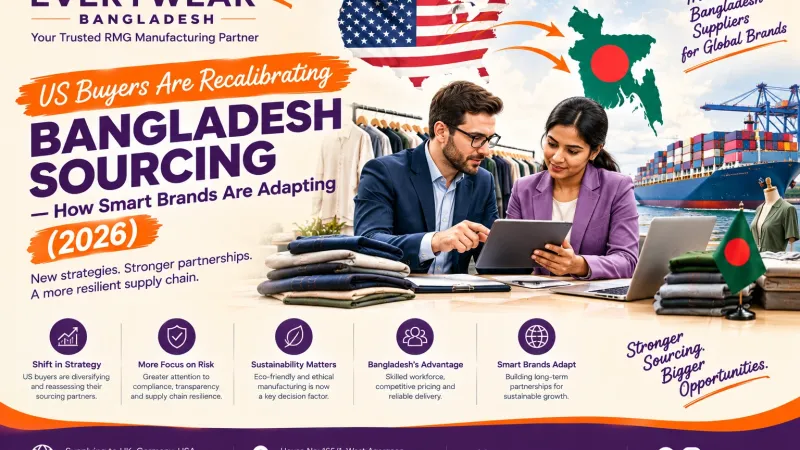
US Buyers Are Recalibrating Bangladesh Sourcing — How Smart Brands Are Adapting (2026)
Last updated: September 21, 2026 • [Complete Analysis for US Fashion Brands, Amazon FBA Sellers & Sourcing Directors]
Quick Answer: What Is Happening with US Apparel Sourcing from Bangladesh in 2026?
The 2026 USFIA Benchmarking Study reveals a major shift: Bangladesh's utilisation rate among US fashion companies dropped to 78.9% from 88.2% a year earlier — but this is not a loss of competitiveness. It reflects "Sourcing Diversification 2.0" — a strategic shift where US brands are consolidating vendors, prioritising compliance capabilities, and building resilient supply chains. Meanwhile, Bangladesh achieved a historic milestone: surpassing China in US apparel imports for the first time in decades (11.3% market share vs China's 9.7%). The US-Bangladesh Trade Deal delivers zero tariffs for US-origin cotton garments and a reduced 19% rate for others. With 92% of US fashion companies citing tariffs as their #1 challenge, the smartest brands are doubling down on Bangladesh — but only with the right partner. Everywear Bangladesh provides the verified factories, compliance documentation, low MOQ, and US Cotton Zero-Tariff sourcing that US brands need to navigate this recalibration successfully.
The 2026 USFIA Benchmarking Study has sent ripples through the apparel sourcing world. The headline number — Bangladesh's utilisation rate dropping from 88.2% to 78.9% — has been interpreted by some as a warning sign for the industry[reference:0].
But a deeper reading of the data tells a different story. This is not about Bangladesh losing its competitive edge. It's about US brands fundamentally changing how they source — and Bangladesh remaining a strategically critical partner in that evolution.
At the same time, Bangladesh achieved a historic milestone: it surpassed China in US apparel imports for the first time in decades, capturing 11.3% of the US market[reference:1]. Meanwhile, the US-Bangladesh Trade Deal has created a zero-tariff pathway for US-origin cotton garments — a structural advantage that no other major sourcing destination can match[reference:2].
This comprehensive guide covers: what the USFIA data really means, the four sourcing strategies US brands are adopting, why Bangladesh remains critical, how the trade deal changes the calculus, and how Everywear Bangladesh helps US brands navigate this recalibration with confidence.
The USFIA Data Explained: What's Really Happening
Before drawing conclusions, let's understand the numbers.
The Headline Numbers
| Metric | 2025 | 2026 | Change |
|---|---|---|---|
| Bangladesh Utilisation Rate | 88.2% | 78.9% | -9.3 pts |
| Vietnam Utilisation Rate | 100% | ~78% | -22 pts |
| China Utilisation Rate | 100% | 73% | -27 pts |
| Average US Apparel Tariff | 15.2% | 21.6% | +6.4 pts |
| Companies Citing Tariffs as #1 Challenge | — | 92% | — |
Source: 2026 USFIA Benchmarking Study, covering April-June 2026[reference:3]
What This Actually Means
The decline in utilisation rates across all major Asian sourcing destinations — not just Bangladesh — reveals the real story: US brands are intentionally maintaining diverse sourcing bases prioritising capacity, flexibility, inventory agility, and regional balancing[reference:4].
As the USFIA report explicitly states: "The decline in Bangladesh's utilisation rate should not be interpreted as a loss of competitiveness. Instead, it reflected a broader transformation in global sourcing strategies."[reference:5]
In fact, Bangladesh tied with Vietnam, Cambodia, and Indonesia as the most-utilised apparel sourcing destination in 2026[reference:6]. Nearly 47% of US companies source more than 10% of their apparel from Bangladesh — highlighting its continued strategic importance[reference:7].
And looking ahead, 46.7% of respondents plan to increase sourcing from Bangladesh over the next two years — making it the second most popular "rising star" for future expansion, behind only Indonesia[reference:8].
The Four Sourcing Strategies US Brands Are Adopting
The 2026 USFIA study identified four key strategies that US fashion companies are pursuing[reference:9]:
Strategy 1: Sourcing Diversification (Reducing China Exposure)
US brands continue to reduce sourcing from China while expanding from lower-cost manufacturing hubs in Asia — primarily Bangladesh and Vietnam. China's share of US apparel imports has plummeted to 9.7%, falling behind both Vietnam (22.2%) and Bangladesh (11.3%)[reference:10].
What this means for Bangladesh: As China's share declines, Bangladesh is structurally positioned to capture displaced volume — particularly in knitwear and basic apparel categories.
Strategy 2: Tariff Relief & Optimization
With tariffs now the "single most influential challenge" driving sourcing decisions, companies are moving beyond short-term workarounds to long-term tariff management strategies — including duty refunds, First Sale programs, and restructuring sourcing operations within existing tariff rules[reference:11].
What this means for Bangladesh: The US-Bangladesh Trade Deal's zero-tariff pathway for US-origin cotton is now a critical tariff management tool for US brands.
Strategy 3: Vendor Consolidation
In a major departure from post-pandemic expansion, US brands are consolidating their vendor networks — working with fewer, more capable partners who offer flexibility, compliance capabilities, and strategic alignment[reference:12].
Key data: Nearly half of respondents plan to source from fewer suppliers over the next two years — almost three times the share reported in 2025[reference:13].
What this means for Bangladesh: The "one accountable partner" model becomes more valuable than ever. Brands don't want to manage 50 factories — they want 3-5 trusted partners who can deliver across categories.
Strategy 4: Compliance as a Sourcing Requirement
The study found that sourcing decisions are increasingly shaped by supplier capabilities, not just cost. Flexibility, agility, and compliance capabilities have grown in importance as brands navigate expanding traceability, ESG reporting, and forced labor requirements[reference:14].
What this means for Bangladesh: Compliance documentation, traceability, and transparency are now table stakes — not differentiators.
Why Bangladesh Remains Critical for US Brands
Despite the headline decline, Bangladesh's strategic importance to US brands is stronger than ever.
1. Historic Milestone: Surpassing China
For the first time in decades, Bangladesh has overtaken China as the #2 apparel supplier to the US. During January-May 2026, Bangladesh accounted for 11.3% of US apparel imports, compared to China's 9.7%[reference:15].
This milestone reflects structural shifts in global trade — and positions Bangladesh as a primary beneficiary of China's decline.
2. The US-Bangladesh Trade Deal Advantage
The Agreement on Reciprocal Trade (ART) signed in February 2026 creates a two-tier tariff structure that no other sourcing destination can match:
| Tariff Tier | Rate | Qualification |
|---|---|---|
| Standard Reciprocal Tariff | 19% | Most Bangladeshi goods |
| Zero-Tariff Tier | 0% | Garments made with US-origin cotton or man-made fibres |
Source: US-Bangladesh Joint Statement on Reciprocal Trade, February 9, 2026[reference:16]
The competitive advantage: Vietnam faces a 20% reciprocal tariff with no zero-tariff pathway for cotton garments. For US buyers sourcing volume knit and jersey garments, the structural incentive to redirect procurement to Bangladesh is significant[reference:17].
3. Cost-Efficient, Large-Scale Production
Bangladesh continues to excel in cost-efficient, large-scale production — particularly in knitwear, which grew 6.17% to $4.19 billion in July-August 2026[reference:18]. US exports surged 11.42% to $1.61 billion, with the US share of Bangladesh's total RMG exports rising to 21.52%[reference:19].
4. Growing Buyer Intent
46.7% of USFIA respondents plan to increase sourcing from Bangladesh over the next two years — making it the second most popular expansion destination behind Indonesia[reference:20].
The Challenges: What US Brands Are Concerned About
The USFIA study also identified three major challenges that Bangladesh must address:
Challenge 1: Speed-to-Market (Score: 2.3/5)
Bangladesh received a score of only 2.3 out of 5 for speed-to-market, reflecting logistical constraints and geographical distance from major consumer markets[reference:21]. This is Bangladesh's weakest competitive area.
What this means for buyers: Longer lead times (45+ days vs 15-25 days for nearshoring) require better planning and inventory management. Working with a partner who provides realistic timelines and proactive communication is essential.
Challenge 2: Compliance Scores (Labour: 2.2, Environmental: 2.4)
Bangladesh scored 2.2 for labour and social compliance and 2.4 for environmental compliance — placing it among the lower-performing sourcing destinations in these areas[reference:22].
What this means for buyers: Traceability and compliance documentation are non-negotiable. Weak traceability can result in shipment delays or order cancellations[reference:23].
Challenge 3: Supply Chain Flexibility
Limited supply chain flexibility remains a concern, particularly for brands requiring rapid inventory replenishment and shorter fashion cycles[reference:24].
What this means for buyers: The "one accountable partner" model — where a single partner manages multiple factories and can flex production across them — is the most effective way to navigate this challenge.
Why Smart US Brands Choose Everywear Bangladesh
We're not just another sourcing agent. We're your accountable partner in Bangladesh.
| What We Offer | Why It Matters for US Brands in 2026 |
|---|---|
| 700+ Verified Factories | We pre-vet every factory — BGMEA members with valid export licenses. No scams, no surprises. Perfect for the "vendor consolidation" strategy. |
| Low MOQ from 300 Pieces | Test new products without risking $30,000+. Validate demand before scaling. Accessible for startups and established brands alike. |
| US Cotton Zero-Tariff Sourcing | Save ~19% on US import duties with US-origin cotton garments. The most powerful tariff management tool available. |
| Multi-Stage Quality Control | AQL standards + video-call verification before shipment. See your order before it ships. Reduces returns and protects your brand. |
| Full Private Label Support | Custom woven labels, hang tags, poly bags, branded cartons — build a real brand, not a commodity. |
| Direct Amazon FBA Shipping | We coordinate shipping to Amazon warehouses — with full FBA prep services. Your order arrives fulfillment-ready. |
| Compliance Documentation | Full traceability, chain-of-custody, and compliance documentation. We help you meet the USFIA study's new "supplier reporting capability" standard. |
| One Accountable Partner | One point of contact. One invoice. Complete peace of mind. The perfect response to the vendor consolidation trend. |
"Everywear made sourcing from Bangladesh simple. The quality was excellent, and I finally had one partner I could trust."
– Sarah K., Brand Owner, USA
Ready to Source with Confidence? WhatsApp Us: +8801788898174
How Everywear Bangladesh Helps You Navigate the Recalibration
At Everywear Bangladesh, we've built our business around the exact challenges US brands are facing in 2026.
1. Vendor Consolidation Made Simple
The USFIA study shows brands want fewer, more capable vendors. Everywear gives you one partner across multiple categories — T-shirts, hoodies, joggers, dresses, activewear, and more. One invoice, one quality standard, one point of contact.
2. US Cotton Zero-Tariff Sourcing
We source US-origin cotton for qualifying orders, saving you approximately 19% on import duties. This is the most powerful tariff management tool available to US buyers — and we make it simple.
3. Compliance Documentation You Can Trust
We provide full traceability, chain-of-custody documentation, and quality control reports — helping you meet the supplier reporting capability standards that USFIA respondents now demand. Our factories hold ISO, BSCI, WRAP, SA8000, OEKO-TEX, and GOTS certifications.
4. Low MOQ from 300 Pieces
Test new products, validate demand, and scale what works — without overcommitting capital. Our 300-piece MOQ makes Bangladesh accessible for brands of all sizes.
5. Multi-Stage QC + Video Verification
Every order undergoes pre-production, in-line, and final AQL inspection. Plus, we offer video-call verification before shipment — so you see your products before they leave Bangladesh.
6. Direct Amazon FBA Shipping
We coordinate shipping to Amazon fulfillment centers across the USA — with full FBA prep services including polybagging, FNSKU labeling, and cartonization.
7. Speed-to-Market Support
While Bangladesh's overall speed-to-market score is 2.3/5, Everywear works differently. We provide realistic timelines, proactive communication, and flexible production scheduling — helping you plan around longer lead times.
Contact Everywear Bangladesh on WhatsApp
Frequently Asked Questions
Everything US brands need to know about the 2026 sourcing recalibration and Bangladesh's role.
1. Why did Bangladesh's utilisation rate drop in 2026?
The drop from 88.2% to 78.9% reflects "Sourcing Diversification 2.0" — US brands are intentionally maintaining diverse sourcing bases and consolidating vendor networks, not reducing reliance on Bangladesh. The USFIA report explicitly states this should not be interpreted as a loss of competitiveness[reference:25].
2. Did Bangladesh really surpass China in US apparel imports?
Yes. During January-May 2026, Bangladesh accounted for 11.3% of US apparel imports, compared to China's 9.7% — the first time in decades that China has fallen behind both Vietnam and Bangladesh[reference:26].
3. What is the US-Bangladesh Trade Deal and how does it benefit buyers?
The Agreement on Reciprocal Trade (ART) reduces the reciprocal tariff to 19% for most goods and creates a zero-tariff pathway for garments made with US-origin cotton or man-made fibres — saving US buyers approximately 19% on import duties[reference:27].
4. What are the four sourcing strategies US brands are adopting?
The four strategies are: (1) Sourcing diversification (reducing China exposure), (2) Tariff relief and optimization, (3) Vendor consolidation (fewer, more capable partners), and (4) Compliance as a sourcing requirement (traceability, ESG, forced labor)[reference:28].
5. What challenges does Bangladesh face?
Bangladesh's key challenges are: speed-to-market (score: 2.3/5), labour and social compliance (score: 2.2), environmental compliance (score: 2.4), and supply chain flexibility[reference:29][reference:30].
6. How does Everywear help with vendor consolidation?
Everywear gives you one accountable partner across multiple categories — one point of contact, one invoice, one quality standard. This directly addresses the USFIA trend of brands moving toward fewer, more capable vendors.
7. How does the US Cotton Zero-Tariff work?
Garments made with US-origin cotton or man-made fibres qualify for zero reciprocal tariff when entering the US market. Everywear sources US-origin cotton for qualifying orders, saving you approximately 19% on import duties.
8. What compliance documentation does Everywear provide?
We provide full traceability, chain-of-custody documentation, quality control reports, and factory certifications including ISO, BSCI, WRAP, SA8000, OEKO-TEX, and GOTS.
9. Is Bangladesh still competitive compared to Vietnam?
Yes. Bangladesh now offers a structural tariff advantage with the zero-tariff pathway for US cotton garments. Vietnam faces a 20% reciprocal tariff with no equivalent zero-tariff mechanism. For US buyers, Bangladesh offers better tariff economics[reference:31].
10. What is Everywear's MOQ?
Everywear offers low MOQ from 300 pieces per design for custom manufacturing, making Bangladesh accessible for startups and established brands alike.
11. How does Everywear handle quality control?
We use a multi-stage QC process: pre-production inspection, in-line inspection, final AQL inspection, and video-call verification before shipment. You see your products before they ship.
12. Can Everywear ship directly to Amazon FBA?
Yes. We coordinate shipping to Amazon fulfillment centers across the USA with full FBA prep services including polybagging, FNSKU labeling, and cartonization.
13. What does "Sourcing Diversification 2.0" mean?
It's the USFIA's term for the shift from reactive sourcing moves to strategic, resilient supply chains. Brands are sourcing across more regions while consolidating vendors and working with fewer, more capable partners[reference:32].
14. How long does production take with Everywear?
Lead times vary by product and complexity: Samples – 7-14 days; Bulk production – 4-8 weeks; Shipping – sea freight 25-35 days, air freight 8-12 days.
15. What are Everywear's payment terms?
Standard terms: 50% deposit + 50% balance before shipment. Payment methods include wire transfer (T/T), Letter of Credit (L/C), and other secure options.
16. How do I get started with Everywear?
Contact Everywear on WhatsApp at +8801788898174. Our team will understand your requirements, connect you with verified manufacturers, coordinate samples, manage production and quality control, and handle shipping.
17. What product categories does Everywear cover?
We cover virtually any garment category — T-shirts, hoodies, joggers, denim, dresses, activewear, jackets, underwear, kids wear, and accessories.
18. Does Everywear offer private label services?
Yes. We provide full private label support including custom woven labels, printed neck labels, hang tags, custom poly bags, and branded cartons.
19. What certifications do Everywear's factories hold?
Our verified factories hold ISO 9001, BSCI, WRAP, SA8000, OEKO-TEX, and GOTS certifications — covering quality, social compliance, and environmental standards.
20. Why should I choose Everywear over direct factory sourcing?
Everywear provides one accountable partner — we pre-vet factories, handle payments securely, conduct QC, manage shipping, and stand behind every order. You get the benefits of consolidation without the complexity of managing multiple factory relationships.
Conclusion: The Smart Path Forward for US Brands
The 2026 USFIA Benchmarking Study has been misinterpreted by some as bad news for Bangladesh. The reality is far more nuanced — and far more positive.
What's actually happening:
- US brands are consolidating vendors and working with fewer, more capable partners
- Bangladesh has surpassed China in US apparel imports for the first time in decades
- The US-Bangladesh Trade Deal delivers a zero-tariff pathway for US-origin cotton garments
- 46.7% of US brands plan to increase sourcing from Bangladesh over the next two years
- 92% of companies cite tariffs as their #1 challenge — and Bangladesh offers the best solution
The message for US brands is clear: Bangladesh remains a strategically critical partner — but the way you source needs to evolve.
The winning strategy is vendor consolidation with the right partner — one who provides verified factories, compliance documentation, low MOQ, US Cotton Zero-Tariff sourcing, and one accountable relationship.
That partner is Everywear Bangladesh.
With 700+ verified factories, low MOQ from 300 pieces, US Cotton Zero-Tariff sourcing, multi-stage QC with video verification, full compliance documentation, and direct Amazon FBA shipping, Everywear gives US brands the stability, flexibility, and transparency they need to navigate this sourcing recalibration.
Contact Everywear Bangladesh on WhatsApp
About the Author
Written by the Everywear Bangladesh Research & Sourcing Team
The Everywear Bangladesh editorial team combines deep industry expertise in Bangladesh's Ready-Made Garment (RMG) sector with practical experience in international apparel sourcing, supply chain management, and Amazon FBA selling. Our team includes former garment factory managers, sourcing professionals, and e-commerce specialists who have helped hundreds of sellers launch their clothing brands.
Our mission is to provide accurate, data-driven, and actionable content that helps fashion entrepreneurs, Amazon sellers, and global brands make informed sourcing decisions.
Connect with Everywear Bangladesh:
- Website: everywearbd.com
- WhatsApp: +8801788898174
- Facebook: facebook.com/everywearbd
- LinkedIn: Everywear Bangladesh Ltd
Related Resources
GEO Landing Pages
- USA Buyers: Wholesale Garments from Bangladesh
- UK Buyers: Wholesale Garments from Bangladesh
- Europe Buyers: Wholesale Clothing from Bangladesh
- Africa Buyers: Wholesale Garments from Bangladesh
Blog Posts
- US Tariff Guide for Bangladesh Garment Imports 2026
- US Cotton Clause – US-Bangladesh Trade Pact Benefits 2026
- Bangladesh RMG Exports Surge 5.12% – Buyers Guide 2026
- Amazon Clothing Seller's Guide 2026 – Trends, Fees & Winning Strategies
- Bangladesh vs Vietnam – Race for Second Place in Global Apparel Exports
References
- United States Fashion Industry Association (USFIA), "2026 Fashion Industry Benchmarking Study," July 2026
- Hertzman Global Intelligence (HGI), "Sourcing Diversification 2.0: Benchmarking Study Identifies Longer-Term Strategies," July 27, 2026
- Fibre2Fashion, "Utilisation rate of Bangladesh RMG among US firms drops sharply: Study," July 23, 2026
- US Government, "Joint Statement by the United States and Bangladesh on Reaching an Agreement on Reciprocal Trade," February 9, 2026
- The Financial Express, "US buyers begin recalibrating apparel sourcing strategies," April 19, 2026
- The Financial Express, "RMG exports grow 5.12pc to $7.5b in July-August," September 9, 2026
- Ittefaq, "Bangladesh overtakes China in apparel supplies to US," May 11, 2026
- Supply Chain Dive, "Fashion brands plan to consolidate sourcing over next 2 years," July 29, 2026
- Fibre2Fashion, "Labour compliance puts Bangladesh garment exporters under pressure," August 10, 2026
- Moneycontrol, "The tariff math behind Bangladesh's zero-duty access for US cotton garments," February 12, 2026
This guide is updated regularly. Last reviewed: September 21, 2026. For sourcing solutions tailored to your brand, contact Everywear Bangladesh on WhatsApp.
Everywear Bangladesh Ltd. – Bangladesh's First RMG Wholesale Marketplace | 300 Pcs Custom Orders | Export Quality Garments
WhatsApp: +8801788898174 • Website: everywearbd.com
Leave a comment