





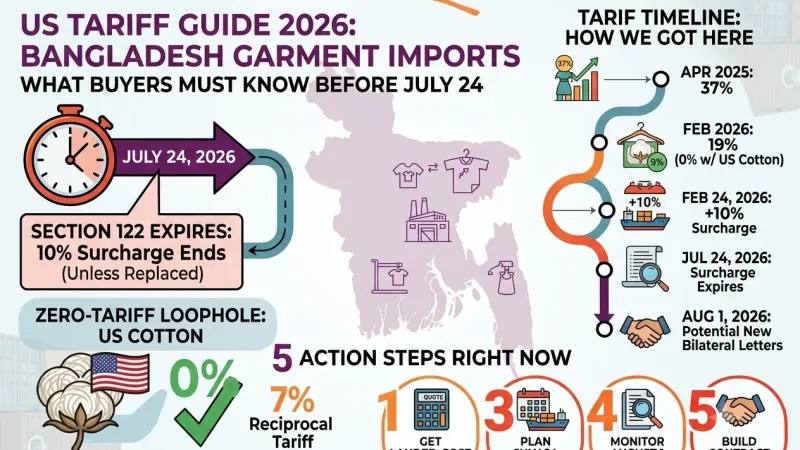
US Tariff Guide for Bangladesh Garment Imports (2026) – What Buyers Must Know Before July 24
Last updated: July 17, 2026 • [Important] Section 122 10% tariff expires in 7 days
If you are a US‑based fashion brand, retailer, or wholesaler sourcing from Bangladesh, you are navigating the most volatile tariff environment in decades. Since April 2025, rates have swung from 37% down to 19%, then to a temporary 10% under Section 122 – which expires July 24, 2026. The Section 301 replacement is still under review, and bilateral tariff letters may reshape the landscape by August 1.
This guide cuts through the noise. You will get a clear timeline, a competitor comparison, a zero‑tariff loophole using US cotton, and five concrete actions to protect your margins – all backed by the latest GSC data and real‑world search trends.
Tariff Timeline: How We Got Here
| Date | Event | Tariff Impact |
|---|---|---|
| Apr 2, 2025 | Initial reciprocal tariffs announced | 37% on Bangladeshi goods |
| Jul 7, 2025 | First reduction | 35% |
| Aug 2, 2025 | Post‑negotiation rate | 20% |
| Feb 9, 2026 | Agreement on Reciprocal Trade (ART) | 19% (0% with US cotton) |
| Feb 24, 2026 | Section 122 invoked (10% surcharge) | Effective 10% on most imports |
| Jul 24, 2026 | Section 122 EXPIRES | 10% surcharge ends – unless replaced |
| Jun 2, 2026 | USTR proposes Section 301 tariffs | Additional 10 to 12.5% proposed on 60 countries |
| Jul 7, 2026 | Section 301 hearings concluded | Awaiting final decision |
| Aug 1, 2026 (expected) | Potential new bilateral tariff letters | Country‑specific rates likely announced |
Section 122: The 10% Surcharge That Ends July 24
Section 122 of the Trade Act of 1974 allows the president to impose a temporary import surcharge of up to 15% for no more than 150 days. The current 10% surcharge was invoked on February 24, 2026, and expires on July 24, 2026.
- If your shipment arrives before July 24, you pay the 10% surcharge.
- If your shipment arrives after July 24, the surcharge may disappear – unless it is replaced by new Section 301 tariffs or bilateral agreements.
The Trump administration is expected to announce new tariffs by July 24 to avoid any gap in coverage.
Section 301: The Forced‑Labor Tariff Proposal
On June 2, 2026, the USTR proposed additional tariffs on imports from 60 countries – including Bangladesh, China, Vietnam, and India – under Section 301 of the Trade Act of 1974. The justification: countries that have not taken adequate measures to curb forced labour in their supply chains.
- Proposed additional tariff: 10% to 12.5%
- Applies to textiles and apparel – the category at greatest risk
- Would affect more than 99% of US apparel imports
- Bangladesh is among 60 targeted economies
Current status: Written comments were due July 6, hearings were held July 7. A final decision is expected imminently – possibly before July 24.
[Warning] Critical: If Section 301 tariffs are imposed at 10 to 12.5% on top of existing duties, Bangladesh garments could face effective tariffs of 29 to 32% (19% reciprocal + 10 to 12.5% Section 301) – unless you are using US cotton.
The Agreement on Reciprocal Trade (ART): The Zero‑Tariff Loophole
On February 9, 2026, Bangladesh and the US signed the Agreement on Reciprocal Trade (ART).
- Base tariff: Reduced to 19% for Bangladeshi goods
- Zero tariff: Garments made with US‑origin cotton or man‑made fibres enter duty‑free
- Scope: Applies to textile and apparel products
This is a massive opportunity for US buyers. If you source garments made with US cotton, you pay zero tariff – not 19%, not 29%, not 32%.
What this means for your sourcing strategy:
- Specify US cotton in your manufacturing contracts. Bangladesh factories already prefer US cotton for quality – but historically, financing and logistics have been constraints. Those barriers are now worth overcoming.
- Ask your supplier for certification of US‑origin cotton or man‑made fibres. The tariff exemption is conditional on documentation.
- Re‑evaluate your landed cost. The difference between 0% and 29% is roughly $2.90 per garment on a $10 FOB price. For a 10,000‑piece order, that is $29,000 in tariff savings.
Tariff Comparison: Bangladesh vs. Competitors
| Country | Reciprocal Tariff | Section 301 Risk | Effective Rate (without US cotton) |
|---|---|---|---|
| Bangladesh | 19% (0% with US cotton) | 10 to 12.5% proposed | 29 to 32% (or 0% with US cotton) |
| Vietnam | Default 12.5% (no trade agreement) | 10 to 12.5% proposed | 22.5 to 25% |
| India | 18% (interim deal) | 10 to 12.5% proposed | 28 to 30.5% |
| Cambodia | 19% (trade agreement) | 10 to 12.5% proposed | 29 to 32% |
Key insight: Bangladesh is the only major supplier with a path to zero tariff – provided you use US cotton. Vietnam's default rate is lower (12.5%), but they face the same Section 301 risk.
What Is Actually Happening in the Market
- US imports from Bangladesh declined 16.4% year‑on‑year – buyers are pausing, waiting for clarity. But orders are not disappearing – they are being delayed.
- Bangladesh apparel exports to the US declined 1.6% in Q2 2026 – the drop is modest, suggesting buyers are absorbing the tariff adjustments.
- Over 20,000 garment workers lost jobs in H1 2026 – factories are under pressure. This means buyers with ready orders have negotiating leverage – but also that supplier stability is more important than ever.
5 Action Steps for US Buyers Right Now
1. Get a landed‑cost quote for your specific product
Tariff rates vary by product category (HS codes). The 19% reciprocal rate applies broadly, but Section 301 and Section 122 apply differently. Do not assume – get a quote.
Contact Everywear on WhatsApp for a current landed‑cost estimate on your specific SKU. We track tariff changes daily and can quote your exact landed cost within 24 hours.
2. Specify US cotton in your next order
If you are ordering T‑shirts, polos, hoodies, or any cotton garment, specify US cotton in your manufacturing agreement. This unlocks the zero‑tariff provision under ART.
3. Plan for the July 24 transition
- Ship before July 24 if you want to lock in the 10% Section 122 rate (assuming it is lower than the replacement).
- Ship after July 24 if you are willing to wait for the new tariff regime – but be prepared for potential Section 301 tariffs.
- Best practice: Ask your supplier for split shipments – some before, some after – to hedge your risk.
4. Monitor the August 1 bilateral letters
The Trump administration is reviving bilateral tariff letters – the same mechanism that set the August 2025 rates. Country‑specific rates may be announced around August 1.
5. Build tariff flexibility into your sourcing contracts
Include clauses that allow for price adjustments based on tariff changes. This protects both you and your supplier.
Frequently Asked Questions
Q: What tariff will I pay if I order today?
A: If your shipment arrives before July 24, you pay the current Section 122 10% surcharge on top of the 19% reciprocal rate – effective 29% (unless you are using US cotton, in which case you pay 0% + 10% = 10%). If it arrives after July 24, the rate depends on what replaces Section 122.
Q: What if I use US cotton?
A: You pay 0% reciprocal tariff under ART. The Section 122 surcharge (10%) still applies until July 24, but after that, you may pay only the Section 301 rate (if imposed). This is the single biggest tariff‑saving opportunity in the market right now.
Q: Is Bangladesh still competitive vs. Vietnam?
A: Yes – if you use US cotton. Without it, Vietnam's default rate (12.5%) is lower than Bangladesh's 19% reciprocal rate. But with US cotton, Bangladesh's 0% rate beats everyone.
Q: What about the forced labor allegations?
A: The USTR investigation is ongoing. Bangladesh's government and industry associations (BGMEA, BKMEA) are working on compliance frameworks. For buyers, the key is supplier transparency – work with factories that can demonstrate clean supply chains.
Q: How do I verify US cotton?
A: Ask your supplier for:
- Cotton purchase invoices showing US origin
- Certificates of origin for the cotton
- Traceability documentation from yarn to finished garment
Everywear works with certified factories that can provide full documentation on request.
Why This Matters for Your Business
The US is Bangladesh's single largest export destination, absorbing roughly 20% of the country's exports – primarily ready‑made garments. RMGs constitute more than 80% of Bangladesh's total exports.
Both governments have a strong incentive to maintain trade flows. The ART agreement and the proposed Section 301 framework are part of an ongoing negotiation – not a final verdict.
For US buyers, this means:
- Uncertainty is temporary. A stable tariff regime will emerge by August 2026.
- Opportunity exists. Buyers who act now – especially those who specify US cotton – can lock in significant cost advantages.
- Partner selection matters. Work with suppliers who understand tariff dynamics and can provide documentation for US cotton and compliance.
Everywear's Commitment
At Everywear Bangladesh, we track tariff changes daily. We work with certified factories that can produce garments with US cotton and provide full documentation for tariff exemption.
We offer:
- US cotton sourcing – we can specify US‑origin cotton for your order
- Full documentation – cotton certificates, origin documents, and compliance records
- Landed‑cost quoting – within 24 hours, with current tariff rates applied
- MOQ from 300 pieces – accessible for small and medium brands
- QC and logistics support – we manage quality control and international shipping
Contact us on WhatsApp for a current landed‑cost quote
We will factor in your product's HS code, current tariff rates, US cotton eligibility, and shipping costs.
Related Resources
GEO Landing Pages (Country‑Specific Guides)
- USA Buyers: Wholesale Garments from Bangladesh
- UK Buyers: Wholesale Garments from Bangladesh
- Europe Buyers: Wholesale Clothing from Bangladesh
- Africa Buyers: Wholesale Garments from Bangladesh
Blog Posts (Platform and Product Guides)
- Import Clothes from Bangladesh: USA, UK, EU and Africa Guide
- Bangladesh vs. China vs. India – Wholesale Clothing 2026
- Shopify Clothing Manufacturer Bangladesh
- TikTok Shop Clothing Supplier Bangladesh
- Wholesale Clothing Suppliers for eBay Sellers
- Amazon Fashion Sellers: Source Clothing from Bangladesh
- How to Start a Streetwear Brand with Bangladesh Manufacturers
- Low MOQ Clothing Manufacturer Bangladesh
- Buy Wholesale Garments – Importer Step‑by‑Step Guide
- Custom Garment Manufacturing Bangladesh 2026 – Guide for Small Brands
- Bangladesh RMG Wholesale Marketplace – How Everywear Works
- Private Label Clothing Manufacturing Bangladesh – Complete Brand Guide 2026
- Oversized T‑Shirt Manufacturer Bangladesh
- Etsy Clothing Manufacturer Bangladesh
- Oversized Hoodie Manufacturer Bangladesh
- Blank T‑Shirt Manufacturer Bangladesh
This guide is updated regularly. Last reviewed: July 17, 2026. Tariff rates are subject to change. For the most current landed‑cost quote, contact Everywear directly on WhatsApp.
Everywear Bangladesh Ltd. – Bangladesh's First RMG Wholesale Marketplace | 300 Pcs Custom Orders | Export Quality Garments
WhatsApp: +8801788898174 • Website: everywearbd.com
Leave a comment