





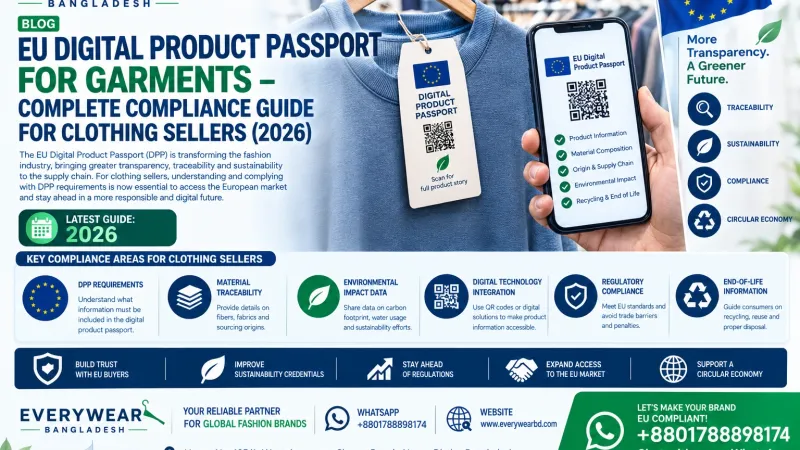
EU Digital Product Passport for Garments – Complete Compliance Guide for Clothing Sellers (2026)
Last updated: September 10, 2026 • [Complete Guide for Clothing Brands, Amazon FBA Sellers, Exporters & Fashion Manufacturers]
Quick Answer: What Is the EU Digital Product Passport and How Does It Affect Clothing Sellers?
The EU Digital Product Passport (DPP) is a mandatory digital record that will soon be required for every garment sold in the European Union. Introduced under the Ecodesign for Sustainable Products Regulation (ESPR) (EU) 2024/1781, the DPP functions as a product's "digital identity" – containing verified information about materials, origin, environmental impact, durability, and end-of-life management. The passport is accessed via a QR code, NFC chip, or RFID tag on the garment. For clothing sellers, this represents a fundamental shift in market access: a product without a compliant DPP may not be legally sold in the EU. The regulation applies to all finished textile products containing at least 80% textile fibers by weight placed on the EU market – regardless of where the brand is headquartered. While the delegated act for textiles is expected in late 2027 with mandatory compliance in 2028, the time to prepare is now. The solution: start auditing your supply chain data, engage suppliers early, and partner with manufacturers who can provide the traceability and documentation required for DPP compliance.
The European Union's Digital Product Passport (DPP) is one of the most significant regulatory changes facing the global apparel industry in decades. Described as a product's "digital identity" or "official biography", the DPP will transform how garments are documented, traced, and sold in the EU market.
For clothing sellers – whether you're an Amazon FBA seller, boutique brand, or large-scale exporter – the DPP represents both a compliance obligation and a strategic opportunity. Those who prepare early will turn regulation into competitive advantage; those who wait will face disruption and market exclusion.
This comprehensive guide covers: what the DPP is, the legal framework, which products are affected, mandatory data requirements, implementation timeline, industry reactions, practical preparation steps, and how Everywear Bangladesh helps you get DPP-ready – everything you need to navigate this regulatory shift with confidence.
What Is the EU Digital Product Passport?
The Digital Product Passport (DPP) is a standardized digital record attached to each physical product, providing verified, structured information about a product's entire lifecycle – from raw materials to end-of-life.
Think of it as a product's "biography": where it was made, what it's made of, how it performed against environmental benchmarks, and what should happen to it at the end of its life. Unlike traditional product labels or marketing claims, the DPP is a regulatory requirement – not optional, not voluntary, and directly linked to market access.
Beyond the QR Code: What the DPP Really Is
A common misconception is that a QR code linking to a supplier list satisfies the DPP requirement. It does not.
The DPP is a living data system built on four interconnected components:
- Product Data – Verified information about materials, composition, durability, chemical safety, recycled content, and end-of-life guidance
- Data System – A secure, interoperable infrastructure that exchanges data according to EU technical standards including the draft prEN 1821X series
- Unique Product Identifier – A permanent, serialized digital identity for each item, following GS1 standards, that links the physical garment to its digital record
- Persistent Data Carrier – The physical access point, such as a QR code, NFC chip, or RFID tag, that connects consumers and regulators to the DPP data
Without verified primary data and traceability infrastructure, a digital product passport is nothing more than a digital brochure.
The Legal Framework: ESPR and the DPP
The Digital Product Passport was formally introduced under the Ecodesign for Sustainable Products Regulation (ESPR), Regulation (EU) 2024/1781, published in June 2024 and in force since July 18, 2024.
The ESPR establishes a horizontal framework on sustainability and circularity for most physical goods placed on the EU market. Under this framework, the European Commission is empowered to adopt delegated acts – secondary legislation that defines the specific data requirements for each product category.
For textiles and apparel, the delegated act is still being developed. The Joint Research Centre (JRC) – the European Commission's in-house science service – published a landmark study on May 15, 2026 titled "Study on DPP Content for Textile Apparel Products under ESPR". This report provides the technical recommendations that will inform the future delegated act.
Key ESPR Provisions Already in Effect
While the DPP for textiles is not yet mandatory, other ESPR provisions are already in force:
- July 19, 2026 – The ban on destroying unsold apparel, clothing accessories, and footwear began applying to large companies. Medium-sized companies must comply by 2030.
- July 20, 2026 – The European Commission launched the digital product passport register, together with a testing environment. This central EU registry will support products covered by the ESPR, including textiles.
Which Products Are Covered?
Understanding the scope of the DPP requirement is essential for compliance planning.
Products in Scope
According to the JRC's recommendations, Digital Product Passports for textiles would apply primarily to finished textile products containing at least 80% textile fibers by weight.
Examples include:
- Most apparel products – T-shirts, dresses, jeans, jackets, sweaters, trousers
- Fashion accessories – Scarves, bags, beanies, belts
- Functional sportswear – Activewear, gym wear, yoga wear
- Workwear and occupational clothing
Products Excluded from Initial Scope
The study proposes excluding certain product categories from the initial scope:
- Intermediate textile products – Individual fibers, yarns, and fabrics
- Smart textiles and e-textiles – Electronic textiles
- Personal Protective Equipment (PPE)
- Medical devices
- Textile products classified as toys
This targeted approach allows regulators to focus first on mainstream consumer textile products while further assessment continues for more complex product categories.
Who Is Responsible?
The legal obligation to register the DPP and ensure its accuracy rests firmly with the economic operator placing the product on the EU market – typically the manufacturer, or the importer if the manufacturer is based outside the EU.
This means: If you are a clothing brand headquartered outside the EU but selling into the EU market, you are responsible for DPP compliance – regardless of where your manufacturing takes place.
Mandatory DPP Data Requirements: The Four Pillars
The JRC study recommends structuring DPP information into four major categories, aligned with Annex III of the ESPR framework. To comply, product data must be machine-readable and highly structured.
Pillar 1: Product Identification and Classification
To ensure traceability and standardization, each product may be required to include:
- Unique product identifiers – Global Trade Item Number (GTIN) or SGTIN
- Batch identifiers – For tracking groups of items
- Model identifiers – e.g., "Men's Blue T-Shirt, Size M"
- Product categories – Aligned with ESPR and Product Environmental Footprint Category Rules (PEFCR)
- Commodity and customs codes – HS and TARIC codes
Pillar 2: Manufacturer and Facility Information
The DPP would also contain detailed information regarding responsible economic operators and production facilities:
- Manufacturer or importer details – Name and address
- Global Location Number (GLN) – For facilities
- Information about production facilities and relevant supply chain actors
- Contact information – Email and website
Pillar 3: Product Attributes and Environmental Data
One of the most significant components of the DPP relates to sustainability and environmental performance. Suggested data fields include:
- Fiber composition – e.g., "98% Cotton, 2% Elastane"
- Durability information – Supported by standardized testing
- Substances of Concern (SoC) – Including their location and concentration within the product
- Recycled and organic material content – With chain-of-custody evidence
- Product Environmental Footprint (PEF) data – Aligned with PEFCR methodologies
- Product care instructions – May become mandatory under revised textile labelling rules
- Repair instructions and services – Optional but encouraged
- Warranty or durability guarantee – Mandatory if longer than 2 years
- Recyclability score – Proposed, not yet mandatory
- Carbon/environmental footprint class – Proposed, not yet mandatory
This level of transparency aims to improve consumer awareness while supporting circular economy objectives.
Pillar 4: Compliance Documentation
The Digital Product Passport is also expected to serve as a repository for regulatory compliance information:
- EU Declaration of Conformity – Proof the product meets rules
- Technical specifications
- Test reports – e.g., for durability, shrinkage, spirality
- Third-party certifications – e.g., GOTS, GRS, OEKO-TEX
- Additional certification and conformity assessment documents
Data Granularity: Three Levels of Information
Recognizing the complexity of textile supply chains, the JRC study proposes three levels of DPP data granularity:
Level 1: Model Level (Baseline)
Products sharing the same design, pattern, and technical characteristics would generally be grouped together under a single model identifier, regardless of color or size variations.
Data at this level includes:
- Fiber composition
- Baseline environmental footprints
- Durability/robustness scores
- Care instructions
Level 2: Batch Level (Variable Data)
A batch would refer to products manufactured within the same timeframe, facility, and production process.
Data at this level includes:
- Specific production facility identifiers
- Conformity certifications for recycled content
- Precise chemical usage information
- Test results for parameters subject to manufacturing variability – visual inspection (ISO 15487), spirality (ISO 16322-3), and dimensional change (ISO 3759)
Level 3: Item Level (Future-Proofing)
The most detailed level of traceability would apply to individual products.
Currently proposed as a voluntary early adoption mechanism, item-level tracking uses serialized identifiers (e.g., SGTIN) to support advanced circular economy models such as:
- Second-hand resale tracking
- Individual item repair tracing
- Enhanced consumer engagement
Important Note: Ecommerce Europe has urged policymakers to adopt a flexible granularity approach, warning that rigid item-level requirements could impose high costs on businesses, particularly for low-value products. The association recommends allowing companies to determine the appropriate level of DPP data granularity based on product value, operational realities, and cost considerations.
Access Rights: Who Can See What?
The DPP employs a strict role-based access model to protect commercially sensitive information:
Public Access (Consumers)
Consumers can access:
- Basic product identification
- Producer information
- Fiber composition
- Durability/robustness scores
- Care instructions
- Recyclability score
Regulatory Access (Authorities)
Market surveillance and customs authorities will have:
- Full access to all data – including detailed compliance documents, technical specifications, and test results
- Unrestricted access to footprint calculation parameters
- Access to specific conformity certifications
Legitimate Interest Access (Recyclers & Repairers)
Professional participants (e.g., waste sorters, recyclers, repair services) will be granted access to:
- Precise material purity data
- Chemical information and substance locations
- Disassembly instructions
- Component specifications
- Repair guides
Brands & Suppliers
Can add extra data (like logistics codes) but must be marked as "voluntary".
Implementation Timeline: When Does This Become Mandatory?
Understanding the timeline is critical for planning. Here's the current regulatory trajectory:
Key Dates
| Date | Event | Impact |
|---|---|---|
| July 18, 2024 | ESPR Regulation (EU) 2024/1781 enters into force | Framework established; delegated acts to follow |
| May 15, 2026 | JRC publishes "Study on DPP Content for Textile Apparel Products" | Technical recommendations for future delegated act |
| July 19, 2026 | Ban on destroying unsold textiles applies to large companies | First ESPR enforcement action |
| July 20, 2026 | EU DPP Registry launched with testing environment | Infrastructure now operational for all product categories |
| Late 2026 / Early 2027 | Delegated act for textiles anticipated | Final data requirements defined |
| 2027 | Delegated act for textiles expected | First mandatory DPPs for textiles (indicative) |
| 2027-2028 | Mandatory compliance for textiles | 18-month transition period after delegated act adoption |
| 2030 | Full compliance for all relevant categories | Complete ESPR implementation |
Why You Cannot Wait
Despite what you might assume, you cannot wait for the legislation to be finalized before starting. The data infrastructure, supplier relationships, and internal systems required to run a DPP program take time to build.
Brands that started piloting in 2024 and 2025 are already discovering costly gaps. Those that wait until 2027 will be scrambling to catch up.
Important: 2027 does not automatically mark the start of enforcement. Enforcement timelines will be determined closer to adoption. Regulatory uncertainty concerns timing and technical standards – not the existence of the obligation itself.
Industry Reactions: What the Sector Is Saying
Industry associations have responded to the DPP with support for the sustainability goals but concerns about implementation complexity.
EURATEX – European Apparel and Textile Confederation
EURATEX supports the introduction of the Digital Product Passport for apparel but stresses the need for a system that remains practical, secure, and proportionate.
Key priorities:
- Limit mandatory information – The DPP should include only information required by law
- Protect confidential business information – Strict access rules to prevent misuse
- Support SMEs – The DPP must remain simple and affordable
- Transition period – Recommends 24 to 36 months for adaptation
- Fair enforcement – All producers and foreign exporters must follow the same rules
Ecommerce Europe
Ecommerce Europe has urged policymakers to adopt a flexible approach to implementation, warning that rigid item-level requirements could impose high costs on businesses, particularly for low-value products.
Key recommendations:
- Flexible granularity – Allow businesses to select the appropriate level of data reporting based on value and cost assessments
- Gradual rollout – Phased implementation to help businesses adapt
- Initial focus on basic data – Easy-to-digitize data points that don't require frequent updates
- Impact evaluation – Carefully evaluate expansion to additional product categories
Industry Consensus
While the industry supports the sustainability goals of the DPP, there is broad consensus on several points:
- The DPP is coming – delay is not an option
- Implementation is a data governance and supply chain transformation project – not a purely IT exercise
- Data availability and reliability, standardization, supplier engagement, and cross-functional coordination are the key challenges
- For brands operating complex outsourcing models, this represents a multi-year transformation
What Clothing Sellers Need to Do Now – Practical Preparation Steps
Based on guidance from industry experts and regulatory bodies, here are the essential steps to prepare for the DPP:
Step 1: Understand Your Product Scope
Identify which of your products fall within the DPP scope:
- Finished textile products with ≥80% textile fibers by weight
- All apparel, fashion accessories, functional sportswear, and workwear
- Products sold or to be sold in the EU market
Step 2: Audit Your Current Data
Conduct a comprehensive data audit to identify gaps:
- What data do you already have? – Material composition, supplier information, certifications
- What data is missing? – Durability test results, environmental footprint, substances of concern
- Where is the data? – Is it accessible, structured, and verifiable?
Step 3: Map Your Supply Chain
Document your entire supply chain from raw materials to finished product:
- Tier 1 – Final assembly and manufacturing
- Tier 2 – Fabric and textile production
- Tier 3 – Yarn and fiber production
- Tier 4 – Raw material origins
Key challenge: Many businesses have encountered significant difficulties in obtaining necessary information from suppliers and value chain partners. Start these conversations now.
Step 4: Engage Your Suppliers Early
Building a robust chain of custody (CoC) model is critical for ensuring upstream data integrity. This is especially important for verifying claims such as recycled content.
What to ask your suppliers:
- Can you provide verified fiber composition data?
- Do you have test results for durability, shrinkage, and other parameters?
- Can you document substances of concern in your materials?
- Do you have chain-of-custody certifications (e.g., GOTS, GRS, OEKO-TEX)?
- Are you prepared to provide batch-level data?
Step 5: Build Your Technology Infrastructure
Select the right technology stack to support DPP implementation:
- Data collection systems – To gather structured product data from suppliers
- Data management platforms – To store, organize, and update DPP information
- Data carriers – QR codes, NFC chips, or RFID tags for physical products
- DPP registry integration – To connect with the central EU DPP Registry
Step 6: Start a Pilot Program
Begin with a small-scale pilot to test your systems:
- Select 1-2 product lines for your pilot
- Work with willing suppliers to collect required data
- Create test DPPs using available tools
- Identify gaps and challenges before scaling
Step 7: Train Your Team
DPP compliance requires cross-functional coordination:
- Product development – Understanding data requirements
- Sourcing and procurement – Engaging suppliers
- Quality control – Managing test results and certifications
- IT and data management – Building and maintaining systems
- Legal and compliance – Ensuring regulatory alignment
How Everywear Bangladesh Helps You Get DPP-Ready
At Everywear Bangladesh, we understand that the DPP represents both a challenge and an opportunity for clothing brands sourcing from Bangladesh. We help you navigate this regulatory shift with confidence.
1. Supply Chain Traceability
We maintain comprehensive documentation for every order, including:
- Fiber composition – Verified material data for every garment
- Manufacturer and facility information – With Global Location Numbers (GLN) where applicable
- Batch and production details – For batch-level data requirements
- Chain-of-custody documentation – Supporting sustainability claims
2. Quality Control and Testing
We implement rigorous quality control that generates the test data required for DPP compliance:
- Durability testing – Visual inspection (ISO 15487), spirality (ISO 16322-3), and dimensional change (ISO 3759)
- Fabric and material testing – Composition verification and substance of concern screening
- Compliance documentation – Test reports, technical specifications, and certifications
3. Certified and Compliant Materials
We work with certified suppliers who can provide:
- GOTS – Global Organic Textile Standard
- GRS – Global Recycled Standard
- OEKO-TEX – Chemical safety certification
- Recycled content verification – With chain-of-custody evidence
4. Data and Documentation Support
We help you collect, organize, and structure the data needed for DPP compliance:
- Product identification data – GTIN, batch IDs, model IDs
- Material and composition data – Verified fiber content
- Environmental footprint data – Supporting PEFCR calculations
- Compliance documentation – Declarations of Conformity, test results
5. US Cotton Zero-Tariff Advantage
We source US-origin cotton for qualifying orders, saving you approximately 19% in tariffs. This US-origin cotton also provides clear traceability – a key advantage for DPP compliance.
6. End-to-End Support
You deal with Everywear directly – not multiple factories or middlemen. We provide:
- Dedicated account manager – Your single point of contact
- Regular production updates – Photos and progress reports
- 24/7 WhatsApp support – For urgent queries
- Transparent pricing – No hidden costs
Contact Everywear Bangladesh on WhatsApp
Frequently Asked Questions
Everything you need to know about the EU Digital Product Passport for garments and textiles.
1. What is the EU Digital Product Passport (DPP)?
The Digital Product Passport (DPP) is a mandatory digital record linked to every garment sold in the EU, containing verified information about materials, origin, environmental impact, durability, and end-of-life management. It is accessed via a QR code, NFC chip, or RFID tag on the product.
2. When does the DPP become mandatory for clothing?
The delegated act for textiles is expected in late 2027, with mandatory compliance following an 18-month transition period – meaning 2027-2028. However, preparation cannot wait; the data infrastructure and supplier relationships take time to build.
3. Which products are covered by the DPP?
The DPP applies to finished textile products containing at least 80% textile fibers by weight – including most apparel, fashion accessories, functional sportswear, and workwear. Excluded products include intermediate textiles (fibers, yarns, fabrics), PPE, medical devices, and textile toys.
4. Who is responsible for DPP compliance?
The legal obligation rests with the economic operator placing the product on the EU market – typically the manufacturer, or the importer if the manufacturer is outside the EU. This applies to all brands selling into the EU, regardless of where they are headquartered.
5. What data must be included in a DPP for garments?
The JRC study proposes four pillars of data: Product Identification (GTIN, batch IDs, model IDs, customs codes), Manufacturer and Facility Information (GLN, production facilities), Product Attributes and Environmental Data (fiber composition, durability, substances of concern, recycled content, PEF data), and Compliance Documentation (Declarations of Conformity, test reports, certifications).
6. What are the data granularity levels?
Three levels are proposed: Model Level – for broader product traits that don't change (fiber composition, baseline footprints); Batch Level – for variable data (facility identifiers, chemical usage, test results); and Item Level – currently voluntary, using serialized identifiers (SGTIN) for advanced circular economy models.
7. What is the EU DPP Registry?
The EU DPP Registry is a central system launched on July 20, 2026 that stores unique product identifiers and supports DPP implementation under the ESPR. It covers textiles, steel, aluminium, and other priority product groups.
8. How does the DPP affect brands outside the EU?
The DPP applies to any brand or retailer placing textile products on the EU market – including international brands headquartered outside the EU. The legal obligation falls on the importer if the manufacturer is outside the EU.
9. What is the cost of DPP compliance?
Costs vary widely depending on your current data infrastructure, supply chain complexity, and product volume. Key cost drivers include data collection, supplier engagement, testing, technology infrastructure, and ongoing data management. Industry groups like Ecommerce Europe have warned that rigid item-level requirements could impose disproportionate costs, especially for basic, low-value apparel.
10. What happens if a product doesn't have a DPP?
A product without a compliant DPP may not be legally sold in the EU. The DPP is directly linked to market access – unlike traditional ESG reporting, DPP compliance is a hard regulatory requirement.
11. How does the DPP relate to the ban on destroying unsold textiles?
Both are part of the ESPR framework. The ban on destroying unsold apparel, accessories, and footwear began applying to large companies on July 19, 2026. Medium companies must comply by 2030. The DPP and the destruction ban are complementary measures to increase circularity and transparency.
12. What is the role of the JRC study?
The Joint Research Centre (JRC) published the "Study on DPP Content for Textile Apparel Products under ESPR" on May 15, 2026. While the report does not represent the European Commission's final position, it provides valuable insight into the likely direction of future EU textile compliance requirements. Final rules will be confirmed in the delegated act expected around 2027.
13. What certifications help with DPP compliance?
Third-party certifications that provide verified data will be valuable for DPP compliance, including GOTS (Global Organic Textile Standard), GRS (Global Recycled Standard), and OEKO-TEX. These certifications provide chain-of-custody evidence and verified sustainability data.
14. Can the DPP include voluntary information?
Yes – voluntary information, such as sustainability labels, repair services, and brand-specific data, may appear in the passport. However, it must be marked as "voluntary" to distinguish it from mandatory data. No greenwashing is allowed – only standardized, verified environmental claims can be made.
15. What should I do to prepare for the DPP now?
Start with these steps: 1) Audit your current data and identify gaps, 2) Map your supply chain from raw materials to finished product, 3) Engage your suppliers early to understand their data capabilities, 4) Build your technology infrastructure, and 5) Start a pilot program with 1-2 product lines. The brands that prepare now will barely notice the transition.
16. How does the DPP affect Amazon FBA sellers?
Amazon FBA sellers placing products in the EU market will need to ensure every garment has a compliant DPP. This means collecting and structuring the required data, attaching data carriers (QR codes, etc.) to products, and working with manufacturers who can provide the necessary documentation and traceability. Amazon is likely to enforce DPP compliance as a marketplace requirement.
17. Is there an exemption for small businesses?
While SMEs won't be forced to build complex systems – they can use existing tools or partner with platforms – there is no general exemption from DPP requirements. EURATEX has called for the DPP to remain simple and affordable for small and medium-sized enterprises.
18. What are the main challenges of DPP implementation?
Key challenges include: data availability and reliability – obtaining verified data from suppliers, standardisation across systems, supplier engagement – particularly for brands with complex outsourcing models, and cross-functional internal coordination. For many brands, this represents a multi-year transformation.
19. Can the DPP be delayed or cancelled?
While recent adjustments and delays affecting certain ESG regulations (such as CSRD and CSDDD) have led some to speculate whether DPP requirements might be softened, there is currently no indication of a material rollback. DPPs remain a key pillar of the EU's circular economy policy. Relying on regulatory retreat would be a high-risk strategy.
20. How can Everywear Bangladesh help with DPP compliance?
Everywear Bangladesh provides supply chain traceability, quality control and testing, certified and compliant materials, data and documentation support, and end-to-end manufacturing services – all designed to help you prepare for DPP compliance while sourcing high-quality garments from Bangladesh with low MOQ from 300 pieces and US Cotton Zero-Tariff savings.
Conclusion
The EU Digital Product Passport represents one of the most significant regulatory shifts in the history of the global apparel industry. What was once voluntary sustainability reporting is becoming mandatory market-access regulation. A product without a compliant DPP may not be legally sold in the EU.
For clothing sellers, this creates both challenges and opportunities. The brands that prepare early – by auditing their data, engaging suppliers, and building the necessary infrastructure – will turn regulation into competitive advantage. Those who wait will face disruption and potential market exclusion.
The time to act is now. The delegated act for textiles is expected in late 2027, with mandatory compliance following an 18-month transition period. But the data infrastructure, supplier relationships, and internal systems required to run a DPP program take time to build.
At Everywear Bangladesh, we're committed to helping our clients navigate this regulatory shift with confidence. With supply chain traceability, quality control and testing, certified materials, and comprehensive documentation support, we provide the foundation you need for DPP compliance – while delivering the quality, cost, and flexibility that makes Bangladesh the world's premier garment sourcing destination.
Contact Everywear Bangladesh on WhatsApp
About the Author
Written by the Everywear Bangladesh Research & Sourcing Team
The Everywear Bangladesh editorial team combines deep industry expertise in Bangladesh's Ready-Made Garment (RMG) sector with practical experience in international apparel sourcing, supply chain management, and Amazon FBA selling. Our team includes former garment factory managers, sourcing professionals, and e-commerce specialists who have helped hundreds of sellers launch their clothing brands.
Our mission is to provide accurate, data-driven, and actionable content that helps fashion entrepreneurs, Amazon sellers, and global brands make informed sourcing decisions. We leverage real-time data from Amazon Seller Central, the Bangladesh Garment Manufacturers and Exporters Association (BGMEA), Export Promotion Bureau (EPB), and other authoritative sources to ensure our insights reflect the latest industry developments.
Connect with Everywear Bangladesh:
- Website: everywearbd.com
- WhatsApp: +8801788898174
- Facebook: facebook.com/everywearbd
- LinkedIn: Everywear Bangladesh Ltd
Related Resources
GEO Landing Pages
- USA Buyers: Wholesale Garments from Bangladesh
- Europe Buyers: Wholesale Clothing from Bangladesh
- UK Buyers: Wholesale Garments from Bangladesh
- Africa Buyers: Wholesale Garments from Bangladesh
Blog Posts
- Bangladesh Clothing Suppliers – Complete Directory & Sourcing Guide 2026
- Private Label Clothing Manufacturing Bangladesh – Complete Brand Guide 2026
- Amazon Clothing Seller's Guide 2026 – Trends, Fees & Winning Strategies
References
- European Commission, Joint Research Centre, "Study on DPP Content for Textile Apparel Products under ESPR," May 15, 2026
- Ecodesign for Sustainable Products Regulation (ESPR), Regulation (EU) 2024/1781, published June 2024, in force July 18, 2024
- European Commission, "Digital Product Passport Registry Launch," July 20, 2026
- European Commission, "ESPR Working Plan 2025-2030"
- Ecommerce Europe, "Position Paper on Digital Product Passport for Apparel," June 2026
- EURATEX, "Position Paper on Digital Product Passport for Apparel"
- Kinstellar, "Digital Product Passports: The Regulatory Shift Fashion Brands Need To Plan For," February 2026
- Intertek, "Strategic Insights: Preparing for the EU Digital Product Passport (DPP) in Textile Apparel," May 2026
- SGS, "EU Textile Digital Product Passport Gains Momentum: JRC Publishes Key Study on DPP Data Requirements," August 2026
- Bureau Veritas, "EU Digital Product Passport – JRC Study on Content for Textile Apparel," July 2026
- TrusTrace, "How Fashion Brands Can Prepare for the EU Digital Product Passport: A Practical Guide," March 2026
- COSH, "EU Digital Product Passport explained: ESPR rules, timeline and what it means for fashion," April 2026
- 广东省应对技术性贸易壁垒信息平台, "为纺织服装行业的欧盟数字产品护照(DPP)做好准备," June 2026
- Textile Today, "Ecommerce Europe calls for flexible Digital Product Passport rules for apparel sector," June 2026
This guide is updated regularly. Last reviewed: September 10, 2026. For sourcing solutions tailored to your brand and DPP compliance support, contact Everywear Bangladesh on WhatsApp.
Everywear Bangladesh Ltd. – Bangladesh's First RMG Wholesale Marketplace | 300 Pcs Custom Orders | Export Quality Garments
WhatsApp: +8801788898174 • Website: everywearbd.com
Leave a comment