





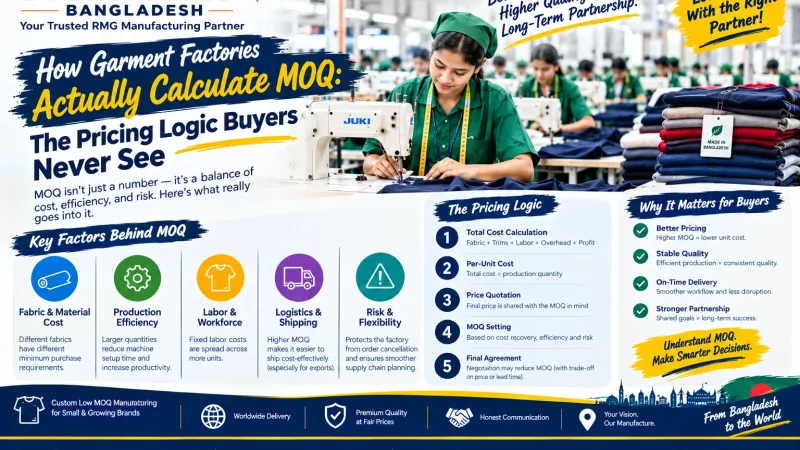
How Garment Factories Actually Calculate MOQ: The Pricing Logic Buyers Never See
Last Updated: October 15, 2026 | By: Everywear Bangladesh Research & Sourcing Team
Why Do Garment Factories Reject Low MOQ Orders?
Factories do not reject low MOQ because they are difficult. They reject it because small orders create hidden cost and risk that most buyers never see. When a factory quotes 3,000 pieces per style, it is usually repeating what its fabric mill said — not setting an arbitrary rule. The useful question is not "can you go lower," but which layer of the supply chain is setting your minimum, and what can you change about it.
What Is MOQ in Garment Manufacturing?
MOQ stands for minimum order quantity — the smallest number of units a factory will produce in a single run for one style. Minimums exist because factories carry fixed setup costs before the first garment is sewn: sourcing fabric rolls, cutting markers, programming machines, and scheduling a production line. These costs are identical whether you order 30 units or 3,000, which is why small runs cost more per unit and why many factories decline them outright.
The critical detail most founders miss is that MOQ is usually set per style, per colorway. Ordering one t-shirt design in black and white at a 100-unit minimum is not a 100-unit order. It is two separate minimums totaling 200 units.
How Many Numbers Are in a Single MOQ?
Most buyers hear one figure and assume it applies to the whole order. In practice, three separate minimums stack:
| MOQ Layer | What It Means | Who Sets It |
|---|---|---|
| Per Style | One pattern, one construction, one set of markers | The factory (sewing line) |
| Per Colourway | Every colour is a separate dye lot | The dye house / fabric mill |
| Per Fabric Quality | Yarn count, GSM, construction, and finish define a quality | The fabric mill |
The failure mode is a range that clears the style minimum comfortably and fails the colour minimum in every single line. That is the most common reason a first quote comes back higher than expected.
What Are the Upstream Minimums That Set Your MOQ?
Your MOQ is almost always determined upstream of the sewing floor — by the fabric mill, the dye house, and the trim suppliers.
The Fabric Mill and Dye House
For knits, greige fabric is knitted and then dyed in batches. The dye machine sets the practical floor, and it is measured in kilograms, not pieces. A typical batch runs in the low hundreds of kilograms per colour per quality. Convert that with your garment weight and you get the real minimum: a light jersey tee at roughly a quarter of a kilo per piece turns a 300 kg lot into somewhere near 1,200 pieces.
For wovens, the constraint is usually the loom and the finishing range, expressed in metres per colour per construction. Made-to-order shirting or twill in a specific shade commonly needs a run in the low thousands of metres. Yarn-dyed constructions — stripes, checks, chambray — are worse, because the yarn itself has to be dyed to lot before weaving starts.
Both constraints disappear the moment you accept a mill's existing programme quality and stock shade. That single decision moves more MOQ than any amount of negotiation.
The Sewing Line
A sewing line of 20 to 40 operators has to be rebalanced for every new style. Output during that changeover is low, and efficiency climbs over the first days of a run. The factory recovers that cost across the order, so a short run carries a higher cost per minute. This matters because it makes the sewing-side minimum soft rather than hard. A factory will often run 600 pieces — at a cut-and-make rate that reflects what the changeover cost it. Fabric minimums are rigid; CM minimums are priced.
Trims, Artwork, and Testing
Labels, hangtags, zips, elastic, and interlining all carry supplier minimums, usually per colour and per size. Screen printing has a set-up cost per artwork per colour. Physical and chemical testing is charged per fabric, per colour, and does not get cheaper because your order is small.
How Do Factories Calculate the Price for a Low MOQ Order?
From a factory's point of view, cost is not just fabric + trims + CM. It is a stack of fixed and variable costs where the fixed portion does not shrink with quantity.
| Cost Component | Fixed or Variable? | What Happens at Low MOQ |
|---|---|---|
| Pattern & marker making | Fixed | Same cost for 200 pcs or 1,000 pcs |
| Fabric booking | Semi-fixed | Mill minimum applies per colour |
| Dyeing / finishing | Fixed per batch | Batch minimum applies per shade |
| Cutting setup | Fixed | Spread cost over fewer units |
| Sewing line changeover | Fixed | Efficiency loss in first days |
| Trims & labels | Semi-fixed | Supplier minimums per colour/size |
| Printing / embroidery | Fixed per artwork | Setup cost per colour per design |
| Testing | Fixed per fabric/colour | Charged regardless of order size |
| QC & packing | Semi-variable | Lower volume, same inspection points |
At low MOQ, the factory spreads these fixed costs over fewer units, which is why your unit FOB is higher than 800–2,000+ pcs orders. The setup costs do not shrink with quantity.
What Do Typical MOQ Bands Look Like in Bangladesh?
MOQ bands in Bangladesh vary by product type and factory tier. Here are the realistic ranges for 2026.
| MOQ Band | Best For | Buyer Mindset | Common Risk |
|---|---|---|---|
| 50–300 pcs | Capsule drops, fit validation, test launches | Pay for learning, reduce variables | Too many colours/washes, scope creep |
| 300–800 pcs | Repeat capsules, early wholesale, growth runs | Balance cost + speed | Late approvals delaying bulk |
| 800–2,000+ pcs | Core programs, best efficiency | Process discipline | Capacity booking / lead times |
MOQ is rarely "per style only." In practice it becomes per style + per colour for woven, and often per wash/finish for denim. The more variants you add, the more your quote becomes a development project with setup cost.
How Do Knit and Woven MOQs Differ?
Knit and woven garments have different constraint drivers, which changes how MOQ is calculated.
| Constraint | Knit (jersey, piqué, fleece) | Woven (shirting, twill, denim) |
|---|---|---|
| Primary driver | Dye machine batch (kg per colour) | Loom run + finishing range (metres per colour) |
| Unit of measure | Kilograms | Metres |
| Typical floor | ~300 kg per colour (≈1,200 light tees) | Low thousands of metres per shade |
| Made-to-order risk | High if custom colour | Higher — yarn must be dyed before weaving |
| Stock fabric route | Widely available | Available for common constructions |
| Denim addition | Not applicable | Wash development adds time and cost |
The constraint disappears if you accept the mill's existing programme quality and stock shade. That single decision moves more MOQ than negotiation.
How Can Buyers Make Low MOQ Workable?
Smart buyers make low MOQ workable by reducing variables, not by demanding lower minimums.
1. Reduce colours first, not quality. A 1,200-piece order split across four colours is four lots of 300. Reducing to two colours doubles your effective run per colour.
2. Start with stock or proven base fabrics. Accepting a mill's stock shade eliminates the dye batch minimum entirely.
3. Approve trims early and choose available options. Standard zips, elastic, and labels have lower minimums than custom hardware.
4. Combine similar styles to hit a workable run. If you have two similar t-shirt designs, combining them into one production run reduces changeover cost.
5. Share a clear tech pack, target FOB, and repeat plan. Factories respond to buyers who show they understand the operational reality and have a plan to scale.
What Does Everywear Bangladesh Bring to the Table?
We are your managed sourcing partner — one accountable entity handling every stage from factory selection through final delivery to your fulfillment center.
| What We Offer | What This Means for Your Business |
|---|---|
| 700+ Verified Factories | Every factory holds active BGMEA membership, valid export licenses, and verified compliance certifications. |
| 300-Piece MOQ | Test new designs without committing $30,000+ in inventory. |
| Multi-Stage Quality Control | Pre-production, in-line, final AQL inspection, plus video-call verification before shipment. |
| Full Private Label Support | Custom woven labels, printed tags, hang tags, poly bags, and branded cartons. |
| US Cotton Zero-Tariff Sourcing | Save approximately 19% on US import duties with US-origin cotton garments. |
| Direct Amazon FBA Shipping | Full FBA prep including polybagging, FNSKU labeling, and cartonization. |
| Compliance Documentation | Full traceability and QC reports to support EU DPP and PPWR requirements. |
| One Accountable Partner | One point of contact, one invoice, one quality standard. We fix problems, not point fingers. |
Frequently Asked Questions
Why do factories set a minimum order quantity?
Factories set MOQ because production has fixed setup costs before the first garment is made — including fabric booking, pattern making, cutting markers, machine programming, and line scheduling. These costs do not shrink with quantity, so small runs carry a higher cost per unit.
Is MOQ calculated per style or per colour?
MOQ is usually set per style, per colourway. Ordering one design in two colours at a 100-unit minimum is not a 100-unit order — it is two separate minimums totaling 200 units.
What is the most common MOQ in Bangladesh?
Most export factories in Bangladesh quote between 1,000 and 3,000 pieces per style, with 1,000 common for knits and higher for made-to-order woven fabric.
Can I order less than 300 pieces from Bangladesh?
Yes, through sourcing partners like Everywear Bangladesh. We specialize in 300-piece MOQ for custom manufacturing, making Bangladesh accessible to startups and small brands testing new products.
What happens to unit price at low MOQ?
Your unit FOB is higher than 800–2,000+ pcs orders because setup costs do not shrink with quantity. The fabric, dye, and trims minimums apply regardless of order size, so the fixed cost per unit increases as volume decreases.
How do I reduce MOQ without sacrificing quality?
Reduce colours first, use stock fabrics, approve trims early, combine similar styles, and share a clear tech pack with a repeat plan. These steps reduce variables and make small runs more feasible for factories.
What is the MOQ for denim in Bangladesh?
Denim and jeans typically carry MOQs of 200–400 units per style, with structured outerwear reaching 300–500 units. Wash development adds time and cost at low volumes.
How do I start ordering from Everywear Bangladesh?
Contact our team on WhatsApp at +8801788898174. We will review your requirements, connect you with suitable factories, coordinate samples, manage production and quality control, and handle shipping to your fulfillment center.
Conclusion
MOQ is not an arbitrary number — it is arithmetic that starts in yarn lots, dye batches, and the cost of stopping a sewing line to change style. When a factory quotes you 3,000 pieces, it is usually repeating what its mill said.
The useful question is not "can you go lower," but which layer of the supply chain is setting your minimum, and what can you change about it. Reduce colours, accept stock fabrics, combine similar styles, and show factories you understand the operational reality. That is how smart buyers make low MOQ workable.
For brands that need 300-piece MOQ without navigating this complexity alone, Everywear Bangladesh provides the verified factory access, multi-stage quality control, and end-to-end sourcing support that makes small runs feasible.
Contact Everywear Bangladesh on WhatsApp
About the Author
Written by the Everywear Bangladesh Research & Sourcing Team
The Everywear Bangladesh editorial team combines deep industry expertise in Bangladesh's Ready-Made Garment sector with practical experience in international apparel sourcing, supply chain management, and Amazon FBA selling. Our team includes former garment factory managers, sourcing professionals, and e-commerce specialists who have helped hundreds of sellers launch and scale their clothing brands.
Connect with Everywear Bangladesh:
- Website: everywearbd.com
- WhatsApp: +8801788898174
- Facebook: facebook.com/everywearbd
- LinkedIn: Everywear Bangladesh Ltd
Related Resources
GEO Landing Pages
- USA Buyers: Wholesale Garments from Bangladesh
- UK Buyers: Wholesale Garments from Bangladesh
- Europe Buyers: Wholesale Clothing from Bangladesh
- Africa Buyers: Wholesale Garments from Bangladesh
- Canada Buyers: Wholesale Garments from Bangladesh
- Australia Buyers: Wholesale Garments from Bangladesh
- Middle East Buyers: Wholesale Garments from Bangladesh
- Latin America Buyers: Wholesale Garments from Bangladesh
- Germany Buyers: Wholesale Garments from Bangladesh
- France Buyers: Wholesale Garments from Bangladesh
- Netherlands Buyers: Wholesale Garments from Bangladesh
Blog Posts
- Top 10 Clothing Manufacturers in Bangladesh: Complete 2026 Directory
- Bangladesh T-Shirt Supplier: Complete Wholesale Guide 2026
- Low MOQ Clothing Manufacturer Bangladesh – The Complete Guide
- How to Order Your First Sample from a Bangladesh Manufacturer
- How to Avoid Scams When Sourcing from Bangladesh
References
- Antor Hossain, "Understanding MOQ Rejection Reasons and Workarounds," LinkedIn, February 2026
- Nak Fashion BD, "Garment MOQ in Bangladesh: What Drives the Number," September 2026
- Antor Hossain, "Bangladesh Woven & Denim Sourcing Guide 2026," antor.xyz, December 2025
- Antor Hossain, "50–300 pcs Capsule Production in Bangladesh," antor.xyz, December 2025
- Wears For You, "MOQ by Garment Type: 2026 Industry Data," July 2026
- Antor Hossain, "MOQ & Lead Time in Bangladesh Garments (2026 Buyer Guide)," antor.xyz, January 2026
- ZS Apparels, "Low MOQ Support for Small Fashion Brands in Bangladesh," LinkedIn, October 2025
- SDF Clothing, "OEM Clothing Manufacturer – 300 Piece MOQ," 2026
This guide is updated regularly. Last reviewed: October 15, 2026. For sourcing solutions tailored to your brand, contact Everywear Bangladesh on WhatsApp.
Everywear Bangladesh Ltd. – Bangladesh's First RMG Wholesale Marketplace | 300 Pcs Custom Orders | Export Quality Garments
WhatsApp: +8801788898174 • Website: everywearbd.com
Leave a comment