





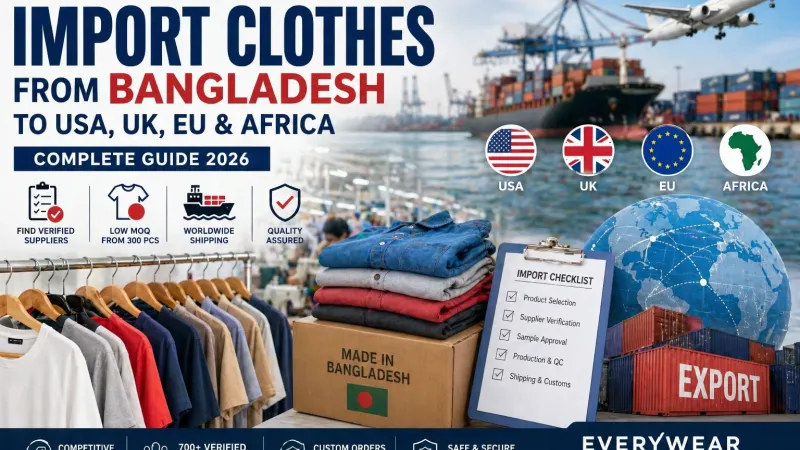
How to Import Clothes from Bangladesh to USA, UK, EU & Africa (Complete Guide 2026)
The global wholesale clothing business is evolving rapidly. Buyers across the USA, UK, Europe, and Africa are actively shifting their sourcing strategies toward Bangladesh. The reason is simple. Bangladesh offers one of the most competitive combinations of price, quality, and scalability in the global garment industry.
In 2026, importing clothes from Bangladesh is no longer limited to large corporations. Small brands, online sellers, boutique stores, and wholesalers can now access the same supply chain. With the right process and sourcing support, importing garments becomes structured, predictable, and highly profitable.
Why Bangladesh Is a Global Leader in Garment Export
Bangladesh stands as the second-largest exporter of ready-made garments in the world. The country supplies billions of dollars worth of clothing annually to global markets, including the United States, the United Kingdom, the European Union, and emerging African economies.
The garment sector contributes more than 80 percent of Bangladesh’s total export earnings. Thousands of factories specialize in knitwear, denim, woven garments, uniforms, and private label production. Many of these factories already produce for globally recognized brands.
Compared to China, Bangladesh offers significantly lower labor costs. Compared to India, Bangladesh often provides better pricing for finished garments. This makes Bangladesh one of the most attractive sourcing destinations for wholesale buyers.
Step 1: Define Your Garment Product Clearly
Every successful import process begins with clarity. Buyers must define exactly what type of garments they want before contacting suppliers. Without clear direction, pricing becomes inaccurate and production delays become common.
You should decide product categories such as T-shirts, polo shirts, hoodies, denim jeans, woven shirts, kidswear, or uniforms. Each category has different pricing, MOQ requirements, and production timelines.
Buyers who are starting new clothing brands often choose simple products like T-shirts or hoodies. These items allow faster production and lower investment while testing market demand.
Step 2: Find Verified Bangladesh Garment Suppliers
Bangladesh has thousands of garment factories. However, not all suppliers are suitable for international buyers. Choosing the right supplier directly affects product quality, delivery time, and overall business success.
Buyers should always work with verified suppliers or sourcing platforms. A reliable supplier provides clear communication, consistent pricing, factory details, and export experience.
- Check factory production capability
- Request product samples or previous work
- Confirm export history
- Understand MOQ requirements
- Evaluate communication speed
Avoid suppliers who refuse to share information, change pricing frequently, or demand full payment upfront.
Step 3: Send a Professional Inquiry
A strong inquiry helps suppliers provide accurate quotations. Weak or unclear inquiries result in confusion and delays.
Your inquiry should include product type, quantity, fabric specification, color options, size range, logo or branding requirements, and shipping destination.
For custom production, include a tech pack or reference image. The more detailed your inquiry, the better the supplier can understand your requirements.
Step 4: Request and Approve Samples
Sampling is one of the most critical stages in garment sourcing. A sample represents the final product before bulk production begins. Skipping this step can lead to costly mistakes.
Buyers must carefully inspect the sample for fabric quality, stitching accuracy, sizing consistency, color matching, and print or embroidery placement.
If any issue appears, request revisions before moving to bulk production. A properly approved sample reduces risk and ensures production accuracy.
Step 5: Negotiate Price, MOQ, and Payment Terms
Garment pricing depends on multiple factors, including fabric type, design complexity, order quantity, and customization requirements. Buyers should understand how pricing works before negotiating.
Many factories in Bangladesh require large minimum order quantities. However, modern sourcing platforms now allow buyers to start from as low as 300 pieces per design.
Standard payment terms often follow a 60 percent deposit and 40 percent balance before shipment. Buyers should avoid paying full amounts before production begins.
Step 6: Production Process and Quality Control
Once the sample is approved and payment terms are confirmed, production begins. The factory sources fabric, cuts patterns, assembles garments, and applies branding elements.
Production usually takes between 20 to 45 days depending on product complexity and order size.
Quality control is essential at this stage. Buyers should conduct inspections to verify stitching, measurements, fabric quality, labeling, and packaging.
Many importers use third-party inspection services or sourcing partners to ensure quality standards before shipment.
Step 7: Shipping and Logistics
Shipping is the final stage of the import process. Buyers can choose between air freight and sea freight based on urgency and budget.
Air freight is faster but more expensive. Sea freight is more cost-effective for large orders but takes longer.
| Shipping Method | Delivery Time | Cost | Best For |
|---|---|---|---|
| Air Freight | 5–10 Days | High | Urgent small orders |
| Sea Freight | 20–45 Days | Low | Bulk wholesale orders |
Required Documents for Importing Clothes
- Commercial Invoice
- Packing List
- Bill of Lading
- Certificate of Origin
- Export Documentation
Each country may have specific customs regulations, so buyers should always check import rules before shipment.
Country-Specific Import Guidelines
United States
The USA is one of the largest importers of Bangladesh garments. Importers must comply with customs duties, labeling regulations, and documentation requirements. Demand remains high for T-shirts, denim, and workwear.
United Kingdom
The UK market values both affordability and quality. Importers should focus on compliance, sustainable sourcing, and proper documentation to avoid delays.
European Union
The EU requires strict adherence to environmental and safety standards. Buyers often prioritize sustainable fabrics and certified production facilities.
Africa
African markets are growing rapidly. Demand for affordable wholesale clothing continues to increase across multiple regions. Bangladesh provides strong opportunities due to competitive pricing.
How Everywear Bangladesh Simplifies the Import Process
Importing garments can be complex, especially for new buyers. Everywear Bangladesh simplifies this process by acting as a complete sourcing partner and marketplace.
Instead of searching for multiple suppliers, buyers can access verified factories and manage production through a single platform.
- Low MOQ production from 300 pieces
- Verified supplier network
- Tech pack and product development support
- Sample coordination
- Quality control before shipment
- Worldwide shipping assistance
- Export documentation support
This approach reduces risk, improves communication, and ensures consistent product quality.
Conclusion
Importing clothes from Bangladesh to the USA, UK, EU, and Africa has become one of the most profitable strategies for clothing businesses in 2026. Bangladesh offers competitive pricing, strong production capacity, and reliable export systems.
By following a structured sourcing process and working with trusted partners, buyers can scale their business efficiently. Whether you are launching a new clothing brand or expanding a wholesale operation, Bangladesh provides a powerful and practical solution for global garment sourcing.
Explore More from Everywear Bangladesh
Discover more valuable resources to grow your fashion business with Bangladesh RMG wholesale:
- Bangladesh RMG Wholesale Blog
- Shopify Clothing Manufacturer Bangladesh
- TikTok Shop Clothing Supplier Bangladesh
- Wholesale Clothing Suppliers for eBay Sellers
- Amazon Fashion Sellers – Source from Bangladesh
- How to Start a Streetwear Brand with Bangladesh Manufacturers
- Low MOQ Clothing Manufacturer Bangladesh
- Import Clothes from Bangladesh to USA, UK, EU & Africa
- Buy Wholesale Garments from Bangladesh – Step by Step Guide
- Custom Garment Manufacturing Bangladesh 2026 Guide
- How Everywear Bangladesh Works – RMG Wholesale Marketplace
- Bangladesh vs China vs India Wholesale Clothing 2026
- Private Label Clothing Manufacturing Bangladesh 2026 Guide
Country-Specific Sourcing Guides
- USA Buyers – Wholesale Garments from Bangladesh
- UK Wholesale Garments from Bangladesh
- Europe Wholesale Clothing from Bangladesh
- Africa Wholesale Garments from Bangladesh
Ready to source high-quality RMG from Bangladesh with 300 pcs minimum order? Contact us on WhatsApp +8801788898174 or browse our full collection.
Leave a comment