





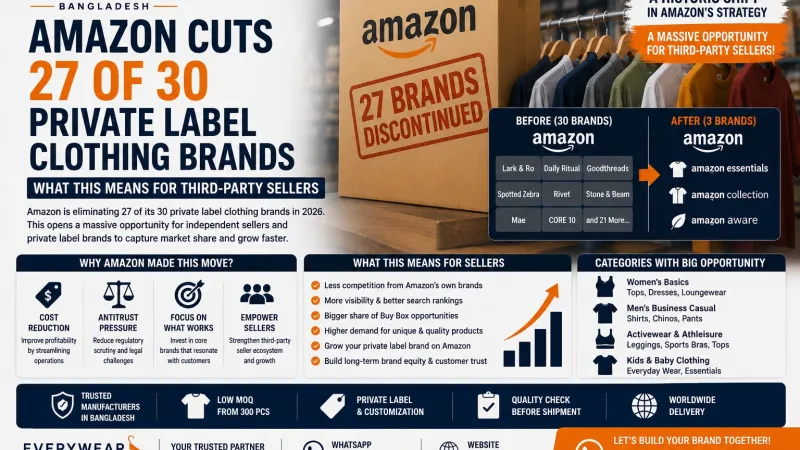
Amazon Cuts 27 of 30 Private Label Clothing Brands – What This Means for Third-Party Sellers
Last updated: August 20, 2026 • [Complete Guide for Amazon Sellers & Fashion Entrepreneurs]
Quick Answer: What Does Amazon Cutting 27 Private Label Clothing Brands Mean for Sellers?
In August 2026, Amazon made a historic decision to eliminate 27 of its 30 private-label clothing brands, including Lark & Ro, Daily Ritual, and Goodthreads. This leaves only Amazon Essentials, Amazon Collection, and Amazon Aware as the remaining in-house apparel brands. For third-party sellers, this represents a massive opportunity to capture search positions, Buy Box share, and traffic previously dominated by Amazon's own brands – particularly in women's basics, men's business casual, and activewear categories. The key to capitalizing is acting quickly with low-MOQ manufacturing, private label branding, and quality differentiation to build consumer trust in the vacuum left by Amazon's retreat.
In a move that has sent shockwaves through the Amazon seller community, the e-commerce giant has announced it will eliminate 27 of its 30 private-label clothing brands – a dramatic reduction that signals a fundamental shift in Amazon's strategy toward third-party sellers.
This is not a small adjustment. This is a historic restructuring of Amazon's apparel ecosystem. The company that once built a massive "400-brand empire" is now dismantling the vast majority of its in-house clothing lines, leaving only Amazon Essentials, Amazon Collection, and Amazon Aware as the sole remaining private-label apparel brands.
For third-party sellers, fashion entrepreneurs, and private-label brands, this is a once-in-a-decade opportunity to capture market share, search positions, and customer trust that was previously locked up by Amazon's own brands. This comprehensive guide explains what happened, why it happened, which brands are being eliminated, and – most importantly – how you can capitalize on this seismic shift to grow your Amazon clothing business.
The News: Amazon Eliminates 27 of 30 Private Label Clothing Brands
In August 2026, Amazon confirmed it was completely eliminating 27 of its 30 in-house clothing brands, a move first reported by The Wall Street Journal and confirmed by Amazon Vice President of Private Brands Matt Taddy.
According to sources familiar with the matter, the decision was driven by a combination of factors: cost-cutting measures, antitrust scrutiny, and a strategic shift toward focusing on brands that "resonate with customers."
The eliminated brands span a wide range of categories, including women's apparel, men's business casual, activewear, and children's clothing. Many of these brands were launched during Amazon's aggressive private-label expansion between 2017 and 2020, when the company sought to capture market share across dozens of fashion subcategories.
Which Brands Are Being Eliminated?
According to multiple reports, the following brands are being phased out:
| Brand Name | Category | Status |
|---|---|---|
| Lark & Ro | Women's Apparel | Being Phased Out |
| Daily Ritual | Women's Basics | Being Phased Out |
| Goodthreads | Men's Apparel | Being Phased Out |
| Spotted Zebra | Children's Clothing | Previously Discontinued |
| Rivet | Furniture | Being Phased Out |
| Stone & Beam | Furniture | Being Phased Out |
The Remaining Brands
After the dust settles, Amazon's private-label clothing division will consist of just three brands:
- Amazon Essentials – Amazon's core basics brand, offering affordable everyday clothing
- Amazon Collection – A mid-range apparel line
- Amazon Aware – Amazon's sustainable fashion brand
Amazon Vice President Matt Taddy stated that the company is focused on eliminating brands that "aren't resonating with customers," noting that shoppers prefer larger, more established labels.
Why Is Amazon Doing This? Three Key Drivers
Amazon's decision to cut 27 of 30 private-label clothing brands didn't happen in a vacuum. Three major factors converged to force this historic restructuring.
1. Regulatory Pressure and Antitrust Scrutiny
This is perhaps the most significant driver. Amazon has faced increasing antitrust scrutiny from regulators worldwide over its practice of using third-party seller data to develop competing private-label products.
The U.S. Federal Trade Commission (FTC) has been investigating Amazon's use of platform data to benefit its own brands. The core allegation is that Amazon has been simultaneously acting as both "referee and player" – operating the marketplace while also competing against third-party sellers.
Former CEO Jeff Bezos was grilled by Congress about these practices in 2020. At the time, Bezos acknowledged that Amazon had a policy against using seller-specific data to aid its private-label business, but admitted he "can't guarantee that that policy has never been violated."
In 2023, Amazon agreed to a number of legally binding commitments to settle EU antitrust investigations. The agreement settled two investigations that could have led to fines worth 10% of Amazon's annual global turnover.
By eliminating dozens of private-label brands, Amazon is signaling a retreat from the aggressive private-label expansion that drew regulatory scrutiny. It's a calculated move to demonstrate "platform neutrality" and reduce antitrust exposure.
2. Cost-Cutting and Focus on Core Brands
Amazon has been under significant pressure to reduce costs across its retail operations. Maintaining dozens of private-label clothing brands across multiple categories is expensive – requiring separate product development, sourcing, marketing, and inventory management.
Amazon Vice President Matt Taddy stated that the company is eliminating brands that "aren't resonating with customers" and focusing on what shoppers actually want.
By consolidating its private-label apparel portfolio to just three brands, Amazon can reduce operational complexity, cut costs, and focus resources on brands that generate the highest returns.
3. The Rise of Third-Party Sellers
Amazon's third-party seller ecosystem has grown dramatically. In 2026, third-party sellers account for the majority of units sold on Amazon, and the platform has become increasingly dependent on independent sellers for selection and customer satisfaction.
By stepping back from competing directly with third-party sellers in apparel, Amazon is strengthening its relationship with the seller community while reducing regulatory risk. It's a strategic pivot from "competitor" to "enabler."
What This Means for Third-Party Sellers: The Opportunity
For third-party sellers, Amazon's retreat from private-label apparel is one of the most significant opportunities in recent memory. Here's why:
1. Search Positions Are Up for Grabs
Amazon's private-label brands occupied highly visible search positions across thousands of clothing-related keywords. Brands like Lark & Ro, Daily Ritual, and Goodthreads regularly appeared in the top search results for categories like women's blouses, men's dress shirts, and women's activewear.
With these brands being phased out, those search positions are being released back into the ecosystem. Third-party sellers who optimize their listings and advertising can capture this traffic.
2. Buy Box Share Is Being Redeployed
Amazon's private-label brands often dominated the Buy Box – the coveted "Add to Cart" button that drives the majority of sales. With these brands disappearing, the Buy Box is being reallocated to third-party sellers.
This means more opportunities for sellers to win the Buy Box and increase conversion rates.
3. Recommendation Traffic Is Shifting
Amazon's recommendation algorithms often favored its own brands in "Customers Also Bought" and "Frequently Bought Together" sections. With private-label brands eliminated, recommendation traffic is being redistributed to third-party sellers.
4. Reduced Competition in Key Categories
Categories where Amazon's private-label brands were strong – particularly women's basics, men's business casual, activewear, and children's clothing – will become less competitive.
For sellers in these categories, this is a direct competitive advantage. Fewer competitors means higher visibility, better conversion rates, and improved margins.
5. Trust Vacuum Creates Brand-Building Opportunity
With Amazon's brands disappearing, a trust vacuum is being created. Customers who previously bought Lark & Ro or Daily Ritual will need to find alternatives.
Third-party sellers who can establish trust through quality, branding, and customer service will capture these customers and build long-term brand loyalty.
The Data: What's at Stake
To understand the scale of this opportunity, consider the following metrics:
| Metric | Value |
|---|---|
| Private Label Brands Eliminated | 27 of 30 |
| Remaining Private Label Clothing Brands | 3 (Amazon Essentials, Amazon Collection, Amazon Aware) |
| Amazon's Private Label Empire Peak | ~400 brands |
| Third-Party Seller Share of Units | ~60% |
| Private Label Share of Sales | ~1% of total retail sales |
| Fashion Brands on Amazon (Men's) | ~7,200 |
Even though Amazon's private-label sales represent only about 1% of total retail sales, their strategic position in search, Buy Box, and recommendations gave them outsized influence. The elimination of 27 brands will free up significant digital real estate for third-party sellers.
How to Capitalize: A Step-by-Step Guide for Sellers
Amazon's retreat from private-label apparel creates a limited-time opportunity. Here's how to capture it:
1. Identify the Keywords and Search Positions Being Vacated
The first step is understanding which keywords and search positions were previously occupied by Amazon's private-label brands.
Action Steps:
- Use Amazon's Brand Analytics or third-party tools like Jungle Scout, Helium 10, or SellerSprite
- Search for keywords associated with Lark & Ro, Daily Ritual, and Goodthreads products
- Identify the search volume and ranking difficulty for these keywords
- Look for keywords where Amazon's brands ranked in the top 10
Example Keywords to Target:
- Women's blouses / blouses for women
- Men's dress shirts / business casual shirts
- Women's activewear / workout sets
- Women's basics / essential tops
- Men's chinos / casual pants
- Children's clothing / kids' apparel
2. Optimize Your Listings for the Vacated Space
Once you've identified the keywords, optimize your listings to capture the traffic.
Action Steps:
- Update your product titles to include the high-value keywords
- Optimize bullet points and product descriptions for search relevance
- Improve backend search terms with the identified keywords
- Ensure your images are high-quality and meet Amazon's requirements (1000x1000+ pixels, white background)
- Add A+ Content (EBC) to improve conversion rates
3. Ramp Up Amazon PPC Advertising
With Amazon's private-label brands no longer bidding aggressively on these keywords, advertising costs may decrease – at least temporarily.
Action Steps:
- Increase bids on keywords previously dominated by Amazon's brands
- Launch new Sponsored Products and Sponsored Brands campaigns
- Use Sponsored Display ads to retarget customers who viewed competing products
- Monitor advertising performance and adjust bids regularly
- Focus on keywords with high conversion potential
4. Focus on Quality to Build Trust
Amazon's private-label brands were known for decent quality at affordable prices. With them gone, customers will be looking for reliable alternatives.
Action Steps:
- Invest in high-quality manufacturing (partner with reliable suppliers like Everywear Bangladesh)
- Request and review samples before bulk production
- Implement rigorous quality control processes
- Encourage customer reviews and respond to feedback
- Build a brand that customers can trust
5. Build Your Brand Through Amazon Brand Registry
To fully capitalize on the opportunity, you need to establish a legitimate brand presence on Amazon.
Action Steps:
- Register your brand with Amazon Brand Registry (requires a trademark)
- Create a professional brand storefront
- Use A+ Content and brand storytelling
- Build an email list for off-Amazon marketing
- Consider expanding to other marketplaces (Amazon Canada, Europe)
6. Leverage Low MOQ Manufacturing to Test and Scale
The traditional 500-unit private label model is becoming too risky. The smarter approach is to start small, validate demand, then scale.
This is where low MOQ from 300 pieces becomes a critical competitive advantage. With low MOQ, you can:
- Test multiple products and variations without excessive inventory risk
- Validate demand before committing to large orders
- Manage cash flow more effectively
- Iterate based on customer feedback
How Everywear Bangladesh Helps You Capitalize on This Opportunity
At Everywear Bangladesh, we understand that the 2026 Amazon landscape requires smarter manufacturing – not just lower costs. Here's how we help Amazon sellers capture the opportunity created by Amazon's private-label retreat:
1. Low MOQ from 300 Pieces – Test and Scale
Amazon's private-label retreat has created a limited-time window to capture market share. The traditional 500-unit model is becoming too risky. Everywear Bangladesh supports low MOQ production starting from 300 pieces per design. This allows you to:
- Test product-market fit in the newly vacated categories
- Validate demand before committing to larger orders
- Manage cash flow more effectively
- Iterate based on customer feedback
2. Private Label Manufacturing – Build Your Brand
With Amazon's brands disappearing, customers will be looking for alternatives. We help you build a trustworthy brand that captures these customers:
- Custom woven labels – Your brand name and logo
- Printed neck labels – Professional brand presentation
- Hang tags – Branded marketing materials
- Custom poly bags – Professional packaging for Amazon FBA
- Branded cartons – Consistent brand experience
3. Quality Control – Build Customer Trust
Quality is the foundation of customer trust. Our quality control process includes:
- Fabric inspection – Before cutting begins
- In-line sewing inspection – Throughout production
- Printing and embroidery verification – Accurate artwork placement
- Final AQL inspection – Comprehensive quality check with measurable pass/fail thresholds
- Video-call inspection – Verify your order before shipment
4. US Cotton Zero-Tariff – Save on Import Duties
Under the Agreement on Reciprocal Trade (ART) signed between the US and Bangladesh in February 2026, garments made with US-origin cotton or man-made fibres enter the US market at a zero reciprocal tariff rate. This can save US Amazon sellers approximately 19% in tariffs – directly improving your margins and allowing you to compete more effectively in the newly vacated categories.
5. Fast Production and Shipping to Amazon Warehouses
Speed matters when capturing a limited-time opportunity. We coordinate fast production and shipping:
- Sea freight – Most economical for bulk orders (25-35 days)
- Air freight – Faster option for urgent restocking (8-12 days)
- Courier services – Perfect for samples and small shipments (3-5 days)
- Export documentation – Commercial invoices, packing lists, certificates of origin
- Amazon FBA prep – Polybagging and labeling support
6. End-to-End Support – One Accountable Partner
You deal with Everywear directly – not multiple factories or middlemen. We provide:
- Dedicated account manager – Your single point of contact
- Regular production updates – Photos and progress reports
- 24/7 WhatsApp support – For urgent queries
- Transparent pricing – No hidden costs
- Factory visits and virtual tours – Upon request
Contact Everywear Bangladesh on WhatsApp
Frequently Asked Questions
Everything you need to know about Amazon's private-label cuts and how to capitalize on the opportunity.
1. What Amazon private label clothing brands are being discontinued in 2026?
Amazon is eliminating 27 of its 30 private-label clothing brands, including Lark & Ro, Daily Ritual, and Goodthreads. Other brands like Spotted Zebra (children's clothing) have already been discontinued. The remaining brands are Amazon Essentials, Amazon Collection, and Amazon Aware.
2. Why is Amazon cutting its private label clothing brands?
Amazon is cutting these brands for three main reasons: (1) Regulatory pressure and antitrust scrutiny – regulators have been investigating Amazon's use of seller data to benefit its own brands, (2) Cost-cutting – maintaining dozens of brands is expensive, and (3) Strategic shift – Amazon is focusing on brands that "resonate with customers" and strengthening its relationship with third-party sellers.
3. What does this mean for third-party Amazon sellers?
This is a massive opportunity for third-party sellers. Amazon's private-label brands occupied search positions, Buy Box share, and recommendation traffic. With 27 brands disappearing, these digital assets are being redeployed to third-party sellers. Sellers who act quickly can capture this traffic and build brand trust in the vacuum left by Amazon's retreat.
4. Which categories will be most impacted by Amazon's private-label retreat?
Categories where Amazon's private-label brands were strong will see the biggest changes: women's basics, men's business casual, activewear, and children's clothing. Sellers in these categories will face less competition and have more opportunities to capture search positions and Buy Box share.
5. How can I capitalize on Amazon cutting its private label brands?
To capitalize: (1) Identify keywords and search positions vacated by Amazon's brands, (2) Optimize your listings for these keywords, (3) Ramp up Amazon PPC advertising, (4) Focus on quality to build trust, (5) Build your brand through Amazon Brand Registry, and (6) Leverage low MOQ manufacturing to test and scale quickly.
6. What is the "Frequently Returned" badge and why does it matter?
The "Frequently Returned" badge (expanded February 16, 2026) is a warning label Amazon places on products with high return rates. It can cut conversions by 25-50% with no appeal. For clothing sellers, this is critical because apparel return rates are 20-40%. Avoiding this badge requires quality manufacturing, accurate sizing, and clear product images.
7. Is Amazon completely exiting the private label clothing business?
No. Amazon is keeping three brands: Amazon Essentials, Amazon Collection, and Amazon Aware. Amazon is not exiting private label entirely – it's consolidating to focus on brands with the highest customer appeal and profitability. Amazon Basics (non-apparel) will also continue operating.
8. What is the "Project Nile" rumor and how could it affect sellers?
Project Nile is a rumored Amazon internal program targeting high-performing ASINs (annual GMV over $2M, 4.4+ star rating, competitors under 3). It reportedly offers 60-65% of average selling price as a 90-day exclusive wholesale deal, then transitions these products into Amazon's own catalog. If true, this represents a new form of Amazon competition – not through private label brands, but through direct wholesale acquisition of successful third-party products. Sellers should be aware of this risk and diversify their sales channels.
9. What is the "Project Granite" rumor?
Project Granite is another rumored Amazon initiative described as adjusting ranking signals to systematically lower third-party listing priority when Amazon's own brands or supplier-direct inventory is available. This suggests Amazon may still be finding ways to favor its own products in search, even after eliminating private-label brands. Sellers should focus on differentiation and quality to remain competitive.
10. What is the FTC antitrust investigation about?
The FTC antitrust investigation focuses on allegations that Amazon used non-public data from third-party marketplace sellers to develop competing private-label products. This includes accusations that Amazon adjusted pricing, altered product launch dates, and manipulated search results to favor its own brands. The elimination of 27 private-label brands is seen as a response to this regulatory pressure.
11. How long will it take for Amazon's private-label brands to disappear?
Amazon is phasing out these brands gradually by selling through existing inventory. Once inventory is depleted, the brands will be completely removed from the platform. Sellers should act quickly to capture the traffic and search positions being vacated, as the window of opportunity is limited.
12. What is the Amazon clothing referral fee in 2026?
Amazon charges a 17% referral fee on the total sale price of clothing items (including shipping). In 2026, apparel under $20 moved to 17% (up from 15%), and items $20-$70 moved to 17% from 16% in most subcategories. Combined with FBA fees, storage fees, and returns processing fees, the total effective take rate for apparel sellers is now 34-38% of sale price.
13. What is the Amazon clothing return processing fee?
Amazon charges apparel and shoe sellers a return processing fee equal to the full FBA fulfillment fee on every single returned unit – no threshold, no exceptions. At a $6.50 fulfillment fee, a 25% return rate across 400 monthly units means $650 per month in return processing fees alone. Apparel is the highest-return category on Amazon (20-40% return rates).
14. How can Everywear Bangladesh help me launch a clothing brand on Amazon?
Everywear Bangladesh connects Amazon sellers with verified manufacturers offering low MOQ from 300 pieces, private label manufacturing, quality control, and shipping to Amazon warehouses. We help you test products with minimal risk, build a trustworthy brand, and scale efficiently – all with one accountable partner.
15. Why is Bangladesh a good sourcing destination for Amazon clothing brands?
Bangladesh offers low MOQ from 300 pieces, competitive pricing (10-15% lower than China), a skilled workforce of 4 million workers, 290+ LEED-certified green factories, and the US Cotton Clause for zero tariff on US-origin cotton garments. This makes it ideal for testing new products and building profitable Amazon brands.
16. What is Amazon Brand Registry and why is it important?
Amazon Brand Registry is a program that gives brand owners control over their product listings, access to A+ Content, and protection against counterfeiters. To register, you need a valid trademark (registered or pending). For private-label clothing sellers, Brand Registry is essential for building a legitimate brand that can compete effectively in the post-Amazon-private-label landscape.
17. What is the US Cotton Clause and how does it benefit Amazon sellers?
Under the Agreement on Reciprocal Trade (ART) signed between the US and Bangladesh in February 2026, garments made with US-origin cotton or man-made fibres enter the US market at a zero reciprocal tariff rate. This can save US Amazon sellers approximately 19% in tariffs – directly improving margins and allowing more competitive pricing in the newly vacated categories.
18. How does low MOQ help Amazon clothing sellers in 2026?
The traditional 500-unit private label model is becoming too risky due to increased FBA fees, advertising costs, and returns processing fees. Low MOQ (300 pieces) allows sellers to test products with minimal risk, validate demand before scaling, manage cash flow effectively, and iterate based on customer feedback. This is particularly important when capturing opportunities created by Amazon's private-label retreat.
19. What are the best clothing categories to sell on Amazon after the private-label cuts?
Categories previously dominated by Amazon's private-label brands offer the biggest opportunities: women's basics, men's business casual, activewear, children's clothing. Specific products include blouses, dress shirts, chinos, workout sets, and kids' apparel. Niche-focused fashion consistently outperforms generic apparel, so consider subcategories like plus-size, sustainable, or premium materials.
20. How do I start sourcing clothing from Bangladesh for my Amazon brand?
Contact Everywear Bangladesh on WhatsApp. Our team will understand your requirements, connect you with verified manufacturers, assist with product development, manage quality control, and coordinate shipping to Amazon warehouses. With low MOQ from 300 pieces and full private label support, we make it easy to test and scale your Amazon clothing brand.
Conclusion
Amazon's decision to eliminate 27 of its 30 private-label clothing brands is a historic shift that creates a massive opportunity for third-party sellers, fashion entrepreneurs, and private-label brands. The search positions, Buy Box share, and recommendation traffic previously occupied by Lark & Ro, Daily Ritual, Goodthreads, and other Amazon brands are being released back into the ecosystem.
Success requires speed, quality, and smart manufacturing. The traditional 500-unit private label model is becoming too risky. The winning strategy is to start small, validate demand, and scale intelligently – leveraging low MOQ manufacturing from 300 pieces.
At Everywear Bangladesh, we help Amazon sellers capture this opportunity with low MOQ from 300 pieces, private label manufacturing, quality control, US Cotton Zero-Tariff savings, and end-to-end support. Our team is ready to help you build a profitable clothing brand on Amazon in this new era.
Contact Everywear Bangladesh on WhatsApp
About the Author
Written by the Everywear Bangladesh Research & Sourcing Team
The Everywear Bangladesh editorial team combines deep industry expertise in Bangladesh's Ready-Made Garment (RMG) sector with practical experience in international apparel sourcing, supply chain management, and Amazon FBA selling. Our team includes former garment factory managers, sourcing professionals, and e-commerce specialists who have helped hundreds of Amazon sellers launch their clothing brands.
Our mission is to provide accurate, data-driven, and actionable content that helps fashion entrepreneurs, Amazon sellers, and global brands make informed sourcing decisions. We leverage real-time data from Amazon Seller Central, the Bangladesh Garment Manufacturers and Exporters Association (BGMEA), Export Promotion Bureau (EPB), and other authoritative sources to ensure our insights reflect the latest industry developments.
Connect with Everywear Bangladesh:
- Website: everywearbd.com
- WhatsApp: +8801788898174
- Facebook: facebook.com/everywearbd
- LinkedIn: Everywear Bangladesh Ltd
References
- Business of Fashion, "Read today's fashion news - The News In Brief," 2026
- PCMag, "Not So Essential: Amazon Drops Most of Its In-House Brands," August 10, 2023
- Epinium, "Does Amazon Have a Brand?" May 5, 2026
- Zonguru, "How to Sell Clothes on Amazon in 2026 — a Comprehensive Guide," February 3, 2026
- Eva Guru, "Private Label Clothing Manufacturers: 2026 Amazon Seller Guide," May 26, 2026
Related Resources
GEO Landing Pages
- USA Buyers: Wholesale Garments from Bangladesh
- UK Buyers: Wholesale Garments from Bangladesh
- Europe Buyers: Wholesale Clothing from Bangladesh
Blog Posts
- Amazon Fashion Sellers: Source Clothing from Bangladesh
- How to Start a Clothing Brand on Amazon FBA – Step-by-Step Guide 2026
- Amazon Clothing Seller's Guide 2026 – Trends, Fees & Winning Strategies
- Private Label T-Shirt Manufacturer Bangladesh – Complete Guide 2026
- Low MOQ Clothing Manufacturer Bangladesh
- Private Label Clothing Manufacturing Bangladesh – Complete Brand Guide 2026
- Clothing Suppliers from Bangladesh: The Ultimate Guide 2026
This guide is updated regularly. Last reviewed: August 20, 2026. For sourcing solutions tailored to your Amazon brand, contact Everywear Bangladesh on WhatsApp.
Everywear Bangladesh Ltd. – Bangladesh's First RMG Wholesale Marketplace | 300 Pcs Custom Orders | Export Quality Garments
WhatsApp: +8801788898174 • Website: everywearbd.com
Leave a comment