





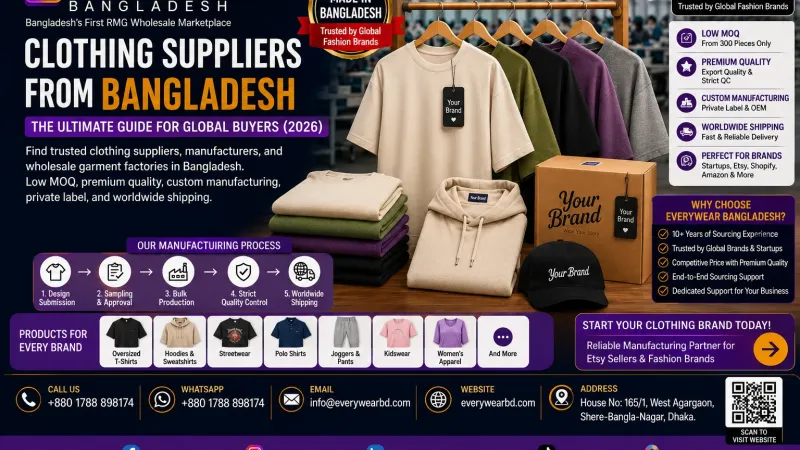
Clothing Suppliers from Bangladesh: The Ultimate Guide to Finding Reliable Bangladesh Clothing Manufacturers for Wholesale, Private Label & Custom Apparel (2026)
Bangladesh has become one of the most important apparel manufacturing hubs in the world. For decades, global fashion brands, retailers, wholesalers, and startup clothing businesses have trusted Bangladesh to manufacture high-quality garments at competitive prices. Today, whether you are launching a new fashion label, expanding an existing clothing business, or looking for reliable wholesale clothing suppliers, Bangladesh offers one of the strongest garment manufacturing ecosystems available anywhere in the world.
If you have searched for terms such as Clothing Suppliers from Bangladesh, Bangladesh Clothing Suppliers, Bangladesh Clothing Manufacturers, Wholesale Clothing Bangladesh, Private Label Clothing Manufacturer Bangladesh, or Custom Clothing Manufacturer Bangladesh, you have probably discovered thousands of suppliers claiming to offer the best quality, lowest prices, and fastest delivery.
But here's the reality.
Not every clothing supplier in Bangladesh is the right fit for your business.
Some factories specialize in large production runs for international retailers. Others focus on premium private label collections, oversized streetwear, sportswear, corporate uniforms, children's clothing, or sustainable apparel. Understanding these differences can save you thousands of dollars, reduce production risks, and help you build a long-term sourcing partnership instead of simply placing one successful order.
This comprehensive guide explains everything international buyers need to know before sourcing garments from Bangladesh. Whether you are an Amazon seller, Shopify entrepreneur, TikTok Shop merchant, eBay wholesaler, Etsy brand owner, fashion startup, promotional products company, or global retailer, this article will help you make informed sourcing decisions.
Instead of simply listing clothing manufacturers, we'll explain how Bangladesh's Ready-Made Garment (RMG) industry works, how to evaluate suppliers, how pricing is determined, what quality standards to expect, and how to avoid common sourcing mistakes. We'll also share practical insights based on real manufacturing experience to help you choose the right supplier for your products and business goals.
Why Bangladesh Is One of the World's Largest Clothing Manufacturing Countries
Bangladesh is no longer just a low-cost sourcing destination. Over the last three decades, it has transformed into one of the world's most advanced apparel manufacturing ecosystems.
Today, Bangladesh is the second-largest exporter of ready-made garments (RMG) globally, supplying clothing to leading international brands across North America, Europe, Asia, Australia, and Africa. Millions of garments produced in Bangladesh are worn every day by consumers who may never realize where their clothing originated.
The country's success is built on several key advantages:
- Highly experienced garment manufacturing workforce
- Strong textile and fabric supply chain
- Competitive production costs
- Modern export-oriented factories
- International compliance standards
- Advanced printing and embroidery technologies
- Efficient logistics and export infrastructure
- Growing focus on sustainability and innovation
Unlike many emerging manufacturing destinations, Bangladesh has developed a complete ecosystem that supports every stage of apparel production—from yarn spinning and knitting to dyeing, finishing, cutting, sewing, quality inspection, packaging, and international shipping.
This integrated supply chain enables buyers to source a wide variety of products from a single country while maintaining consistency in quality and production.
What Does "Clothing Suppliers from Bangladesh" Actually Mean?
One of the biggest misconceptions among international buyers is assuming that every company advertising itself as a clothing supplier owns a garment factory.
In reality, the term "clothing supplier" can refer to several different types of businesses.
Garment Manufacturers
These companies own and operate factories where garments are physically produced. They manage production lines, workers, machinery, quality control, and export operations.
Buying Houses
Buying houses act as intermediaries between buyers and factories. They help source products, negotiate prices, monitor production, and coordinate shipments.
Sourcing Companies
Professional sourcing companies work closely with multiple factories and help buyers identify the most suitable manufacturer based on product type, order quantity, quality expectations, and budget.
Wholesale Clothing Suppliers
Wholesale suppliers may stock finished garments or coordinate production through manufacturing partners before supplying products to retailers and distributors.
Understanding these distinctions is important because each business model offers different advantages depending on your sourcing strategy.
Why International Buyers Continue Choosing Bangladesh
Every year, thousands of businesses shift part of their apparel sourcing to Bangladesh. While competitive pricing is one reason, it is far from the only factor.
International buyers increasingly choose Bangladesh because of the country's ability to manufacture export-quality garments while supporting flexible production requirements.
Some of the biggest advantages include:
Competitive Manufacturing Costs
Bangladesh remains one of the most cost-effective locations for manufacturing knitwear, casual apparel, uniforms, and fashion basics without sacrificing quality.
Experienced Workforce
The country's garment industry employs millions of skilled workers with decades of experience producing apparel for global brands.
Massive Production Capacity
Whether you need 300 pieces for a startup collection or hundreds of thousands of garments for a retail chain, Bangladesh has factories capable of meeting diverse production requirements.
Wide Product Range
Bangladesh manufactures:
- T-Shirts
- Polo Shirts
- Hoodies
- Sweatshirts
- Joggers
- Shorts
- Denim
- Sportswear
- Activewear
- School Uniforms
- Corporate Uniforms
- Children's Clothing
- Baby Wear
- Fashion Accessories
- Private Label Apparel
Strong Export Infrastructure
The country has well-established export procedures, freight forwarding companies, customs expertise, and shipping networks serving global markets.
Bangladesh's Ready-Made Garment (RMG) Industry at a Glance
The Ready-Made Garment (RMG) sector is the backbone of Bangladesh's export economy and one of the most influential apparel manufacturing industries in the world.
Key characteristics include:
- Thousands of export-oriented garment factories
- Millions of skilled workers
- Strong relationships with international buyers
- Continuous investment in factory modernization
- Increasing adoption of automation and digital technologies
- Growing emphasis on sustainable manufacturing
Bangladesh exports garments to more than 150 countries, with the United States, United Kingdom, Germany, France, Spain, Italy, Netherlands, Canada, Japan, Australia, and several African nations representing some of its largest markets.
The country's reputation continues to grow because manufacturers consistently adapt to changing fashion trends, buyer requirements, and international quality standards.
What Products Can You Source from Bangladesh?
One of Bangladesh's greatest strengths is manufacturing diversity.
International buyers can source almost every major apparel category, including:
- Basic Cotton T-Shirts
- Premium Heavyweight T-Shirts
- Oversized T-Shirts
- Blank Apparel
- Polo Shirts
- Hoodies
- Sweatshirts
- Tank Tops
- Long Sleeve T-Shirts
- Joggers
- Cargo Pants
- Denim Jeans
- Denim Jackets
- Sportswear
- Gym Wear
- Yoga Apparel
- Uniforms
- School Wear
- Children's Clothing
- Baby Clothing
- Workwear
- Promotional Apparel
- Fashion Accessories
Many factories also specialize in private label manufacturing, allowing brands to customize every aspect of the garment—from fabric selection and sizing to labels, embroidery, packaging, and branding.
Meet Everywear Bangladesh: Your Trusted Apparel Sourcing Partner
At Everywear Bangladesh, we believe international apparel sourcing should be transparent, efficient, and accessible for businesses of every size.
Rather than limiting buyers to a single factory, we are building the Bangladesh RMG Wholesale Marketplace—a sourcing ecosystem designed to connect international buyers with trusted export-oriented manufacturers based on their specific product requirements.
Our services include:
- Clothing Sourcing
- Wholesale Garment Supply
- Private Label Manufacturing
- OEM Production
- Low MOQ Manufacturing (Starting from 300 Pieces for selected products)
- Fabric Sourcing
- Product Development
- Pattern Making
- Sample Development
- Screen Printing
- High-Density Printing
- Plastisol Printing
- Puff Printing
- Embroidery
- Woven Labels
- Custom Packaging
- Production Monitoring
- Quality Inspection
- Export Documentation
- Worldwide Shipping Support
Whether you're building a streetwear brand, sourcing uniforms, launching an Amazon product, or importing wholesale apparel, our goal is to simplify the manufacturing process while helping you work with the right factory for your products.
Understanding the Bangladesh Garment Manufacturing Process: From Concept to Finished Clothing
One of the biggest advantages of working with experienced clothing suppliers from Bangladesh is access to a complete manufacturing ecosystem. Unlike many countries where different production stages are outsourced to separate companies, Bangladesh has developed a highly integrated apparel industry that allows buyers to manage everything from fabric sourcing to final shipment through one coordinated supply chain.
If you understand how the manufacturing process works, you will communicate more effectively with your supplier, reduce costly mistakes, and receive products that match your expectations.
Let's walk through the complete apparel manufacturing journey.
Step 1: Product Planning and Design
Every successful garment begins with a clear product concept.
Before contacting a Bangladesh clothing manufacturer, you should define:
- Product category
- Target customer
- Intended retail price
- Fabric quality
- GSM requirement
- Color options
- Size range
- Printing requirements
- Embroidery requirements
- Packaging requirements
The clearer your requirements are, the easier it becomes for manufacturers to prepare accurate quotations.
Professional buyers typically prepare a Tech Pack before requesting prices.
A complete Tech Pack usually includes:
- Technical sketches
- Measurement chart
- Fabric composition
- GSM
- Stitch specifications
- Neck label design
- Wash care label artwork
- Hang tag artwork
- Packaging instructions
- Printing location
- Embroidery placement
- Color references (Pantone)
Even if you are a startup, investing time in creating a proper Tech Pack will save significant time during production.
Step 2: Fabric Selection
Fabric is one of the most important factors influencing garment quality.
Bangladesh produces a wide variety of knitted and woven fabrics suitable for different clothing categories.
Popular knitted fabrics include:
- Single Jersey
- Interlock
- Rib
- French Terry
- Fleece
- Pique
- Waffle Knit
- Lycra Jersey
Popular woven fabrics include:
- Poplin
- Twill
- Oxford
- Canvas
- Denim
- Linen Blends
Choosing the correct fabric depends on your product.
For example:
Basic Promotional T-Shirts
- Single Jersey
- 160–180 GSM
Premium Streetwear
- Heavyweight Interlock
- 240–320 GSM
Luxury Oversized T-Shirts
- Combed Cotton
- Compact Cotton
- Bio-Washed Cotton
- 260–320 GSM
Premium Hoodies
- French Terry
- Brushed Fleece
- 320–450 GSM
Sportswear
- Polyester
- Spandex Blends
- Moisture-Wicking Fabrics
Bangladesh clothing suppliers can also source:
- Organic Cotton
- Recycled Cotton
- Recycled Polyester
- BCI Cotton
- Sustainable Fabric Options
Step 3: Pattern Making
Pattern making transforms a clothing design into production-ready templates.
Professional pattern makers calculate:
- Body proportions
- Fit
- Sleeve angle
- Neck opening
- Shoulder drop
- Hem allowance
- Shrinkage allowance
Accurate patterns ensure:
- Better fitting garments
- Reduced fabric wastage
- Consistent sizing
- Faster production
This stage becomes especially important for:
- Oversized Fashion
- Streetwear
- Luxury Basics
- Activewear
- Children's Clothing
Step 4: Sample Development
Never skip sample development.
Professional Bangladesh clothing manufacturers generally produce several sample stages before beginning bulk production.
Common sample types include:
Development Sample
Created to evaluate the overall product concept.
Fit Sample
Used to verify garment measurements.
Size Set Sample
Confirms grading across different sizes.
Pre-Production Sample (PP Sample)
Final approved sample before bulk production begins.
Salesman Sample
Produced for marketing and wholesale presentations.
Every approved sample becomes the production reference.
Step 5: Fabric Inspection
Quality begins before cutting.
Professional factories inspect incoming fabrics for:
- Shade variation
- Fabric defects
- Width consistency
- GSM
- Color matching
- Holes
- Oil stains
- Knitting faults
Early inspection prevents expensive production problems later.
Step 6: Fabric Relaxation
Many international buyers overlook this step.
Before cutting, fabrics are allowed to relax naturally to minimize shrinkage after sewing.
Skipping this stage may lead to inaccurate garment measurements after washing.
Professional manufacturers follow controlled relaxation procedures based on fabric type.
Step 7: Fabric Cutting
Once patterns are finalized, large fabric lays are prepared for cutting.
Modern Bangladesh garment factories use:
- Automatic Cutting Machines
- CAD Systems
- Marker Planning Software
- Manual Cutting Tables
Efficient marker planning reduces fabric waste and lowers production costs.
Since fabric represents nearly 60–70% of garment cost, accurate cutting significantly improves overall manufacturing efficiency.
Step 8: Printing Process
Bangladesh is now recognized for producing premium printing quality comparable to leading manufacturing countries.
Available printing methods include:
Screen Printing
Best for bulk production.
Plastisol Printing
Excellent durability and vibrant colors.
High Density Printing
Popular for premium streetwear.
Rubber Print
Soft-touch premium finish.
Puff Print
Raised three-dimensional effect.
DTF Printing
Suitable for complex artwork.
DTG Printing
Ideal for small production quantities.
Discharge Printing
Soft vintage appearance.
Water-Based Printing
Eco-friendly option.
Silicone Printing
Luxury sportswear branding.
Everywear Bangladesh works with specialized printing partners capable of delivering export-quality results for international brands.
Step 9: Embroidery
Embroidery remains one of the highest-value garment decoration techniques.
Bangladesh manufacturers offer:
- Flat Embroidery
- 3D Puff Embroidery
- Chenille Embroidery
- Applique Embroidery
- Patch Embroidery
- Towel Embroidery
- Metallic Thread Embroidery
Professional embroidery enhances perceived product value and strengthens brand identity.
Step 10: Sewing Production
The sewing department is where garments begin taking shape.
Typical production lines include specialized operators responsible for:
- Shoulder Joining
- Neck Rib Attachment
- Sleeve Attachment
- Side Seam Closing
- Bottom Hemming
- Sleeve Hemming
- Label Attachment
- Thread Trimming
Quality supervisors continuously monitor every production stage.
Modern Machinery Used by Bangladesh Clothing Manufacturers
Today's export-oriented factories utilize advanced machinery from leading global manufacturers.
Common equipment includes:
- JUKI
- Brother
- Pegasus
- Kansai Special
- Yamato
- Siruba
- Hashima
- Eastman Cutting Systems
These machines improve:
- Sewing accuracy
- Production speed
- Stitch consistency
- Product durability
Washing and Finishing
Some garments require specialized washing techniques to achieve their final appearance.
Popular finishing options include:
- Bio Wash
- Silicone Wash
- Enzyme Wash
- Acid Wash
- Stone Wash
- Snow Wash
- Vintage Wash
- Pigment Dye
- Garment Dye
These treatments improve:
- Softness
- Color appearance
- Fabric feel
- Premium aesthetics
Heavyweight oversized fashion brands increasingly rely on garment dyeing to achieve unique premium finishes.
Final Quality Inspection
Before shipment, export-quality clothing suppliers from Bangladesh perform final inspections covering:
- Measurements
- Stitch Quality
- Color Consistency
- Printing Quality
- Embroidery Accuracy
- Label Placement
- Packaging
- Carton Markings
- Quantity Verification
Many factories follow internationally recognized AQL inspection standards before shipment approval.
Packaging and Branding
Packaging is often underestimated, but it directly affects customer perception.
Bangladesh clothing suppliers can produce:
- Custom Poly Bags
- Zip Bags
- Biodegradable Packaging
- Recycled Packaging
- Printed Cartons
- Barcode Labels
- QR Codes
- Custom Hang Tags
- Woven Labels
- Satin Labels
- Care Labels
Professional packaging enhances retail presentation and strengthens brand identity.
Export Documentation
Professional suppliers assist buyers with export documentation, including:
- Commercial Invoice
- Packing List
- Bill of Lading
- Certificate of Origin
- GSP Documentation (where applicable)
- Inspection Certificates
- Shipping Documents
Proper documentation ensures smooth customs clearance at the destination.
Why This Manufacturing Process Matters
Many buyers compare suppliers only by price.
Professional buyers compare suppliers by process.
A supplier with strong production planning, experienced technicians, modern machinery, and strict quality control consistently delivers better products than one competing solely on cost.
This is why successful brands build long-term relationships with trusted Bangladesh clothing manufacturers rather than changing suppliers for every order.
At Everywear Bangladesh, our sourcing approach focuses on matching buyers with factories that have the right expertise for their product category. Instead of treating every project the same, we evaluate fabric requirements, production complexity, quality expectations, decoration techniques, and order volume before selecting the most suitable manufacturing partner.
This structured approach reduces production risks, improves communication, and helps our clients receive export-quality garments that meet international standards while supporting the long-term growth of their brands.
How to Choose the Best Clothing Suppliers from Bangladesh
Choosing the right clothing supplier is one of the most important decisions you will make for your apparel business. A reliable manufacturing partner can help your brand grow consistently, while the wrong supplier can lead to poor quality, delayed shipments, lost customers, and financial losses.
Many first-time buyers believe that the supplier offering the lowest quotation is automatically the best choice. In reality, professional sourcing is about evaluating value rather than simply comparing prices.
Whether you are searching for a Bangladesh clothing manufacturer, clothing supplier Bangladesh, private label clothing manufacturer Bangladesh, or wholesale clothing supplier, there are several factors that should always be evaluated before placing an order.
1. Experience in Your Product Category
Not every garment factory manufactures every type of clothing.
Some factories specialize in knitwear.
Others focus on woven garments.
Some are experts in sportswear.
Others manufacture premium oversized streetwear.
Some produce school uniforms, while others focus entirely on corporate apparel.
Always ask questions such as:
- Have you manufactured this product before?
- Can you provide previous production examples?
- What brands have you worked with?
- What fabrics do you normally use?
- What is your monthly production capacity?
A factory with ten years of experience producing polo shirts may not be the best choice for heavyweight oversized hoodies.
Product specialization matters.
2. Factory Size Does Not Always Mean Better Quality
Many buyers assume bigger factories automatically produce better garments.
This is not always true.
Large factories often prioritize massive orders from multinational brands.
Smaller export-oriented factories may provide:
- Better communication
- More production flexibility
- Faster sampling
- Lower MOQ
- Greater attention to detail
The ideal supplier depends on your business size and production requirements.
3. Evaluate Communication
Good communication is one of the strongest indicators of a professional supplier.
Ask yourself:
Do they answer emails promptly?
Can they explain technical details clearly?
Do they understand garment terminology?
Can they identify potential production problems before manufacturing begins?
Professional communication prevents expensive mistakes later.
4. Ask About Minimum Order Quantity (MOQ)
MOQ varies depending on:
- Product type
- Fabric
- Printing
- Color quantity
- Factory specialization
Typical ranges include:
Basic T-Shirts
300–1,000 Pieces
Premium Hoodies
300–800 Pieces
Sportswear
500–2,000 Pieces
Uniforms
300–5,000 Pieces
Denim
800–3,000 Pieces
At Everywear Bangladesh, we understand that startups often need smaller production runs.
For many product categories, manufacturing starts from 300 pieces, helping entrepreneurs launch their brands without excessive inventory investment.
5. Request Product Samples
Never skip sampling.
Even experienced international buyers approve multiple sample stages before bulk production.
A sample helps verify:
- Fabric quality
- Stitching
- Measurements
- Printing
- Embroidery
- Fit
- Packaging
Approving a sample dramatically reduces production risks.
6. Understand Fabric Quality
Fabric determines:
- Comfort
- Durability
- Appearance
- Customer satisfaction
Some questions to ask include:
Is the cotton combed or carded?
Is the fabric compact?
What is the GSM?
Is it pre-shrunk?
Is it bio-washed?
Is the color fastness tested?
Does it comply with international standards?
Professional clothing manufacturers willingly answer these questions.
7. Review Printing Capabilities
If your products require custom graphics, printing quality becomes extremely important.
Ask suppliers about available printing methods.
Common options include:
Screen Printing
Best for large orders.
Plastisol Printing
Excellent durability.
High Density Printing
Ideal for premium streetwear.
Rubber Printing
Soft-touch finish.
Puff Printing
Three-dimensional effect.
DTF Printing
Excellent for detailed artwork.
DTG Printing
Ideal for small production runs.
Silicone Printing
Popular in luxury sportswear.
The printing technique should match your product positioning.
8. Check Embroidery Quality
Embroidery quality varies significantly between suppliers.
Evaluate:
- Stitch density
- Thread quality
- Logo accuracy
- Backside finishing
- Color consistency
Premium embroidery creates a much stronger customer impression than poor-quality stitching.
9. Evaluate Quality Control Systems
Reliable Bangladesh clothing suppliers inspect garments throughout production—not only after completion.
Professional quality systems include:
Raw Material Inspection
Fabric Inspection
Cutting Inspection
Inline Inspection
Printing Inspection
Embroidery Inspection
Measurement Inspection
Final Inspection
Packaging Inspection
AQL Inspection
Factories following structured quality systems consistently deliver better products.
10. Production Capacity
Ask suppliers:
How many pieces can you produce monthly?
Do you have dedicated production lines?
What happens during peak seasons?
Can production scale if our orders increase?
Selecting a supplier capable of supporting future growth avoids changing factories later.
Certifications to Look For
Professional buyers increasingly evaluate factories based on compliance and sustainability.
Common certifications include:
BSCI
SEDEX
WRAP
ISO 9001
OEKO-TEX®
GOTS
GRS
These certifications demonstrate commitment to quality, ethical manufacturing, and environmental responsibility.
Sustainability in Bangladesh's Garment Industry
The Bangladesh apparel industry has undergone a remarkable transformation over the last decade.
Today, many export-oriented factories have invested heavily in:
Energy-efficient machinery
Solar power
Wastewater treatment
Rainwater harvesting
Organic cotton sourcing
Recycled polyester
Green manufacturing
Sustainable packaging
Bangladesh is home to many internationally recognized green garment factories, reflecting the industry's commitment to environmental responsibility.
If sustainability is important to your brand, ask suppliers about:
Organic fabrics
Recycled materials
Eco-friendly dyeing
Plastic-free packaging
Carbon reduction initiatives
Environmental certifications
Consumers increasingly prefer brands that demonstrate responsible sourcing.
How Pricing Works in Bangladesh Clothing Manufacturing
One of the most common questions buyers ask is:
"How much does clothing manufacturing cost in Bangladesh?"
The answer depends on multiple factors.
The largest cost components include:
Fabric
The single biggest cost.
Usually 50–70% of total garment cost.
Accessories
Labels
Hang Tags
Elastic
Buttons
Zippers
Threads
Printing
Embroidery
Packaging
Labor
Quality Inspection
Export Documentation
Shipping
Because every product differs, professional suppliers prepare quotations after reviewing complete specifications.
Be cautious of suppliers providing prices without understanding your product.
Why the Cheapest Price Can Cost More
Many businesses fail because they choose suppliers based solely on price.
Extremely cheap quotations often result in:
Lower GSM fabric
Inferior stitching
Poor printing
Color inconsistencies
Production delays
Communication problems
Higher rejection rates
Professional sourcing focuses on total value rather than simply reducing unit cost.
Consistent quality generates repeat customers.
Repeat customers generate long-term profits.
Understanding Lead Time
Lead time depends on:
Fabric availability
Production complexity
Printing
Embroidery
Order quantity
Factory workload
Typical timeline:
Product Development
7–10 Days
Sampling
7–15 Days
Bulk Production
25–45 Days
Shipping
Air Freight
5–10 Days
Sea Freight
25–45 Days
Planning ahead helps avoid expensive last-minute shipping.
Common Mistakes New Buyers Make
Thousands of first-time importers repeat the same mistakes every year.
Avoid these common errors:
Choosing suppliers based only on price
Skipping sample approval
Sending incomplete specifications
Changing designs during production
Ignoring quality inspections
Not understanding payment terms
Selecting factories without product experience
Failing to communicate clearly
Professional sourcing is built on preparation.
The better your planning, the smoother your production.
Why Long-Term Partnerships Matter
Successful fashion brands rarely change suppliers every season.
Instead, they build long-term relationships.
Long-term partnerships offer:
Better pricing
Priority production
Consistent quality
Improved communication
Faster sampling
Product innovation
Trust
Shared growth
At Everywear Bangladesh, we believe sourcing should be based on partnership—not transactions.
Our objective is to become an extension of your business by helping you manufacture apparel efficiently, consistently, and professionally as your brand grows.
Rather than simply producing garments, we aim to build lasting relationships that support sustainable business success for buyers around the world.
Private Label Clothing Manufacturing in Bangladesh: Everything Brands Need to Know
One of the fastest-growing segments in the global fashion industry is private label clothing. Instead of selling products manufactured under another company's name, businesses are increasingly launching their own clothing brands with unique designs, custom packaging, and personalized branding.
Bangladesh has become one of the preferred destinations for private label clothing manufacturing because of its experienced workforce, competitive production costs, flexible manufacturing capabilities, and growing network of export-oriented factories.
Whether you're creating a luxury streetwear brand, gym wear collection, oversized essentials, corporate apparel, children's clothing, or lifestyle basics, Bangladesh provides access to manufacturers capable of turning your ideas into finished products.
At Everywear Bangladesh, private label manufacturing is more than simply adding a custom label. It is a complete product development process designed to help brands create apparel that reflects their identity and stands out in competitive markets.
What Is Private Label Clothing Manufacturing?
Private label manufacturing means producing garments that carry your own brand name rather than the manufacturer's.
Your customers only see your brand.
Every element can be customized.
This includes:
- Brand Labels
- Woven Labels
- Printed Neck Labels
- Wash Care Labels
- Hang Tags
- Packaging
- Poly Bags
- Cartons
- Product Stickers
- QR Codes
- Barcode Labels
- Size Stickers
- Brand Story Cards
The finished garment becomes your product—not the factory's.
This business model allows startups and established companies to compete with larger brands without investing millions in building their own manufacturing facilities.
OEM vs ODM vs Private Label
Many buyers confuse these three manufacturing models.
Understanding the difference helps you choose the right production partner.
OEM (Original Equipment Manufacturer)
You provide:
- Design
- Measurements
- Artwork
- Branding
- Specifications
The factory manufactures according to your instructions.
Ideal for:
- Established clothing brands
- Fashion designers
- Premium apparel companies
ODM (Original Design Manufacturer)
The manufacturer already has existing products.
You customize:
- Logo
- Packaging
- Labels
- Colors
Best for:
- Fast product launches
- Budget-conscious startups
Private Label
Private Label combines both approaches.
You create your own branded product while utilizing the manufacturer's production expertise.
This is currently one of the fastest-growing business models among Shopify brands, Amazon sellers, TikTok Shop businesses, Etsy sellers, and independent fashion labels.
Why Fashion Startups Choose Bangladesh
Launching a clothing brand requires balancing quality, investment, and scalability.
Bangladesh offers several advantages for startups.
Low Initial Investment
Many product categories can begin from approximately 300 pieces, allowing entrepreneurs to test new products before scaling production.
Premium Quality
Bangladesh manufacturers produce garments for globally recognized brands, meaning startups can access the same manufacturing expertise.
Flexible Product Development
Factories can assist with:
- Pattern Making
- Fabric Selection
- Sampling
- Printing
- Embroidery
- Packaging
Competitive Pricing
Lower production costs improve profit margins while maintaining quality.
Products Ideal for Private Label Manufacturing
Bangladesh manufacturers produce almost every apparel category.
Most popular include:
Premium T-Shirts
Heavyweight T-Shirts
Oversized T-Shirts
Polo Shirts
Luxury Hoodies
Sweatshirts
Joggers
Cargo Pants
Shorts
Gym Wear
Sportswear
Activewear
Corporate Uniforms
Children's Wear
Baby Clothing
Fashion Accessories
Promotional Apparel
Blank Apparel
Luxury Basics
Choosing the Right Fabric
Fabric selection defines product quality.
Some of the most requested fabrics include:
100% Cotton
Combed Cotton
Compact Cotton
Organic Cotton
Recycled Cotton
Single Jersey
Interlock
French Terry
Fleece
Pique
Lycra Blends
Polyester
Recycled Polyester
Cotton-Spandex Blends
Heavyweight Jersey
Each fabric serves a different purpose.
For example:
Luxury Streetwear
240–320 GSM Heavyweight Cotton
Corporate Polo Shirts
220–240 GSM Pique
Basic Promotional T-Shirts
160–180 GSM Single Jersey
Premium Hoodies
320–450 GSM French Terry
Sportswear
Performance Polyester
Understanding GSM
GSM (Grams per Square Meter) indicates fabric weight.
Lower GSM
Lightweight garments
Higher GSM
Premium heavyweight garments
General reference:
160 GSM
Lightweight
180 GSM
Standard retail quality
220 GSM
Premium
240 GSM
Heavy Premium
260 GSM
Luxury Streetwear
300 GSM+
Heavyweight Fashion
Choosing the correct GSM influences comfort, durability, and customer perception.
Decoration Options
Modern Bangladesh clothing manufacturers provide extensive customization options.
Printing methods include:
Screen Printing
Plastisol Printing
High Density Printing
Rubber Printing
Puff Printing
Silicone Printing
DTF Printing
DTG Printing
Water-Based Printing
Discharge Printing
Embroidery options include:
Flat Embroidery
3D Puff Embroidery
Chenille Embroidery
Patch Embroidery
Applique Embroidery
Premium decoration significantly increases perceived product value.
Packaging Matters More Than Most Buyers Think
Today's customers judge brands long before wearing the garment.
Professional packaging creates a premium unboxing experience.
Options include:
Custom Poly Bags
Biodegradable Packaging
Zip Lock Bags
Luxury Boxes
Custom Tissue Paper
Brand Story Cards
Thank You Cards
QR Code Cards
Branded Stickers
Printed Cartons
Professional packaging strengthens customer trust and encourages repeat purchases.
Why Shopify, Amazon, TikTok Shop and Etsy Sellers Source from Bangladesh
Thousands of online sellers have shifted production to Bangladesh because it combines export-quality manufacturing with competitive pricing.
Bangladesh suppliers can manufacture products suitable for:
Shopify Clothing Stores
Amazon FBA
Amazon Merch
TikTok Shop
Facebook Shop
Instagram Shops
eBay
Etsy
Wholesale Distribution
Corporate Merchandise
Subscription Clothing Boxes
Print-on-Demand Expansion
Many businesses begin by selling on one platform before expanding internationally.
Reliable manufacturing becomes the foundation for sustainable growth.
How Everywear Bangladesh Supports Growing Brands
Everywear Bangladesh is not just another garment supplier.
We help brands build reliable manufacturing systems.
Our process includes:
Product Consultation
Supplier Selection
Factory Matching
Fabric Sourcing
Pattern Development
Sample Development
Production Planning
Quality Monitoring
Printing Coordination
Embroidery Management
Packaging Development
Export Documentation
Worldwide Logistics Support
Instead of asking buyers to manage multiple suppliers, we coordinate the manufacturing journey through trusted export-oriented production partners.
Our Low MOQ Advantage
Many startups believe international manufacturing requires orders of thousands of garments.
That is no longer always true.
For selected products, Everywear Bangladesh offers manufacturing starting from approximately 300 pieces, making it easier for new brands to validate products before scaling production.
This approach helps entrepreneurs:
Reduce inventory risk
Preserve cash flow
Test new collections
Launch seasonal products
Gather customer feedback
Expand gradually
Growing step by step often produces stronger long-term businesses than over-investing in the first production run.
Why Long-Term Manufacturing Relationships Create Better Brands
Many successful global clothing brands have worked with the same manufacturing partners for years.
Why?
Because manufacturing consistency builds customer trust.
Long-term partnerships offer:
Consistent sizing
Consistent fabric quality
Improved communication
Faster sampling
Better production planning
Lower defect rates
Priority scheduling
Product innovation
As your business grows, your manufacturing partner should grow with you.
That is the philosophy behind Everywear Bangladesh.
We believe success comes from building long-term partnerships—not simply completing transactions.
Our objective is to become your trusted sourcing partner while helping your clothing brand manufacture premium garments that compete successfully in global markets.
How to Import Clothes from Bangladesh: A Complete Step-by-Step Guide for International Buyers
If you're planning to source garments from Bangladesh for the first time, you may wonder where to start. Importing clothing might seem complicated, but when you understand the process and work with an experienced sourcing partner, it becomes straightforward.
Whether you're importing 300 pieces for a startup or 100,000 pieces for a retail chain, following a structured sourcing process will reduce risks, improve communication, and help ensure your products arrive on time and meet your quality expectations.
This section explains the complete import process used by professional buyers worldwide.
Step 1: Define Your Product Clearly
Before contacting any clothing supplier from Bangladesh, you should know exactly what you want to manufacture.
Your product specification should include:
- Product Type
- Target Customer
- Fabric Composition
- Fabric GSM
- Color Options
- Size Range
- Fit Type
- Printing Requirements
- Embroidery Requirements
- Packaging Style
- Target Retail Price
- Target Manufacturing Cost
The more information you provide, the more accurate the supplier's quotation will be.
Professional manufacturers prefer detailed specifications because they reduce misunderstandings during production.
Step 2: Prepare a Professional Tech Pack
A Tech Pack is the blueprint of your garment.
Think of it as the instruction manual your manufacturer will follow.
A complete Tech Pack usually contains:
- Front View Sketch
- Back View Sketch
- Measurement Chart
- Fabric Details
- Stitch Construction
- Label Placement
- Print Artwork
- Embroidery Artwork
- Packaging Instructions
- Carton Information
- Color References
- Pantone Codes
- Size Grading
Without a Tech Pack, manufacturers must make assumptions, increasing the risk of production errors.
Step 3: Request a Quotation
Once your specifications are ready, request a quotation.
A professional quotation should include:
- Unit Price
- MOQ
- Sample Cost
- Sample Lead Time
- Production Lead Time
- Payment Terms
- Incoterms
- Packaging Details
- Shipping Method
- Production Capacity
Avoid suppliers who provide quotations without reviewing your specifications.
Accurate pricing requires accurate information.
Step 4: Compare Suppliers Properly
Do not compare suppliers using price alone.
Instead, compare:
Product Experience
Communication
Factory Capability
Quality Systems
Sampling Speed
Export Experience
Lead Time
Compliance
Printing Quality
Embroidery Quality
Packaging
Buyer Support
Long-term value is always more important than saving a few cents per garment.
Step 5: Sample Development
Before mass production begins, samples should be approved.
Typical sampling stages include:
Development Sample
Fit Sample
Pre-Production Sample
Size Set Sample
Salesman Sample
Sample approval protects both buyer and manufacturer.
Everything produced during bulk production should match the approved sample.
Step 6: Confirm Production
Once samples are approved, production begins.
Professional suppliers should provide regular updates, including:
Fabric Arrival
Fabric Inspection
Cutting Progress
Printing Progress
Embroidery Progress
Sewing Progress
Finishing
Packing
Inspection
Shipment Preparation
Transparency creates confidence.
Step 7: Production Monitoring
Many international buyers cannot visit Bangladesh during production.
That is why production monitoring is extremely valuable.
Professional sourcing partners supervise:
Fabric Quality
Measurements
Printing
Embroidery
Production Timeline
Quality Control
Packaging
Final Inspection
At Everywear Bangladesh, production monitoring is an essential part of our sourcing process because we believe communication should continue throughout manufacturing—not only when production is finished.
Step 8: Final Inspection
Never ship garments without inspection.
Professional inspections verify:
Measurements
Fabric Quality
Printing
Embroidery
Label Placement
Packaging
Carton Quantity
Carton Weight
Visual Appearance
Needle Detection (if required)
AQL Inspection Standards
Final inspection protects your investment before shipment.
Step 9: Shipping
Several shipping options are available.
Sea Freight
Best for:
Wholesale Orders
Retail Chains
Large Production
Advantages
Lowest Shipping Cost
Large Capacity
Container Shipping
Air Freight
Best for:
Urgent Orders
Product Launches
Seasonal Collections
Advantages
Fast Delivery
Lower Transit Time
Courier
Ideal for:
Samples
Small Orders
Prototype Development
Most international buyers use DHL, FedEx, UPS, or TNT for sample shipments.
Understanding Incoterms
Every importer should understand Incoterms before placing an order.
FOB (Free On Board)
The supplier delivers goods to the port.
The buyer arranges international shipping.
Most experienced apparel buyers prefer FOB.
CIF (Cost Insurance Freight)
The supplier arranges transportation and insurance until the destination port.
Suitable for buyers with limited shipping experience.
DDP (Delivered Duty Paid)
The supplier manages nearly the entire shipping process, including customs where agreed.
Ideal for buyers seeking maximum convenience.
Always clarify shipping terms before production begins.
Payment Terms Used in Bangladesh Garment Manufacturing
Payment structures vary depending on:
Order Value
Customer Relationship
Product Type
Production Complexity
Typical payment terms include:
Advance Payment
Balance Before Shipment
Letter of Credit (LC)
Telegraphic Transfer (TT)
Long-term buyers often negotiate more flexible payment arrangements after building trust.
Documents Required for Importing Clothing
Professional Bangladesh clothing suppliers prepare export documentation such as:
Commercial Invoice
Packing List
Bill of Lading
Certificate of Origin
Export Declaration
Inspection Certificate
Shipping Documents
Proper documentation speeds up customs clearance in your destination country.
Countries That Import Clothing from Bangladesh
Bangladesh exports apparel to more than 150 countries.
Major export markets include:
United States
United Kingdom
Canada
Germany
France
Italy
Spain
Netherlands
Belgium
Australia
Japan
South Korea
United Arab Emirates
Saudi Arabia
Nigeria
South Africa
Kenya
Morocco
Egypt
Each market has different product preferences, compliance requirements, and import regulations.
Why More Businesses Are Buying Directly from Bangladesh
Over the last decade, many businesses have shifted away from trading companies and started sourcing directly from Bangladesh clothing manufacturers.
Reasons include:
Better Communication
Competitive Pricing
Greater Product Customization
Improved Quality Control
Direct Factory Relationships
Private Label Opportunities
OEM Manufacturing
Flexible Production
Professional sourcing partners make this process even easier by managing communication between buyers and manufacturers.
Everywear Bangladesh's Complete Sourcing Solution
Everywear Bangladesh was created to simplify international garment sourcing.
Instead of requiring buyers to communicate with multiple factories, we provide a complete sourcing solution through our Bangladesh RMG Wholesale Marketplace.
Our sourcing process includes:
Initial Consultation
Product Analysis
Supplier Matching
Quotation Collection
Fabric Selection
Sample Development
Production Planning
Quality Monitoring
Inspection
Packaging
Export Documentation
International Logistics
Buyer Support
Whether you're a startup launching your first clothing brand or a global wholesaler expanding your product line, our objective is to reduce sourcing complexity while helping you manufacture export-quality garments with confidence.
Case Study: Helping a UK Clothing Seller Scale Production
One of our UK clients approached Everywear Bangladesh after facing inconsistent quality and delayed deliveries from multiple suppliers.
The client needed a dependable manufacturing partner capable of producing premium custom T-shirts for resale through online marketplaces.
Project Overview:
- Product: Premium Custom T-Shirts
- Total Quantity: 2,100 Pieces
- Number of Designs: 7
- Fabric: 100% Cotton Interlock
- GSM: 240–260
- Printing: Plastisol, High-Density & Rubber Print
- Branding: Custom Labels & Premium Embroidery
- Production Time: 17 Days
- Shipping: Door-to-Door UK Delivery
By carefully selecting the right manufacturing partner, monitoring production, and maintaining clear communication throughout the process, the project was completed successfully and delivered according to schedule.
This example demonstrates the value of structured sourcing rather than relying solely on the lowest quotation.
Why Bangladesh Is the Global Hub for Wholesale Clothing Manufacturing
Bangladesh has earned its reputation as one of the world's leading apparel manufacturing countries through decades of experience, continuous investment, and an unwavering focus on export quality. Today, thousands of international buyers source garments from Bangladesh because the country combines competitive manufacturing costs with modern production capabilities, skilled workers, and reliable export infrastructure.
For wholesalers, distributors, retailers, and private label brands, Bangladesh offers far more than affordable production. It provides an integrated apparel supply chain capable of supporting businesses from startup level to global retail operations.
Unlike countries where buyers must source fabric, trims, printing, sewing, and logistics separately, Bangladesh offers a complete manufacturing ecosystem that simplifies the sourcing process.
Whether you are searching for a wholesale clothing supplier Bangladesh, Bangladesh garment factory, apparel manufacturer Bangladesh, or clothing manufacturer Bangladesh, understanding the country's strengths will help you build a more efficient and profitable supply chain.
Bangladesh vs China vs India vs Vietnam: Which Country Is Better for Clothing Manufacturing?
One of the most common questions buyers ask is:
"Should I manufacture clothing in Bangladesh, China, India, or Vietnam?"
The answer depends on your business model, target market, product category, and production volume.
Bangladesh
Best For:
- Knitwear
- T-Shirts
- Hoodies
- Sweatshirts
- Polo Shirts
- Uniforms
- Private Label Clothing
- Wholesale Apparel
- Heavyweight Streetwear
Strengths:
- Excellent price-to-quality ratio
- Strong export experience
- Large-scale manufacturing
- Competitive labor costs
- Extensive knitwear expertise
- Modern export-oriented factories
China
Best For:
- Complex technical products
- Fashion accessories
- Fast product development
- High product diversity
Strengths:
- Extremely advanced manufacturing
- Extensive material sourcing
- Fast innovation
- Automation
Challenges:
- Higher production costs
- Increasing labor expenses
India
Best For:
- Cotton garments
- Handmade textiles
- Fashion fabrics
Strengths:
- Strong textile heritage
- Cotton production
- Artisan craftsmanship
Challenges:
- Factory quality varies significantly.
Vietnam
Best For:
- Sportswear
- Outdoor apparel
- Performance clothing
Strengths:
- High-quality sewing
- Strong international trade agreements
Challenges:
- Higher manufacturing costs compared to Bangladesh.
For many fashion brands, Bangladesh offers one of the best balances between quality, production capability, and manufacturing cost.
Why Bangladesh Is Ideal for Startup Clothing Brands
Starting a clothing brand involves many financial decisions.
Inventory is often the largest investment.
Choosing a manufacturing partner that supports flexible production can significantly reduce business risk.
Bangladesh has become increasingly attractive for startups because many suppliers now offer:
- Lower Minimum Order Quantities
- Product Development Assistance
- Custom Branding
- Premium Printing
- Packaging Solutions
- Export Support
At Everywear Bangladesh, selected product categories can begin from approximately 300 pieces, making it easier for entrepreneurs to launch collections, validate products, and grow gradually.
This approach allows businesses to:
- Test designs
- Preserve cash flow
- Improve product quality
- Reduce unsold inventory
- Scale production based on customer demand
Manufacturing Products for Shopify Clothing Stores
Thousands of entrepreneurs launch fashion brands using Shopify every year.
Successful Shopify brands require more than attractive websites—they need reliable manufacturing partners capable of delivering consistent quality.
Popular Shopify products manufactured in Bangladesh include:
- Oversized T-Shirts
- Heavyweight Cotton T-Shirts
- Hoodies
- Sweatshirts
- Matching Sets
- Activewear
- Streetwear
- Luxury Basics
- Blank Apparel
- Accessories
Everywear Bangladesh works with brands that require custom manufacturing rather than generic wholesale products.
Services include:
- Private Label
- Custom Labels
- Branded Packaging
- Premium Printing
- Premium Embroidery
- Product Development
Clothing Manufacturing for Amazon Sellers
Amazon remains one of the largest online marketplaces for apparel.
However, success depends heavily on product quality and consistency.
Bangladesh manufacturers can produce:
- Blank T-Shirts
- Fashion Basics
- Hoodies
- Sportswear
- Children's Clothing
- Uniforms
- Custom Apparel
Professional packaging and barcode labeling ensure products are ready for Amazon fulfillment requirements.
Manufacturing for TikTok Shop Sellers
Social commerce continues growing rapidly.
TikTok Shop has created opportunities for apparel entrepreneurs worldwide.
Winning products often include:
- Oversized T-Shirts
- Trendy Hoodies
- Graphic Tees
- Matching Sets
- Activewear
- Streetwear
Bangladesh manufacturers can support fast-growing brands by producing high-quality garments suitable for social media-driven businesses.
Clothing Suppliers for Etsy Sellers
Etsy customers appreciate originality.
Rather than mass-produced products, Etsy buyers often prefer:
- Handmade-inspired apparel
- Premium cotton garments
- Personalized clothing
- Embroidered products
- Limited collections
Bangladesh manufacturers can support Etsy businesses through flexible production and premium finishing.
Wholesale Clothing Suppliers for eBay Businesses
Many successful eBay sellers source products directly from Bangladesh.
Popular wholesale categories include:
- Blank Apparel
- Fashion Basics
- Promotional Clothing
- Sportswear
- Workwear
- School Uniforms
- Casual Apparel
Reliable manufacturing ensures repeat customers and positive marketplace reviews.
Choosing Between Ready Stock and Custom Manufacturing
Buyers generally have two sourcing options.
Ready Stock
Advantages:
- Fast delivery
- Lower lead time
- Immediate availability
Disadvantages:
- Limited customization
- Generic products
- Minimal branding opportunities
Custom Manufacturing
Advantages:
- Unique products
- Full branding
- Better profit margins
- Stronger customer loyalty
- Greater market differentiation
Disadvantages:
- Longer production timeline
- Sampling required
For long-term brand building, custom manufacturing usually provides significantly greater value.
Common Red Flags When Choosing Clothing Suppliers from Bangladesh
Not every supplier operates at the same professional level.
Watch for these warning signs:
- Prices that seem unrealistically low
- Poor communication
- No factory photos
- No production references
- Unclear payment terms
- Refusal to provide samples
- No quality control process
- No export experience
- Constant delays in responding
- Inconsistent quotations
Professional suppliers welcome questions and provide transparent information.
Questions Every Buyer Should Ask Before Placing an Order
Before confirming production, ask your supplier:
- What products do you specialize in?
- Can you manufacture my design?
- What is your MOQ?
- What fabrics do you recommend?
- Can I customize labels and packaging?
- How long does production take?
- What quality inspections are performed?
- Can I visit the factory?
- What printing methods do you offer?
- What payment terms are available?
- How do you handle production delays?
- What export markets do you currently serve?
The answers will reveal far more than a simple quotation.
Building a Long-Term Sourcing Strategy
Successful apparel brands rarely think one order ahead.
Instead, they develop sourcing strategies that support growth over many years.
An effective sourcing strategy includes:
- Reliable manufacturing partners
- Consistent product quality
- Standardized specifications
- Long-term pricing discussions
- Seasonal product planning
- Continuous quality improvements
- Supply chain diversification
Everywear Bangladesh works closely with buyers to build sourcing systems that remain efficient as businesses expand into new markets and introduce new product categories.
Why Everywear Bangladesh Is More Than a Clothing Supplier
Our goal is not simply to manufacture garments.
We aim to become your long-term sourcing partner.
By combining sourcing expertise with trusted manufacturing relationships, Everywear Bangladesh helps businesses simplify apparel production while maintaining quality, transparency, and reliability.
Whether you are searching for:
- Clothing Suppliers from Bangladesh
- Bangladesh Clothing Manufacturers
- Wholesale Clothing Bangladesh
- Private Label Clothing Manufacturer Bangladesh
- Low MOQ Clothing Manufacturer Bangladesh
- Oversized T-Shirt Manufacturer Bangladesh
- Hoodie Manufacturer Bangladesh
- OEM Clothing Manufacturer Bangladesh
Our objective is the same—to help you manufacture garments that strengthen your brand and support sustainable business growth.
The Complete Apparel Product Categories You Can Manufacture in Bangladesh
One of the biggest reasons international buyers choose Bangladesh is the country's remarkable manufacturing versatility. Unlike many sourcing destinations that specialize in only a handful of product categories, Bangladesh has built an apparel ecosystem capable of producing almost every type of garment for fashion brands, wholesalers, retailers, promotional companies, corporate buyers, schools, sports brands, and eCommerce businesses.
Whether you're launching your first clothing brand or managing an international retail chain, Bangladesh offers manufacturing solutions for virtually every apparel category.
Understanding which factories specialize in which products is one of the keys to successful sourcing.
T-Shirt Manufacturer Bangladesh
T-shirts remain Bangladesh's largest apparel export category.
Thousands of factories manufacture millions of T-shirts every month for some of the world's biggest fashion brands.
Popular T-shirt categories include:
- Basic Cotton T-Shirts
- Premium Cotton T-Shirts
- Oversized T-Shirts
- Heavyweight T-Shirts
- Vintage Washed T-Shirts
- Acid Wash T-Shirts
- Garment Dyed T-Shirts
- Graphic T-Shirts
- Blank T-Shirts
- Fashion T-Shirts
- Corporate Promotional T-Shirts
- Sports T-Shirts
- Performance T-Shirts
- Children's T-Shirts
Available fabric options include:
- Single Jersey
- Interlock
- Compact Cotton
- Combed Cotton
- Organic Cotton
- Recycled Cotton
- Cotton-Spandex
- Bamboo Cotton
Popular GSM ranges:
160 GSM
180 GSM
200 GSM
220 GSM
240 GSM
260 GSM
280 GSM
300 GSM
320 GSM
For premium streetwear brands, heavyweight interlock fabrics between 240–320 GSM continue to gain popularity because they offer excellent durability, structure, and premium hand feel.
Oversized T-Shirt Manufacturer Bangladesh
The oversized fashion segment has experienced explosive growth over the past few years.
Consumers increasingly prefer relaxed silhouettes inspired by streetwear culture.
Bangladesh has become one of the leading manufacturing destinations for oversized apparel because factories have developed extensive experience producing:
- European Drop Shoulder T-Shirts
- Box Fit T-Shirts
- Heavyweight Oversized Tees
- Luxury Streetwear Basics
- Washed Oversized Apparel
- Premium Fashion Essentials
Most premium oversized collections use:
240 GSM
260 GSM
280 GSM
300 GSM
320 GSM
Heavyweight Cotton
Compact Cotton
Interlock
French Terry
Everywear Bangladesh works closely with buyers developing oversized collections for Shopify brands, TikTok Shop businesses, luxury basics, and premium streetwear labels.
Blank T-Shirt Manufacturer Bangladesh
Blank apparel continues growing because businesses need products for:
- Printing Companies
- Promotional Products
- Corporate Uniforms
- Fashion Startups
- POD Businesses
- Wholesale Distribution
Blank T-shirts manufactured in Bangladesh offer:
Consistent Sizing
Premium Cotton
Retail Quality Stitching
Multiple Color Options
Large Size Range
Private Label Opportunities
Blank apparel serves as the foundation for countless clothing businesses worldwide.
Hoodie Manufacturer Bangladesh
Bangladesh is also recognized internationally for premium hoodie manufacturing.
Popular hoodie styles include:
- Pullover Hoodies
- Zip Hoodies
- Oversized Hoodies
- Heavyweight Hoodies
- French Terry Hoodies
- Fleece Hoodies
- Washed Hoodies
- Luxury Hoodies
Typical fabrics include:
French Terry
Brushed Fleece
Cotton Polyester Blend
Heavyweight Cotton
Loopback Terry
Common GSM:
320 GSM
350 GSM
380 GSM
400 GSM
450 GSM
Luxury fashion brands increasingly request heavyweight hoodies because customers associate weight with premium quality.
Sweatshirt Manufacturer Bangladesh
Sweatshirts remain one of the fastest-growing apparel categories.
Manufacturers produce:
Crewneck Sweatshirts
Oversized Sweatshirts
Vintage Sweatshirts
Pigment Dyed Sweatshirts
Acid Wash Sweatshirts
Luxury Basics
Premium embroidery and high-density printing are frequently combined with heavyweight sweatshirts to create higher-value fashion products.
Polo Shirt Manufacturer Bangladesh
Bangladesh has decades of experience manufacturing premium polo shirts.
Factories produce:
Corporate Polos
Golf Polos
School Uniform Polos
Hospitality Uniforms
Luxury Fashion Polos
Sports Polos
Available fabrics include:
Pique
Interlock
Cotton Polyester
Performance Fabrics
Stretch Fabrics
Many global corporate brands source polo shirts from Bangladesh because of the country's consistent production quality.
Sportswear Manufacturer Bangladesh
Performance apparel has become another major export category.
Manufacturers produce:
Gym Wear
Training Apparel
Football Jerseys
Basketball Jerseys
Running Shirts
Yoga Apparel
Compression Wear
Athleisure
Sports Shorts
Training Pants
Available performance fabrics include:
Polyester
Spandex
Dry-Fit
Mesh
Moisture Wicking Fabrics
Recycled Polyester
Bangladesh continues investing heavily in sportswear technology to meet growing international demand.
Activewear Manufacturer Bangladesh
Health-conscious consumers continue driving growth in activewear.
Bangladesh manufacturers produce:
Sports Bras
Leggings
Training Tops
Workout T-Shirts
Running Apparel
Gym Shorts
Performance Jackets
Compression Garments
Factories increasingly utilize:
Four-Way Stretch Fabrics
Quick Dry Technology
Breathable Mesh Panels
Anti-Bacterial Finishes
UV Protection Fabrics
Children's Clothing Manufacturer Bangladesh
Bangladesh is also one of the world's largest exporters of children's apparel.
Products include:
Baby Clothing
Infant Wear
School Uniforms
Kids Fashion
Sleepwear
Onesies
Rompers
Pajamas
Jackets
T-Shirts
Shorts
Factories follow strict international safety standards regarding:
Needle Detection
Child Safety Regulations
Color Fastness
Chemical Compliance
Label Requirements
School Uniform Manufacturer Bangladesh
Many educational institutions worldwide import uniforms from Bangladesh.
Popular products include:
School Shirts
School Pants
Skirts
Polo Shirts
Blazers
Sports Uniforms
Sweaters
Cardigans
Bangladesh manufacturers provide:
Embroidery
School Logos
Custom Colors
Custom Sizing
Durable Fabrics
Long-lasting stitching
Corporate Uniform Manufacturer Bangladesh
Businesses increasingly invest in branded uniforms to strengthen professional image.
Manufacturers produce:
Office Shirts
Polo Shirts
Hospital Uniforms
Restaurant Uniforms
Hotel Uniforms
Industrial Uniforms
Security Uniforms
Retail Staff Uniforms
Airline Uniforms
Custom branding options include:
Embroidery
Heat Transfer
Woven Labels
Reflective Printing
Name Badges
Workwear Manufacturer Bangladesh
Industrial workwear requires durability.
Factories manufacture:
Coveralls
Safety Vests
Work Shirts
Cargo Pants
Construction Uniforms
Mechanic Uniforms
Warehouse Uniforms
Heavy-duty fabrics and reinforced stitching improve product lifespan.
Promotional Apparel Manufacturer Bangladesh
Promotional products remain a major wholesale category.
Popular products include:
Event T-Shirts
Conference Apparel
Corporate Gifts
Campaign Clothing
Brand Merchandise
Festival Apparel
Printed Hoodies
Sports Event Uniforms
Bangladesh manufacturers provide competitive pricing for bulk promotional orders.
Why Product Specialization Matters
Not every garment factory excels at every product.
Some factories manufacture millions of basic T-shirts every month.
Others specialize exclusively in:
Luxury Streetwear
Sportswear
Children's Clothing
Uniforms
Heavyweight Apparel
Fashion Basics
This is why factory selection should always be based on product expertise rather than price alone.
At Everywear Bangladesh, we evaluate each buyer's requirements before matching them with the most suitable manufacturing partner. Instead of treating every project the same, we consider fabric type, product complexity, decoration techniques, production volume, quality expectations, and delivery timelines.
This product-first sourcing strategy consistently produces better manufacturing outcomes, fewer production issues, and stronger long-term partnerships for international buyers.
How to Verify Clothing Suppliers from Bangladesh Before Placing Your First Order
Finding a clothing supplier is easy.
Finding a reliable clothing supplier is where successful apparel businesses separate themselves from everyone else.
Every year, thousands of buyers search Google for terms like Bangladesh Clothing Suppliers, Clothing Manufacturer Bangladesh, Garment Factory Bangladesh, and Wholesale Clothing Bangladesh. Many receive dozens of quotations within days. However, receiving a quotation does not automatically mean you have found a trustworthy manufacturing partner.
Professional sourcing is not about choosing the cheapest supplier. It is about identifying a supplier that can consistently deliver quality products, communicate effectively, meet deadlines, and support your business as it grows.
This section explains how experienced buyers verify Bangladesh clothing suppliers before investing thousands of dollars into production.
Why Supplier Verification Is So Important
Choosing the wrong supplier can lead to serious business problems, including:
- Poor fabric quality
- Incorrect garment measurements
- Weak stitching
- Low-quality printing
- Packaging mistakes
- Production delays
- Missed selling seasons
- Financial losses
- Customer complaints
- Damaged brand reputation
On the other hand, choosing the right supplier creates long-term advantages:
- Consistent product quality
- Faster product development
- Better communication
- Reliable delivery schedules
- Competitive pricing
- Priority production
- Long-term business growth
A supplier should never be selected based only on price.
Step 1: Verify Export Experience
Ask the supplier:
- Which countries do you currently export to?
- How many years have you been exporting garments?
- Which product categories do you specialize in?
- Do you have experience working with international buyers?
Suppliers with established export experience usually understand:
- International quality standards
- Shipping documentation
- Production planning
- Commercial communication
- Buyer expectations
Experience reduces risk.
Step 2: Ask for Product Portfolio
A professional clothing manufacturer should be able to show examples of previous production.
Request photographs of:
- T-Shirts
- Hoodies
- Sweatshirts
- Polo Shirts
- Sportswear
- Uniforms
- Private Label Products
Pay attention to:
- Stitch quality
- Printing quality
- Embroidery quality
- Fabric appearance
- Overall finishing
The portfolio should reflect products similar to your own.
Step 3: Verify Factory Capability
Every factory has strengths and limitations.
Questions to ask include:
How many sewing lines do you operate?
What is your monthly production capacity?
How many workers do you employ?
Which machines do you use?
Do you specialize in knitwear or woven garments?
Can you handle custom printing?
Can you produce heavyweight fabrics?
Can you manufacture oversized garments?
Professional factories answer these questions confidently.
Step 4: Request Fabric Information
Fabric quality determines customer satisfaction.
Ask for detailed information about:
Fabric Composition
Fabric GSM
Shrinkage Rate
Color Fastness
Fabric Origin
Available Colors
Fabric Certification
Professional suppliers understand these technical specifications.
Step 5: Review Printing and Embroidery Samples
Decoration quality significantly influences perceived product value.
If your garments require logos, graphics, or branding, request close-up photographs or physical samples showing:
Screen Printing
High Density Printing
Plastisol Printing
Rubber Printing
Puff Printing
Silicone Printing
DTF Printing
Flat Embroidery
3D Puff Embroidery
Professional decoration should appear clean, consistent, and durable.
Step 6: Evaluate Communication
Communication often predicts production success.
Observe how suppliers respond.
Do they:
Answer questions clearly?
Provide technical explanations?
Respond within a reasonable time?
Identify potential production issues?
Offer recommendations?
Professional communication builds confidence long before production begins.
Step 7: Ask About Quality Control
Reliable Bangladesh clothing suppliers follow structured quality systems.
Typical inspections include:
Raw Material Inspection
Fabric Inspection
Cutting Inspection
Inline Sewing Inspection
Printing Inspection
Embroidery Inspection
Measurement Inspection
Finishing Inspection
Packing Inspection
Final AQL Inspection
Factories with organized quality systems consistently deliver better results.
Step 8: Verify Compliance
Many international buyers require suppliers to meet ethical manufacturing standards.
Common compliance certifications include:
BSCI
SEDEX
WRAP
OEKO-TEX®
ISO 9001
GOTS
GRS
Not every project requires certification, but professional suppliers should clearly explain their compliance practices.
Step 9: Understand Production Capacity
Before placing large orders, ask:
How many garments can you produce monthly?
Can you increase production if our business grows?
How many sewing lines are available?
What happens during peak season?
Growth planning prevents future sourcing problems.
Step 10: Request Samples
Never skip sampling.
Samples verify:
Fabric
Fit
Measurements
Printing
Embroidery
Construction
Packaging
Every successful apparel brand approves samples before bulk production.
Factory Audit Checklist
Professional buyers often conduct factory audits before confirming long-term partnerships.
A basic audit includes:
Factory Location
Production Capacity
Machine Condition
Worker Safety
Quality Systems
Warehouse Management
Fabric Storage
Cutting Department
Sewing Department
Printing Department
Embroidery Department
Finishing Department
Packing Area
Export Documentation
Production Planning
Cleanliness
Management Structure
Production Records
Audit results help buyers make informed sourcing decisions.
Common Red Flags You Should Never Ignore
Watch for suppliers who:
Offer prices dramatically below market average.
Avoid answering technical questions.
Cannot explain their manufacturing process.
Refuse to provide samples.
Cannot show previous production.
Promise unrealistic delivery times.
Change quotations frequently.
Communicate inconsistently.
Pressure buyers into making immediate payments.
These warning signs often indicate future production problems.
How Professional Buyers Compare Suppliers
Experienced sourcing managers usually score suppliers using multiple criteria rather than relying on price alone.
Typical evaluation factors include:
Product Expertise
Communication
Factory Experience
Quality Systems
Sampling
Printing Capability
Embroidery Capability
Compliance
Lead Time
Production Capacity
Pricing
Buyer Support
Long-term Reliability
The supplier with the highest overall value—not the lowest quotation—is usually the best business partner.
Why Factory Visits Can Be Valuable
If your order volume justifies travel, visiting the factory offers valuable insights.
During a factory visit, observe:
Production Flow
Machine Maintenance
Worker Organization
Quality Inspection
Fabric Storage
Finished Goods Warehouse
Packing Standards
Cleanliness
Management Practices
Professional factories are generally transparent and proud to demonstrate their manufacturing capabilities.
Why Many Buyers Work with a Sourcing Partner
Managing multiple factories independently can be time-consuming, especially for startups and international businesses.
A sourcing partner helps by:
Identifying suitable manufacturers
Collecting quotations
Reviewing samples
Monitoring production
Performing quality inspections
Managing communication
Coordinating logistics
Reducing sourcing risks
This allows buyers to focus on growing their business rather than managing daily production activities.
Everywear Bangladesh's Supplier Verification Process
At Everywear Bangladesh, we believe supplier selection should never be based solely on price.
Before recommending a manufacturing partner, we evaluate:
Product specialization
Factory capability
Production capacity
Quality systems
Fabric expertise
Printing capability
Embroidery capability
Compliance standards
Communication quality
Export experience
This structured evaluation helps us match buyers with manufacturers that best fit their products, budgets, quality expectations, and long-term business goals.
Instead of offering a one-size-fits-all solution, we focus on building sourcing partnerships that create lasting value for both buyers and manufacturers.
The Ultimate Buyer Checklist Before Confirming Production
Before sending your deposit, make sure you have confirmed the following:
✓ Final Tech Pack Approved
✓ Fabric Confirmed
✓ GSM Confirmed
✓ Color Confirmed
✓ Size Chart Approved
✓ Labels Approved
✓ Packaging Approved
✓ Printing Artwork Approved
✓ Embroidery Approved
✓ Sample Approved
✓ Production Timeline Confirmed
✓ Payment Terms Confirmed
✓ Shipping Method Confirmed
✓ Inspection Method Confirmed
✓ Export Documents Confirmed
✓ Communication Contact Assigned
Completing this checklist dramatically reduces production mistakes and ensures a smoother sourcing experience.
Reliable clothing sourcing is not about luck—it is about following a professional process. By carefully evaluating suppliers, requesting samples, verifying capabilities, and maintaining clear communication, buyers can build long-term manufacturing partnerships that support sustainable business growth. At Everywear Bangladesh, this disciplined approach is at the core of how we help international brands source high-quality garments from Bangladesh with confidence.
Frequently Asked Questions About Clothing Suppliers from Bangladesh
Choosing the right clothing supplier is a significant business decision, and many buyers have similar questions before placing their first order. Below are answers to some of the most common questions asked by fashion brands, wholesalers, retailers, and eCommerce businesses. These concise, practical answers are also optimized to improve visibility in Google's AI Overviews, featured snippets, and Answer Engine results.
Is Bangladesh a good country for clothing manufacturing?
Yes. Bangladesh is one of the world's largest apparel manufacturing countries and the second-largest exporter of ready-made garments (RMG). It is recognized for producing high-quality apparel at competitive prices while serving many of the world's leading fashion brands. The country has thousands of export-oriented factories, an experienced workforce, and strong expertise in knitwear, woven garments, denim, sportswear, uniforms, and private label manufacturing.
Why do global brands manufacture clothing in Bangladesh?
International brands source clothing from Bangladesh because of:
- Competitive manufacturing costs
- Skilled workforce
- Modern export-oriented factories
- Strong textile ecosystem
- High production capacity
- Experienced quality control teams
- Reliable export infrastructure
- Flexible manufacturing capabilities
Bangladesh combines affordability with quality, making it one of the most attractive apparel sourcing destinations globally.
What is the minimum order quantity (MOQ) in Bangladesh?
MOQ depends on the product, fabric, and factory. Traditional factories may require higher quantities, while sourcing partners like Everywear Bangladesh can offer production starting from approximately 300 pieces for selected apparel categories. Lower MOQs are particularly beneficial for startups and growing fashion brands that want to test products before scaling production.
Can Bangladesh manufacturers produce custom clothing?
Yes. Most export-oriented manufacturers offer complete OEM and private label services, including:
- Custom fabrics
- Custom GSM
- Custom colors
- Pattern development
- Screen printing
- High-density printing
- Plastisol printing
- Puff printing
- Embroidery
- Custom labels
- Hang tags
- Retail packaging
- Barcode labels
- Custom cartons
Can I launch my own clothing brand using Bangladesh manufacturers?
Absolutely. Many successful clothing brands began with private label manufacturing in Bangladesh. Startups can work with experienced sourcing partners to develop custom products, approve samples, manufacture garments, and build a complete branded collection without owning a factory.
What products can Bangladesh clothing manufacturers produce?
Bangladesh manufacturers produce a wide variety of apparel, including:
- T-Shirts
- Oversized T-Shirts
- Hoodies
- Sweatshirts
- Polo Shirts
- Joggers
- Shorts
- Sportswear
- Activewear
- Denim
- School Uniforms
- Corporate Uniforms
- Children's Clothing
- Baby Wear
- Promotional Apparel
- Blank Apparel
- Fashion Accessories
How long does clothing production take?
Typical timelines are:
- Product Development: 7–10 days
- Sample Development: 7–15 days
- Bulk Production: 25–45 days
- Air Shipping: 5–10 days
- Sea Shipping: 25–45 days
Production times vary depending on fabric availability, order quantity, product complexity, and factory scheduling.
How can I verify a Bangladesh clothing supplier?
Before placing an order, you should verify:
- Product specialization
- Export experience
- Factory capability
- Sample quality
- Fabric quality
- Quality control system
- Communication
- Compliance standards
- Production capacity
- Buyer references
Working with an experienced sourcing partner further reduces sourcing risks.
Is Bangladesh suitable for sustainable apparel manufacturing?
Yes. Bangladesh has made significant investments in sustainable manufacturing. Many factories now use energy-efficient equipment, wastewater treatment systems, recycled materials, and environmentally responsible production methods. Buyers interested in sustainable apparel should discuss certifications and environmental practices with their manufacturing partner.
Why Choose Everywear Bangladesh?
Finding the right clothing supplier is not simply about obtaining the lowest quotation. It is about finding a sourcing partner that understands your product, your brand, and your long-term business goals.
At Everywear Bangladesh, we are building more than a garment sourcing company. Our vision is to create the leading Bangladesh RMG Wholesale Marketplace, connecting international buyers with trusted export-oriented manufacturers through one reliable sourcing platform.
Our mission is simple:
Help businesses manufacture high-quality garments with confidence.
Whether you are a startup launching your first collection or an established company expanding globally, we provide professional support throughout the manufacturing journey.
Our services include:
- Clothing Manufacturing
- Private Label Clothing Manufacturing
- OEM Apparel Production
- Custom Garment Manufacturing
- Low MOQ Manufacturing
- Fabric Sourcing
- Product Development
- Pattern Making
- Sample Development
- Screen Printing
- High-Density Printing
- Plastisol Printing
- Puff Printing
- Rubber Printing
- Silicone Printing
- Flat Embroidery
- 3D Puff Embroidery
- Custom Woven Labels
- Printed Neck Labels
- Hang Tags
- Retail Packaging
- Quality Inspection
- Production Monitoring
- Export Documentation
- Worldwide Shipping Support
Instead of forcing buyers to work with a single factory, we identify manufacturing partners based on the specific product category, quality requirements, production volume, and business objectives of each client.
This flexible sourcing model helps reduce production risks while ensuring buyers receive garments that meet international export standards.
Final Thoughts
Bangladesh has earned its place as one of the world's most trusted clothing manufacturing destinations through decades of experience, continuous investment, and a strong commitment to quality. Today, businesses of every size—from independent fashion startups to global retailers—rely on Bangladesh to manufacture apparel that combines competitive pricing with professional craftsmanship.
However, successful sourcing is about much more than choosing the lowest price. The most successful brands build long-term relationships with reliable manufacturing partners who understand their products, maintain consistent quality, communicate transparently, and support growth over time.
If you are searching for Clothing Suppliers from Bangladesh, Bangladesh Clothing Manufacturers, Wholesale Clothing Bangladesh, Private Label Clothing Manufacturer Bangladesh, or Custom Clothing Manufacturer Bangladesh, the best results come from working with partners who prioritize quality, reliability, and collaboration.
At Everywear Bangladesh, we are committed to simplifying international apparel sourcing by connecting buyers with trusted export-oriented manufacturers and providing end-to-end support throughout the production process. From initial product development to final shipment, our goal is to help businesses manufacture garments that strengthen their brands and succeed in competitive global markets.
Whether you need premium oversized T-shirts, heavyweight hoodies, blank apparel, private label collections, uniforms, or wholesale garments, Bangladesh offers the expertise and manufacturing capacity to bring your ideas to life—and Everywear Bangladesh is ready to help you every step of the way.
Author Information
Author: Everywear Bangladesh Editorial Team
The Everywear Bangladesh Editorial Team combines practical sourcing knowledge with apparel manufacturing expertise to create educational resources for global buyers. Our content is based on industry best practices, export-oriented manufacturing experience, and ongoing research into international apparel sourcing, helping businesses make informed decisions when manufacturing garments in Bangladesh.
Trusted References
For readers who want to explore Bangladesh's apparel industry further, the following organizations provide reliable information:
- BGMEA (Bangladesh Garment Manufacturers and Exporters Association)
- BKMEA (Bangladesh Knitwear Manufacturers and Exporters Association)
- Export Promotion Bureau (EPB) Bangladesh
- International Trade Centre (ITC)
- World Trade Organization (WTO)
- International Labour Organization (ILO)
- OECD Due Diligence Guidance for Responsible Supply Chains
- Textile Exchange
Related Blog Posts
- Bangladesh RMG Wholesale Blog
- Shopify Clothing Manufacturer Bangladesh
- TikTok Shop Clothing Supplier Bangladesh
- Wholesale Clothing Suppliers for eBay Sellers Bangladesh
- Amazon Fashion Sellers Source Clothing from Bangladesh
- How to Start a Streetwear Brand with Bangladesh Manufacturers
- Low MOQ Clothing Manufacturer Bangladesh
- Import Clothes from Bangladesh – USA, UK, EU & Africa
- Buy Wholesale Garments from Bangladesh – Step by Step Guide
- Custom Garment Manufacturing Bangladesh 2026 Guide for Small Brands
- Bangladesh RMG Wholesale Marketplace – How Everywear Works
- Bangladesh vs China vs India Wholesale Clothing 2026
- Private Label Clothing Manufacturing Bangladesh – Complete Brand Guide 2026
- Oversized T-Shirt Manufacturer Bangladesh
- Etsy Clothing Manufacturer Bangladesh
- Oversized Hoodie Manufacturer Bangladesh
- Blank T-Shirt Manufacturer Bangladesh
- US Tariff Guide for Bangladesh Garment Imports 2026
Leave a comment