





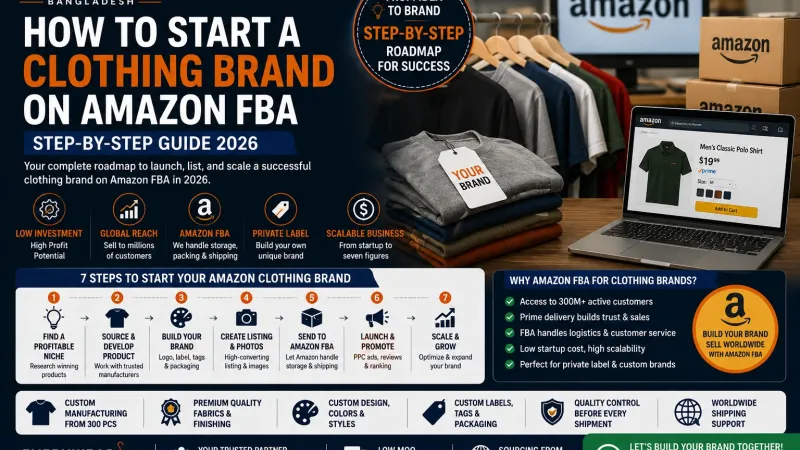
How to Start a Clothing Brand on Amazon FBA – Step-by-Step Guide 2026
Last updated: August 18, 2026 • [Complete Guide for Aspiring Fashion Entrepreneurs & Amazon Sellers]
Amazon's apparel category represents a massive opportunity for entrepreneurs. With the platform capturing 35% of U.S. online apparel sales and clothing items making up nearly 20% of all Amazon sales, starting a clothing brand on Amazon FBA in 2026 is one of the most accessible paths to building a profitable e-commerce business.
Yet for every successful clothing brand on Amazon, dozens fail. The difference comes down to one thing: understanding the complete process before you start. Many aspiring entrepreneurs rush to find a manufacturer without understanding Amazon's fee structure, category requirements, or the unique challenges of selling apparel online.
This step-by-step guide covers everything you need to know: choosing your business model, setting up your Amazon seller account, understanding 2026 FBA fees, selecting profitable products, finding a reliable manufacturer in Bangladesh, creating listings that convert, and managing returns. Whether you're launching your first private label brand or expanding an existing business, this guide will help you navigate the entire journey from idea to your first sale.
Why Amazon FBA for Clothing in 2026
Amazon has become the dominant force in online apparel retail. In 2023 alone, Amazon sold over $56 billion in clothing, footwear, and apparel accessories in the U.S. market. The platform's decision to lift blanket gated restrictions from the apparel category has opened doors for small sellers to launch their own clothing private labels and brands without excessive barriers.
Several factors make 2026 an ideal time to start:
- Massive audience: Amazon has over 300 million active users and billions in daily transaction volume
- Prime advantage: FBA sellers gain Prime eligibility and Buy Box advantage
- Growing fashion share: Amazon now enjoys nearly one-third of the entire online clothing sold in the US
- Third-party seller growth: Amazon fashion category third-party seller share reached nearly 65% in 2024
- Private label opportunity: The apparel category is ideal for private label sellers who can differentiate through branding and quality
The clothing category is one of the most popular on Amazon, with millions of shoppers buying apparel online every month. Small independent sellers are making significant profits from it – and with the right strategy, you can too.
Choosing Your Business Model: Which Path Is Right for You?
Before you source any products, you need to decide how you'll sell on Amazon. Each model has different requirements, costs, and risk levels.
Private Label
You create your own unique clothing brand name, find a factory to manufacture your designs, and sell with your own custom tags and packaging. This is the most profitable model long-term but requires the highest upfront investment in product development, MOQ, and branding.
Best for: Entrepreneurs building a sustainable brand with custom designs. MOQ requirement: Typically 300+ pieces per design.
Wholesale
You buy authentic branded clothes in bulk from established brands at wholesale prices and resell them on Amazon. This requires less product development but faces competition from other sellers offering identical products.
Best for: Sellers with existing brand relationships and lower upfront capital. MOQ requirement: Varies by brand, usually 500+ pieces.
Print on Demand
You design graphics for t-shirts, hoodies, or other items, and a printing partner creates and ships the item only after an order is placed. This is a low-risk way to test clothing designs with zero inventory storage issues.
Best for: Testing product ideas with minimal investment. MOQ requirement: Zero – print on demand.
Retail Arbitrage / Online Arbitrage
You find clearance clothing deals at retail stores or online marketplaces and resell them for a profit on Amazon. This requires the least upfront capital but is difficult to scale and faces Amazon gating restrictions.
Best for: Quick cash flow with minimal investment. MOQ requirement: None – buy what you find.
For most entrepreneurs building a long-term clothing brand, private label is the recommended path. It gives you control over your brand, product quality, and pricing – and it's where Bangladesh manufacturers excel.
Step 1: Set Up Your Amazon Seller Account
To start selling on Amazon, you need to create a seller account. Here's the process:
Choose Your Seller Plan
| Plan | Cost | Best For |
|---|---|---|
| Individual | $0.99 per item sold | Testing the waters, under 40 items/month |
| Professional | $39.99/month | Serious sellers, unlimited items |
For any aspiring seller who is in it for the long game, the professional seller plan is always the better option. There is no sales volume cap – whether you sell 100, 1,000, or 10,000 units a month, you pay the flat subscription fee of $39.99.
Registration Requirements
- Active email address and phone number
- Business details (store address, tax information)
- Active bank account for receiving sales proceeds
- Government-issued ID and recent bank statement
Clothing Category Approval
Amazon has specific requirements for selling in the clothing category. While Amazon lifted the blanket gated restriction, certain subcategories remain gated or require additional approval:
- Gated brands: Famous fashion brands require real invoices from official suppliers
- Certain subcategories: Baby clothes or safety gear must pass extra quality checks
- New seller accounts: Brand-new profiles often need to establish sales history before gaining access to some subcategories
Step 2: Understand Amazon Clothing Fees (2026)
Understanding Amazon's fee structure is critical to pricing your products profitably. Here's the complete breakdown for clothing sellers in 2026.
Amazon Clothing Referral Fee
The referral fee is the most significant ongoing cost for clothing sellers. Amazon charges a 17% referral fee on the total sale price – including the item price, shipping, and any gift-wrapping charges.
| Clothing Subcategory | Referral Fee |
|---|---|
| Apparel (General) | 17% |
| T-Shirts & Tops | 17% |
| Dresses | 17% |
| Pants & Jeans | 17% |
| Activewear | 17% |
FBA Fulfillment Fees (2026)
If you use FBA (Fulfilled by Amazon), you'll pay fulfillment fees per unit. Clothing is typically lightweight, qualifying for lower-tier fees:
| Size Tier | Fulfillment Fee (2026) |
|---|---|
| Standard Size (under 0.5 lb) | $3.22 per unit |
| Standard Size (0.5–1 lb) | $3.77 per unit |
| Standard Size (1–2 lb) | $4.75 per unit |
| Large Standard (up to 1 lb) | $4.10 per unit |
| Large Standard (1–2 lb) | $5.65 per unit |
Note: Apparel categories may pay an additional surcharge (currently $0.40 per unit)
FBA Storage Fees (2026)
| Period | Storage Fee |
|---|---|
| January – September | $0.78 per cubic foot per month |
| October – December (Peak) | $2.40 per cubic foot per month |
Returns Processing Fee (New for 2026)
Starting in 2026, Amazon applies a Returns Processing Fee to categories with historically high return rates – most prominently apparel and footwear. This is a critical consideration for clothing sellers, as apparel has the highest return rate of any category (20-30%).
Total Fee Example
For a $30 t-shirt:
- Referral Fee: $30 × 17% = $5.10
- FBA Fulfillment Fee: ~$3.77 (0.5-1 lb)
- Storage Fee: ~$0.20-0.50 per month (depends on volume)
- Total Amazon Fees: ~$9.00-9.50 per unit
- Effective Fee Rate: ~30-32% of selling price
Always use the FBA revenue calculator before committing to inventory.
Step 3: Choose Your Products – What Sells on Amazon in 2026
Selecting the right products is critical to your success. Here are the top clothing categories and trends for 2026.
Top-Selling Clothing Categories on Amazon in 2026
According to Amazon trends data, the $20-50 price range shows the highest commercial value, with sales share significantly exceeding SKU count share. Key product categories include:
| Category | Trending Products |
|---|---|
| Women's | Boho/cottagecore dresses, vintage jersey tops, wide-leg jeans, plus-size bikinis |
| Men's | Streetwear/Millennium t-shirts, lightweight denim shirts, athletic shorts, cargo pants |
| Niche Categories | Women's nightwear, cotton co-ord sets, kids' clothing, seasonal accessories |
| Activewear | Sweatsuits, workout sets |
Niche-focused fashion consistently outperforms generic apparel.
Clothing Category Challenges to Consider
- High return rates: Apparel return rates are 20-30% – the highest of any category
- Sizing complexity: Sizes and colours add complexity for sellers
- Competition: About 7,200 men's fashion brands are sold on Amazon
- Returns Processing Fee: New for 2026, apparel sellers pay a returns processing fee
What to Look for in a Product Niche
- Niche focus: Choose a specific subcategory rather than "clothing" generally
- Branding potential: Can you differentiate through design, quality, or packaging?
- Size standardization: Products with fewer size variations reduce return risk
- Seasonal vs. evergreen: Basic items sell year-round; seasonal items have concentrated sales periods
- MOQ compatibility: Can you start with 300 pieces and test the market?
Step 4: Find a Reliable Clothing Manufacturer
This is where your product becomes real. Finding the right manufacturing partner is the most critical decision in your clothing brand journey.
Why Bangladesh Is the Ideal Sourcing Destination for Amazon Sellers
Bangladesh has emerged as one of the world's leading apparel manufacturing hubs. Here's why it's the top choice for Amazon clothing sellers:
| Advantage | Benefit for Amazon Sellers |
|---|---|
| Low MOQ | Production from 300 pieces – perfect for testing new products |
| Competitive Pricing | 10-15% lower costs than China and Vietnam |
| Skilled Workforce | 4 million experienced garment workers |
| Export Experience | Exports to 150+ countries, including USA |
| LEED Green Factories | 290+ certified sustainable factories |
| US Cotton Zero-Tariff | Garments with US-origin cotton enter US duty-free |
What to Look for in a Manufacturer
- BGMEA membership: Bangladesh Garment Manufacturers and Exporters Association membership ensures compliance and quality
- Factory certifications: LEED, GOTS, OEKO-TEX, WRAP, BSCI, SEDEX, ISO 9001
- Minimum Order Quantity (MOQ): Can they start with 300 pieces?
- Sample policy: Can you order samples before bulk production?
- Export experience: Have they shipped to the US before?
- Communication: Do they respond promptly and clearly?
Step 5: Understand the Manufacturing Process
Knowing the production timeline helps you plan your Amazon inventory. Here's what to expect:
Manufacturing Timeline Overview
| Stage | Timeline |
|---|---|
| Product Development / Tech Pack | 7-14 days |
| Sample Development | 14-21 days |
| Sample Approval | 3-5 days |
| Bulk Fabric Procurement | 7-14 days |
| Bulk Manufacturing | 25-45 days |
| Quality Inspection | 3-5 days |
| Packaging & Shipping | 5-10 days |
Total lead time: Approximately 60-90 days from order confirmation to delivery at Amazon warehouses. Plan accordingly.
Shipping Options to Amazon Warehouses
| Shipping Method | Transit Time | Best For |
|---|---|---|
| Sea Freight (LCL) | 25-35 days | Larger orders (500+ pieces) |
| Sea Freight (FCL) | 20-30 days | Bulk orders (5,000+ pieces) |
| Air Freight | 8-12 days | Urgent smaller orders |
| Express Courier | 3-5 days | Samples and small shipments |
Step 6: Create Your Amazon Product Listing
Your product listing is your storefront. Here's how to create listings that convert.
Amazon Clothing Listing Requirements
- Title: Include brand, product type, key features, and size
- Images: Main image must be 1000x1000+ pixels with pure white background
- Size chart: Accurate sizing is critical to reducing returns
- Bullet points: Highlight key features – fabric, fit, care instructions
- Description: Detailed product information and brand story
- Keywords: Include relevant search terms for discoverability
Amazon Brand Registry for Clothing Sellers
To sell private label clothing, you need to register with Amazon Brand Registry. Requirements include:
- A valid trademark (registered or pending) issued by an accepted trademark office (e.g., USPTO for US sellers)
- Permanently affixed branding – your brand name must be clearly visible and permanently attached to the product or its packaging
Brand Registry gives you control over your listings, access to A+ Content, and protection against counterfeiters.
Product Images
- High-quality, professional photography is essential for clothing
- Include multiple angles and lifestyle shots
- Show the product on models when possible
- Include close-ups of fabric texture and details
Size Charts
Clear pictures and accurate size charts are the best ways to prevent customer returns. Provide detailed size measurements in inches and centimeters for each size option.
Step 7: Ship Your Inventory to Amazon
Once your products are manufactured, you'll ship them to Amazon warehouses for FBA fulfillment.
Amazon FBA Shipping Requirements
- All apparel must be placed in a polybag to protect from dust
- If products arrive without a polybag, Amazon may polybag them at your cost – or return the inventory
- Each unit must have a scannable barcode (FNSKU)
- Boxes must meet Amazon's weight and dimension requirements
- Proper labeling is required for all shipments
Amazon FBA Prep Services
You can use Amazon's FBA Item Prep (Polybagging) service if you need help
Key FBA Shipping Timeline
- Create your shipment plan in Seller Central
- Print FBA labels and apply to each box
- Ship to the designated Amazon fulfillment center
- Allow 3-5 days for receiving and processing
- Inventory becomes available for sale after processing
For Prime Day 2026, Amazon recommends sellers complete inbound shipments by mid-May to avoid FBA congestion
Step 8: Launch and Grow Your Brand
With products in Amazon warehouses, it's time to launch.
Launch Strategies
- Amazon PPC Advertising: Start with automatic campaigns, then optimize with keyword data
- Early reviews: Use Amazon's Early Reviewer Program or Vine to get initial ratings
- Competitive pricing: Price competitively initially to gain traction
- Listing optimization: Continuously test and improve your listing
Managing Returns
Returns are a reality of selling clothing on Amazon. Apparel return rates are 20-30%, the highest of any category. To manage returns:
- Provide accurate size charts to reduce sizing returns
- Use high-quality product images that accurately represent the product
- Monitor return reasons and address common issues
- Factor return costs into your pricing strategy
Scaling Your Brand
- Expand your product line based on best-seller data
- Consider variations (colors, sizes) of successful products
- Build an email list for off-Amazon marketing
- Consider expanding to other marketplaces (Amazon Canada, Europe)
How Everywear Bangladesh Helps Amazon Sellers Launch Their Clothing Brands
At Everywear Bangladesh, we understand that launching a clothing brand on Amazon FBA requires more than just finding a factory. You need a trusted partner who can guide you through every stage – from product development to shipping to Amazon warehouses. Here's how we help Amazon sellers succeed:
1. Low MOQ from 300 Pieces – Test Your Product Before Scaling
Traditional factories require 1,000-5,000+ pieces per design. Everywear Bangladesh supports low MOQ production starting from 300 pieces per design. This allows you to test your product with Amazon customers before committing to large inventory investments.
Why this matters for Amazon sellers:
- Test product-market fit with minimal risk
- Validate demand before scaling to larger orders
- Manage cash flow more effectively
- Iterate based on customer feedback
2. Private Label Manufacturing – Build Your Brand on Amazon
We help you create a unique brand identity with full private label manufacturing support:
- Custom woven labels – Your brand name and logo
- Printed neck labels – Professional brand presentation
- Hang tags – Branded marketing materials
- Custom poly bags – Professional packaging for Amazon FBA
- Branded cartons – Consistent brand experience
3. Product Development and Tech Pack Support
Not sure how to create a tech pack? Our experienced team can help:
- Tech pack creation – We help you develop professional specifications
- Pattern making – Expert pattern development for perfect fit
- Sample development – Professional samples before bulk production
- Fabric sourcing – Access to Bangladesh's extensive textile mills
4. Quality Control – Ensure Amazon Customer Satisfaction
Quality is critical for Amazon sellers. Poor quality leads to negative reviews and returns. Our quality control process includes:
- Fabric inspection – Before cutting begins
- In-line sewing inspection – Throughout production
- Printing and embroidery verification – Accurate artwork placement
- Final AQL inspection – Comprehensive quality check
- Video-call inspection – Verify your order before shipment
5. US Cotton Zero-Tariff – Save on US Import Duties
Under the Agreement on Reciprocal Trade (ART) signed between the US and Bangladesh in February 2026, garments made with US-origin cotton or man-made fibres enter the US market at a zero reciprocal tariff rate. This can save US Amazon sellers approximately 19% in tariffs.
What this means for you:
- Lower landed costs = better profit margins
- Competitive advantage over sellers sourcing from other countries
- We handle all documentation and compliance
6. Worldwide Shipping to Amazon Warehouses
We coordinate shipping to Amazon fulfillment centers across the USA:
- Sea freight – Most economical for bulk orders
- Air freight – Faster option for urgent restocking
- Courier services – Perfect for samples and small shipments
- Export documentation – Commercial invoices, packing lists, certificates of origin
- Amazon FBA prep – Polybagging and labeling support
7. End-to-End Support – One Accountable Partner
You deal with Everywear directly – not multiple factories or middlemen. We provide:
- Dedicated account manager – Your single point of contact
- Regular production updates – Photos and progress reports
- 24/7 WhatsApp support – For urgent queries
- Transparent pricing – No hidden costs
- Factory visits and virtual tours – Upon request
8. Amazon-Friendly Product Categories
We manufacture products that are proven sellers on Amazon:
- T-Shirts and Oversized T-Shirts
- Hoodies and Sweatshirts
- Polo Shirts
- Blank T-Shirts for Customization
- Etsy-Style Custom Apparel
- Streetwear Collections
Contact Everywear Bangladesh on WhatsApp
Frequently Asked Questions
1. How much does it cost to start a clothing brand on Amazon FBA?
Most new private label sellers launch with $3,000 to $5,000 for inventory, shipping, photography, and initial advertising. This includes: Amazon professional seller account ($39.99/month), product samples ($50-$150 per style), initial inventory (300+ pieces from ~$2-5/piece), shipping to Amazon (~$200-$500), product photography (~$200-$500), and initial PPC advertising ($500-$1,000).
2. What is the Amazon clothing referral fee?
Amazon charges a 17% referral fee on the total sale price of clothing items (including shipping). This applies to all clothing subcategories including T-shirts, dresses, pants, activewear, and outerwear.
3. What are the FBA fulfillment fees for clothing in 2026?
FBA fulfillment fees for standard-size clothing range from $3.22 to $4.75 per unit depending on weight, plus an apparel surcharge of approximately $0.40 per unit. Storage fees are $0.78/cubic foot (Jan-Sep) and $2.40/cubic foot (Oct-Dec).
4. How do I get approved to sell clothing on Amazon?
While Amazon lifted blanket gating on apparel, some subcategories remain restricted. You'll need a professional seller account, valid business information, and potentially invoices and product images for approval. For private label, you'll need to register for Amazon Brand Registry with a trademark.
5. What is the best business model for selling clothing on Amazon?
Private label is the most profitable model for building a long-term clothing brand. You create your own brand, control product quality, and build customer loyalty. Print on Demand is best for testing ideas with minimal risk. Wholesale requires less development but faces more competition.
6. How many clothing items should I order for my first batch?
Start with 300-500 pieces per design to test the market. This allows you to validate demand without excessive inventory risk. Everywear Bangladesh supports MOQ from 300 pieces per design.
7. How long does it take to manufacture clothing in Bangladesh?
Manufacturing typically takes 25-45 days for bulk production, plus 14-21 days for sample development, and 3-5 days for quality inspection. Total lead time from order to Amazon warehouse is approximately 60-90 days.
8. Can I start a clothing brand with a small budget?
Yes. While most private label sellers launch with $3,000-$5,000, you can start with Print on Demand for as little as $500-$1,000. Retail arbitrage can start from as low as $500. However, private label offers the best long-term margins and brand control.
9. What are the best clothing categories to sell on Amazon in 2026?
Trending categories include women's boho/cottagecore dresses, vintage-style tops, wide-leg jeans, plus-size swimwear, men's streetwear t-shirts, lightweight denim shirts, athletic shorts, cargo pants, and niche categories like women's nightwear and children's clothing.
10. What is the return rate for clothing on Amazon?
The return rate for apparel on Amazon is 20-30% – the highest of any category. Returns are the biggest challenge for clothing sellers. Accurate sizing, clear images, and quality products help reduce returns.
11. How do I handle returns as a clothing seller?
Amazon handles returns for FBA sellers. You'll pay a returns processing fee (new for 2026) for returned items. Monitor return reasons, address common issues (e.g., sizing), and factor return costs into your pricing strategy.
12. How do I get reviews for my Amazon clothing brand?
Use Amazon's Early Reviewer Program and Vine to get initial reviews. Follow up with customers through Amazon's "Request a Review" button. Focus on product quality to earn positive reviews organically.
13. What is the size chart requirement for Amazon clothing?
Provide clear, accurate size charts for every product. Include measurements in inches and centimeters for each size option. Clear pictures and accurate size charts are the best ways to prevent customer returns.
14. Why is Bangladesh a good sourcing destination for Amazon clothing brands?
Bangladesh offers low MOQ (from 300 pieces), competitive pricing (10-15% lower than China), a skilled workforce of 4 million workers, export experience to 150+ countries, 290+ LEED-certified green factories, and the US Cotton Clause for zero tariff on US-origin cotton garments.
15. How can Everywear Bangladesh help me start my clothing brand?
Everywear Bangladesh connects Amazon sellers with verified manufacturers offering low MOQ from 300 pieces, private label manufacturing, product development, fabric sourcing, printing and embroidery, quality control, export documentation, and shipping to Amazon warehouses. Contact us on WhatsApp to get started.
Conclusion
Starting a clothing brand on Amazon FBA in 2026 is a significant opportunity, but success requires careful planning, the right manufacturing partner, and a deep understanding of Amazon's fee structure and requirements. By following this step-by-step guide, you'll be prepared to navigate the entire journey from idea to your first sale.
The keys to success: choose a profitable niche, find a reliable manufacturer with low MOQ, understand your costs, create professional listings with accurate sizing, and continuously optimize based on customer feedback.
At Everywear Bangladesh, we help Amazon sellers simplify the manufacturing process with low MOQ from 300 pieces, private label manufacturing, quality control, and worldwide shipping support. Our team is ready to help you turn your clothing brand idea into reality.
Contact Everywear Bangladesh on WhatsApp
About the Author
Written by the Everywear Bangladesh Research & Sourcing Team
The Everywear Bangladesh editorial team combines deep industry expertise in Bangladesh's Ready-Made Garment (RMG) sector with practical experience in international apparel sourcing, supply chain management, and Amazon FBA selling. Our team includes former garment factory managers, sourcing professionals, and e-commerce specialists who have helped hundreds of Amazon sellers launch their clothing brands.
Our mission is to provide accurate, data-driven, and actionable content that helps fashion entrepreneurs, Amazon sellers, and global brands make informed sourcing decisions. We leverage real-time data from Amazon Seller Central, the Bangladesh Garment Manufacturers and Exporters Association (BGMEA), Export Promotion Bureau (EPB), and other authoritative sources to ensure our insights reflect the latest industry developments.
Everywear Bangladesh is committed to promoting responsible, transparent, and sustainable garment manufacturing practices while helping businesses navigate the complexities of international apparel sourcing.
Connect with Everywear Bangladesh:
- Website: everywearbd.com
- WhatsApp: +8801788898174
- Facebook: facebook.com/everywearbd
- LinkedIn: Everywear Bangladesh Ltd
References
- Amazon Seller Central, "2026 FBA Fee Changes and Category Requirements"
- ecomcalctools.com, "Amazon Clothing FBA Fulfillment Fee: Apparel Size Tiers," 2026
- ecomcalctools.com, "Amazon Clothing Referral Fee: Apparel Category Breakdown," 2026
- Zonguru.com, "How to Sell Clothes on Amazon in 2026 — a Comprehensive Guide," January 27, 2026
- Gonukkad.com, "How to Sell Clothes Online on Amazon Successfully," May 29, 2026
- Ecomcalctools.com, "Amazon FBA for Beginners: Everything You Need to Know in 2026"
- Flapen.com, "Clothing, Shoes & Jewelry Niches on Amazon US — $4.1B/yr Tracked (2026)"
- WWD.com, "By the Numbers: Chinese Brands Make Inroads in Menswear Sales on Amazon," April 17, 2026
- Sellerview.ai, "Best-Selling Amazon Categories 2026: Real Profit Margins," June 24, 2026
- Connectbooks.com, "Amazon FBA Fees in 2026: A Seller's Complete Cost Breakdown," June 16, 2026
Related Resources
GEO Landing Pages
- USA Buyers: Wholesale Garments from Bangladesh
- UK Buyers: Wholesale Garments from Bangladesh
- Europe Buyers: Wholesale Clothing from Bangladesh
Blog Posts
- Amazon Fashion Sellers: Source Clothing from Bangladesh
- Private Label T-Shirt Manufacturer Bangladesh – Complete Guide 2026
- Low MOQ Clothing Manufacturer Bangladesh
- Private Label Clothing Manufacturing Bangladesh – Complete Brand Guide 2026
- Clothing Suppliers from Bangladesh: The Ultimate Guide 2026
- Shopify Clothing Manufacturer Bangladesh
This guide is updated regularly. Last reviewed: August 18, 2026. For sourcing solutions tailored to your Amazon brand, contact Everywear Bangladesh on WhatsApp.
Everywear Bangladesh Ltd. – Bangladesh's First RMG Wholesale Marketplace | 300 Pcs Custom Orders | Export Quality Garments
WhatsApp: +8801788898174 • Website: everywearbd.com
Leave a comment