





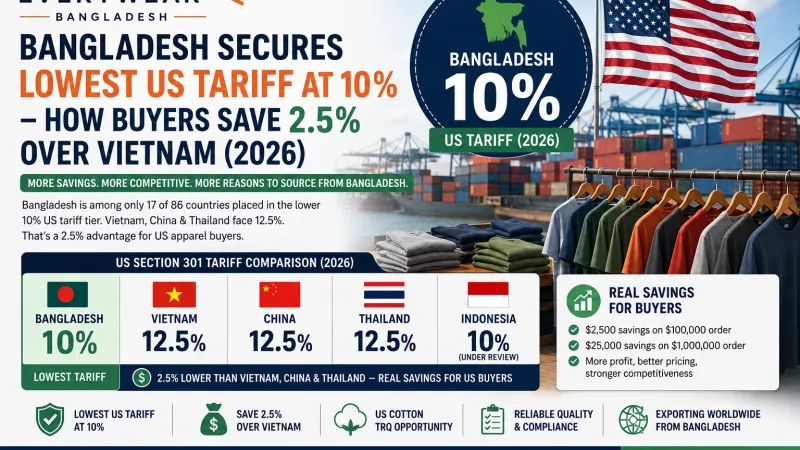
Bangladesh Secures Lowest US Tariff at 10% – How Buyers Save 2.5% Over Vietnam (2026)
Last updated: August 11, 2026 • Complete Guide for US Fashion Brands, Importers & Apparel Buyers
Bangladesh has gained an important cost advantage in the United States apparel sourcing market after the US announced a 10% Section 301 additional tariff rate for Bangladesh on July 23, 2026. Vietnam, by comparison, falls under the 12.5% Section 301 rate. That creates a 2.5 percentage-point tariff advantage for Bangladesh on covered imports, giving US apparel buyers another reason to review their sourcing strategies.
This difference can translate into meaningful savings at scale. On a $100,000 customs value, a 2.5 percentage-point difference represents approximately $2,500 in additional-duty savings. On $1 million of covered imports, the difference is approximately $25,000, before considering the underlying MFN duty, customs classification, freight, insurance, brokerage, or other landed-cost components.
For US fashion brands, wholesalers, retailers, private-label businesses, Amazon sellers, Shopify merchants, and apparel importers, the development changes the sourcing equation. Bangladesh was already one of the world's major apparel manufacturing hubs. A lower Section 301 rate compared with Vietnam and several other competitors adds another financial consideration when buyers evaluate factories, product categories, production capacity, lead times, quality, and total landed cost.
There is another development that makes the situation even more important. The United States is considering a Tariff-Rate Quota (TRQ) mechanism that could provide additional tariff benefits for qualifying Bangladesh garments using specified US-origin inputs. However, buyers should treat this as a developing policy opportunity rather than assume that every Bangladesh garment automatically receives zero tariff.
This guide explains what the 10% Bangladesh tariff rate means, how the Bangladesh vs Vietnam tariff difference affects apparel sourcing, how buyers can calculate potential savings, what the US cotton opportunity means, and how international buyers can build a more competitive Bangladesh sourcing strategy in 2026.
Why Did Bangladesh Receive the 10% US Section 301 Tariff Rate?
The US Trade Representative's July 23, 2026 action followed Section 301 investigations concerning the failure of economies to impose and effectively enforce prohibitions on goods produced with forced labor.
According to the Office of the United States Trade Representative (USTR), economies that had imposed, committed to impose, or maintained qualifying forced-labor import prohibitions were placed in the 10% Section 301 duty tier. Bangladesh was included in that group along with countries such as India, Indonesia, Malaysia, Pakistan, Sri Lanka, the United Kingdom, Canada, Mexico, and others.
Economies that did not meet the applicable criteria were assigned the higher 12.5% Section 301 rate. Vietnam is included in the higher tier.
For Bangladesh's apparel industry, the distinction matters because the country competes directly with Vietnam, China, Indonesia, Cambodia, India, and other major apparel manufacturing destinations for US sourcing programs.
The tariff advantage should therefore be viewed as one component of a larger sourcing decision rather than as the only reason to select a factory.
US buyers still need to evaluate:
- Product quality
- Factory capacity
- Production lead time
- Fabric availability
- Compliance standards
- Factory energy resilience
- Minimum order quantity
- Shipping and logistics
- Customs classification
- Country-of-origin requirements
- Documentation and traceability
- Total landed cost
For buyers already considering Bangladesh clothing manufacturers, the new tariff structure provides an additional economic reason to compare Bangladesh against alternative manufacturing countries.
The US action is also relevant to supply-chain diversification. US brands that have historically concentrated production in China or Vietnam can now evaluate Bangladesh with a different tariff scenario.
That makes the 2026 tariff change especially relevant for companies searching for clothing manufacturer Bangladesh, Bangladesh clothing manufacturers wholesale, clothing suppliers from Bangladesh, and other Bangladesh apparel sourcing options.
Bangladesh vs Vietnam: Understanding the 2.5% Tariff Advantage
Vietnam has become one of the most important competitors to Bangladesh in the global apparel manufacturing industry. Vietnamese factories have strong capabilities in knitwear, woven garments, sportswear, footwear-related supply chains, man-made fibre products, and fast-fashion production.
However, the July 2026 US Section 301 action creates a clear numerical difference between the two sourcing destinations.
| Country | Section 301 Additional Duty | Difference vs Bangladesh | Buyer Implication |
|---|---|---|---|
| Bangladesh | 10% | Baseline | Lower Section 301 rate |
| Vietnam | 12.5% | 2.5 percentage points higher | Higher additional duty exposure |
| China | 12.5% | 2.5 percentage points higher | Higher additional duty exposure |
| Thailand | 12.5% | 2.5 percentage points higher | Higher additional duty exposure |
| Indonesia | 10% tier | Comparable | Different competitive factors apply |
Important: These figures refer to the additional Section 301 duty announced by USTR. They should not be interpreted as the complete customs duty payable on every apparel product. Actual landed cost depends on the applicable HTS classification, ordinary MFN duty, additional trade measures, exemptions, origin rules, and other customs requirements.
For buyers comparing Bangladesh vs Vietnam, however, the 2.5 percentage-point difference is straightforward to understand.
Suppose two comparable orders have a customs value of $100,000:
- Bangladesh at 10% additional duty = approximately $10,000
- Vietnam at 12.5% additional duty = approximately $12,500
- Difference = approximately $2,500
At $1 million in covered import value:
- Bangladesh at 10% = approximately $100,000
- Vietnam at 12.5% = approximately $125,000
- Potential difference = approximately $25,000
This is why the phrase "Bangladesh 10% tariff" is becoming increasingly relevant to US apparel buyers researching sourcing destinations in 2026.
How Much Can US Apparel Buyers Save by Sourcing from Bangladesh?
The answer depends on the customs value of the shipment and the exact tariff treatment of the imported product. A simple comparison of the Section 301 component, however, illustrates the potential impact.
| Customs Value | 10% Bangladesh Rate | 12.5% Vietnam Rate | Potential Difference |
|---|---|---|---|
| $25,000 | $2,500 | $3,125 | $625 |
| $50,000 | $5,000 | $6,250 | $1,250 |
| $100,000 | $10,000 | $12,500 | $2,500 |
| $250,000 | $25,000 | $31,250 | $6,250 |
| $500,000 | $50,000 | $62,500 | $12,500 |
| $1,000,000 | $100,000 | $125,000 | $25,000 |
These calculations illustrate the 2.5 percentage-point difference in the Section 301 component only. Buyers should obtain a product-specific landed-cost calculation before making a sourcing decision.
For a fashion company importing $2 million of covered goods annually, the simple difference could represent approximately $50,000 in additional-duty savings compared with a 12.5% rate.
For a larger importer with $10 million in covered customs value, the mathematical difference reaches approximately $250,000.
That is why tariff analysis should be part of a broader Bangladesh clothing sourcing strategy.
Why the 10% Rate Matters for Bangladesh Clothing Manufacturers
Bangladesh already has a mature Ready-Made Garment manufacturing ecosystem. The country has decades of experience producing knitwear, woven garments, denim, T-shirts, shirts, sweaters, outerwear, uniforms, workwear, sportswear, and other apparel categories.
The new tariff structure can make Bangladesh more attractive when US buyers compare factory quotations from several countries.
Imagine a buyer receiving the following simplified sourcing options:
- Bangladesh factory: competitive FOB price + 10% Section 301 rate
- Vietnam factory: similar FOB price + 12.5% Section 301 rate
- China factory: similar FOB price + 12.5% Section 301 rate
The buyer should not automatically select Bangladesh simply because of the tariff difference. The factory still needs to demonstrate acceptable quality, capacity, compliance, delivery performance, and communication.
But when product quality and manufacturing economics are comparable, the additional-duty difference can become a meaningful deciding factor.
This is especially relevant for businesses searching for:
- Bangladesh clothing manufacturers
- Bangladesh clothing factory wholesale
- Clothing manufacturer Bangladesh
- Bangladesh apparel manufacturers
- Bangladesh garment suppliers
- Wholesale clothing Bangladesh
- Private label clothing manufacturer Bangladesh
- Bangladesh OEM clothing manufacturer
- Clothing suppliers from Bangladesh
- Bangladesh wholesale garments
For small and medium-sized brands, tariff savings can also improve the economics of repeat orders. A brand that saves thousands of dollars across multiple shipments can potentially reinvest part of that difference into product development, marketing, inventory, packaging, or customer acquisition.
The US Cotton and Potential Zero-Tariff Opportunity
One of the most important developments for US buyers is the potential relationship between Bangladesh apparel production and US-origin cotton or other qualifying US-origin inputs.
The US-Bangladesh trade framework has created discussion around a potential Tariff-Rate Quota (TRQ) mechanism. Under the proposed structure described in the source material for this guide, eligible garments using qualifying US-origin cotton or man-made fibres could receive additional tariff treatment under a quota system.
However, this is an area where buyers must be careful.
A potential TRQ benefit is not the same thing as a blanket zero-tariff rule for every Bangladesh garment.
Eligibility can depend on the final legal framework, product classification, quota availability, input requirements, origin documentation, traceability, and other customs conditions.
For buyers interested in this opportunity, the correct approach is to begin preparing the supply chain rather than simply assuming a zero-duty outcome.
A buyer should discuss:
- US-origin cotton requirements
- Approved fibre specifications
- Supplier documentation
- Purchase invoices
- Certificates of origin
- Traceability records
- Production documentation
- Customs documentation
- HTS classification
- Quota eligibility
This is one area where working with an experienced Bangladesh apparel sourcing partner can reduce the risk of documentation mistakes.
What Does the Tariff Advantage Mean for Small and Medium Fashion Brands?
Large multinational brands are not the only businesses that can benefit from a more favorable sourcing environment.
Small and medium-sized fashion brands are increasingly looking for low MOQ clothing manufacturers in Bangladesh because they cannot commit to the massive production quantities required by some traditional factories.
For these businesses, a 2.5 percentage-point Section 301 difference can become meaningful when orders are repeated throughout the year.
Consider a growing online fashion brand that imports four $100,000 shipments annually.
A simplified calculation of the Section 301 difference would be:
- Annual covered import value: $400,000
- Bangladesh additional duty at 10%: $40,000
- Vietnam additional duty at 12.5%: $50,000
- Potential annual difference: $10,000
Again, this is not a complete landed-cost calculation. Freight, ordinary customs duties, brokerage, insurance, port charges, and product-specific tariff classifications must also be considered.
But the example shows why US brands should evaluate tariff rates together with factory pricing.
A sourcing decision should therefore compare:
- FOB price
- Section 301 duty
- Applicable MFN duty
- Freight
- Insurance
- Customs clearance
- Lead time
- MOQ
- Quality control
- Defect rate
- Payment terms
- Production capacity
The cheapest factory quotation is not always the cheapest supply chain.
Bangladesh vs Vietnam: Tariff Is Only One Part of the Sourcing Decision
The 2.5% Section 301 difference is significant, but sophisticated apparel buyers know that sourcing decisions involve much more than tariffs.
Vietnam remains highly competitive in several product categories and benefits from strong logistics, deep-sea port connections, established textile supply chains, and significant man-made fibre capabilities.
Bangladesh, on the other hand, has particularly strong capabilities in large-scale apparel manufacturing, knitwear, woven products, denim, basic garments, cotton apparel, and increasingly sustainable manufacturing.
Therefore, a buyer should compare countries based on the actual product being purchased.
| Factor | Bangladesh | Vietnam |
|---|---|---|
| 2026 Section 301 rate | 10% | 12.5% |
| Large-scale apparel manufacturing | Strong | Strong |
| Cotton apparel | Strong | Strong |
| MMF / technical apparel | Growing | Strong |
| Sustainable manufacturing | Major strength | Strong |
| US market access | Strong and expanding | Very strong |
The right question is therefore not simply, "Is Bangladesh cheaper than Vietnam?"
The better question is:
"Which sourcing country provides the best combination of factory price, tariff exposure, quality, lead time, capacity, compliance and total landed cost for my specific product?"
In 2026, Bangladesh deserves a serious place in that comparison.
How the New US Tariff Rate Changes Supply Chain Diversification
US apparel companies have been diversifying their sourcing strategies for several years. Geopolitical uncertainty, shipping disruptions, changing trade policies, labor costs, manufacturing capacity, and consumer demand have encouraged brands to avoid excessive dependence on a single country.
The 2026 Section 301 structure adds another variable to that decision.
A company sourcing exclusively from Vietnam may now consider moving a portion of suitable products to Bangladesh if the factory economics and production capabilities match its requirements.
Similarly, a company dependent on China may use Bangladesh as part of a China-plus-one or multi-country sourcing strategy.
A diversified sourcing model could include:
- Bangladesh for cotton basics and high-volume apparel
- Vietnam for selected technical and MMF-intensive products
- India for specific textile and apparel categories
- Other countries for regional or specialized production
The goal is not necessarily to replace one country overnight.
The goal is to create a supply chain that gives the buyer greater flexibility.
Bangladesh's 10% Section 301 rate makes that diversification strategy more attractive for US apparel businesses that previously overlooked the country.
What US Buyers Should Check Before Ordering from Bangladesh
A lower tariff rate does not eliminate the need for supplier due diligence.
Before placing a large order with a Bangladesh clothing manufacturer, US buyers should verify the supplier's actual manufacturing capabilities.
1. Confirm Factory Capacity
Ask how many pieces the factory can realistically produce per month and whether your product will compete for capacity with larger customers.
2. Request a Product Sample
Never rely exclusively on photographs. Request physical samples and evaluate fabric, GSM, measurements, stitching, construction, printing, embroidery and finishing.
3. Verify Production Lead Time
Agree on a realistic timeline covering fabric procurement, cutting, sewing, printing, embroidery, washing, finishing, inspection and packing.
4. Check Quality Control
Ask whether the manufacturer performs fabric inspection, inline inspection, measurement checks and final inspection.
5. Confirm Compliance
Depending on your market and customer requirements, request relevant compliance documentation and factory certifications.
6. Confirm Country of Origin
Ensure your customs documentation accurately reflects the actual country of origin and production process.
7. Review Tariff Classification
Work with your customs broker or trade professional to determine the correct HTS classification. Do not assume that a general tariff percentage applies identically to every garment.
8. Verify US-Origin Input Documentation
If you are pursuing a future or existing US-cotton-related tariff preference, confirm exactly what documentation and traceability requirements apply to your shipment.
How Everywear Bangladesh Helps US Buyers Source from Bangladesh
Everywear Bangladesh is built around a simple problem: international buyers often struggle to identify reliable Bangladesh garment manufacturers, compare products, understand production capabilities, and manage the sourcing process from outside Bangladesh.
Our sourcing model is designed to connect international buyers with Bangladesh's apparel manufacturing ecosystem while providing additional sourcing support.
For US buyers evaluating the 2026 tariff advantage, our role can include:
1. Manufacturer Matching
We help buyers identify suitable Bangladesh garment manufacturers based on product type, quantity, fabric, quality requirements and customization needs.
2. Product Development
For customized products, we support fabric sourcing, pattern development, sample development, branding, labels, printing, embroidery and packaging requirements.
3. Low MOQ Manufacturing
Selected product categories can be produced from approximately 300 pieces, making Bangladesh sourcing more accessible to startups, independent fashion brands and growing online businesses.
4. Quality Control
We support quality verification and communication between international buyers and manufacturing partners.
5. Tariff and Documentation Coordination
For US buyers exploring tariff advantages, we can help coordinate the information required from manufacturers. Buyers should still work with their customs broker and qualified trade professionals for final legal and customs determinations.
6. Worldwide Logistics Support
Depending on the order, buyers can use sea freight, air freight or courier services. Documentation can include commercial invoices, packing lists, certificates of origin and other export documents as applicable.
7. Private Label Manufacturing
Brands can develop customized collections with private labels, hang tags, packaging, custom designs and other brand requirements.
How US Buyers Can Maximize the Bangladesh Tariff Advantage
The most effective strategy is not simply to search for the lowest factory price. Buyers should calculate their complete landed cost.
Use this framework:
- Step 1: Determine your exact product specifications.
- Step 2: Request comparable FOB quotations from Bangladesh and Vietnam.
- Step 3: Confirm the applicable HTS classification.
- Step 4: Calculate the applicable MFN and additional tariff components.
- Step 5: Calculate freight, insurance, brokerage and other landed costs.
- Step 6: Compare lead times and inventory carrying costs.
- Step 7: Compare factory quality and compliance.
- Step 8: Evaluate whether US-origin cotton or other qualifying inputs can provide additional benefits under applicable rules.
- Step 9: Request samples before placing bulk production.
- Step 10: Build a repeat-order and quality-control system.
This approach transforms tariff savings from a headline into an actual sourcing strategy.
What the 10% Bangladesh Tariff Means for the Future of US Apparel Sourcing
The 2026 tariff change comes at an important moment for Bangladesh's apparel industry.
The industry is simultaneously dealing with energy costs, production capacity challenges, changing global demand, increasing competition in man-made fibre products, infrastructure constraints and Bangladesh's upcoming LDC graduation.
At the same time, Bangladesh continues to possess major structural strengths.
These include:
- A large and experienced apparel manufacturing workforce
- A mature export-oriented garment ecosystem
- Strong knitwear and woven garment capabilities
- Competitive manufacturing costs
- Growing man-made fibre capabilities
- Large-scale sustainable manufacturing capacity
- International compliance experience
- Established relationships with global apparel buyers
- Strong potential for private-label and OEM production
The tariff advantage does not solve every challenge facing Bangladesh.
It does, however, improve one important part of the equation for US buyers.
As global brands continue searching for alternative sourcing destinations, the combination of manufacturing scale, competitive pricing and a comparatively lower Section 301 rate makes Bangladesh increasingly relevant.
Frequently Asked Questions
1. What is the US tariff on Bangladesh garments in 2026?
Bangladesh is in the 10% Section 301 additional-duty tier announced by the US Trade Representative on July 23, 2026. This is an additional tariff measure and should not be confused with the complete tariff applicable to every individual apparel product. Actual customs treatment depends on product classification and other applicable rules.
2. How does Bangladesh's tariff compare with Vietnam?
Bangladesh's Section 301 rate is 10%, while Vietnam is in the 12.5% tier. The difference is therefore 2.5 percentage points. On $100,000 of covered customs value, that difference equals approximately $2,500 in additional-duty savings.
3. Does Bangladesh now have the lowest total apparel tariff in the US?
Not necessarily. The 10% figure refers specifically to the Section 301 additional duty announced in July 2026. A buyer's total tariff burden can include ordinary MFN duties and other applicable measures depending on the HTS classification and product. Buyers should therefore calculate the complete landed cost rather than compare only one tariff component.
4. How much can a US buyer save by sourcing from Bangladesh instead of Vietnam?
The simple Section 301 difference is 2.5 percentage points. For a $100,000 customs value, the difference is approximately $2,500. For $1 million, it is approximately $25,000. Actual savings depend on the product's customs classification and complete tariff treatment.
5. Can Bangladesh garments receive zero tariff using US cotton?
A proposed or applicable tariff-rate mechanism may provide special treatment for qualifying garments using specified US-origin inputs, but buyers should not assume that every Bangladesh garment qualifies automatically. Eligibility depends on the final legal framework, product requirements, origin rules, documentation, quota conditions and customs procedures.
6. Is Bangladesh still competitive compared with Vietnam?
Yes, particularly for many cotton-based, knitwear, woven and large-scale apparel programs. Vietnam remains highly competitive in several categories, especially products with strong man-made fibre and technical manufacturing capabilities. The correct choice depends on the buyer's product, price, lead time, quality and supply-chain requirements.
7. What types of clothing can I source from Bangladesh?
Bangladesh manufacturers produce T-shirts, oversized T-shirts, polo shirts, shirts, hoodies, sweatshirts, denim, jackets, sportswear, activewear, uniforms, children's apparel, streetwear, workwear and private-label collections. Product capability varies by factory, so buyers should match the product to an appropriate manufacturer.
8. Can small US clothing brands source from Bangladesh?
Yes. Selected Bangladesh manufacturers can support lower MOQ production, including orders starting from approximately 300 pieces for certain product categories. Buyers should confirm MOQ based on the specific product, fabric, construction, printing and customization requirements.
9. Should US buyers move all their Vietnam orders to Bangladesh?
Not necessarily. A better strategy is to compare product categories and build a diversified sourcing portfolio. Bangladesh may be highly competitive for certain products, while Vietnam may remain advantageous for other categories. The 10% versus 12.5% Section 301 difference should be included in the total landed-cost comparison.
10. What should US buyers do now?
US buyers should review their sourcing matrix, compare Bangladesh and Vietnam quotations, verify HTS classifications, calculate complete landed costs, request samples, assess factory capacity, investigate applicable US-origin input opportunities, and establish relationships with reliable Bangladesh garment manufacturers.
Conclusion
Bangladesh's 10% Section 301 tariff rate creates a meaningful new advantage for US apparel buyers in 2026. Compared with Vietnam's 12.5% rate, the difference is 2.5 percentage points, which can translate into approximately $2,500 of additional-duty savings on a $100,000 customs value or approximately $25,000 on $1 million.
The opportunity becomes even more interesting when combined with Bangladesh's established garment manufacturing ecosystem, competitive production costs, growing sustainability capabilities, skilled workforce and expanding range of apparel products.
However, sophisticated buyers should avoid treating the tariff headline as the entire sourcing decision.
The strongest sourcing strategy considers:
- Factory price
- Section 301 tariff exposure
- Applicable MFN duty
- Product classification
- Freight and logistics
- Production lead time
- Quality control
- Factory compliance
- Production capacity
- Country-of-origin documentation
- US-origin cotton opportunities where legally applicable
- Total landed cost
For US fashion brands and importers considering diversification away from China or Vietnam, 2026 is an important year to reassess Bangladesh.
The country is not simply a low-cost garment manufacturing destination. It is a mature apparel production ecosystem with the potential to serve startups, independent fashion brands, wholesalers, retailers and large international buyers.
At Everywear Bangladesh, we help international buyers connect with Bangladesh's apparel manufacturing ecosystem for wholesale, OEM, private-label and customized garment production.
Whether you are looking for clothing suppliers from Bangladesh, a Bangladesh clothing manufacturer, wholesale clothing Bangladesh, private-label manufacturing or a low-MOQ production partner, the 2026 US tariff environment makes Bangladesh worth serious consideration.
The smartest next step is not simply to change suppliers.
It is to compare your complete landed cost, product quality, lead time and supply-chain risk — and see whether Bangladesh can give your business a measurable competitive advantage.
Contact Everywear Bangladesh on WhatsApp
Related Resources
US Buyer Resources
- USA Buyers: Wholesale Garments from Bangladesh
- US Tariff Guide for Bangladesh Garment Imports (2026)
- The US Cotton Clause: How the US-Bangladesh Trade Pact Benefits Your Business
- Bangladesh RMG Exports to US Fall 5.58% – What Buyers Need to Know (2026)
Bangladesh Sourcing Resources
- Clothing Suppliers from Bangladesh: The Ultimate Guide 2026
- Bangladesh Garment Industry Guide 2026
- Custom Garment Manufacturing Bangladesh 2026 Guide for Small Brands
- Low MOQ Clothing Manufacturer Bangladesh
- Private Label Clothing Manufacturing Bangladesh – Complete Brand Guide 2026
- Alibaba Alternative for Clothing Sourcing: Why Buyers Choose Bangladesh (2026)
Bangladesh vs Competitors
- Bangladesh vs Vietnam – The Race for Second Place in Global Apparel Exports (2026)
- Bangladesh vs China vs India Wholesale Clothing 2026
International Buyer GEO Pages
- USA – Buy Wholesale Garments from Bangladesh
- UK – Wholesale Garments from Bangladesh
- Europe – Wholesale Clothing from Bangladesh
- Africa – Wholesale Garments from Bangladesh
About the Author
Written by the Everywear Bangladesh Content & Sourcing Team
The Everywear Bangladesh editorial team combines practical knowledge of Bangladesh's Ready-Made Garment (RMG) sector with experience in international apparel sourcing, wholesale garment manufacturing, private-label production and global supply-chain management.
Our content is designed to help fashion brands, retailers, wholesalers, importers and eCommerce businesses make informed sourcing decisions using industry information, manufacturing knowledge and current trade developments.
Everywear Bangladesh focuses on connecting international buyers with Bangladesh's apparel manufacturing ecosystem while supporting product development, private-label manufacturing, low-MOQ production, quality control, export documentation and worldwide delivery.
Everywear Bangladesh Ltd.
Bangladesh's First RMG Wholesale Marketplace
House No: 165/1, West Agargaon, Shere-Bangla-Nagar, Dhaka
WhatsApp: +8801788898174
Website: everywearbd.com
References
- U.S. Trade Representative (USTR), "USTR Takes Action in Forced Labor Section 301 Investigations," July 23, 2026.
- U.S. Trade Representative (USTR), "Fact Sheet: USTR Section 301 Action in Response to the Failure of 60 Economies to Ban Imports Produced with Forced Labor," July 23, 2026.
- United States International Trade Commission (USITC), Harmonized Tariff Schedule of the United States, 2026 revisions.
- US Office of Textiles and Apparel (OTEXA), US apparel import and textile trade data, 2026.
- Bangladesh Garment Manufacturers and Exporters Association (BGMEA), Bangladesh RMG industry and trade information, 2026.
- Everywear Bangladesh, Bangladesh RMG sourcing and manufacturing research, 2026.
Trade policy disclaimer: Tariff rates, exemptions, quota programs and customs requirements can change. The information in this article is provided for general business and sourcing information and should not be treated as legal, customs, tax or trade-law advice. US importers should verify the applicable HTS classification and current tariff treatment with U.S. Customs and Border Protection, the USITC HTS, USTR notices, and their qualified customs broker or trade counsel before placing an order.
This guide is updated regularly. Last reviewed: August 11, 2026. For sourcing solutions tailored to your brand, contact Everywear Bangladesh on WhatsApp.
Everywear Bangladesh Ltd. – Bangladesh's First RMG Wholesale Marketplace | 300 Pcs Custom Orders | Export Quality Garments
WhatsApp: +8801788898174 • Website: everywearbd.com
Leave a comment