





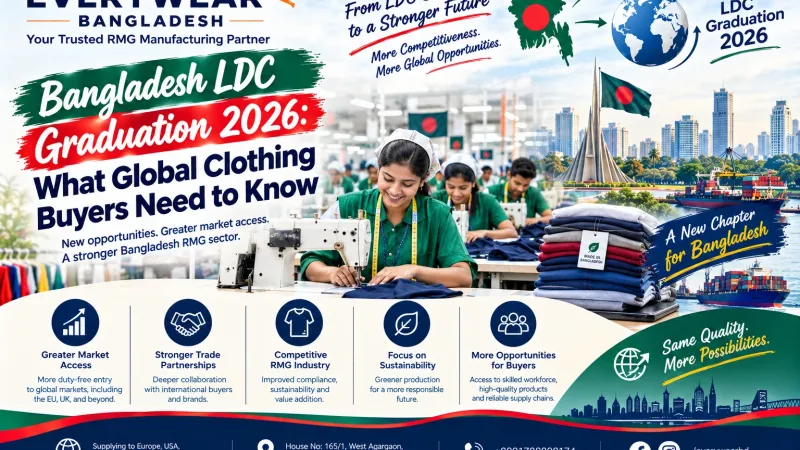
Bangladesh LDC Graduation 2026: What Global Clothing Buyers Need to Know
Last updated: October 3, 2026 • [Complete Guide for EU, UK, US, Canada & Japan Buyers]
Quick Answer: What Happens When Bangladesh Graduates from LDC Status?
Bangladesh officially graduates from the United Nations Least Developed Country (LDC) category on November 24, 2026. This triggers a three-year extended preference window under the EU's Everything But Arms (EBA) programme, meaning duty-free access to the EU continues until late 2029. After 2029, standard GSP tariffs of 9.6% for knitwear and 12.0% for woven garments will apply unless Bangladesh secures GSP+ status. Other markets face different timelines: the UK's Developing Countries Trading Scheme (DCTS) continues duty-free access, Canada's GPT remains in place, and Japan's GSP requires renegotiation. For buyers, the key action is to secure supply chain relationships now, before the tariff landscape shifts. Everywear Bangladesh helps buyers navigate this transition with 300-piece MOQ, US Cotton Zero-Tariff sourcing, DPP/PPWR compliance support, and one accountable partner from sample to shipment.
???? KEY TAKEAWAYS
- November 24, 2026 — Bangladesh officially exits the UN LDC category, triggering a three-year transition period
- EU access continues until late 2029 — EBA-style duty-free access under a confirmed extension
- Post-2029 tariff cliff — Knitwear 9.6%, woven garments 12.0% unless GSP+ is secured
- UK, Canada, Japan, Australia — Different timelines and frameworks apply
- Buyers should act now — Secure supply chain relationships before the tariff shift
- Everywear Bangladesh provides 300-piece MOQ, US Cotton Zero-Tariff sourcing, and full DPP/PPWR compliance support
On November 24, 2026, Bangladesh will officially graduate from the United Nations Least Developed Country (LDC) category — a milestone that marks decades of economic progress but also triggers a fundamental shift in the tariff landscape for global apparel buyers.
For clothing brands, retailers, and importers sourcing from Bangladesh, this is not a future concern — it is happening now. The decisions made in the next 12-18 months will determine whether buyers lock in competitive pricing or face a tariff cliff in 2029.
This comprehensive guide covers: what LDC graduation means, the timeline for each major market, the GSP+ pathway, tariff impacts by destination, and how Everywear Bangladesh helps buyers prepare for the post-graduation landscape.
What Is LDC Graduation and Why Does It Matter?
The United Nations categorizes countries as Least Developed Countries (LDCs) based on three criteria: income per capita, human assets, and economic vulnerability. LDC status provides preferential market access to developed countries, including duty-free and quota-free treatment for most products.
Bangladesh has met the criteria for graduation since 2018 and was scheduled to graduate in 2024. The timeline was extended twice — first to 2026 due to COVID-19, and more recently, a three-year deferment has been discussed to allow Bangladesh more time to prepare.
What changes on graduation day:
- Bangladesh officially becomes a "developing country" in UN terminology
- Automatic LDC-specific trade preferences begin to phase out
- Different markets have different transition periods and frameworks
- Buyers face new tariff structures, rules of origin, and compliance requirements
What does NOT change:
- Bangladesh remains the world's second-largest garment exporter
- Production capacity, quality, and workforce remain unchanged
- Competitive pricing advantages versus Turkey, Europe, and nearshoring remain
- LEED-certified manufacturing and sustainability leadership remain
The Graduation Timeline: What Happens and When
Understanding the timeline is critical for sourcing strategy. Here is the complete schedule:
| Date | Event | Impact on Buyers |
|---|---|---|
| November 24, 2026 | Bangladesh officially graduates from LDC status | Transition period begins; no immediate tariff change |
| 2026-2029 | Three-year extended preference window | EU EBA-style duty-free access continues |
| 2029 | EBA access expires (unless GSP+ secured) | Standard GSP tariffs apply: 9.6% knitwear, 12% woven |
| 2029+ | GSP+ application decision | If approved, duty-free access restored in exchange for 27 convention ratifications |
| 2030-2031 | Medium companies must comply with textile destruction ban | Overproduction risk increases; buyers should align orders with demand |
Source: UN Committee for Development Policy; EU Everything But Arms Programme; LDC Graduation Impact Assessment, 2026
Market-by-Market Tariff Impact for Buyers
Different markets have different transition timelines and frameworks. Here is what buyers need to know for each major destination:
European Union — Three-Year Extension Confirmed
The EU has confirmed a three-year extended preference window after LDC graduation. This means EBA-style duty-free access continues until late 2029. The EU EBA programme has allowed Bangladesh to ship approximately €24 billion of apparel into the EU, with duty savings estimated at €2.6-3.0 billion per year.
Post-2029: Standard GSP tariffs of 9.6% for knitwear and 12.0% for woven garments will apply unless Bangladesh secures GSP+ status.
United Kingdom — DCTS Continues Duty-Free Access
The UK's Developing Countries Trading Scheme (DCTS) provides duty-free access for Bangladesh after LDC graduation. The DCTS was designed specifically to support developing countries through graduation and maintains preferential access.
Canada — GPT Remains in Place
Canada's General Preferential Tariff (GPT) provides duty-free access for most Bangladeshi garments and remains in place after LDC graduation. Canadian importers continue to benefit from zero-duty access.
Japan — GSP Requires Renegotiation
Japan's GSP scheme provides duty-free access for LDCs. After graduation, Bangladesh will need to renegotiate its access under Japan's standard GSP framework, which may have different rules and product coverage.
United States — Separate Trade Deal Framework
The US does not provide LDC-specific duty-free access for apparel. Instead, the US-Bangladesh Agreement on Reciprocal Trade (ART), signed in February 2026, establishes a separate framework:
- Reciprocal tariff reduced to 19% for most goods
- Zero reciprocal tariff for garments made with US-origin cotton or man-made fibres
- Volume mechanism linked to Bangladesh's purchases of US cotton
Australia — ASTP Continues
Australia's Australian System of Tariff Preferences (ASTP) provides duty-free access for most Bangladeshi garments and continues after LDC graduation.
Market-by-Market Summary Table
| Market | Current Access | Post-Graduation Access | Post-2029 Access |
|---|---|---|---|
| EU | 0% (EBA) | 0% (extended to 2029) | 9.6-12% (unless GSP+) |
| UK | 0% (EBA equivalent) | 0% (DCTS) | 0% (DCTS continues) |
| Canada | 0% (LDC/GPT) | 0% (GPT) | 0% (GPT continues) |
| Japan | 0% (LDC GSP) | Requires renegotiation | To be determined |
| US | 19% (ART) | 19% (ART framework) | 19% (ART framework) |
| Australia | 0% (ASTP/LDC) | 0% (ASTP) | 0% (ASTP continues) |
The GSP+ Pathway: What Buyers Need to Know
GSP+ is the single most important factor determining whether Bangladesh maintains duty-free access to the EU after 2029. Global RMG buyers have largely welcomed Bangladesh's efforts to secure GSP+, viewing it as a "game-changing" opportunity for the sector[reference:0].
What Is GSP+?
GSP+ (Generalized Scheme of Preferences Plus) is a special EU trade arrangement that provides duty-free access to the EU market for developing countries that ratify and implement 27 international conventions covering human rights, labour rights, environmental protection, and good governance.
What Bangladesh Must Do to Qualify
- Ratify all 27 conventions — including UN human rights treaties, ILO labour standards, and environmental agreements
- Implement and enforce these conventions in practice
- Accept monitoring by EU institutions
- Meet reporting requirements on progress
Current Status
Bangladesh has signalled intent to apply for GSP+ status. However, the European Commission's existing rules do not currently provide GSP+ facilities for Bangladesh, and revising those rules will be difficult. The BGMEA is hopeful that a free trade agreement with the EU could be signed within three to four years, calling this necessary instead of pursuing GSP+ status[reference:1].
What this means for buyers: The post-2029 tariff landscape is not yet certain. Buyers should prepare for both scenarios — GSP+ approval (0% duty) or standard GSP tariffs (9.6-12%).
Why Smart Buyers Choose Everywear Bangladesh
We help you navigate LDC graduation with confidence.
| What We Offer | Why It Matters for LDC Graduation |
|---|---|
| 300-Piece MOQ | Test new products without risking $30,000+. Validate demand before scaling. Perfect for navigating tariff uncertainty. |
| 700+ Verified Factories | We pre-vet every factory — BGMEA members with valid export licenses. No scams, no surprises. |
| US Cotton Zero-Tariff | Save ~19% on US import duties with US-origin cotton garments. A powerful tariff management tool. |
| Multi-Stage Quality Control | AQL standards + video-call verification before shipment. See your order before it ships. |
| Full Private Label Support | Custom woven labels, hang tags, poly bags, branded cartons — build a real brand. |
| DPP and PPWR Compliance Support | Prepare for EU Digital Product Passport and Packaging Waste Regulation — both mandatory by 2028-2029. |
| Direct Amazon FBA Shipping | We coordinate shipping to Amazon warehouses — with full FBA prep services. |
| One Accountable Partner | One point of contact. One invoice. Complete peace of mind. |
"Everywear made sourcing from Bangladesh simple. The quality was excellent, and I finally had one partner I could trust."
– Sarah K., Brand Owner, USA
Ready to Source with Confidence? WhatsApp Us: +8801788898174
How Everywear Bangladesh Helps You Prepare for LDC Graduation
At Everywear Bangladesh, we've built our business around helping buyers navigate transitions like this.
1. Supply Chain Stability
With 700+ verified factories and one accountable partner, we help you secure supply chain relationships now — before the tariff landscape shifts. Our 300-piece MOQ allows you to test and scale without overcommitting.
2. US Cotton Zero-Tariff Sourcing
For US-bound orders, we source US-origin cotton to qualify for the zero reciprocal tariff — saving approximately 19% on import duties. This is the most powerful tariff management tool available for the US market.
3. EU Compliance Readiness
We provide supply chain traceability, quality control data, and documentation support to help you prepare for the EU Digital Product Passport (DPP) and Packaging and Packaging Waste Regulation (PPWR) — both becoming mandatory in 2028-2029.
4. Full Private Label Support
We help you create a professional, brand-first product with custom woven labels, printed neck labels, hang tags, custom poly bags, and branded cartons.
5. Multi-Stage Quality Control
Every order undergoes pre-production, in-line, and final AQL inspection, plus video-call verification before shipment.
6. Direct Amazon FBA Shipping
We coordinate shipping to Amazon fulfillment centers across the USA, UK, EU, Canada, and Australia — with full FBA prep services.
7. Proactive Communication
We keep you informed about policy developments, tariff changes, and compliance requirements — so you're never caught off guard.
Contact Everywear Bangladesh on WhatsApp
Frequently Asked Questions
Everything buyers need to know about Bangladesh LDC graduation and its impact on apparel sourcing.
1. When does Bangladesh officially graduate from LDC status?
Bangladesh officially graduates from the United Nations Least Developed Country (LDC) category on November 24, 2026. A three-year deferment has been discussed to allow more preparation time.
2. What happens to EU duty-free access after graduation?
The EU has confirmed a three-year extended preference window after LDC graduation. This means EBA-style duty-free access continues until late 2029. After 2029, standard GSP tariffs of 9.6% for knitwear and 12.0% for woven garments will apply unless Bangladesh secures GSP+ status.
3. What is GSP+ and how does it affect apparel buyers?
GSP+ is a special EU trade arrangement that provides duty-free access for developing countries that ratify and implement 27 international conventions. If Bangladesh secures GSP+, duty-free access to the EU is restored after 2029. Buyers should prepare for both scenarios — GSP+ approval (0% duty) or standard GSP tariffs (9.6-12%).
4. What about UK access after LDC graduation?
The UK's Developing Countries Trading Scheme (DCTS) provides duty-free access for Bangladesh after LDC graduation. The DCTS was designed specifically to support developing countries through graduation and maintains preferential access.
5. What about Canada, Japan, and Australia?
Canada — GPT remains in place; duty-free access continues. Japan — GSP requires renegotiation after graduation. Australia — ASTP continues; duty-free access continues.
6. How does LDC graduation affect US sourcing?
The US does not provide LDC-specific duty-free access for apparel. The US-Bangladesh Agreement on Reciprocal Trade (ART) establishes a separate framework: reciprocal tariff reduced to 19% for most goods, with a zero reciprocal tariff for garments made with US-origin cotton or man-made fibres.
7. Should buyers stop sourcing from Bangladesh because of LDC graduation?
No. Bangladesh remains the world's second-largest garment exporter with competitive pricing, large-scale capacity, and 290 LEED-certified factories. The key is to prepare for the transition by securing supply chain relationships and understanding the new tariff landscape.
8. What is the EU DPP and how does it relate to LDC graduation?
The EU Digital Product Passport (DPP) is a mandatory digital record for every garment sold in the EU, introduced under the ESPR. The EU DPP Registration System launched on July 20, 2026, and the textile-specific delegated act is expected by Q2 2027, with mandatory compliance approximately 18 months later. Everywear provides supply chain traceability and documentation support to help buyers prepare.
9. What is PPWR and when does it apply?
The Packaging and Packaging Waste Regulation (PPWR) began applying progressively from August 12, 2026. It introduces binding requirements for packaging design, material use, and waste management. Affected packaging includes hangtags, labels, dust bags, corrugated cartons, and courier bags. Everywear provides PPWR-compliant packaging options.
10. What should buyers do NOW to prepare for LDC graduation?
Buyers should: (1) Secure supply chain relationships now before the tariff landscape shifts, (2) Understand the tariff timeline for each market, (3) Prepare for DPP and PPWR compliance, (4) Monitor GSP+ developments, and (5) Work with a knowledgeable sourcing partner like Everywear Bangladesh.
11. How does Everywear Bangladesh help with LDC graduation preparation?
Everywear provides 700+ verified factories, 300-piece MOQ, US Cotton Zero-Tariff sourcing, multi-stage QC, full private label support, DPP/PPWR compliance support, and one accountable partner — everything you need to navigate the transition successfully.
12. What is the US-Bangladesh trade deal and how does it help buyers?
The Agreement on Reciprocal Trade (ART) signed in February 2026 reduces the US reciprocal tariff to 19% and establishes a mechanism for garments made with US-origin cotton or man-made fibres to enter at a zero reciprocal tariff rate. This saves US buyers approximately 19% on import duties.
13. Will Bangladesh remain competitive after LDC graduation?
Yes. Bangladesh's competitive advantages — labor costs, production capacity, LEED-certified factories, and export infrastructure — remain unchanged. The key differentiator will be how well buyers and suppliers adapt to the new tariff and compliance landscape.
14. What is the three-year deferment of LDC graduation?
A three-year deferment has been discussed to allow Bangladesh more time to prepare for the post-graduation transition. This would send a message to international retailers that local exporters can supply garments at competitive prices for longer[reference:2].
15. How does LDC graduation affect small and mid-sized buyers?
Small and mid-sized buyers are most vulnerable to tariff changes because they have less negotiating power and fewer resources to absorb cost increases. Everywear's 300-piece MOQ and US Cotton Zero-Tariff sourcing help smaller buyers maintain competitive pricing through the transition.
16. What is the EU's textile destruction ban and how does it affect buyers?
From July 19, 2026, large companies in the EU may no longer destroy unsold clothing, accessories, and footwear. Medium companies must comply by 2030. This increases the risk of overproduction and makes accurate demand forecasting more important than ever[reference:3].
17. How does Everywear help with DPP compliance?
Everywear provides supply chain traceability, quality control data, and documentation support to help you prepare for the EU Digital Product Passport. We help you collect and structure the data needed for DPP compliance, including fiber composition, durability test results, and chain-of-custody documentation.
18. What certifications do Everywear factories hold?
Our verified factories hold ISO 9001, BSCI, WRAP, SA8000, OEKO-TEX, and GOTS certifications — covering quality, social compliance, and environmental standards.
19. How do I start sourcing from Bangladesh with Everywear?
Contact Everywear Bangladesh on WhatsApp at +8801788898174. Our team will understand your requirements, connect you with verified manufacturers, coordinate samples, manage production and quality control, and handle shipping — all with one point of contact.
20. What is the single most important action buyers should take now?
Secure your supply chain relationships now. The buyers who act early will be best positioned to navigate the tariff transition, lock in competitive pricing, and maintain supply chain stability through 2029 and beyond.
Conclusion: The Time to Prepare Is Now
Bangladesh's LDC graduation on November 24, 2026 is not a crisis — it's a transition. The country remains the world's second-largest garment exporter with competitive pricing, large-scale capacity, and world-leading sustainable manufacturing.
But the tariff landscape is shifting, and buyers who prepare now will be best positioned to maintain competitive pricing and supply chain stability.
What buyers should do:
- Understand the timeline for each market — EU until 2029, UK/Canada continues, Japan requires renegotiation
- Monitor GSP+ developments — the single most important factor for post-2029 EU access
- Prepare for DPP and PPWR compliance — both mandatory by 2028-2029
- Secure supply chain relationships now — before the tariff landscape shifts
- Work with a knowledgeable sourcing partner — like Everywear Bangladesh
At Everywear Bangladesh, we help buyers navigate this transition with 300-piece MOQ, US Cotton Zero-Tariff sourcing, multi-stage QC, full private label support, DPP/PPWR compliance support, and one accountable partner from sample to shipment.
Contact Everywear Bangladesh on WhatsApp
About the Author
Written by the Everywear Bangladesh Research & Sourcing Team
The Everywear Bangladesh editorial team combines deep industry expertise in Bangladesh's Ready-Made Garment (RMG) sector with practical experience in international apparel sourcing, supply chain management, and Amazon FBA selling. Our team includes former garment factory managers, sourcing professionals, and e-commerce specialists who have helped hundreds of sellers launch their clothing brands.
Our mission is to provide accurate, data-driven, and actionable content that helps fashion entrepreneurs, Amazon sellers, and global brands make informed sourcing decisions.
Connect with Everywear Bangladesh:
- Website: everywearbd.com
- WhatsApp: +8801788898174
- Facebook: facebook.com/everywearbd
- LinkedIn: Everywear Bangladesh Ltd
Related Resources
GEO Landing Pages
- USA Buyers: Wholesale Garments from Bangladesh
- UK Buyers: Wholesale Garments from Bangladesh
- Europe Buyers: Wholesale Clothing from Bangladesh
- Africa Buyers: Wholesale Garments from Bangladesh
- Canada Buyers: Wholesale Garments from Bangladesh
- Australia Buyers: Wholesale Garments from Bangladesh
- Middle East Buyers: Wholesale Garments from Bangladesh
- Latin America Buyers: Wholesale Garments from Bangladesh
- Germany Buyers: Wholesale Garments from Bangladesh
- France Buyers: Wholesale Garments from Bangladesh
- Netherlands Buyers: Wholesale Garments from Bangladesh
Blog Posts
- EU Digital Product Passport for Garments – Complete Compliance Guide 2026
- Bangladesh Raises Garment Value-Addition Requirement – Buyers Guide 2026
- US Cotton Clause – US-Bangladesh Trade Pact Benefits 2026
- Bangladesh vs Vietnam – The Race for Second Place in Global Apparel Exports
- Bangladesh RMG Exports Surge 5.12% – Buyers Guide 2026
References
- United Nations Committee for Development Policy, "LDC Graduation Criteria and Timeline," 2026
- European Commission, "Everything But Arms (EBA) Programme – Transition Arrangements," 2026
- UK Government, "Developing Countries Trading Scheme (DCTS)," 2026
- Canada Border Services Agency, "General Preferential Tariff (GPT)," 2026
- Japan Customs, "Generalized System of Preferences (GSP)," 2026
- US Government, "Joint Statement by the United States and Bangladesh on Reaching an Agreement on Reciprocal Trade," February 9, 2026
- The Financial Express, "RMG buyers eye GSP Plus as next growth driver," February 17, 2026
- The Daily Star, "Some RMG buyers shifting work orders for strategic reasons," September 18, 2026
- Deluair, "Bangladesh LDC graduation 2026: GSP loss arithmetic across EU, UK, Canada, Japan," April 26, 2026
- EU Transition Pathways, "PassportLab pledges to provide ESPR-compliant DPP infrastructure for EU textile importers and SMEs," April 30, 2026
- Verisav, "DPP Timeline 2026–2030: every Digital Product Passport deadline by category," July 12, 2026
- BGMEA, "Bangladesh RMG Industry Overview 2026"
This guide is updated regularly. Last reviewed: October 3, 2026. For sourcing solutions tailored to your brand, contact Everywear Bangladesh on WhatsApp.
Everywear Bangladesh Ltd. – Bangladesh's First RMG Wholesale Marketplace | 300 Pcs Custom Orders | Export Quality Garments
WhatsApp: +8801788898174 • Website: everywearbd.com
Leave a comment