





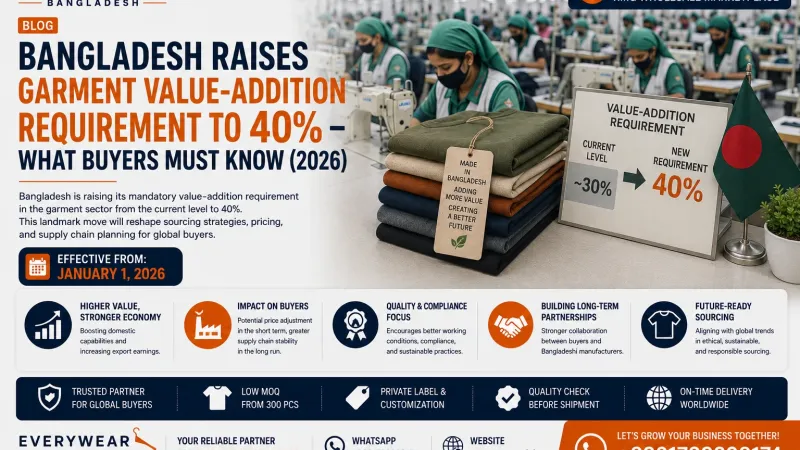
Bangladesh Raises Garment Value-Addition Requirement to 40% – What Buyers Must Know (2026)
Last updated: September 1, 2026 • [Complete Guide for International Apparel Buyers & Sourcing Professionals]
Quick Answer: What Is Bangladesh's New 40% Value-Addition Requirement?
On August 26, 2026, the Bangladesh government raised the value-addition requirement for garment exports to as high as 40% under the Import Policy Order 2026-2029. This means that for every dollar of fabric or raw material imported, manufacturers must now add more value through local processing to qualify for export benefits. The policy differentiates between standard Letter of Credit (LC) and Focus of Concern (FoC) systems, with higher thresholds for FoC imports. For woven and knitwear with FOB above $60 per dozen, the requirement is 40% for FoC and 30% for regular LC. Children's wear requires 30% (FoC) or 15% (LC), while underwear and synthetic garments need 40% (FoC) or 20% (LC). For buyers, this means potential cost increases, tighter supplier selection, and a need to work with vertically integrated manufacturers who can meet these higher thresholds. The policy is designed to reduce reliance on imported raw materials and accelerate Bangladesh's shift toward value-added manufacturing.
On August 26, 2026, the Bangladesh government raised the value-addition requirement for garment exports to as high as 40% under the Import Policy Order 2026-2029. This policy change, published via a Statutory Regulatory Order (SRO), mandates that for every dollar of fabric or raw material imported, manufacturers must now add more value through local processing to qualify for export benefits.
The new requirement is a significant escalation from previous standards. Under the back-to-back Letter of Credit (LC) system, the value-addition requirement was previously set at a reduced 10%. The new policy introduces a tiered structure based on product category, FOB value, and the type of import mechanism used.
For international buyers, this policy change represents a critical development that could affect pricing, supplier selection, and supply chain strategy. This comprehensive guide explains what the new policy means, how it affects different product categories, and what buyers need to do to navigate this change effectively.
What Is the New Value-Addition Requirement?
The Import Policy Order 2026-2029 introduces a tiered value-addition requirement based on product category, FOB value, and import mechanism. The new requirements apply to imports under both standard Letter of Credit (LC) and Focus of Concern (FoC) systems.
Value-Addition Requirements by Product Category
| Product Category | FoC Requirement | LC Requirement | Conditions |
|---|---|---|---|
| Woven & Knitwear | 40% | 30% | FOB above $60 per dozen |
| Children's Wear | 30% | 15% | Reduced rates for children's apparel |
| Underwear & Synthetic | 40% | 20% | MMF garments face higher thresholds |
| Home Textiles | 40% | 20% | Higher requirement for home textiles |
Understanding the Two Import Systems
1. Letter of Credit (LC) System
The standard LC system allows manufacturers to import raw materials and components under a lower value-addition requirement. This is the traditional import mechanism used by most garment manufacturers.
2. Focus of Concern (FoC) System
The FoC system refers to imports that are closely monitored by customs authorities. Under this system, manufacturers face higher value-addition requirements to qualify for export benefits. The FoC system is typically used for imports that may raise concerns about duty evasion or misdeclaration.
According to the Ministry of Commerce, the new policy aims to encourage local value addition and reduce reliance on imported raw materials, particularly in the textile and apparel sector.
Industry Consultation and Stakeholder Input
Before finalizing the policy, the Ministry of Commerce consulted with industry stakeholders, including:
- BGMEA (Bangladesh Garment Manufacturers and Exporters Association)
- BKMEA (Bangladesh Knitwear Manufacturers and Exporters Association)
- BTMA (Bangladesh Textile Mills Association)
Industry bodies agreed on a target of 30% value addition as a reasonable benchmark. However, the government set the final requirement at 40% for some categories, pushing manufacturers to increase local value addition significantly.
Industry leaders have expressed concerns that the 40% requirement may be too high, particularly for MMF-based garments, where local backward linkage remains limited. However, the government views this as a necessary step to accelerate the industry's transition toward value-added manufacturing.
To learn more about Bangladesh's textile and apparel industry, read our Bangladesh Garment Industry Guide 2026.
What This Means for International Buyers
The new value-addition requirement has several implications for international buyers sourcing from Bangladesh.
1. Potential Cost Increases
Manufacturers will need to invest more in local processing to meet the 40% threshold. This could lead to:
- Higher production costs – manufacturers will need to source more locally
- Increased FOB prices – costs will be passed on to buyers
- Limited price negotiation – manufacturers with lower value addition may not qualify
2. Supplier Selection Becomes Critical
Not all manufacturers will be able to meet the 40% requirement. Buyers should prioritize suppliers with:
- Vertical integration – own fabric mills, dyeing facilities, and finishing units
- Strong backward linkage – local sourcing of yarn, fabric, and accessories
- Higher value-addition capacity – ability to process raw materials locally
For a detailed guide on finding reliable suppliers, visit our Clothing Suppliers from Bangladesh: The Ultimate Guide 2026.
3. Impact on MMF Garments
MMF-based garments face particularly high thresholds (40% for FoC, 20% for LC). This could affect buyers sourcing:
- Activewear – often MMF-based
- Sportswear – requires synthetic fabrics
- Performance apparel – relies on imported MMF materials
4. Compliance and Documentation
Buyers may need to request additional documentation to ensure compliance:
- Value-addition certificates – proof that local processing meets the threshold
- Raw material sourcing documents – to verify local content
- Customs clearance documentation – to avoid delays at the port
For US buyers, understanding the US Cotton Clause and US Tariff Guide can help you navigate customs and tariff considerations.
Why Bangladesh Introduced This Policy
The policy change is part of Bangladesh's broader strategy to shift from volume-driven to value-driven growth.
1. Reduce Reliance on Imported Raw Materials
Bangladesh currently imports a significant portion of its raw materials, particularly fabrics and yarns. By raising the value-addition requirement, the government aims to encourage local textile and manufacturing capacity.
2. Support the $100 Billion Export Target
Bangladesh has set an ambitious target of reaching $100 billion in garment exports by 2030. Achieving this target requires moving beyond low-cost manufacturing to higher-value products.
3. Prepare for Post-LDC Graduation
After LDC graduation, Bangladesh will lose duty-free access to the EU market unless a new FTA is signed. Higher value addition will help Bangladesh compete on product quality and complexity rather than just price.
For EU buyers, understanding Bangladesh's EU export trends and premium fashion sourcing opportunities is essential for long-term planning.
4. Boost Local Textile Industry
The policy is designed to stimulate investment in local textile mills, spinning units, dyeing facilities, and finishing plants. This would reduce reliance on imported fabrics and strengthen the domestic supply chain.
For buyers interested in sustainable sourcing, explore our guides on Sustainable Clothing Manufacturing and Jute and Wool Sustainable Fabric Revolution.
How Everywear Bangladesh Helps Buyers Navigate This Policy Change
At Everywear Bangladesh, we understand that navigating policy changes requires expertise and local knowledge. Here's how we help international buyers adapt to the new value-addition requirement:
1. Supplier Verification
We connect you with manufacturers that meet the new value-addition requirements:
- Vertical integration – factories with own fabric mills and processing units
- Strong backward linkage – local sourcing of yarn, fabric, and accessories
- Compliance-ready – ability to provide value-addition documentation
2. Cost Analysis
We help you understand how the new policy affects your landed costs:
- Cost impact assessment – calculate potential price increases
- Supplier comparison – identify manufacturers with the best value-addition capacity
- Alternative sourcing options – explore other suppliers or product categories
3. Compliance Support
We ensure your orders meet the new regulatory requirements:
- Documentation assistance – help with value-addition certificates
- Customs clearance support – ensure smooth customs processing
- Regulatory updates – keep you informed of policy changes
4. Low MOQ from 300 Pieces
With the new value-addition requirement potentially increasing costs for small orders, our low MOQ from 300 pieces helps you test the market before committing to larger volumes:
- Test new suppliers with reduced risk
- Validate demand before scaling up
- Manage cash flow effectively
Learn more about our Low MOQ Clothing Manufacturing and Private Label Manufacturing services.
5. End-to-End Support
You deal with Everywear directly – not multiple factories or middlemen. We provide:
- Dedicated account manager – Your single point of contact
- Regular production updates – Photos and progress reports
- 24/7 WhatsApp support – For urgent queries
- Transparent pricing – No hidden costs
Contact Everywear Bangladesh on WhatsApp
Frequently Asked Questions
Everything you need to know about Bangladesh's new 40% value-addition requirement and its impact on sourcing.
1. What is the new value-addition requirement in Bangladesh?
On August 26, 2026, Bangladesh raised the value-addition requirement for garment exports to as high as 40% under the Import Policy Order 2026-2029. The requirement varies by product category: woven and knitwear with FOB above $60 per dozen require 40% (FoC) or 30% (LC), children's wear requires 30% (FoC) or 15% (LC), while underwear, synthetic garments, and home textiles require 40% (FoC) or 20% (LC).
2. When did this policy take effect?
The policy was announced on August 26, 2026 under the Import Policy Order 2026-2029. It is effective immediately, and manufacturers must comply with the new requirements for all shipments moving forward.
3. What is the difference between LC and FoC systems?
LC (Letter of Credit) is the standard import mechanism used by most manufacturers. FoC (Focus of Concern) refers to imports that are closely monitored by customs authorities. The FoC system requires higher value-addition (40% in many categories) compared to the LC system (30% or 20%).
4. How does this affect woven and knitwear products?
For woven and knitwear with FOB above $60 per dozen, the requirement is 40% for FoC imports and 30% for LC imports. This is the highest threshold among all product categories and may affect buyers sourcing higher-value garments.
5. What about children's wear?
Children's wear faces lower requirements: 30% for FoC imports and 15% for LC imports. This recognizes the specific characteristics of children's apparel production.
6. How does the policy affect MMF-based garments?
Underwear, synthetic garments, and home textiles require 40% for FoC imports and 20% for LC imports. This is particularly challenging for MMF-based products, as Bangladesh has limited local backward linkage for synthetic yarns and fabrics.
7. Will this increase the cost of garments from Bangladesh?
Potentially yes. Manufacturers will need to invest more in local processing to meet the 40% threshold, which could increase production costs and ultimately lead to higher FOB prices. Buyers should work with vertically integrated suppliers who can meet the requirements with minimal cost impact.
8. Why did Bangladesh introduce this policy?
The policy aims to reduce reliance on imported raw materials and encourage local value addition. It supports Bangladesh's $100 billion export target, prepares the industry for post-LDC graduation, and stimulates investment in local textile mills, spinning units, dyeing facilities, and finishing plants.
9. What kind of manufacturers can meet the 40% requirement?
Manufacturers with vertical integration (own fabric mills, dyeing facilities, finishing units), strong backward linkage (local sourcing of yarn, fabric, and accessories), and higher value-addition capacity will be best positioned to meet the 40% requirement. Everywear Bangladesh connects buyers with such manufacturers.
10. Will the policy affect MMF garment manufacturers more?
Yes. MMF-based garments face 40% for FoC imports, which is particularly challenging as Bangladesh has limited local backward linkage for synthetic yarns and fabrics. Manufacturers of activewear, sportswear, and performance apparel may find it harder to meet the threshold.
11. How can buyers ensure their suppliers comply with the new requirement?
Buyers should request value-addition certificates from suppliers, ask for raw material sourcing documents to verify local content, and work with sourcing partners like Everywear Bangladesh who can verify compliance on their behalf.
12. Does this policy apply to all garment exports?
Yes. The policy applies to all garment exports under the Import Policy Order 2026-2029. However, the specific value-addition requirement varies by product category and import mechanism (LC vs FoC).
13. What is the industry's response to the policy?
Industry bodies (BGMEA, BKMEA, BTMA) agreed on a target of 30% value addition as a reasonable benchmark. However, the government set the final requirement at 40% for some categories. Industry leaders have expressed concerns that the 40% requirement may be too high, particularly for MMF-based garments.
14. How can Everywear Bangladesh help me navigate this policy change?
Everywear Bangladesh offers supplier verification to connect you with compliant manufacturers, cost analysis to understand landed cost impacts, compliance support for documentation and customs, low MOQ from 300 pieces to test new suppliers, and end-to-end support with one accountable partner.
15. What should buyers do now?
Buyers should: (1) Communicate with suppliers to understand their value-addition capacity, (2) Request documentation to verify compliance, (3) Review pricing to assess cost impacts, (4) Consider vertical integration in supplier selection, and (5) Work with sourcing partners like Everywear Bangladesh who can verify compliance.
Conclusion
Bangladesh's decision to raise the value-addition requirement to 40% represents a significant policy shift that will reshape the country's apparel sourcing landscape. Effective immediately under the Import Policy Order 2026-2029, the new requirements vary by product category, with woven and knitwear facing the highest threshold of 40% for FoC imports.
For international buyers, this means:
- Potential cost increases as manufacturers invest more in local processing
- Tighter supplier selection – only vertically integrated manufacturers can meet the 40% threshold
- Greater focus on compliance – documentation of value addition will become critical
- MMF challenges – synthetic garment manufacturers face particularly high thresholds
However, the policy also presents an opportunity to work with more resilient, value-added manufacturing partners. Buyers who adapt quickly and work with compliant suppliers will be better positioned to maintain supply chain stability.
At Everywear Bangladesh, we help buyers navigate this policy change with supplier verification, cost analysis, compliance support, and end-to-end sourcing solutions. Our team is ready to help you adapt to Bangladesh's evolving regulatory landscape.
Contact Everywear Bangladesh on WhatsApp
About the Author
Written by the Everywear Bangladesh Research & Sourcing Team
The Everywear Bangladesh editorial team combines deep industry expertise in Bangladesh's Ready-Made Garment (RMG) sector with practical experience in international apparel sourcing, supply chain management, and global trade analysis. Our team includes former garment factory managers, sourcing professionals, and trade analysts who have worked with fashion brands across the United States, Europe, and Asia.
Our mission is to provide accurate, data-driven, and actionable content that helps fashion entrepreneurs, retailers, wholesalers, importers, and global brands make informed sourcing decisions. We leverage real-time data from the Bangladesh Garment Manufacturers and Exporters Association (BGMEA), Export Promotion Bureau (EPB), Ministry of Commerce, and other authoritative sources to ensure our insights reflect the latest industry developments.
Connect with Everywear Bangladesh:
- Website: everywearbd.com
- WhatsApp: +8801788898174
- Facebook: facebook.com/everywearbd
- LinkedIn: Everywear Bangladesh Ltd
References
- Ministry of Commerce, Bangladesh, "Import Policy Order 2026-2029," August 26, 2026
- Bangladesh Garment Manufacturers and Exporters Association (BGMEA), "Value Addition Requirements for RMG Exports," August 2026
- Bangladesh Knitwear Manufacturers and Exporters Association (BKMEA), "Industry Response to Import Policy Changes," August 2026
- Bangladesh Textile Mills Association (BTMA), "Backward Linkage and Value Addition Analysis," August 2026
- Export Promotion Bureau (EPB), "Bangladesh RMG Export Data FY2025-26," 2026
- The Financial Express, "Govt raises value-addition requirement to 40% for garment export," August 26, 2026
Related Resources
GEO Landing Pages
- USA Buyers: Wholesale Garments from Bangladesh
- UK Buyers: Wholesale Garments from Bangladesh
- Europe Buyers: Wholesale Clothing from Bangladesh
- Africa Buyers: Wholesale Garments from Bangladesh
Blog Posts
- Beyond Basics: Premium & Sustainable Fashion Sourcing from Bangladesh
- Private Label Clothing Manufacturing Bangladesh – Complete Brand Guide 2026
- Low MOQ Clothing Manufacturer Bangladesh
- Clothing Suppliers from Bangladesh: The Ultimate Guide 2026
- Bangladesh Garment Industry Guide 2026
- US Tariff Guide for Bangladesh Garment Imports (2026)
- The US Cotton Clause: How the US-Bangladesh Trade Pact Benefits Your Business
This guide is updated regularly. Last reviewed: September 1, 2026. For sourcing solutions tailored to your brand, contact Everywear Bangladesh on WhatsApp.
Everywear Bangladesh Ltd. – Bangladesh's First RMG Wholesale Marketplace | 300 Pcs Custom Orders | Export Quality Garments
WhatsApp: +8801788898174 • Website: everywearbd.com