





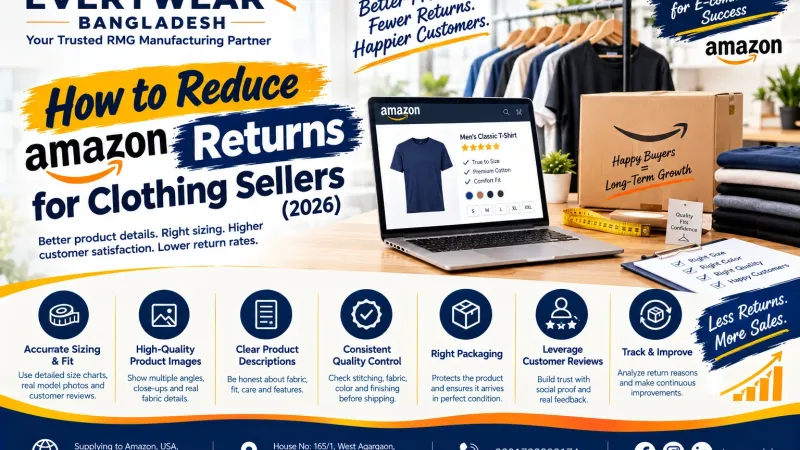
How to Reduce Amazon Returns for Clothing Sellers (2026)
Last updated: October 10, 2026 • [Complete Guide for Amazon FBA Clothing Sellers & Private Label Brands]
Quick Answer: How Can Clothing Sellers Reduce Amazon Returns in 2026?
Amazon clothing return rates average 15-30%, with some categories reaching 40% or higher[reference:0]. The three biggest drivers are sizing confusion, inaccurate listings, and quality defects. To reduce returns, clothing sellers should: (1) Invest in accurate size charts with real measurements in both inches and centimetres[reference:1]; (2) Use detailed product descriptions including fabric composition, fit type, and model measurements[reference:2]; (3) Show accurate images from multiple angles, with fit and scale clearly visible[reference:3]; (4) Leverage the FIT Insights Tool and Size Chart Self-serve Tool in Seller Central[reference:4]; (5) Add sizing information directly in bullet points, not just the description[reference:5]; and (6) Improve manufacturing quality through rigorous QC and verified factory partnerships. Amazon charges a returns processing fee on every returned apparel unit, with no threshold[reference:6]. The Frequently Returned Item badge can reduce conversions by 25-50% and is only removed when your return rate aligns with category averages[reference:7]. Everywear Bangladesh helps clothing sellers reduce returns at the source with 300-piece MOQ, multi-stage QC, size chart support, and verified factory partnerships.
KEY TAKEAWAYS
- Amazon apparel return rates average 15-30%, with some women's categories reaching 40%+ and activewear skirts hitting 65% in extreme cases[reference:8]
- Sizing confusion is the #1 driver of apparel returns — accurate size charts and fit guidance are the highest-leverage fixes[reference:9]
- Amazon charges a returns processing fee on every returned apparel unit — with no threshold and no exemptions[reference:10]
- The Frequently Returned Item badge can cut conversions by 25-50% and is only removed when return rates align with category averages[reference:11]
- Returns cost $15-$20 per unit in total losses (processing fee + lost inventory + shipping + review impact)[reference:12]
- Everywear Bangladesh provides 300-piece MOQ, multi-stage QC, size chart support, and verified factory partnerships to help sellers reduce returns at the source
Returns are the silent killer of Amazon clothing businesses. They drain margins, damage rankings, trigger fee penalties, and erode customer trust. Yet most sellers don't measure return rate with the same urgency as CTR, CVR, or ACOS — and that's a costly mistake[reference:13].
In 2026, the stakes are higher than ever. Amazon now charges a returns processing fee on every returned apparel unit, with no threshold[reference:14]. The Frequently Returned Item badge appears on listings with above-average return rates, cutting conversions by 25-50%[reference:15]. And with return rates for apparel averaging 15-30% — and reaching 40%+ in some categories — the financial impact is enormous[reference:16].
This comprehensive guide covers: the real cost of returns, why customers return clothing, proven strategies to reduce returns, how to avoid the Frequently Returned badge, and how Everywear Bangladesh helps clothing sellers address returns at the manufacturing source.
The Real Cost of Returns: More Than Just a Refund
Returns are one of the most underestimated costs in Amazon selling. The true cost extends far beyond the refund amount — it compounds across multiple areas of your business.
Direct Costs Per Return
| Cost Component | Typical Cost | Notes |
|---|---|---|
| Returns Processing Fee | $2-$5+ per unit | Charged on every returned apparel unit, no threshold[reference:17] |
| Lost Product Cost | Full unit cost | Most returned apparel cannot be resold as "new" |
| Inbound Shipping | Already paid | You paid to ship to FBA; that cost is not recovered |
| Prep & Labeling | $0.50-$2.00 per unit | Polybagging, FNSKU labeling, etc. |
| Total Direct Cost | $15-$20 per return | For a $25 product[reference:18] |
Indirect Costs: The Hidden Damage
- Negative Reviews: Returning customers may leave negative reviews, reducing conversion rate and future sales[reference:19]
- Account Health Warnings: High return rates can trigger Amazon account health warnings and listing suppression[reference:20]
- BSR and Ad Performance Erosion: Above penalty thresholds, returns become a ranking issue, not just a margin issue[reference:21]
- Operational Overhead: Someone needs to monitor return reasons, investigate trends, and implement fixes[reference:22]
- Frequently Returned Badge: Can cut conversions by 25-50% and is only removed when return rates align with category averages[reference:23]
Real-World Example: The $24,000 Annual Return Cost
At a 10% return rate on 1,000 monthly units of a $25 product, you're losing $1,500-$2,000 per month in direct return costs alone. Over a year, that's $18,000-$24,000 — more than enough to fund a significant product improvement or launch a new product[reference:24].
Why Customers Return Clothing: The Top Reasons
Understanding why customers return clothing is the foundation of any reduction strategy. The data reveals clear patterns.
Top Return Reasons for Apparel
| Return Reason | % of Returns | Fixability |
|---|---|---|
| Wrong size or fit | 40-50% | HIGH — size charts, fit guidance, model measurements[reference:25] |
| Not as described | 20-25% | HIGH — accurate images, honest descriptions[reference:26] |
| Defective or poor quality | 15-20% | MEDIUM — upstream QC, supplier audits[reference:27] |
| Damaged in shipping | 5-10% | MEDIUM — packaging improvements[reference:28] |
| Changed mind | 5-10% | LOW — difficult to prevent |
Source: Jarvio, "How to Reduce Your Amazon Return Rate in 2026"; Amazon Seller Central论坛; Velocity Sellers audit data
Why "Sizing Confusion" Is the #1 Driver
Sizing confusion isn't just about the size chart — it's about the entire fit communication system on your listing. Amazon's own data shows that fit-related returns (items being too small or too large) account for a significant portion of apparel returns[reference:29].
The real drivers of size-related returns are:
- Image sequencing: The lead image doesn't communicate fit or scale[reference:30]
- Fit language: "Slim fit" or "relaxed fit" without context is meaningless to buyers
- Model diversity: Showing the garment on only one body type doesn't help buyers visualize it on themselves[reference:31]
- Size chart visibility: Burying the size chart in the gallery makes it easy to miss[reference:32]
- No comparison guidance: "If you normally wear a Medium in regular fit, we recommend Small in this oversized style"[reference:33]
Amazon's Return Policies in 2026: What Sellers Must Know
Returns Processing Fee for Apparel
Amazon's returns processing fee structure changed significantly. For apparel and shoes, Amazon charges a returns processing fee on every returned unit — with no threshold and no exemptions[reference:34]. The fee is equal to 50% of the fulfillment fee for that product[reference:35].
Example: If your FBA fulfillment fee is $4.20, the returns processing fee is $2.10 per returned unit. At 100 returns per month, that's $210 in fees alone — before accounting for lost inventory, shipping, and prep costs.
The Frequently Returned Item Badge
Amazon introduced the Frequently Returned Item badge in February 2026. The badge appears on product detail pages where the customer-initiated return rate is higher than similar products within the same category[reference:36]. Amazon uses recent sales data, your product's return rate, and average return rates for similar items to determine eligibility[reference:37].
Impact: The badge can reduce conversions by 25-50%. It is only removed when your return rate decreases to align with similar products in your category[reference:38].
High-Value Return Policy Changes
As of January 2026, Amazon removed the safeguard that previously flagged high-value returns for review before issuing a refund. High-value apparel and shoes are now treated the same as lower-priced items — refunds can be issued before you receive the item back, and you lose the opportunity to inspect and dispute[reference:39].
Proven Strategies to Reduce Amazon Clothing Returns
Strategy 1: Build an Accurate, Visible Size Chart
This is the single highest-leverage fix for reducing apparel returns. Amazon's own Seller Central guidance states: "Sizing confusion is the #1 driver of apparel returns"[reference:40].
What to do:
- Use actual measurements in both inches and centimetres — not generic S/M/L labels[reference:41]
- Make the size chart prominent — ideally as one of the first few product images, not buried later in the gallery[reference:42]
- Add sizing information directly in bullet points — e.g., "Runs small — consider ordering one size up" or "True to size based on standard US measurements"[reference:43]
- Use the Size Chart Self-serve Tool in Seller Central to create and manage your size charts[reference:44]
- Include model measurements: "Model is 5'10" and wears a size Medium"
- Show the garment on multiple body types in lifestyle images[reference:45]
Strategy 2: Optimize Your Product Listing for Fit Clarity
Your listing is your first line of defence against returns[reference:46]. Better listings reduce "not as described" returns by 20-40%[reference:47].
What to do:
- Use high-quality images from multiple angles showing the actual product — not stock photos[reference:48]
- Show fit and scale clearly — include photos that demonstrate how the garment drapes, stretches, and moves[reference:49]
- Write detailed bullet points about materials and durability — fabric composition, GSM, care instructions[reference:50]
- Highlight any limitations or restrictions — don't hide them[reference:51]
- Include lifestyle photos that demonstrate intended use — gym, office, casual, etc.[reference:52]
- Use the FIT Insights Tool — Amazon's free tool analyzes return data, size charts, and buyer reviews to identify fit issues and provide optimization recommendations[reference:53]
Strategy 3: Improve Manufacturing Quality
Quality defects account for 15-20% of apparel returns. This is where upstream fixes — better QC, supplier audits, and pre-shipment inspection — make the biggest difference[reference:54].
What to do:
- Implement multi-stage QC: pre-production inspection, in-line inspection, and final AQL inspection
- Conduct pre-shipment inspection of a sample from every production batch[reference:55]
- Work only with verified, compliant factories — check BGMEA membership and export licenses
- Use video-call verification before shipment — see your products before they ship
- Address shrinkage, color fading, and stitching issues before bulk production
Strategy 4: Use Packaging to Deter Wear-and-Return
Some customers buy clothing, wear it, and then return it. This is a significant but manageable problem.
What to do:
- Use retail-standard, tamper-proof packaging with tags that need cutting off — this deters returns of worn items[reference:56]
- Add tamper-evident packaging or unique tags that make it obvious when an item has been worn and returned[reference:57]
- Keep detailed photos of items before shipping as evidence[reference:58]
- Apply restocking fees on returns that come back in a condition that does not match what was originally shipped[reference:59]
- Use the Guided Refund Workflow to assess returned contents and claim restocking fees within the first 4 days[reference:60]
Strategy 5: Monitor and Act on Return Data
You cannot fix what you don't measure. Amazon provides several tools to track return performance.
What to do:
- Check ASIN-level data regularly in Seller Central — go to Reports > Return Reports to identify which products have the highest return rates and why[reference:61]
- Review Voice of the Customer dashboard for return dissatisfaction rate (RDR) — Amazon's policy requires sellers to maintain an RDR under 10%[reference:62]
- Track return rate against category benchmarks — apparel averages 15-30%, but you should aim below your specific category average[reference:63]
- Investigate return spikes immediately — they often indicate a production issue or listing problem
Why Smart Sellers Choose Everywear Bangladesh to Reduce Returns at the Source
We help you address the root causes of returns — before your products ship.
| What We Offer | How It Reduces Returns |
|---|---|
| Multi-Stage Quality Control | Pre-production, in-line, and final AQL inspection catches defects before shipment — reducing quality-related returns (15-20% of all returns)[reference:64]. |
| Video-Call Verification | You see your products before they ship. Verify measurements, stitching, and finish — the details that prevent "not as described" returns. |
| Size Chart Support | We provide accurate, detailed measurements in both inches and centimetres for every garment — the foundation of effective size charts[reference:65]. |
| 300-Piece MOQ | Test new products with minimal risk. If return rates are high, you can pivot quickly without losing $30,000+ in unsold inventory. |
| Verified Factory Network | 700+ BGMEA-registered factories with valid export licenses. No scams, no surprises — just consistent quality. |
| Custom Packaging Support | Tamper-evident packaging and retail-standard presentation help deter wear-and-return. |
| US Cotton Zero-Tariff | Save ~19% on US import duties — offsetting the cost of returns processing fees. |
| Direct Amazon FBA Shipping | We coordinate shipping to Amazon warehouses with full FBA prep — reducing damage-related returns from poor packaging. |
"Everywear made sourcing from Bangladesh simple. The quality was excellent, and I finally had one partner I could trust."
– Sarah K., Brand Owner, USA
How Everywear Bangladesh Helps You Reduce Returns
At Everywear Bangladesh, we've built our business around helping Amazon clothing sellers succeed. Reducing returns starts with better manufacturing and better listing preparation.
1. Quality Control That Prevents Defects
Every order undergoes multi-stage QC: pre-production inspection, in-line sewing inspection, final AQL inspection, and video-call verification before shipment. This directly addresses the 15-20% of returns caused by quality defects.
2. Size Chart and Measurement Support
We provide accurate measurements for every garment — chest, waist, hip, length, sleeve — in both inches and centimetres. This gives you the data you need to build effective size charts that reduce sizing-related returns.
3. Manufacturing Consistency
Our verified factories use standardised patterns and measurements, ensuring consistency across production runs. Inconsistent sizing is a major driver of returns — we help you avoid it.
4. Packaging That Deters Wear-and-Return
We offer retail-standard, tamper-proof packaging with custom tags and labels. This helps deter customers who buy, wear, and return items.
5. Direct Amazon FBA Shipping
We coordinate shipping to Amazon warehouses with full FBA prep services — polybagging, FNSKU labeling, and cartonization. Proper packaging reduces damage-related returns.
6. Low MOQ for Testing
Our 300-piece MOQ lets you test new products without overcommitting capital. If return rates are high, you can pivot quickly and test alternative designs.
7. One Accountable Partner
You deal with Everywear directly — not multiple factories. One point of contact, one quality standard, one invoice. If something goes wrong, we fix it.
Contact Everywear Bangladesh on WhatsApp
Frequently Asked Questions
Everything Amazon clothing sellers need to know about reducing returns and protecting margins.
1. What is the average return rate for clothing on Amazon?
Amazon apparel return rates average 15-30%, with some women's categories reaching 40%+ and activewear skirts hitting 65% in extreme cases[reference:66]. The median return rate for apparel and footwear is approximately 14.2%, with a "healthy" floor below 10% and a penalty threshold above 18%[reference:67].
2. How much does each return cost me?
Each return costs approximately $15-$20 in total losses for a $25 product — including returns processing fee ($2-$5+), lost product cost, inbound shipping, and prep/labeling costs[reference:68]. This does not include indirect costs like negative reviews, account health warnings, or BSR erosion.
3. What is the Amazon returns processing fee for apparel?
For apparel and shoes, Amazon charges a returns processing fee on every returned unit — with no threshold and no exemptions. The fee is equal to 50% of the fulfillment fee for that product[reference:69][reference:70].
4. What is the Frequently Returned Item badge and how do I remove it?
The Frequently Returned Item badge appears on listings with above-average return rates. It can reduce conversions by 25-50%. The badge is automatically removed when your return rate decreases to align with similar products in your category[reference:71]. Focus on the strategies in this guide to reduce your return rate.
5. What is the #1 cause of clothing returns on Amazon?
Sizing confusion is the #1 driver of apparel returns, accounting for 40-50% of all returns[reference:72]. Fit-related returns (items being too small or too large) are the single largest category of preventable returns.
6. How can I improve my size chart to reduce returns?
Provide actual measurements in both inches and centimetres, make the size chart prominent in your image gallery, add sizing information directly in bullet points, include model measurements, and show the garment on multiple body types[reference:73][reference:74].
7. What is the FIT Insights Tool?
The FIT Insights Tool is a free Amazon Seller Central tool that analyzes return data, size charts, and buyer reviews to identify fit issues and provide optimization recommendations[reference:75]. It helps you understand exactly why customers are returning your products and what to fix.
8. How can I prevent customers from wearing and returning items?
Use retail-standard, tamper-proof packaging with tags that need cutting off[reference:76]. Add tamper-evident packaging or unique tags that make it obvious when an item has been worn[reference:77]. Keep detailed photos of items before shipping as evidence[reference:78]. Apply restocking fees on returns that don't match what was shipped[reference:79].
9. What is the Return Dissatisfaction Rate (RDR)?
The Return Dissatisfaction Rate (RDR) measures customer satisfaction with the return experience (not the rate itself). Amazon's policy requires sellers to maintain an RDR under 10%[reference:80].
10. How can Everywear Bangladesh help reduce my return rate?
Everywear provides multi-stage QC (reducing quality defects), size chart support (accurate measurements), tamper-proof packaging (deterring wear-and-return), 300-piece MOQ (testing without risk), and direct Amazon FBA shipping (reducing damage). We address the root causes of returns at the manufacturing source.
11. What is a good return rate for clothing on Amazon?
Aim for below your category average. For apparel, the median is 14.2%, with a "healthy" floor below 10%. The penalty threshold — where returns start affecting BSR and ad performance — is above 18%[reference:81].
12. Can I reduce returns by improving product quality?
Yes. Quality defects account for 15-20% of apparel returns. Pre-shipment inspection of a sample from every production batch, better QC processes, and supplier audits directly reduce quality-related returns[reference:82].
13. What is the high-value return policy change in 2026?
As of January 2026, Amazon removed the safeguard that previously flagged high-value returns for review before issuing a refund. High-value apparel and shoes are now treated the same as lower-priced items — refunds can be issued before you receive the item back[reference:83].
14. How do I track my return rate by ASIN?
Go to Reports > Return Reports in Seller Central to identify which products have the highest return rates and why[reference:84]. Also check the Voice of the Customer dashboard for return dissatisfaction rate and the FBA Customer Returns report for detailed return reasons.
15. What packaging changes can reduce returns?
Use retail-standard, tamper-proof packaging with tags that need cutting off. This deters wear-and-return and makes it obvious when an item has been used[reference:85]. Also, ensure packaging is strong enough to protect the product during Amazon's fulfilment process[reference:86].
16. How does Everywear's quality control reduce returns?
Everywear implements a multi-stage QC process: fabric inspection before cutting, in-line sewing inspection, final AQL inspection, and video-call verification before shipment. This catches defects before your products leave the factory, directly reducing quality-related returns.
17. Can I test a product with low MOQ before committing to a large order?
Yes. Everywear offers 300-piece MOQ for custom manufacturing. This lets you test a new product, monitor return rates, and validate demand before scaling — without risking $30,000+ on inventory that might not sell.
18. What should I do if my return rate spikes suddenly?
Investigate immediately. Sudden return rate spikes often indicate a production defect, a listing error, or a packaging failure. Check the FBA Customer Returns report for return reasons, review recent reviews, and inspect a sample from your latest production batch.
19. How do I get started with Everywear Bangladesh?
Contact Everywear on WhatsApp at +8801788898174. Our team will understand your requirements, help you select fabrics and styles, coordinate samples, manage production and quality control, and handle shipping — all with one point of contact.
20. What is the single most impactful thing I can do to reduce returns?
Invest in an accurate, visible size chart. Sizing confusion is the #1 driver of apparel returns. Combining a detailed size chart with sizing information in your bullet points and multiple model images addresses 40-50% of all returns.
Conclusion: Reduce Returns, Protect Margins, Build a Sustainable Brand
Returns are not inevitable. They are a measurable, fixable problem — and the sellers who address them systematically gain a significant competitive advantage.
The highest-leverage actions:
- Build an accurate, visible size chart — sizing confusion is the #1 driver of returns[reference:87]
- Optimize your listing for fit clarity — images, descriptions, and bullet points that set accurate expectations
- Improve manufacturing quality — pre-shipment inspection, supplier audits, and multi-stage QC
- Use tamper-proof packaging — deter wear-and-return
- Monitor ASIN-level return data — track, investigate, and act
At Everywear Bangladesh, we help clothing sellers reduce returns at the source. With 300-piece MOQ, multi-stage QC, size chart support, verified factory partnerships, and direct Amazon FBA shipping, we address the root causes of returns — quality defects, sizing inconsistencies, and packaging failures — before your products reach Amazon.
Contact Everywear Bangladesh on WhatsApp
About the Author
Written by the Everywear Bangladesh Research & Sourcing Team
The Everywear Bangladesh editorial team combines deep industry expertise in Bangladesh's Ready-Made Garment (RMG) sector with practical experience in international apparel sourcing, supply chain management, and Amazon FBA selling. Our team includes former garment factory managers, sourcing professionals, and e-commerce specialists who have helped hundreds of sellers launch their clothing brands.
Our mission is to provide accurate, data-driven, and actionable content that helps fashion entrepreneurs, Amazon sellers, and global brands make informed sourcing decisions.
Connect with Everywear Bangladesh:
- Website: everywearbd.com
- WhatsApp: +8801788898174
- Facebook: facebook.com/everywearbd
- LinkedIn: Everywear Bangladesh Ltd
Related Resources
GEO Landing Pages
- USA Buyers: Wholesale Garments from Bangladesh
- UK Buyers: Wholesale Garments from Bangladesh
- Europe Buyers: Wholesale Clothing from Bangladesh
- Africa Buyers: Wholesale Garments from Bangladesh
- Canada Buyers: Wholesale Garments from Bangladesh
- Australia Buyers: Wholesale Garments from Bangladesh
- Middle East Buyers: Wholesale Garments from Bangladesh
- Latin America Buyers: Wholesale Garments from Bangladesh
- Germany Buyers: Wholesale Garments from Bangladesh
- France Buyers: Wholesale Garments from Bangladesh
- Netherlands Buyers: Wholesale Garments from Bangladesh
Blog Posts
- Amazon FBA Returns Processing Fee – How Clothing Sellers Can Protect Their Margins (2026)
- Bangladesh Garment QC Checklist for Buyers – Complete Quality Control Guide 2026
- How to Order Your First Sample from a Bangladesh Manufacturer – Complete Guide 2026
- How to Avoid Scams When Sourcing from Bangladesh – Complete Safety Guide 2026
- Low MOQ Clothing Manufacturer Bangladesh – The Complete Guide
References
- Velocity Sellers, "Amazon Return Rate Data Deep-Dive 2026," May 24, 2026
- Jarvio, "How to Reduce Your Amazon Return Rate in 2026," January 13, 2026
- Amazon Seller Central, "Returns Processing Fee – 2026 Rate Card," 2026
- Feedvisor, "Amazon FBA Returns Processing Fees: The Complete 2026 Guide," February 19, 2026
- Amazon Seller Central Forums, "Suggested Short-Term Return Rate for Apparel," May 30, 2026
- Amazon Seller Central Forums, "FRI Badge Threshold Not Updated After Category Correction," June 2, 2026
- Ordoro, "Amazon High-Value Return Policy 2026: What Sellers Should Know," January 15, 2026
- Canopy Management, "Why Better Size Charts Won't Fix Your Amazon Clothing Return Rate," July 28, 2026
- Amazon Seller Central, "Image & Detail Page Success Guide," November 26, 2025
- Amazon Seller Central, "FBA Returns Management: Best Practices for 2026," January 9, 2026
This guide is updated regularly. Last reviewed: October 10, 2026. For sourcing solutions tailored to your brand, contact Everywear Bangladesh on WhatsApp.
Everywear Bangladesh Ltd. – Bangladesh's First RMG Wholesale Marketplace | 300 Pcs Custom Orders | Export Quality Garments
WhatsApp: +8801788898174 • Website: everywearbd.com
Leave a comment