





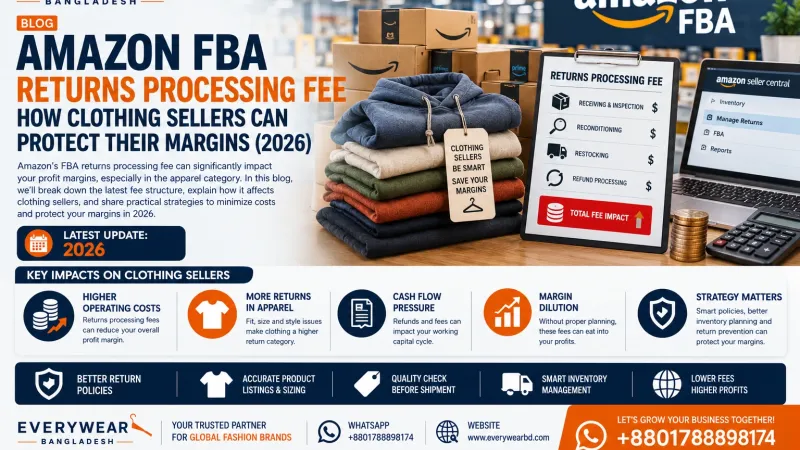
Amazon FBA Returns Processing Fee – How Clothing Sellers Can Protect Their Margins (2026)
Last updated: September 2, 2026 • [Complete Guide for Amazon FBA Clothing Sellers & Fashion Brands]
Quick Answer: What Is Amazon's Returns Processing Fee and How Does It Affect Clothing Sellers?
As of January 15, 2026, Amazon expanded its returns processing fee to nearly every category. But apparel and footwear are uniquely exposed: these categories carry a 0% threshold, meaning every single returned unit is charged the full FBA fulfillment fee, with no free band of returns. For a clothing seller with a $6.50 FBA fulfillment fee and a 25% return rate across 400 monthly units, that's 100 returns and $650 per month in return processing fees alone – before counting the cost of the refund, lost inventory, or ad spend. Combined with the "Frequently Returned Item" badge (which can cut conversions 25-50% with no appeal), returns have become a compounding margin and ranking liability. The good news is that high return rates in fashion are usually addressable – the root cause is almost always a content problem, not a product problem. This guide explains how the fee works, how much it really costs, and a step-by-step system to protect your margins.
For most of Amazon's history, a return was a soft cost. You ate the shipping, you maybe tossed the unit, you moved on. It hurt, but it lived in the fuzzy part of the profit and loss statement you never quite reconciled. In 2026, that changed dramatically.
Returns are now a hard, itemized fee that shows up on your statement – and a public badge that can cut your conversion rate in half. Nowhere is this sharper than in apparel and footwear. These are the highest-return categories on Amazon – clothing commonly runs 20-40% and shoes 17-30% – and they are the categories Amazon singled out for the harshest version of its new returns processing fee.
For clothing sellers, this changes the math on every SKU. Most sellers have not re-run their numbers since the fee took effect. This guide explains exactly how the returns processing fee works, how much it really costs, and a concrete system to protect your margins – including return-reason triage, listing fixes, reimbursement recovery, and a per-SKU keep/fix/cut model.
What Actually Changed in 2026
Amazon introduced the returns processing fee in mid-2024, but only for a limited set of categories and only on units returned above a category-specific threshold. Apparel sellers felt it first. Then, on January 15, 2026, Amazon expanded the fee to apply across nearly the entire catalog as part of its broader fee overhaul. The era of "returns are free until they are a problem" is over for almost everyone.
Two details make apparel and footwear uniquely exposed:
1. 0% Threshold
These categories carry a 0% threshold – there is no free band of returns, so every single returned unit is charged. A homewares seller with a 6% return rate might pay the fee on only the units above their threshold; an apparel seller pays on all of them. And because apparel's natural return rate is the highest on the platform, the per-unit fee gets multiplied by the largest return volume of any category.
2. The Double Hit
In 2026, a single apparel return costs you twice. Once as the returns processing fee (charged on every return, no threshold), and again as a contribution to the return rate that can trigger the "Frequently Returned Item" badge – which then suppresses the sales that were diluting that rate. Fee and badge feed each other.
Amazon's Seller Central help page confirms this directly: "For clothing and footwear, Amazon will charge a return processing fee for each item returned by the buyer. We will not set any threshold."
Other 2026 Changes That Hit Clothing Sellers
The returns fee did not arrive in isolation. Two other major changes took effect in January 2026 that compound the cost pressure on clothing sellers:
1. Amazon Stopped Doing Your FBA Prep (January 1, 2026)
As of January 1, 2026, Amazon discontinued its in-house prep service in the US. Bagging, bubble-wrapping, barcode application, opaque coverings, bundling – all of it is now your responsibility before inventory ever reaches a fulfillment center. Non-compliant shipments can be refused, returned, or disposed of without reimbursement.
2. Fulfillment Fee Increases
On January 15, 2026, Amazon implemented its annual fulfillment and referral fee update. The Large Bulky tier split into Small Bulky and Large Bulky, the Low-Price FBA discount rose to $0.86, and fulfillment fees increased by an average of $0.08 per unit.
The net effect for most private-label sellers is a small per-unit fee increase plus a new prep cost line – but SKUs near breakeven are the ones that need to be modeled now.
The Real Cost of One Return: What Your FBA Calculator Doesn't Show
Most sellers think a return costs them the refund. It does not. A return triggers a cascade of costs that most Amazon FBA calculators ignore entirely.
Consider a standard $42 apparel item sold on Amazon:
| Cost Component | What Actually Happens |
|---|---|
| Full Customer Refund | $42.00 – Amazon credits the buyer in full |
| Refund Admin Fee | Amazon keeps the lesser of $5 or 20% of referral fee. On $42 at 15%: $1.26 |
| Return Processing Fee (Apparel) | Full FBA fulfillment fee charged on every return. $4.80 on standard-size. No threshold. |
| Ad Spend Already Burned | $5.04 at 12% TACoS on a $42 sale. Non-refundable regardless of return. |
| Repackaging (Sellable Return) | $1-3 per unit to reprocess at FBA or prep centre |
| Inventory Write-Off (Unsellable Return) | Full COGS lost – $12 if item cannot be resold |
Total Cost of One Return:
- Sellable return, apparel: ~$11-17 direct costs + $5.04 ad spend = $16-22 per return
- Unsellable return, apparel: ~$23-34 total losses per unit
Your Amazon FBA calculator showed $8.50 profit per unit. A single unsellable return wipes out 2.7-4 clean profitable sales.
At a 20% return rate across 300 monthly units – that's 60 returns – you are looking at $960 to $2,040 in monthly return-driven losses your FBA calculator never flagged.
And at a $6.50 FBA fulfillment fee, a 25% return rate across 400 monthly units means 100 returns – and $650 per month in return processing fees alone on top of every other cost. No exemptions, no threshold to stay under.
The "Frequently Returned Item" Badge – A 25-50% Conversion Killer
On February 16, 2026, Amazon expanded the "Frequently Returned" badge – a warning label that appears on product detail pages for items with high return rates.
The badge can cut conversions by 25-50% with no appeal. Once triggered, it becomes a compounding margin and ranking liability.
This is the double hit in action. The returns processing fee costs you money on every return. Those returns then contribute to a higher return rate. That higher return rate triggers the Frequently Returned badge. The badge suppresses sales. Fewer sales mean fewer units to dilute the return rate. The cycle compounds.
For clothing sellers, this is particularly dangerous because apparel return rates are naturally higher. If your return rate crosses the category threshold – even for one month – the badge appears, and you lose 25-50% of your conversion rate with no way to appeal.
Why Apparel Has the Highest Return Rates
Selling apparel and footwear on Amazon has always come with higher return rates than most other categories. Sizing variability, color accuracy, and fit expectations are difficult to communicate through a product page, and customers frequently buy multiple sizes or styles with the intent to return what does not work.
For years, Amazon's fulfillment model absorbed the cost of processing those returns without passing it back to sellers above the standard restocking fee. That changed in 2026.
Common reasons for high return rates in fashion:
- Sizing runs small or large – customers order the wrong size
- Color looks different from photos – inaccurate product representation
- Quality is lower than the listing implies – customer expectations not met
- Fit differs from what images suggest – poor visual communication
Each of these has a fixable listing cause. The good news is that high return rates in fashion are usually addressable. The root cause is almost always a content problem, not a product problem, and fixing the content typically delivers both fee savings and conversion rate improvement at the same time.
The 2026 Returns-Fee Margin Defense Playbook
This is the concrete system to defend your margin – return-reason triage, listing fixes, reimbursement recovery, and a per-SKU keep/fix/cut model.
Step 1: Audit Your Return Rates by ASIN
Aggregate category return rates mask what is happening at the individual product level. A return rate of 28% across your catalog might include a hero SKU at 15% and a problem SKU at 55%.
The fee impact concentrates on the high-return SKUs, and those are also the products where addressing the root cause has the highest payback.
Action:
- Go to Seller Central → FBA Returns → Return Rate Dashboard
- Export your return data by ASIN
- Sort by return rate (highest to lowest)
- Identify the SKUs with return rates above 15-20%
- Calculate the fee impact for each SKU
Amazon's return analytics in Seller Central, combined with the Voice of the Customer tool, tell you why customers are returning each ASIN. This data should be the starting point for any Amazon returns management effort.
Step 2: Fix Sizing Content – The Highest-Leverage Fix
Sizing content is the highest-leverage fix for most apparel returns. Detailed size charts, not just standard S/M/L/XL mappings but actual measurements in inches and centimeters, reduce return rates measurably.
What to do:
- Add detailed size charts – Include actual measurements in inches and centimeters for each size
- Include model measurements – In product descriptions, include height, weight, and size worn to give shoppers a reference point
- Add fit callouts – In bullet points, include phrases like "runs small," "true to size," or "designed for an athletic build" to set accurate expectations before purchase
- Use comparison sizing – "This shirt fits like a standard US medium"
According to industry data, detailed size charts and model measurements can reduce return rates by 10-15% – a significant impact on your bottom line.
Step 3: Improve Product Images
Image quality is critical for return reduction in fashion because so many returns come from customers receiving something that looks different from what they expected.
What to do:
- True-to-life color representation – Overly saturated photos or shots in unusual lighting create return rates
- Multiple angles – Show the product from different perspectives
- Lifestyle shots – Communicate drape and movement for clothing
- Close-ups – Show texture and construction detail
- Video content – If possible, add a short video showing the product in motion
Ensuring the customer knows exactly what they are buying before they click "add to cart" is the most effective way to reduce returns.
Step 4: Recover Wrongly-Charged Returns
Not all returns are legitimate. Customers return items for reasons that should not count against your return rate – damaged packaging, customer remorse, or items that are not actually defective.
What to do:
- Review return reasons – Check Voice of the Customer for each return
- Dispute invalid returns – Use Amazon's reimbursement process for returns that are not your fault
- Track reimbursement success – Some sellers recover 10-20% of return costs through proper reimbursement claims
- Use third-party tools – Consider tools that automate reimbursement recovery
Amazon's FBA returns processing fee is charged on every return. If you can successfully dispute even 10% of returns, that is 10% less fee liability.
Step 5: Run a Per-SKU Contribution-Margin Model
This is the most important step for long-term profitability. You need to know whether each SKU is worth keeping, fixing, or cutting.
What to do:
- Calculate total cost per unit – Include manufacturing, shipping, FBA fees, returns processing fee, ad spend, and average return cost
- Calculate contribution margin – Sale price minus total cost per unit
- Flag SKUs with negative margin – These are costing you money
- Flag SKUs with margin below 10% – These are at risk and need improvement
If listing improvements do not bring return rates below threshold, it is worth asking whether certain products belong in the catalog at all. A high-return-rate product that is also barely profitable after FBA fees and tariff increases may no longer make economic sense.
Amazon's returns processing fee is a useful signal: it is the marketplace telling you that your product is creating more operational burden than the category average. That is information worth acting on rather than ignoring.
How Everywear Bangladesh Helps Amazon Sellers Protect Their Margins
At Everywear Bangladesh, we understand that the 2026 Amazon landscape requires smarter manufacturing and quality control – not just better advertising. Here is how we help clothing sellers protect their margins against returns:
1. Quality Control – Reduce Returns at the Source
With apparel return rates running 20-40%, quality is your best defense against returns and the new returns processing fee. Our quality control process includes:
- Fabric inspection – Before cutting begins
- In-line sewing inspection – Throughout production
- Printing and embroidery verification – Accurate artwork placement
- Final AQL inspection – Comprehensive quality check with measurable pass/fail thresholds
- Video-call inspection – Verify your order before shipment
Quality issues are one of the top reasons for returns. By ensuring consistent quality, we help you maintain high customer satisfaction and reduce return rates.
2. Accurate Sizing and Fit – Everywear's Commitment
Sizing confusion is the #1 driver of apparel returns. We help you produce garments with consistent sizing that match your specifications. Our pattern-making and sample development process ensures that what you order is what you get – reducing the "wrong size" returns that plague so many Amazon clothing sellers.
3. Low MOQ from 300 Pieces – Test Before You Scale
The traditional 500-unit private label model is becoming too risky due to increased FBA fees, advertising costs, and returns processing fees. Low MOQ from 300 pieces allows you to:
- Test products with minimal risk
- Validate demand before committing to large inventory orders
- Manage cash flow effectively
- Iterate based on customer feedback
- Reduce the risk of overstocking slow-moving inventory
With low MOQ, you can test a product, analyze its return rate, and decide whether to scale – all without massive upfront investment.
4. Private Label Manufacturing – Build a Brand That Stands Out
With the "Frequently Returned" badge cutting conversions 25-50%, brand trust matters more than ever. We help you build a trustworthy brand:
- Custom woven labels – Your brand name and logo
- Printed neck labels – Professional brand presentation
- Hang tags – Branded marketing materials
- Custom poly bags – Professional packaging for Amazon FBA
- Branded cartons – Consistent brand experience
A professional brand presentation reduces the likelihood of returns by setting accurate customer expectations from the moment they receive the product.
5. US Cotton Zero-Tariff – Save on Import Duties
Under the Agreement on Reciprocal Trade (ART) signed between the US and Bangladesh in February 2026, garments made with US-origin cotton or man-made fibres enter the US market at a zero reciprocal tariff rate. This can save US Amazon sellers approximately 19% in tariffs – directly improving your margins and offsetting the new returns processing fee costs.
For more details, read our US Cotton Clause guide and US Tariff Guide.
6. Shipping to Amazon Warehouses with FBA Prep
We coordinate shipping to Amazon fulfillment centers across the USA with proper FBA prep compliance – bagging, labeling, and packaging that meets Amazon's 2026 requirements:
- Sea freight – Most economical for bulk orders (25-35 days)
- Air freight – Faster option for urgent restocking (8-12 days)
- Export documentation – Commercial invoices, packing lists, certificates of origin
- Amazon FBA prep – Polybagging and labeling support
7. End-to-End Support – One Accountable Partner
You deal with Everywear directly – not multiple factories or middlemen. We provide:
- Dedicated account manager – Your single point of contact
- Regular production updates – Photos and progress reports
- 24/7 WhatsApp support – For urgent queries
- Transparent pricing – No hidden costs
Contact Everywear Bangladesh on WhatsApp
Frequently Asked Questions
Everything you need to know about Amazon's returns processing fee and how to protect your clothing seller margins.
1. What is the Amazon returns processing fee for clothing sellers?
Amazon charges apparel and shoe sellers a return processing fee equal to the full FBA fulfillment fee on every single returned unit – no threshold, no exceptions. This applies to all clothing, accessories, and footwear categories.
2. How much does the returns processing fee cost?
The fee is equal to the full FBA fulfillment fee for that product. For standard-size clothing, this ranges from approximately $3.06 to $6.10 per returned unit, depending on the size tier and weight. At a $6.50 FBA fulfillment fee, a 25% return rate across 400 monthly units means $650 per month in return processing fees alone.
3. What is the return rate for clothing on Amazon?
Apparel is the highest-return category on Amazon. Clothing commonly runs 20-40% and shoes 17-30%. During Prime events and the holiday season, those numbers climb even higher as customers freely return things.
4. Does the returns processing fee apply to every clothing return?
Yes. Apparel and footwear carry a 0% threshold, meaning every single returned unit is charged. There is no free band of returns to stay under.
5. What is the "Frequently Returned" badge?
The "Frequently Returned" badge is a warning label Amazon places on products with high return rates. It can cut conversions by 25-50% with no appeal. Once triggered, it becomes a compounding margin and ranking liability.
6. What is the total cost of one clothing return?
The actual cost of a single return – including the refund, admin fee, return processing fee, ad spend, and repackaging – runs $16-22 for a sellable return and $23-34 for an unsellable return. A single unsellable return can wipe out 2.7-4 profitable sales.
7. Why are clothing return rates so high on Amazon?
Sizing variability, color accuracy, and fit expectations are difficult to communicate through a product page. Customers frequently buy multiple sizes or styles with the intent to return what does not work. The root cause is almost always a content problem, not a product problem.
8. How can I reduce my Amazon clothing return rate?
The highest-leverage fix is sizing content. Add detailed size charts with actual measurements, include model measurements, add fit callouts, and use true-to-life product images. A professional review of your highest-return ASINs against a content standard built around return rate reduction is often the most efficient path to bringing your rates below threshold.
9. What is the Amazon FBA prep change in 2026?
As of January 1, 2026, Amazon stopped doing your FBA prep and labeling. Bagging, bubble-wrapping, barcode application, bundling – all of it is now your responsibility before inventory ever reaches a fulfillment center. Non-compliant shipments can be refused or disposed of with no reimbursement.
10. How can Everywear Bangladesh help me reduce clothing returns?
Everywear Bangladesh helps reduce returns through quality control (fabric inspection, in-line sewing inspection, final AQL inspection), accurate sizing and fit, low MOQ from 300 pieces to test products before scaling, and private label manufacturing to build a trustworthy brand. We also offer US Cotton Zero-Tariff savings to offset fee increases.
11. What is the US Cotton Clause and how does it benefit Amazon sellers?
Under the Agreement on Reciprocal Trade (ART) signed between the US and Bangladesh in February 2026, garments made with US-origin cotton or man-made fibres enter the US market at a zero reciprocal tariff rate. This can save US Amazon sellers approximately 19% in tariffs – directly improving margins and offsetting the new returns processing fee costs.
12. What is the per-SKU keep/fix/cut model?
This is a contribution-margin model that tells you whether to keep, fix, or cut each SKU. Calculate total cost per unit (including manufacturing, shipping, FBA fees, returns processing fee, ad spend, and average return cost). Flag SKUs with negative margin or margin below 10%. If listing improvements do not bring return rates below threshold, it may not make economic sense to keep that product.
13. How does the "Frequently Returned" badge affect conversion rates?
The badge can cut conversions by 25-50% with no appeal. Once triggered, it becomes a compounding margin and ranking liability. Fee and badge feed each other – the returns processing fee costs you money, those returns contribute to a higher return rate, which triggers the badge, which suppresses sales, which reduces the units to dilute the return rate.
14. What is the best way to dispute invalid returns?
Review return reasons in Voice of the Customer, identify returns that are not your fault (damaged packaging, customer remorse, items that are not defective), and use Amazon's reimbursement process to dispute them. Some sellers recover 10-20% of return costs through proper reimbursement claims.
15. What should Amazon clothing sellers do to prepare for 2026?
Sellers should: (1) Audit return rates by ASIN, (2) Fix sizing content with detailed size charts and model measurements, (3) Improve product images with true-to-life colors and multiple angles, (4) Recover wrongly-charged returns through reimbursement claims, (5) Run a per-SKU contribution-margin model to keep, fix, or cut products, and (6) Partner with quality manufacturers like Everywear Bangladesh to reduce returns at the source.
Conclusion
Amazon's 2026 returns processing fee represents a fundamental shift in the economics of selling clothing on the platform. With apparel and footwear carrying a 0% threshold – meaning every single returned unit is charged – the fee has become a hard, itemized cost that hits clothing sellers harder than any other category.
For clothing sellers, the math on every SKU has changed. A single unsellable return can wipe out 2.7-4 profitable sales. And at a 25% return rate across 400 monthly units, that is $650 per month in return processing fees alone.
The double hit – the fee plus the "Frequently Returned" badge – makes returns a compounding margin and ranking liability. But the good news is that high return rates in fashion are usually addressable. The root cause is almost always a content problem, not a product problem.
Success in 2026 requires a systematic approach:
- Audit your return rates by ASIN
- Fix sizing content and product images
- Recover wrongly-charged returns
- Run a per-SKU keep/fix/cut model
- Partner with quality manufacturers who can reduce returns at the source
At Everywear Bangladesh, we help Amazon clothing sellers protect their margins with quality control, accurate sizing, low MOQ from 300 pieces, private label manufacturing, and US Cotton Zero-Tariff savings. Our team is ready to help you build a profitable clothing brand on Amazon in this new era of returns fees.
Contact Everywear Bangladesh on WhatsApp
About the Author
Written by the Everywear Bangladesh Research & Sourcing Team
The Everywear Bangladesh editorial team combines deep industry expertise in Bangladesh's Ready-Made Garment (RMG) sector with practical experience in international apparel sourcing, supply chain management, and Amazon FBA selling. Our team includes former garment factory managers, sourcing professionals, and e-commerce specialists who have helped hundreds of Amazon sellers launch their clothing brands.
Our mission is to provide accurate, data-driven, and actionable content that helps fashion entrepreneurs, Amazon sellers, and global brands make informed sourcing decisions. We leverage real-time data from Amazon Seller Central, the Bangladesh Garment Manufacturers and Exporters Association (BGMEA), Export Promotion Bureau (EPB), and other authoritative sources to ensure our insights reflect the latest industry developments.
Connect with Everywear Bangladesh:
- Website: everywearbd.com
- WhatsApp: +8801788898174
- Facebook: facebook.com/everywearbd
- LinkedIn: Everywear Bangladesh Ltd
References
- Amazon Seller Central, "2026 Returns Processing Fee Changes," January 15, 2026
- SellerForge.ai, "The 2026 Returns-Fee Margin Defense Playbook for Apparel and Footwear Sellers," June 16, 2026
- SellerView.ai, "Amazon FBA Calculator: The True Cost of One Return," June 2, 2026
- The Starren Group, "Amazon Returns Processing Fees Are Hitting Apparel Sellers," May 21, 2026
- SellerForge.ai, "Amazon's 2026 FBA Fee Overhaul and the End of FBA Prep," June 2, 2026
- Velocity Sellers, "Amazon Return Rate Data Deep-Dive 2026," May 24, 2026
- Ecommerce Times, "Amazon's New FBA Fee Structure Is Splitting Sellers Into Two Camps," June 24, 2026
- Feedvisor, "Amazon Returns Processing Fees: 2026 Rate Card," 2026
Related Resources
GEO Landing Pages
- USA Buyers: Wholesale Garments from Bangladesh
- UK Buyers: Wholesale Garments from Bangladesh
- Europe Buyers: Wholesale Clothing from Bangladesh
- Africa Buyers: Wholesale Garments from Bangladesh
Blog Posts
- Amazon Fashion Sellers: Source Clothing from Bangladesh
- How to Start a Clothing Brand on Amazon FBA – Step-by-Step Guide 2026
- Amazon Clothing Seller's Guide 2026 – Trends, Fees & Winning Strategies
- Amazon Cuts 27 Private Label Clothing Brands – What This Means for Third-Party Sellers
- Amazon SP Ads on TikTok, YouTube & Instagram – What Clothing Sellers Need to Know
- Private Label T-Shirt Manufacturer Bangladesh – Complete Guide 2026
- Low MOQ Clothing Manufacturer Bangladesh
This guide is updated regularly. Last reviewed: September 2, 2026. For sourcing solutions tailored to your Amazon brand, contact Everywear Bangladesh on WhatsApp.
Everywear Bangladesh Ltd. – Bangladesh's First RMG Wholesale Marketplace | 300 Pcs Custom Orders | Export Quality Garments
WhatsApp: +8801788898174 • Website: everywearbd.com
Leave a comment