





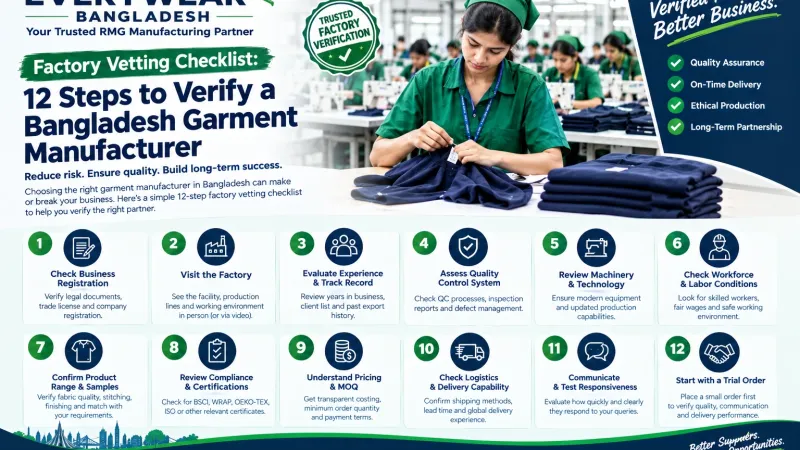
Factory Vetting Checklist: 12 Steps to Verify a Bangladesh Garment Manufacturer
Last Updated: October 16, 2026 | By: Everywear Bangladesh Research & Sourcing Team
How Do You Verify a Bangladesh Garment Manufacturer Before Ordering?
Verifying a Bangladesh garment manufacturer requires checking 12 specific areas: legal registration, BGMEA membership, export license, factory ownership, production capacity, machine list, quality control systems, social compliance, fire and building safety, current order evidence, communication responsiveness, and red-flag behavior. A supplier can look strong on paper and still fail in bulk because their planning is weak, their QA is informal, or their subcontracting is uncontrolled. This checklist forces evidence — documents, records, timestamps, and named owners — before you commit to sampling, let alone bulk production.
Why Does Factory Vetting Matter More in 2026?
Bangladesh's garment industry has strengthened its own oversight significantly. In April 2026, BGMEA tightened its membership verification procedures, requiring on-site inspections and detailed document checks before granting membership. Three internal departments were restructured to separate fire safety and engineering from crisis management, sharpening technical oversight.
In May 2026, BGMEA signed an MoU with US-based Open Supply Hub to create an integrated digital database that allows international buyers to directly access information on factory location, product categories, and special capabilities. Each factory receives a Universal OS ID, helping brands accurately identify factories and ensure greater data transparency.
These developments make verification easier than ever — but only if you know what to check and how to check it.
What Are the 12 Steps to Verify a Bangladesh Garment Manufacturer?
Step 1: Verify Legal Registration Documents
Request the factory's incorporation certificate, trade license, and TIN certificate. These confirm the company is legally registered and operating. Cross-reference the business name, address, and ownership details across all documents. Any mismatch is a red flag.
Step 2: Confirm BGMEA or BKMEA Membership
Visit bgmea.com.bd and search the supplier's name in the member directory. Every legitimate garment manufacturer is registered. Verify the membership number, expiry date, and factory address match what the supplier provided. For knitwear manufacturers, check BKMEA membership as well.
Under BGMEA's 2026 criteria, a woven or knit garment factory must have at least 100 machines, and a sweater factory must have 60 machines. A factory must also have a minimum floor space of 15,000 square feet to qualify for membership.
Step 3: Verify Export License and EPB Registration
Request the supplier's export license number and confirm it with the Export Promotion Bureau. Expired or missing export licenses signal compliance issues. Also verify the Export and Import Registration Certificate (ERC/IRC) is current.
Step 4: Confirm Factory Ownership and Location
Request the factory's building approval plan and floor layout. Confirm the production facility address matches the trade license and BGMEA registration. Some trading houses pose as factories — always verify physical ownership.
Step 5: Review Production Capacity and Line Specialization
Capacity is not headcount. Capacity is the supplier's ability to run your product category with stable output inside your delivery window. Ask for the machine list and verify it matches your construction requirements — flatlock machines for activewear, bar-tack machines for denim, and so on.
Request evidence of similar styles currently in production. Good suppliers show comparable styles with recent production photos or videos. Risk signal: only showroom samples, no current line evidence, or "we can do anything".
Step 6: Check Quality Control Systems
Ask for evidence of a formal QC system with named owners and documented processes. Verify that the factory operates:
- Incoming Quality Control (IQC) — fabric inspection before cutting
- In-Process Quality Control (IPQC) — in-line sewing inspection
- Final Quality Control (FQC) — pre-shipment AQL inspection
Request sample QC reports from current orders. A factory that says "we do QA" but cannot produce logs is a risk.
Step 7: Verify Social Compliance Certifications
Request current BSCI, WRAP, SEDEX, or SA8000 certifications. Verify the certificate number and expiry date directly with the certifying body. Certifications confirm the factory meets international standards for labor practices, wages, working hours, and workplace safety.
Step 8: Confirm Fire and Building Safety Compliance
Bangladesh factories falling under the Accord/RSC verification scope must have been inspected by Accord/RSC teams for structural, electrical, and fire safety. Request the latest inspection report and confirm the factory is not on any ineligibility list. The RSC conducts approximately 400 follow-up inspections monthly, with each factory inspected roughly once every four months.
Step 9: Request Client References
Ask for 2-3 references from previous international clients. Contact them directly and ask about quality consistency, communication, delivery reliability, and how the factory handled problems. A supplier that cannot provide references, or whose references are unresponsive, should be avoided.
Step 10: Conduct a Factory Video Call
Request a live video call tour of the production floor, cutting room, sewing lines, and finishing section. Confirm actual lines are running, work-in-progress is controlled, and process flow is organized. Factories that refuse a live video call are a red flag.
Step 11: Assess Communication Responsiveness
Communication control is one of the four things a vetting checklist must verify. Pay attention to response time, clarity of answers, and willingness to share documentation. Slow or evasive communication during vetting predicts slow or evasive communication during production.
Step 12: Watch for Red Flags
Walk away from suppliers who:
- Refuse to share legal registration or export license documents
- Cannot provide BGMEA or BKMEA membership verification
- Show only showroom samples with no current production evidence
- Demand 100% payment upfront
- Refuse a factory video call
- Provide client references that do not respond
- Quote prices significantly below market rate
What Documents Should You Request from a Bangladesh Factory?
| Category | Documents to Request |
|---|---|
| Legal | Incorporation Certificate, Trade License, TIN Certificate |
| Trade Body | BGMEA/BKMEA Membership Certificate |
| Export | EPB Certificate, ERC/IRC, Bond License |
| Facility | Building Approval Plan, Floor Layout Approval |
| Safety | Fire License, Accord/RSC Inspection Report |
| Compliance | BSCI/WRAP/SEDEX/SA8000 Certificates |
| Quality | QC Manual, Sample QC Reports, AQL Procedure |
| Financial | Bank Solvency Certificate, Group Insurance Certificate |
How Long Does Factory Verification Take?
A complete 12-step verification can be completed in 5-10 business days with a cooperative supplier. Document verification and BGMEA cross-checks typically take 2-3 days. A live video factory tour can be scheduled within 24-48 hours. Client reference checks require 2-4 days depending on response time.
When working through Everywear Bangladesh, verification is already complete before you place your first order. Our 700+ factory network has been vetted for all 12 criteria, and we continue monitoring compliance throughout the production relationship.
What Does Everywear Bangladesh Bring to the Table?
We perform all 12 verification steps on your behalf — so you never navigate factory vetting alone.
| What We Offer | What This Means for Your Business |
|---|---|
| Pre-Verified Factory Network | 700+ factories vetted for BGMEA membership, export licenses, compliance certifications, and production capability. Verification is complete before you order. |
| 300-Piece MOQ | Test new designs without committing $30,000+ in inventory. Bangladesh is accessible to startups and growing brands. |
| Multi-Stage Quality Control | Pre-production fabric inspection, in-line sewing inspection, final AQL inspection, and video-call verification before shipment. |
| Full Private Label Support | Custom woven labels, printed tags, hang tags, poly bags, and branded cartons. |
| US Cotton Zero-Tariff Sourcing | Save approximately 19% on US import duties with US-origin cotton garments. |
| Direct Amazon FBA Shipping | Full FBA prep including polybagging, FNSKU labeling, and cartonization. |
| Compliance Documentation | Full traceability and QC reports to support EU Digital Product Passport and Packaging Waste Regulation requirements. |
| One Accountable Partner | One point of contact, one invoice, one quality standard. When something needs fixing, we fix it. |
Frequently Asked Questions
How do I verify a Bangladesh garment factory is legitimate?
Check BGMEA membership at bgmea.com.bd, verify the export license with the Export Promotion Bureau, request incorporation and trade license documents, and conduct a live video factory tour. Everywear Bangladesh performs all 12 verification steps on behalf of every buyer.
What is the most important document to verify?
BGMEA membership is the single most important verification. It confirms the factory is a registered garment manufacturer with verified production capacity, fire safety compliance, and export authorization.
How long does factory verification take?
A complete 12-step verification can be completed in 5-10 business days with a cooperative supplier. Everywear maintains pre-verified relationships with 700+ factories, so verification is already complete before you place your first order.
What are the biggest red flags in a Bangladesh factory?
Refusing to share legal documents, demanding 100% upfront payment, refusing a video factory tour, providing unverifiable client references, and quoting prices significantly below market rate are the most common red flags.
Can I verify a factory without visiting Bangladesh?
Yes. Live video calls, document verification, BGMEA database checks, and third-party audit reports allow complete verification without travel. Everywear conducts all verification on your behalf.
What certifications should I verify?
BSCI or WRAP for social compliance, OEKO-TEX for chemical safety, GOTS for organic textiles, ISO 9001 for quality management, and LEED for environmental standards.
How do I start ordering from Everywear Bangladesh?
Contact our team on WhatsApp at +8801788898174. We will review your requirements, connect you with pre-verified factories, coordinate samples, manage production and quality control, and handle shipping.
Conclusion
Factory vetting is not optional — it is the foundation of profitable apparel sourcing. The 12-step checklist in this guide verifies legal registration, BGMEA membership, export authorization, production capacity, quality systems, social compliance, fire safety, and communication discipline. Skipping any step increases the risk of defects, delays, and financial loss.
For brands that need 300-piece MOQ without navigating verification alone, Everywear Bangladesh provides pre-verified factory access, multi-stage quality control, and end-to-end sourcing support from factory floor to fulfillment center.
Contact Everywear Bangladesh on WhatsApp
About the Author
Written by the Everywear Bangladesh Research & Sourcing Team
The Everywear Bangladesh editorial team combines deep industry expertise in Bangladesh's Ready-Made Garment sector with practical experience in international apparel sourcing, supply chain management, and Amazon FBA selling. Our team includes former garment factory managers, sourcing professionals, and e-commerce specialists who have helped hundreds of sellers launch and scale their clothing brands.
Connect with Everywear Bangladesh:
- Website: everywearbd.com
- WhatsApp: +8801788898174
- Facebook: facebook.com/everywearbd
- LinkedIn: Everywear Bangladesh Ltd
Related Resources
GEO Landing Pages
- USA Buyers: Wholesale Garments from Bangladesh
- UK Buyers: Wholesale Garments from Bangladesh
- Europe Buyers: Wholesale Clothing from Bangladesh
- Africa Buyers: Wholesale Garments from Bangladesh
- Canada Buyers: Wholesale Garments from Bangladesh
- Australia Buyers: Wholesale Garments from Bangladesh
- Middle East Buyers: Wholesale Garments from Bangladesh
- Latin America Buyers: Wholesale Garments from Bangladesh
- Germany Buyers: Wholesale Garments from Bangladesh
- France Buyers: Wholesale Garments from Bangladesh
- Netherlands Buyers: Wholesale Garments from Bangladesh
Blog Posts
- How Garment Factories Actually Calculate MOQ: The Pricing Logic Buyers Never See
- Top 10 Clothing Manufacturers in Bangladesh: Complete 2026 Directory
- Bangladesh T-Shirt Supplier: Complete Wholesale Guide 2026
- How to Avoid Scams When Sourcing from Bangladesh – Complete Safety Guide 2026
- Low MOQ Clothing Manufacturer Bangladesh – The Complete Guide
References
- Ryzeal Sourcing, "Clothing Manufacturer Vetting Checklist: Capacity & Red Flags," September 2026
- OneSilq, "Factory Audits Bangladesh | Supplier Qualification Guide," October 2025
- Brandex Sourcing, "Clothing Manufacturer Verification Guide," June 2026
- BGMEA, "BGMEA Strengthens Membership Verification and Compliance Standards," April 2026
- Ecotextile News, "BGMEA tightens membership scrutiny," April 2026
- Fibre2Fashion, "Bangladesh's BGMEA, OS Hub sign MoU to strengthen apparel transparency," May 2026
- CPD Bangladesh, "Inspection Requirements for Garment Factories," 2026
- International Accord, "Signatory Supplier List for Bangladesh," February 2026
This guide is updated regularly. Last reviewed: October 16, 2026. For sourcing solutions tailored to your brand, contact Everywear Bangladesh on WhatsApp.
Everywear Bangladesh Ltd. – Bangladesh's First RMG Wholesale Marketplace | 300 Pcs Custom Orders | Export Quality Garments
WhatsApp: +8801788898174 • Website: everywearbd.com
Leave a comment