





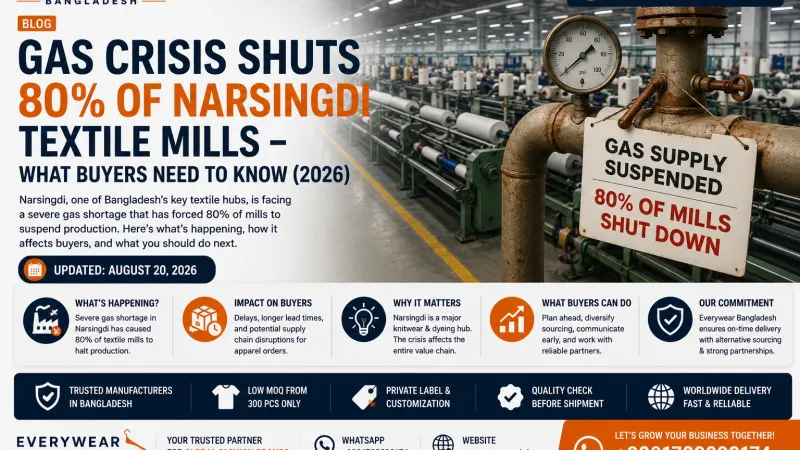
Gas Crisis Shuts 80% of Narsingdi Textile Mills – What Buyers Need to Know (2026)
Last updated: August 25, 2026 • [Complete Guide for International Apparel Buyers & Fashion Brands]
Quick Answer: What Is Happening in Narsingdi and Why Does It Matter for Buyers?
A severe natural gas shortage has shut roughly 80 percent of textile and dyeing mills in Narsingdi, Bangladesh's largest textile processing hub, wiping out an estimated Tk 500 crore (approximately $60 million USD) in daily output. The industrial hub supplies about 75 percent of domestic fabric demand in Bangladesh. The crisis began on July 21, 2026, after a technical fault crippled a floating LNG terminal at Moheshkhali, reducing national gas output by approximately 450 million cubic feet per day – nearly 17 percent of total supply. Gas pressure in key industrial areas like Madhabdi and Chowala has dropped to zero for four straight days, leaving chemically treated fabric stranded mid-cycle. Industry estimates suggest 10-15 million yards of fabric have been ruined, while over 100 mills have closed indefinitely. For international buyers, this means extended lead times, rising costs, potential order cancellations, and supply chain disruption – particularly for fabric-dependent garment orders.
On August 24, 2026, news broke that a severe natural gas shortage had shut roughly 80 percent of textile and dyeing mills in Narsingdi, Bangladesh's largest textile processing hub. The crisis is wiping out an estimated Tk 500 crore (approximately $60 million USD) in daily output and threatening the supply chain for the country's $38.7 billion RMG sector.
Narsingdi is the heart of Bangladesh's textile processing industry. The district houses more than 3,000 production units, including 2,500 sizing, spinning, dyeing and weaving mills. About 400 of these operations rely on uninterrupted natural gas at 10 to 15 pounds per square inch (PSI) to run steam boilers and drying machines. Narsingdi supplies nearly 70-75 percent of the country's domestic fabric demand.
For international apparel buyers, fashion brands, and sourcing professionals, this crisis represents a significant supply chain disruption that could affect lead times, costs, quality, and shipment reliability. This comprehensive guide explains what happened, why it matters, and what buyers can do to protect their supply chains.
What Caused the Narsingdi Gas Crisis?
The crisis traces back to July 21, 2026, when a technical fault crippled an offshore floating liquefied natural gas (LNG) terminal at Moheshkhali in Cox's Bazar. The unit outage suddenly removed about 450 million cubic feet per day of gas – nearly 17 percent of the total national supply – from the main grid.
The Supply-Demand Gap
Bangladesh's daily gas demand stands at approximately 3,800 million cubic feet per day (mmcfd). Before the disruption, supply was maintained at around 2,650 mmcfd through rationing – already below demand. After the LNG terminal failure, supply plunged to 2,175 mmcfd on August 19, leaving a massive gap.
| Metric | Value |
|---|---|
| Daily Gas Demand | 3,800 mmcfd |
| Normal Supply (Pre-Crisis) | 2,650 mmcfd |
| Supply After LNG Failure (Aug 19) | 2,175 mmcfd |
| Shortfall | ~1,625 mmcfd |
| Gas Removed from Grid (LNG Outage) | 450 mmcfd (17% of total supply) |
State distributor Petrobangla lifted supply to 2,300 mmcfd on August 22, but state utility Titas Gas diverted high-pressure flows to the Ghorashal-Palash fertiliser plant, starving private textile processors. This prioritisation of fertiliser production over industrial processing has exacerbated the crisis for textile mills.
Gas Pressure Collapse
Factory owners report that gas pressure fell from the normal 15 pounds per square inch (PSI) to 2-4 PSI last week, and then to almost zero over the past few days. In key industrial pockets like Madhabdi and Chowala, pressure remained at zero for four straight days.
The Impact on Textile Mills: Numbers and Damage
Factory Shutdowns
The crisis has forced 80 percent of textile and dyeing mills in Narsingdi to shut down. More than 100 textile factories have halted production in the last two days alone. Hundreds of factories have been unable to operate, leaving workers idle.
Among the factories that have suspended operations in Narsingdi town and surrounding areas are:
- Chishtia Sizing Mill
- Yamin Sizing Mill
- Momin Sizing Mill
- Hossain Dyeing and Calendaring Mill
- Abed Textile Mills – completely shut for 20 days
- Shilpi Dyeing
- Nadi-Bangla Sizing Mill
- Bhuiyan Textile and Calendar Mills
- Several factories under Amanat Shah Group and Pakiza Group in Madhabdi
Fabric Damage and Financial Losses
Industry estimates suggest that 10 million to 15 million yards of fabric have been ruined due to the gas shortage.
At Tithi Textile in Madhabdi, approximately 250,000 yards of chemically treated fabric were damaged after gas pressure remained at zero for four days, bringing production and generators to a halt.
Chemically soaked fabric normally must be processed within 16 hours. However, with gas pressure at zero for three to four days, machines stopped, and fabric left midway through processing became unusable. Piles of chemically treated grey fabric have been left on factory floors, where they have started to rot and smell.
The daily losses are staggering:
- Tk 500 crore (approximately $60 million USD) in daily output wiped out
- Tk 400-500 crore in daily sector losses reported by industry representatives
- Tk 300 crore in daily losses in Narsingdi alone
Alternative Fuel: Burning Wood
Facing steep losses and wage deadlines, some mills have turned to burning wood in steam boilers as an alternative fuel source. At least 100 small and large textile factories are operating by burning wood.
Each factory is spending more than Tk 12,000 a day on firewood. This practice comes with significant risks:
- Environmental damage – factories are not permitted to use wood as fuel under environmental laws
- Increased costs – firewood is expensive and unsustainable
- Regulatory violations – factories are skirting local environmental permits
Abdullah Al Mamun, spokesperson for the Bangladesh Textile Mills Association (BTMA), warned: "Amid the gas crisis, around 45-55 factories are being forced to use firewood to keep their production running. However, this cannot continue indefinitely."
Supply Chain Bottlenecks: How the Crisis Spreads
The Narsingdi gas crisis is not an isolated event – it is a supply chain shockwave that affects the entire garment manufacturing ecosystem.
Upstream Textile Mills Are Slowing
Upstream textile mills, spinning units, and dyeing facilities rely heavily on gas to run high-pressure thermal boilers. As these primary textile units slow down, garment makers face massive delays in getting yarn, fabric, and finished trims.
Garment Factories Are Affected
The crisis is also sharply affecting garment factories in Gazipur, Narayanganj, and Savar. Many factories are dividing workers into shifts, resulting in production losses of around 20-25 percent.
Costs Are Soaring
Factory production costs have jumped by nearly 30 percent as manufacturers run heavy diesel generators to meet buyer deadlines. Generators that normally run on gas are now being operated with fuel oil, increasing costs nearly fivefold.
Order Cancellations and Delays
Buyers from different countries are cancelling orders, while factories struggle to pay workers' wages and may have to compensate buyers for their losses.
When delays do happen, suppliers face extra financial hits from forced air freight costs and steep buyer discounts.
What This Means for International Buyers
Challenge 1: Extended Lead Times
With 80% of textile mills shut in Narsingdi, fabric availability is severely constrained. Garment makers cannot produce without fabric. This means significant delays in production and shipment.
Factory owners are warning that delayed supplies are threatening shipment schedules and raising the risk of costly air freight.
Challenge 2: Rising Costs
Production costs have jumped nearly 30 percent as factories switch to diesel generators and alternative fuels. These costs will inevitably be passed on to buyers in the form of higher FOB prices.
For buyers, this means:
- Higher per-unit costs – FOB prices may increase 15-30%
- Air freight surcharges – if delays force expedited shipping
- Potential order cancellations – if factories cannot deliver
Challenge 3: Quality Risks
Factories running on alternative fuels (wood, diesel) may experience inconsistent production conditions. Chemically treated fabric left standing for days has already been ruined. Buyers may receive lower quality goods as factories struggle to maintain standards under crisis conditions.
Challenge 4: Supply Chain Instability
The crisis has exposed the fragility of Bangladesh's energy infrastructure. While competing manufacturing hubs in Vietnam and India rely on more diversified power grids, Bangladeshi mills remain exposed to single-point infrastructure failures in offshore gas infrastructure.
This creates long-term uncertainty for buyers planning future orders.
Opportunity: Work with Resilient Partners
While the crisis is severe, not all suppliers are equally affected. Factories with:
- Captive power generation – backup generators, solar panels
- Energy-efficient operations – lower gas dependency
- Diversified locations – factories outside Narsingdi
- Alternative fuel capability – ability to switch to diesel or biomass
...are better positioned to weather the crisis. Buyers should prioritise suppliers with energy resilience.
How Everywear Bangladesh Helps Buyers Navigate the Crisis
At Everywear Bangladesh, we understand that the Narsingdi gas crisis creates significant challenges for international buyers. Here's how we help:
1. Supplier Diversification
We work with factories across multiple locations – not just Narsingdi. Our network includes factories in Gazipur, Narayanganj, Savar, Chattogram, and other industrial zones with better energy access. This allows us to shift production if one location is affected.
2. Energy-Resilient Partners
We prioritise factories with:
- Captive power generation – backup generators, solar installations
- Energy-efficient machinery – lower gas consumption
- Alternative fuel capability – diesel, biomass, and other options
- LEED-certified green factories – which have invested in energy efficiency
3. Real-Time Supply Chain Intelligence
We monitor the situation daily and provide real-time updates to our clients. We track:
- Gas pressure in industrial zones
- Factory production status
- Lead time adjustments
- Alternative sourcing options
4. Quality Assurance
With production disruptions, quality risks increase. Our quality control process helps ensure that even during crises, your products meet international standards:
- Fabric inspection – Before cutting begins
- In-line sewing inspection – Throughout production
- Printing and embroidery verification – Accurate artwork placement
- Final AQL inspection – Comprehensive quality check
- Video-call inspection – Verify your order before shipment
5. Low MOQ from 300 Pieces – Test Before You Scale
With supply chain uncertainty, inventory risk is more critical than ever. Everywear Bangladesh supports low MOQ production from 300 pieces per design, allowing you to:
- Test products before committing to large orders
- Validate demand without massive inventory investment
- Manage cash flow effectively
- Adapt quickly to changing supply conditions
6. End-to-End Support – One Accountable Partner
You deal with Everywear directly – not multiple factories or middlemen. We provide:
- Dedicated account manager – Your single point of contact
- Regular production updates – Photos and progress reports
- 24/7 WhatsApp support – For urgent queries
- Transparent pricing – No hidden costs
Contact Everywear Bangladesh on WhatsApp
Frequently Asked Questions
Everything you need to know about the Narsingdi gas crisis and its impact on apparel sourcing.
1. What is happening in Narsingdi, Bangladesh?
A severe natural gas shortage has shut roughly 80 percent of textile and dyeing mills in Narsingdi, Bangladesh's largest textile processing hub. The crisis has wiped out an estimated Tk 500 crore (approximately $60 million USD) in daily output and affected the supply chain for the country's $38.7 billion RMG sector.
2. Why did the gas crisis happen?
The crisis began on July 21, 2026, after a technical fault crippled a floating LNG terminal at Moheshkhali. The unit outage removed about 450 million cubic feet per day of gas – nearly 17 percent of total national supply – from the main grid. Gas pressure in Narsingdi fell from the normal 15 PSI to almost zero.
3. How much fabric has been damaged?
Industry estimates suggest that 10 million to 15 million yards of fabric have been ruined due to the gas shortage. At Tithi Textile alone, approximately 250,000 yards of chemically treated fabric were damaged.
4. How does this affect international buyers?
The crisis means extended lead times, rising costs, potential order cancellations, and supply chain disruption. Production costs have jumped by nearly 30 percent as factories run diesel generators. Fabric availability is severely constrained, and garment makers cannot produce without fabric.
5. Are factories using alternative fuels?
Yes. At least 100 small and large textile factories are operating by burning wood in steam boilers. Each factory is spending more than Tk 12,000 a day on firewood. However, this practice is not permitted under environmental laws and cannot continue indefinitely.
6. Which factories have been affected?
More than 100 factories have been forced to shut in Narsingdi. Affected factories include Abed Textile Mills (completely shut for 20 days), Chishtia Sizing Mill, Yamin Sizing Mill, Hossain Dyeing, and several factories under Amanat Shah Group and Pakiza Group in Madhabdi.
7. How long will the crisis last?
Titas Gas engineers expect regional gas pressure to show initial signs of recovery next week as repair teams complete work on the Moheshkhali LNG terminal. However, the structural energy vulnerabilities in Bangladesh's infrastructure suggest that similar disruptions could recur in the future.
8. What should buyers do now?
Buyers should: (1) Communicate with suppliers to understand their production status and lead times, (2) Build buffer time into inventory planning, (3) Consider diversifying suppliers across different industrial zones, (4) Work with sourcing partners who have energy-resilient factory networks, and (5) Monitor the situation daily for updates.
9. Is Bangladesh still a reliable sourcing destination?
Despite the crisis, Bangladesh retains buyer confidence for now. International apparel buyers are still keeping their orders in Bangladesh. However, the industry is racing against time to protect its production capacity and delivery reliability. Buyers should work with resilient partners who can navigate these challenges.
10. How is the government responding?
The government is prioritising gas supply to power plants and the Ghorashal-Palash fertiliser plant, leaving less for industries. Textile millers have pressed Prime Minister Tarique Rahman for a solution. However, the Minister for Power, Energy and Mineral Resources has noted the government's limited capacity, saying there is no other option to manage the load shedding.
11. What are the financial losses?
The crisis is wiping out Tk 500 crore in daily output in Narsingdi alone. Industry representatives report losses of Tk 400-500 crore per day across the industrial area. Factory owners face difficulties paying workers' wages, utility bills, and loan repayments.
12. How are workers affected?
Thousands of workers have been left idle as factories shut. Some factories are assigning employees maintenance and cleaning duties to prevent worker dissatisfaction. There is a growing risk of labour unrest, work stoppages, or protests if the situation continues for a long time.
13. How can Everywear Bangladesh help me navigate this crisis?
Everywear Bangladesh offers supplier diversification across multiple industrial zones, energy-resilient partners with backup power, real-time supply chain intelligence, quality assurance during production disruptions, low MOQ from 300 pieces to test products, and end-to-end support with one accountable partner.
14. What is Narsingdi's role in Bangladesh's textile industry?
Narsingdi is the heart of Bangladesh's textile processing industry. The district houses more than 3,000 production units, including 2,500 sizing, spinning, dyeing and weaving mills. It supplies nearly 70-75 percent of the country's domestic fabric demand.
15. Will the crisis affect garment exports?
Yes. The crisis is already affecting garment factories in Gazipur, Narayanganj, and Savar, with production losses of 20-25 percent. Delayed supplies are threatening shipment schedules and raising the risk of costly air freight. International buyers are cancelling orders as factories struggle to deliver.
Conclusion
The Narsingdi gas crisis is one of the most severe supply chain disruptions to hit Bangladesh's textile industry in recent years. With 80 percent of textile mills shut, 10-15 million yards of fabric ruined, and daily losses of Tk 500 crore, the impact on international buyers is significant and growing.
For buyers sourcing from Bangladesh, the crisis means:
- Extended lead times – fabric availability is severely constrained
- Rising costs – production costs up nearly 30%
- Quality risks – inconsistent production conditions
- Supply chain instability – the risk of future disruptions
However, the crisis also presents an opportunity to work with more resilient partners. Buyers who prioritise suppliers with captive power generation, energy-efficient operations, diversified locations, and alternative fuel capability will be better positioned to weather this and future crises.
At Everywear Bangladesh, we help buyers navigate these challenges with supplier diversification, energy-resilient partners, real-time intelligence, and end-to-end support. Our team is ready to help you protect your supply chain and maintain production continuity during this difficult time.
Contact Everywear Bangladesh on WhatsApp
About the Author
Written by the Everywear Bangladesh Research & Sourcing Team
The Everywear Bangladesh editorial team combines deep industry expertise in Bangladesh's Ready-Made Garment (RMG) sector with practical experience in international apparel sourcing, supply chain management, and global trade analysis. Our team includes former garment factory managers, sourcing professionals, and trade analysts who have worked with fashion brands across the United States, Europe, and Asia.
Our mission is to provide accurate, data-driven, and actionable content that helps fashion entrepreneurs, retailers, wholesalers, importers, and global brands make informed sourcing decisions. We leverage real-time data from the Bangladesh Garment Manufacturers and Exporters Association (BGMEA), Export Promotion Bureau (EPB), Bangladesh Textile Mills Association (BTMA), and other authoritative sources to ensure our insights reflect the latest industry developments.
Connect with Everywear Bangladesh:
- Website: everywearbd.com
- WhatsApp: +8801788898174
- Facebook: facebook.com/everywearbd
- LinkedIn: Everywear Bangladesh Ltd
References
- Retail News Asia, "Gas Shortage Shuts 80 Percent of Narsingdi Textile Mills in Bangladesh," August 23, 2026
- Lokmat Times, "Bangladesh: LNG disruption deepens energy crisis, hits industry and power supply," August 14, 2026
- Lokmat Times, "Bangladesh factories shutting down as gas crisis worsens," August 23, 2026
- Observer BD, "Gas crisis halts production at over 300 factories in Narsingdi," August 22, 2026
- Textile Today, "Bangladesh retains buyer confidence despite prolonged gas crisis," August 23, 2026
- The Daily Star, "Gas crunch forces Narsingdi textile mills to burn wood," August 2026
- The Daily Star, "Narsingdi's textile factories gasp for gas as fabric rots," August 2026
- The Daily Star, "Textile millers seek PM's help on gas crisis," July 30, 2026
- New Age, "Gas supply shortage hits industries hard in Bangladesh," August 14, 2026
- BTMA, "Bangladesh Textile Mills Association Industry Report," August 2026
Related Resources
GEO Landing Pages
- USA Buyers: Wholesale Garments from Bangladesh
- UK Buyers: Wholesale Garments from Bangladesh
- Europe Buyers: Wholesale Clothing from Bangladesh
- Africa Buyers: Wholesale Garments from Bangladesh
Blog Posts
- Energy Crisis Threatens Bangladesh RMG Competitiveness – What Foreign Buyers Need to Know
- Bangladesh RMG Exports to US Fall 5.58% – What Buyers Need to Know
- Bangladesh's RMG Exports to EU Plunge 16.43% in H1 2026 – What Buyers Need to Know
- Clothing Suppliers from Bangladesh: The Ultimate Guide 2026
- Low MOQ Clothing Manufacturer Bangladesh
This guide is updated regularly. Last reviewed: August 25, 2026. For sourcing solutions tailored to your brand, contact Everywear Bangladesh on WhatsApp.
Everywear Bangladesh Ltd. – Bangladesh's First RMG Wholesale Marketplace | 300 Pcs Custom Orders | Export Quality Garments
WhatsApp: +8801788898174 • Website: everywearbd.com
Leave a comment