




Print on Demand vs Private Label Clothing – Which Is Right for Your Brand? (2026)
Last updated: September 5, 2026 • [Complete Guide for Clothing Entrepreneurs, Amazon FBA Sellers & Fashion Startups]
Quick Answer: Print on Demand vs Private Label – Which Should You Choose?
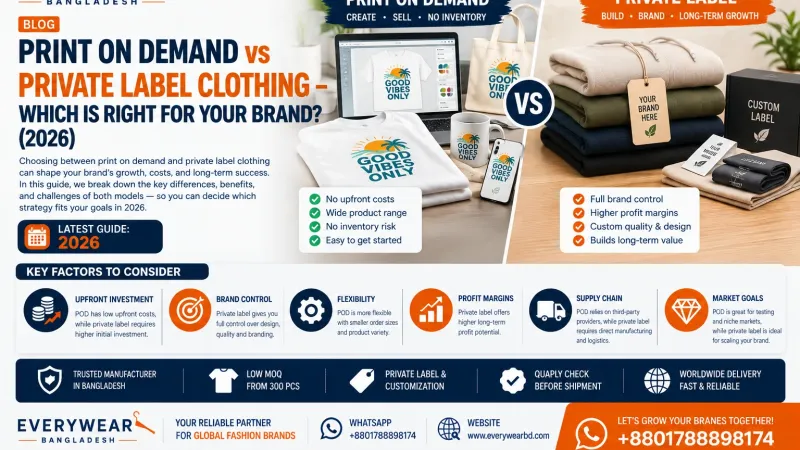
Print on Demand (POD) is the low-risk, low-cost entry point – you design, a third party prints and ships only when an order is placed. No inventory, no minimums, but thin margins (typically 20-40% gross) and zero control over fabric, fit, or quality[reference:0][reference:1]. Private Label is the path to a real brand – you manufacture custom products with your specifications, labels, and packaging[reference:2]. Higher upfront cost (starting around $3,000-$10,000)[reference:3] and minimum order quantities, but 40-60%+ gross margins, full control, and a defensible brand[reference:4][reference:5]. The smartest path: start with POD to validate demand, then scale with private label once you have proven best-sellers[reference:6][reference:7].
If you're starting a clothing brand in 2026, one of the first and most important decisions you'll make is your business model[reference:8]. The choice between Print on Demand (POD) and Private Label determines your startup costs, profit margins, control over quality, and ultimately, whether you build a real brand or just sell commodities.
The global print-on-demand market is projected to reach $57.49 billion by 2033, growing at a CAGR of 23.6%[reference:9][reference:10]. Meanwhile, the broader apparel market is projected to hit $2.54 trillion[reference:11]. Both models are viable – but they serve completely different purposes and lead to very different outcomes.
This guide breaks down: what each model actually is, the real costs, the pros and cons, profit margins, and a clear framework to decide which is right for your brand – plus how to transition from POD to private label when you're ready to scale.
What Is Print on Demand (POD)?
Print on Demand is a fulfillment model where products are manufactured only after a customer places an order[reference:12][reference:13]. A third-party supplier prints your designs on blank garments and ships directly to your customer[reference:14].
How POD Works
- You create designs (graphics, text, artwork)
- You upload designs to a POD platform (Printful, Printify, Merch by Amazon, etc.)
- Customer places an order on your store
- POD partner prints the design on a blank garment
- POD partner ships directly to the customer
- You never touch inventory
POD Startup Costs
POD has the lowest barrier to entry of any clothing business model[reference:15]. You can start with as little as $500-$2,000[reference:16][reference:17]. Your main costs are:
- Website/platform fees – $30-$300/month
- Design costs – $0-$500 (DIY or hire a designer)
- Marketing – Variable
- Sample orders – $50-$200 to test quality
No inventory costs. No storage costs. No minimum orders.
What Is Private Label Clothing?
Private Label involves manufacturing products under your own brand name, with custom specifications, your labels, and your packaging[reference:18][reference:19]. You work directly with a manufacturer to create unique products that belong to your brand[reference:20].
How Private Label Works
- You develop product specifications (fabric, fit, design, colors)
- You work with a manufacturer to create samples
- You approve samples and place a production order
- Manufacturer produces your custom products with your labels
- Products are shipped to you or directly to your fulfillment center
- You own the inventory and the brand
Private Label Startup Costs
Private label requires more upfront capital but delivers much higher returns[reference:21]. Typical costs:
- Samples – $100-$500 per style
- Minimum Order Quantity (MOQ) – 300+ pieces per design
- Production cost – Varies by fabric, quantity, complexity
- Labels and packaging – $0.50-$2.00 per unit
- Shipping – Sea or air freight to your fulfillment center
Total startup cost for private label typically ranges from $3,000-$10,000+[reference:22][reference:23] – but with modern low-MOO manufacturers like Everywear, you can start with as little as $3,000-$5,000 for a small initial run.
Print on Demand vs Private Label – Side-by-Side Comparison
| Factor | Print on Demand | Private Label |
|---|---|---|
| Startup Cost | $500 – $2,000[reference:24] | $3,000 – $10,000+[reference:25] |
| Gross Margin | 20% – 40%[reference:26] | 40% – 60%+[reference:27] |
| Inventory Risk | Zero – no inventory[reference:28] | High – you own all inventory |
| Minimum Order Quantity | 1 piece[reference:29] | 300+ pieces (with low-MOQ manufacturers) |
| Control Over Fabric | None – you use the supplier's blanks[reference:30] | Full – you choose fabric, GSM, composition[reference:31] |
| Control Over Fit | None – standard supplier sizing[reference:32] | Full – custom sizing, fit, silhouette |
| Control Over Quality | Limited – at mercy of supplier[reference:33] | Full – you inspect and approve |
| Brand Differentiation | Low – identical to thousands of POD brands[reference:34] | High – unique products, custom labels[reference:35] |
| Lead Time | 2-7 days (production + shipping) | 4-8 weeks (production) + shipping |
| Best For | Testing, creators, artists, beginners[reference:36] | Scaling, brand builders, serious entrepreneurs[reference:37] |
The Pros and Cons – Deep Dive
Print on Demand – The Good
| Pro | Why It Matters |
|---|---|
| Zero Inventory Risk | No money tied up in unsold stock – you only pay when you sell[reference:38] |
| Lowest Barrier to Entry | Start with $500-$2,000 – accessible to almost anyone[reference:39] |
| Test Multiple Designs | Upload dozens of designs, see what sells, zero risk |
| No Storage or Logistics | POD partner handles printing, packing, and shipping |
| Global Reach | Many POD partners have global fulfillment centers |
Print on Demand – The Bad
| Con | Why It Hurts Your Brand |
|---|---|
| Thin Margins | 20-40% gross margin[reference:40] – hard to build a sustainable business[reference:41] |
| No Control Over Quality | You can't control fabric, stitching, or fit[reference:42][reference:43] |
| Identical Products | Your "brand" uses the same blanks as thousands of others[reference:44] |
| Shipping Times | Can be slow, especially for international orders |
| No Brand Building | You're selling designs, not a brand – low customer loyalty |
| No Unique Products | You can't create custom fits, fabrics, or silhouettes |
Private Label – The Good
| Pro | Why It Matters |
|---|---|
| High Margins | 40-60%+ gross margin[reference:45] – real profitability |
| Full Quality Control | You choose fabric, fit, construction – and inspect everything |
| Unique Products | Your brand has exclusive products nobody else can sell[reference:46] |
| Real Brand Building | Custom labels, packaging, and quality build brand equity |
| Customer Loyalty | Unique, quality products create repeat customers |
| Scalable | As you grow, your margins improve and you can expand collections |
Private Label – The Bad
| Con | Why It's a Barrier |
|---|---|
| Higher Upfront Cost | $3,000-$10,000+ to get started[reference:47] |
| Inventory Risk | You own all inventory – if it doesn't sell, you lose money |
| Minimum Order Quantities | Typically 300+ pieces per design[reference:48] |
| Longer Lead Times | 4-8 weeks from order to delivery[reference:49] |
| More Complex | You manage manufacturing, quality control, shipping, and logistics |
| Sample Costs | You pay for samples before bulk production[reference:50] |
The Financial Reality – What You Actually Keep
This is where the two models diverge dramatically.
Print on Demand – The Numbers
Let's say you sell a POD t-shirt for $30:
- Base garment + print cost: $12-$18
- Shipping: $4-$6
- Platform fees: $0.50-$2.00
- Your gross profit: $4-$13.50 per unit
- Gross margin: 13%-45% (typically 20-40%)[reference:51]
After marketing, you might keep $2-$8 per unit. You need to sell hundreds of units per month just to make a living.
Private Label – The Numbers
Same t-shirt, but private label from Bangladesh with low MOQ (300 pieces):
- Manufacturing cost: $4-$8 per unit (depending on fabric and quantity)
- Labels and packaging: $0.50-$1.50 per unit
- Shipping to Amazon FBA: $1-$3 per unit
- Total COGS: $5.50-$12.50 per unit
- Sell for $30
- Your gross profit: $17.50-$24.50 per unit
- Gross margin: 58%-82%
After Amazon fees and marketing, you might keep $10-$18 per unit. You need to sell 5x fewer units to make the same profit.
The Margin Difference in Real Terms
| Metric | Print on Demand | Private Label |
|---|---|---|
| Units sold to make $1,000 profit | ~125-500 units | ~55-100 units |
| Profit per unit | $2-$8 | $10-$18 |
| Gross margin | 20%-40% | 40%-60%+[reference:52] |
Which Model Is Right for You? A Decision Framework
Here's how to decide based on your goals, capital, and experience.
Choose Print on Demand If:
- ✅ You have less than $2,000 to start[reference:53]
- ✅ You're a creator, artist, or influencer with an existing audience[reference:54]
- ✅ You want to test multiple designs with zero risk[reference:55]
- ✅ You're not sure if your designs will sell
- ✅ You want to start quickly (days, not months)
- ✅ You're okay with thin margins and limited control
- ✅ You're testing the waters before committing to a real brand[reference:56]
Choose Private Label If:
- ✅ You have $3,000-$10,000+ to invest[reference:57]
- ✅ You want to build a real, defensible brand[reference:58]
- ✅ You want 40-60%+ gross margins[reference:59]
- ✅ You care about quality, fabric, and fit[reference:60]
- ✅ You want unique products that nobody else can sell
- ✅ You're in it for the long term
- ✅ You're ready to manage inventory and logistics
- ✅ You have proven demand (through POD or other testing)[reference:61]
The Smart Path: Start POD, Scale to Private Label
The most successful clothing brands follow a two-phase approach[reference:62][reference:63]:
- Phase 1: Validate with POD – Test designs, find your best-sellers, build an audience, prove demand. Zero risk, low cost.
- Phase 2: Scale with Private Label – Take your proven best-sellers and manufacture them with better quality, better margins, and your own branding.
This approach gives you the best of both worlds: you test with zero risk and scale with real profitability.
How to Transition from POD to Private Label
Once you've validated demand with POD, here's how to make the transition:
Step 1: Identify Your Best-Sellers
Look at your POD sales data. Which designs, colors, and styles sell best? Focus on your top 3-5 products for your first private label order.
Step 2: Find a Manufacturer
Work with a trusted clothing manufacturer who offers low MOQ and quality control. Bangladesh is an excellent choice – with low MOQ from 300 pieces, competitive pricing, and US Cotton Zero-Tariff benefits.
Step 3: Order Samples
Never skip samples. Order sample pieces to verify fabric, fit, construction, and quality before committing to bulk production.
Step 4: Place Your First Production Order
Start with a small batch (300-500 pieces). This minimizes risk while allowing you to test the private label process.
Step 5: Upgrade Your Branding
Add custom woven labels, neck labels, hang tags, and custom poly bags – these small touches transform a generic product into a premium brand experience.
Step 6: Ship to Amazon FBA or Your Fulfillment Center
Coordinate shipping to your fulfillment center. With Amazon FBA, you get fast shipping, Prime eligibility, and Amazon's customer service – all of which increase conversion rates.
Why Bangladesh Is the Ideal Private Label Manufacturing Destination
When you're ready to transition to private label, Bangladesh offers unmatched advantages:
1. Low MOQ from 300 Pieces
Many Bangladesh manufacturers, including Everywear, offer low MOQ from 300 pieces per design. This makes private label accessible to small brands and startups.
2. US Cotton Zero-Tariff – Save ~19%
Under the Agreement on Reciprocal Trade (ART) between the US and Bangladesh, garments made with US-origin cotton enter the US at zero tariff – saving approximately 19% on import duties.
3. World-Class Garment Expertise
Bangladesh is the world's second-largest garment exporter with decades of experience producing for global brands. You get quality, scale, and cost-effectiveness that rivals or beats any other sourcing destination.
4. Full Private Label Support
Bangladesh manufacturers offer complete private label services: custom woven labels, printed neck labels, hang tags, custom poly bags, branded cartons, and full quality control.
How Everywear Bangladesh Helps You Build Your Private Label Brand
At Everywear Bangladesh, we help clothing brands transition from POD to private label with one accountable partner.
1. Low MOQ from 300 Pieces
Start your private label journey with just 300 pieces per design. Test new products with less capital exposure and scale what works.
2. Full Private Label Manufacturing
We help you create a professional, brand-first product:
- Custom woven labels – Your brand name and logo
- Printed neck labels – Professional brand presentation
- Hang tags – Branded marketing materials
- Custom poly bags – Professional packaging for Amazon FBA
- Branded cartons – Consistent brand experience
3. Quality Control – Protect Your Brand Reputation
Every garment is physically inspected using AQL standards:
- Fabric inspection – Before cutting begins
- In-line sewing inspection – Throughout production
- Printing and embroidery verification – Accurate artwork placement
- Final AQL inspection – Comprehensive quality check
- Video-call inspection – Verify your order before shipment
4. US Cotton Zero-Tariff – Save on Import Duties
We source US-origin cotton for qualifying orders, saving you approximately 19% in tariffs – directly improving your margins.
5. Shipping to Amazon Warehouses
We coordinate shipping to Amazon fulfillment centers across the USA:
- Sea freight – Most economical for bulk orders (25-35 days)
- Air freight – Faster option for urgent restocking (8-12 days)
- Courier services – Perfect for samples and small shipments (3-5 days)
- Amazon FBA prep – Polybagging and labeling support
6. End-to-End Support – One Accountable Partner
You deal with Everywear directly – not multiple factories or middlemen. We provide:
- Dedicated account manager – Your single point of contact
- Regular production updates – Photos and progress reports
- 24/7 WhatsApp support – For urgent queries
- Transparent pricing – No hidden costs
Contact Everywear Bangladesh on WhatsApp
Frequently Asked Questions
Everything you need to know about choosing between Print on Demand and Private Label for your clothing brand.
1. What is the difference between Print on Demand and Private Label?
Print on Demand prints designs on blank garments only when an order is placed – no inventory, no minimums, but limited control[reference:64]. Private Label involves manufacturing custom products with your specifications, labels, and packaging – higher upfront cost but full control and better margins[reference:65].
2. Which is more profitable – POD or Private Label?
Private Label is significantly more profitable. POD typically delivers 20-40% gross margins while Private Label delivers 40-60%+ gross margins[reference:66]. On a $30 t-shirt, POD might net you $4-$8 profit; Private Label can net you $10-$18+ profit per unit.
3. How much does it cost to start a POD clothing brand?
You can start a POD clothing brand with $500-$2,000[reference:67][reference:68]. This covers your website, design costs, and initial marketing. There are no inventory costs or minimum order requirements.
4. How much does it cost to start a Private Label clothing brand?
Private label typically costs $3,000-$10,000+ to start[reference:69]. This includes samples, minimum order quantities (300+ pieces), labels, packaging, and shipping. With low-MOQ manufacturers, you can start at the lower end of this range.
5. Can I start with POD and switch to Private Label later?
Yes – this is the smartest path[reference:70][reference:71]. Start with POD to test designs and validate demand with zero risk. Once you know what sells, transition your best-sellers to private label for better quality, better margins, and real brand building.
6. What control do I have with Print on Demand?
Very limited control. You control the design (graphics, text, artwork) but zero control over fabric, fit, construction, or quality[reference:72][reference:73]. Your products are identical to thousands of other POD brands[reference:74].
7. What control do I have with Private Label?
Full control. You choose the fabric, GSM, fit, silhouette, construction, labels, packaging, and quality standards[reference:75]. Your products are unique to your brand – nobody else can sell them.
8. What is the minimum order quantity (MOQ) for Private Label?
MOQs vary by manufacturer. Traditional factories require 1,000-3,000+ pieces per design. However, manufacturers like Everywear Bangladesh offer low MOQ from 300 pieces – making private label accessible to small brands and startups.
9. Which model is better for Amazon FBA?
Private Label is significantly better for Amazon FBA. You get higher margins, control over quality, unique products, and the ability to build a real brand[reference:76]. POD on Amazon often loses on shipping speed and margins[reference:77].
10. How do I find a reliable Private Label manufacturer?
Look for manufacturers with verified credentials, quality control processes, and low MOQ options. Bangladesh is an excellent sourcing destination. Partners like Everywear Bangladesh offer end-to-end service – from sampling to production to shipping.
11. What is the US Cotton Zero-Tariff benefit?
Under the Agreement on Reciprocal Trade (ART) signed between the US and Bangladesh in February 2026, garments made with US-origin cotton enter the US market at a zero reciprocal tariff rate – saving US sellers approximately 19% in tariffs.
12. How long does Private Label manufacturing take?
Private label typically takes 4-8 weeks from order confirmation to shipment[reference:78]. This includes sampling, production, and quality control. Shipping adds additional time (sea freight: 25-35 days, air freight: 8-12 days).
13. Can I get samples before placing a bulk Private Label order?
Yes – samples are essential. Always order sample pieces (typically 1-5 pieces) to verify fabric, fit, construction, and quality before committing to bulk production[reference:79]. Never skip this step.
14. What customization options are available with Private Label?
Full customization including fabric GSM and composition, fit and silhouette, custom woven labels, printed neck labels, hang tags, custom poly bags, branded cartons, embroidery, screen printing, and garment dyeing.
15. Is Print on Demand sustainable?
POD is sustainable as a testing tool or side business, but difficult to scale into a profitable brand due to thin margins and lack of differentiation. The global POD market is projected to reach $57.49 billion by 2033[reference:80][reference:81] – but most POD businesses struggle to achieve meaningful profitability.
16. Can I combine POD and Private Label?
Yes – this is a smart strategy. Use POD for testing new designs and seasonal products. Use Private Label for your core collection and best-sellers. This gives you the flexibility of POD with the profitability of Private Label.
17. What makes Everywear Bangladesh different for Private Label?
Everywear is Bangladesh's first RMG wholesale marketplace – you deal with one accountable partner, not multiple factories. We handle everything: sourcing, QC, pricing, photography, and logistics. Low MOQ from 300 pieces, full private label support, and US Cotton Zero-Tariff savings.
18. How do I get started with Private Label manufacturing?
Contact Everywear Bangladesh on WhatsApp. Our team will understand your requirements, help you select fabrics and fits, coordinate samples, manage production, and handle shipping – all with one point of contact and full transparency.
19. What is the failure rate for POD businesses?
While specific data for POD is limited, the broader dropshipping model (which POD is a subset of) has a staggering 80-90% failure rate within the first year[reference:82]. The low barrier to entry creates intense price competition without brand differentiation.
20. What is the best way to validate a clothing brand idea?
Start with Print on Demand to test your designs with zero risk[reference:83][reference:84]. Validate which products sell, then transition to Private Label for your proven best-sellers. This approach minimizes risk while building toward a profitable, defensible brand[reference:85].
Conclusion
The choice between Print on Demand and Private Label is one of the most important decisions you'll make as a clothing entrepreneur. POD offers low risk and low cost – perfect for testing and validation[reference:86]. Private Label offers higher margins, full control, and real brand building – essential for long-term success[reference:87].
The smartest path is not either/or – it's both. Start with POD to validate demand with zero risk. Then transition your proven best-sellers to Private Label for better quality, better margins, and a real brand.
At Everywear Bangladesh, we help clothing brands make that transition with low MOQ from 300 pieces, full private label manufacturing, quality control, US Cotton Zero-Tariff savings, and end-to-end support. Our team is ready to help you build a profitable, defensible clothing brand.
Contact Everywear Bangladesh on WhatsApp
About the Author
Written by the Everywear Bangladesh Research & Sourcing Team
The Everywear Bangladesh editorial team combines deep industry expertise in Bangladesh's Ready-Made Garment (RMG) sector with practical experience in international apparel sourcing, supply chain management, and Amazon FBA selling. Our team includes former garment factory managers, sourcing professionals, and e-commerce specialists who have helped hundreds of sellers launch their clothing brands.
Our mission is to provide accurate, data-driven, and actionable content that helps fashion entrepreneurs, Amazon sellers, and global brands make informed sourcing decisions. We leverage real-time data from Amazon Seller Central, the Bangladesh Garment Manufacturers and Exporters Association (BGMEA), Export Promotion Bureau (EPB), and other authoritative sources to ensure our insights reflect the latest industry developments.
Connect with Everywear Bangladesh:
- Website: everywearbd.com
- WhatsApp: +8801788898174
- Facebook: facebook.com/everywearbd
- LinkedIn: Everywear Bangladesh Ltd
Related Resources
GEO Landing Pages
- USA Buyers: Wholesale Garments from Bangladesh
- UK Buyers: Wholesale Garments from Bangladesh
- Europe Buyers: Wholesale Clothing from Bangladesh
- Africa Buyers: Wholesale Garments from Bangladesh
Blog Posts
- Private Label Clothing Manufacturing Bangladesh – Complete Brand Guide 2026
- Low MOQ Clothing Manufacturer Bangladesh – The Complete Guide
- Blank Crewneck Sweatshirt Manufacturer Bangladesh – Complete Guide 2026
- Joggers & Sweatpants Manufacturer Bangladesh – Complete Guide 2026
- US Tariff Guide for Bangladesh Garment Imports 2026
References
- Grand View Research, "Print on Demand Market Size & Trends Report 2026-2033"
- Grand View Research, "Global Apparel Market Report 2025-2033"
- Kōbō Labs, "How to Start a Clothing Brand in 2026" – Business Model Comparison[reference:88]
- Branvas, "Ecommerce Business Model Decision Tree" – Model Comparison Matrix[reference:89]
- Wix, "How to Start a Clothing Business" – Business Model Overview[reference:90]
- Shopify, "14 Adımda Giyim Mağazası Nasıl Açılır?" – Production Models[reference:91]
- Bangladesh Garment Manufacturers and Exporters Association (BGMEA), "Bangladesh RMG Industry Overview 2026"
- Export Promotion Bureau (EPB), "Bangladesh Garment Export Statistics 2026"
- Agreement on Reciprocal Trade (ART) – US-Bangladesh Trade Agreement 2026
- Textile Exchange, "Organic Cotton and Sustainable Textiles in Bangladesh"
This guide is updated regularly. Last reviewed: September 5, 2026. For sourcing solutions tailored to your brand, contact Everywear Bangladesh on WhatsApp.
Everywear Bangladesh Ltd. – Bangladesh's First RMG Wholesale Marketplace | 300 Pcs Custom Orders | Export Quality Garments
WhatsApp: +8801788898174 • Website: everywearbd.com