





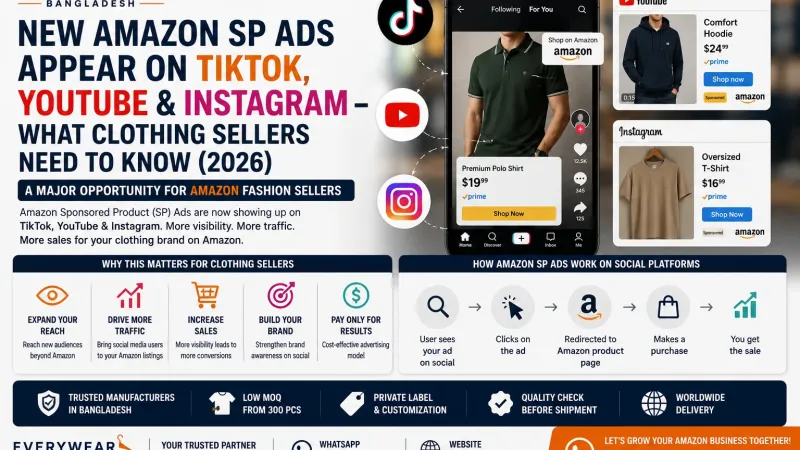
New Amazon SP Ads Appear on TikTok, YouTube & Instagram – What Clothing Sellers Need to Know (2026)
Last updated: August 21, 2026 • [Complete Guide for Amazon FBA Sellers & Fashion Brands]
Quick Answer: What Is Amazon's New SP Ads Update and How Does It Affect Sellers?
Starting August 10, 2026, Amazon automatically expanded Sponsored Products (SP) ads to external creator content on platforms like TikTok, YouTube, and Instagram through the Amazon Influencer Program. This means your existing SP ad budget may now be spent on external influencer videos, product reviews, and shopping guides – without you creating new campaigns. The key concern: budget cannibalization. Your SP ads now compete for the same daily budget between high-intent Amazon search traffic and external "discovery" traffic on social platforms. Sellers who rely heavily on SP ads for search visibility risk having their budget "eaten" by external placements, leaving less for critical search terms. The solution: monitor your ad reports closely, adjust your "Expand Reach" settings, and consider low MOQ manufacturing to test products without massive ad spend risk.
On August 10, 2026, Amazon quietly rolled out one of the most significant advertising changes in recent years – Sponsored Products (SP) ads are now automatically appearing on TikTok, YouTube, and Instagram through creator content.
This update fundamentally changes how Amazon advertising works. Your carefully managed SP ad budget – previously focused on high-intent Amazon search traffic – may now be diverted to external influencer videos, product reviews, and shopping guides without your explicit consent.
For clothing sellers, this is critical news. Fashion and apparel products are highly visual, lifestyle-oriented, and "shoppable" – exactly the type of products that perform well in creator content. This means your ads are more likely to be shown on external platforms, potentially consuming budget that was intended for search campaigns.
This comprehensive guide explains everything you need to know: what changed, why it matters, how it affects your advertising costs, and what you can do to protect your budget and maintain profitability.
What Exactly Changed? The August 10 SP Ads Update
On August 4, 2026, Amazon updated its advertising documentation to include "creator content placements." This was followed by an official email to advertisers confirming: effective August 10, 2026, Sponsored Products ads would automatically be eligible to appear in Amazon Influencer Program creator content across external platforms.
Where Can Your Ads Now Appear?
Your SP ads may now appear in:
- TikTok – Tech reviews, lifestyle content, product recommendations
- YouTube – Product reviews, unboxings, shopping guides
- Instagram – Influencer content, shoppable posts
- Other creator content platforms – Where Amazon Influencer Program creators publish
Amazon is effectively transforming SP ads from "search ads" into "content ads" – positioning itself to compete with TikTok Shop and Instagram's shopping ecosystem.
How Does the New System Work?
| Feature | How It Works |
|---|---|
| Auto-Enrollment | Existing SP campaigns automatically included – no action required from sellers |
| Smart Matching | Amazon matches ads to relevant content based on product category and user behavior |
| Pricing Model | CPC (cost-per-click) – same as standard SP ads |
| Budget Allocation | Shared daily budget between internal and external placements |
| Control Options | "Expand Reach" setting (default ON) – can be disabled to limit external spending |
Why This Matters for Clothing Sellers
Not all products are equally affected by this change. Products with strong visual appeal, lifestyle relevance, and "shoppable" characteristics are more likely to be shown in creator content.
Clothing Products Are Prime Targets for Creator Content
According to Amazon's update, products that are likely to see external placements include:
- Easily demonstrated through video – Clothing is perfect for try-ons, styling videos, and outfit showcases
- Visually distinctive – Fashion is inherently visual and "Instagram-worthy"
- Lifestyle-oriented – Clothing is tied to identity, fashion, and self-expression
- Demonstrable and reviewable – Fashion influencers thrive on clothing content
- Solution-oriented – Solves problems like "what to wear" or "how to style"
- Highly "inspirational" – Clothing is inherently "aspirational" and content-friendly
This means clothing sellers are disproportionately affected by the SP Ads update. Your ads are more likely to be selected for external placements, consuming budget that might otherwise go toward high-intent search traffic.
The Budget Cannibalization Problem
The biggest risk is budget cannibalization – your SP ad budget is now shared between two fundamentally different types of traffic:
| Traffic Type | Intent | Value for Sellers |
|---|---|---|
| Amazon Search Traffic | HIGH – User is actively searching to buy | High conversion, high ROI |
| External Creator Traffic | LOW – User is browsing content | Lower conversion, more "discovery" |
When a seller's daily SP budget is limited, external traffic can "eat" budget that would otherwise go to high-intent search traffic. The result: fewer impressions on Amazon search results when customers are actively looking for your products.
Real-World Impact Example
Consider a clothing seller with a $50 daily SP budget. Previously, all $50 went toward Amazon search traffic. Now, a portion may be diverted to TikTok and YouTube influencer content. The seller may see:
- Fewer impressions on Amazon search results
- Lower conversion rates (external traffic converts less than search traffic)
- Higher ACOS (Advertising Cost of Sales) due to lower conversion
- Reduced visibility for key search terms when budgets run out
How to Protect Your SP Ad Budget
While you cannot completely disable external creator placements, you can manage and limit them.
1. Disable "Expand Reach" in Your Campaign Settings
When creating or editing SP campaigns, look for the "Expand Reach" setting – it is default ON and enables external placements.
Action:
- Review all active SP campaigns
- Locate the "Expand Reach" or "Amazon Standort" setting
- Disable it to limit external spending
- Note: This reduces external exposure but does not completely eliminate it
2. Monitor Your Advertising Reports Closely
Starting August 10, 2026, you need to track where your SP ad spend is going.
Action:
- Check your Advertising Reports for new placement categories
- Look for spikes in external traffic (TikTok, YouTube, Instagram sources)
- Monitor CPC changes – external placements may have different costs
- Track ACOS changes – external traffic typically converts lower
- Analyze ROI by placement – is external traffic delivering value?
3. Optimize Your Listing for Creator Selection
Amazon's algorithm selects products for creator content based on listing quality and engagement signals.
Action:
- Ensure your product images are high-quality and lifestyle-focused
- Include video content on your listing – creators prefer demonstrable products
- Maintain high ratings and positive reviews
- Keep your product title and description clear with key search terms
- Add A+ Content to improve listing quality signals
4. Consider FBA vs FBM Economics
With rising ad costs and new fee structures, some sellers are reevaluating FBA vs FBM.
Action:
- Calculate your total per-unit cost including advertising
- Compare FBA fulfillment costs vs FBM with a 3PL
- Some sellers report FBM can undercut FBA on qualifying SKUs
- Consider diversifying fulfillment options for lower-margin items
5. Leverage Low MOQ Manufacturing to Reduce Risk
With ad budgets becoming less predictable, inventory risk is even more critical. Low MOQ manufacturing from 300 pieces allows you to:
- Test products with less ad spend risk
- Validate demand before committing to large inventory orders
- Adjust quickly to changing ad economics
- Maintain profitability even with higher ACOS
Other August 2026 Amazon Updates You Need to Know
The SP Ads update is not happening in isolation. Amazon has rolled out multiple significant changes in August 2026 that affect clothing sellers.
1. BSA Update: No Account Transfers or Revenue Pledges (Effective August 24)
Effective August 24, 2026, Amazon is updating its Business Solutions Agreement (BSA) to prohibit sellers from transferring their accounts or pledging future Amazon sales revenue as collateral.
What this means:
- Sellers cannot transfer BSA rights without Amazon's written consent
- Sellers cannot pledge future sales revenue as collateral for loans
- This affects account sales, aggregator acquisitions, and revenue-based financing
- Violations can result in account suspension or fund freeze
What to do:
- Review any pending account transfers or M&A conversations before August 24
- Check revenue-based financing agreements – they may need restructuring
- Understand that account changes now require formal Amazon compliance processes
2. AWD Bulk Warehousing Launches in Europe (August 20)
On August 20, 2026, Amazon launched its Amazon Warehousing and Distribution (AWD) service in Germany, France, Italy, Spain, and the UK.
What this means:
- Sellers can store larger quantities of inventory in Amazon distribution centers
- Products are automatically moved to FBA centers based on demand
- Reduces storage costs for long-term inventory
- Ideal for sellers expanding into European markets
3. Amazon Germany Cuts Return Period to 14 Days (September 1)
Starting September 1, 2026, Amazon Germany reduces the return window from 30 to 14 days for 16 product categories. Clothing, shoes, and jewelry are EXEMPT – they keep 30 days.
4. EU Ban on Destroying Unsold Textiles (Effective July 19)
The EU ban on destroying unsold clothes, accessories, and footwear took effect July 19, 2026, under the Ecodesign for Sustainable Products Regulation (ESPR).
What this means:
- Large companies cannot destroy unsold apparel
- Must prioritize: selling, donating, or preparing for reuse
- Medium companies must comply by 2030
- Exemptions: unsafe, damaged, counterfeit, or rejected items
5. FBA Fee Increases (Effective August 1 and 15)
Amazon implemented multiple FBA fee increases in August 2026:
- Standard-size items under $12: +$0.34 per unit
- Low-inventory surcharge: +$0.18 for SKUs below 28 days of cover
- Large Bulky Plus tier: new fee for items exceeding 50 lbs
- Peak surcharge window: extended by six weeks (Oct 1 – Jan 31)
- Apparel sellers: generally paying more for FBA
How Everywear Bangladesh Helps Amazon Sellers Navigate These Changes
At Everywear Bangladesh, we understand that the 2026 Amazon landscape requires smarter manufacturing and inventory management – not just better advertising.
1. Low MOQ from 300 Pieces – Test with Less Ad Spend Risk
With SP ad budgets becoming less predictable, inventory risk is more critical than ever. Everywear Bangladesh supports low MOQ production from 300 pieces per design, allowing you to:
- Test new products with less capital exposure
- Validate demand before committing to large orders
- Manage cash flow more effectively
- Adjust quickly to changing advertising economics
2. Private Label Manufacturing – Build a Brand That Stands Out
With external creator content becoming more important, brand recognition and product quality matter more than ever. We help you build a trustworthy brand:
- Custom woven labels – Your brand name and logo
- Printed neck labels – Professional brand presentation
- Hang tags – Branded marketing materials
- Custom poly bags – Professional packaging for Amazon FBA
- Branded cartons – Consistent brand experience
3. Quality Control – Reduce Returns and Protect Your Ratings
With clothing returns running 20-40%, quality is your best defense. Our quality control process includes:
- Fabric inspection – Before cutting begins
- In-line sewing inspection – Throughout production
- Printing and embroidery verification – Accurate artwork placement
- Final AQL inspection – Comprehensive quality check
- Video-call inspection – Verify your order before shipment
4. US Cotton Zero-Tariff – Save on Import Duties
Under the Agreement on Reciprocal Trade (ART) signed between the US and Bangladesh in February 2026, garments made with US-origin cotton or man-made fibres enter the US market at a zero reciprocal tariff rate. This can save US Amazon sellers approximately 19% in tariffs – directly improving your margins.
5. Shipping to Amazon Warehouses
We coordinate shipping to Amazon fulfillment centers across the USA:
- Sea freight – Most economical for bulk orders (25-35 days)
- Air freight – Faster option for urgent restocking (8-12 days)
- Courier services – Perfect for samples and small shipments (3-5 days)
- Export documentation – Commercial invoices, packing lists, certificates of origin
- Amazon FBA prep – Polybagging and labeling support
6. End-to-End Support – One Accountable Partner
You deal with Everywear directly – not multiple factories or middlemen. We provide:
- Dedicated account manager – Your single point of contact
- Regular production updates – Photos and progress reports
- 24/7 WhatsApp support – For urgent queries
- Transparent pricing – No hidden costs
- Factory visits and virtual tours – Upon request
Contact Everywear Bangladesh on WhatsApp
Frequently Asked Questions
Everything you need to know about Amazon's SP Ads update and other August 2026 changes affecting clothing sellers.
1. What is the new Amazon SP Ads update?
Effective August 10, 2026, Amazon automatically expanded Sponsored Products (SP) ads to external creator content on platforms like TikTok, YouTube, and Instagram through the Amazon Influencer Program. Your existing SP campaigns are automatically included – no action required from sellers.
2. Where can my SP ads now appear?
Your SP ads may now appear in creator content on TikTok, YouTube, and Instagram – including tech reviews, lifestyle content, product recommendations, unboxings, and shopping guides. Amazon is transforming SP ads from "search ads" into "content ads."
3. Why does this matter for clothing sellers?
Clothing products are highly visual, lifestyle-oriented, and "shoppable" – exactly the type of products that perform well in creator content. This means your ads are more likely to be shown on external platforms, potentially consuming budget that was intended for high-intent Amazon search campaigns.
4. What is the budget cannibalization risk?
Your SP ad budget is now shared between high-intent Amazon search traffic and lower-intent external creator traffic. External traffic can "eat" budget that would otherwise go to search results, reducing visibility when customers are actively looking for your products.
5. Can I opt out of external SP ad placements?
You cannot completely disable external creator placements. However, you can limit them by disabling the "Expand Reach" setting when creating or editing SP campaigns. This setting is default ON, so you must actively turn it off.
6. How do I monitor external SP ad spend?
Check your Advertising Reports for new placement categories. Look for spikes in external traffic (TikTok, YouTube, Instagram sources), monitor CPC changes, track ACOS changes, and analyze ROI by placement to determine if external traffic is delivering value.
7. What products are most likely to appear in creator content?
Products that are easily demonstrated through video, visually distinctive, lifestyle-oriented, reviewable, and "aspirational" are more likely to be shown. Clothing, fashion, beauty, and lifestyle products are prime targets.
8. What is the Amazon BSA update effective August 24, 2026?
Effective August 24, 2026, Amazon prohibits sellers from transferring BSA rights without Amazon's written consent and pledging future Amazon sales revenue as collateral. Violations can result in account suspension or fund freeze.
9. Who is affected by the BSA update?
Sellers in active M&A negotiations, revenue-based lenders using Amazon sales as collateral, and aggregators are most affected. Existing revenue-based financing facilities should be reviewed with legal counsel immediately.
10. What is Amazon AWD and when did it launch in Europe?
August 20, 2026, Amazon launched its AWD (Amazon Warehousing and Distribution) service in Germany, France, Italy, Spain, and the UK. It provides long-term bulk storage linked to FBA, with products automatically moved to FBA centers based on demand.
11. Did Amazon Germany reduce clothing return periods?
No. Starting September 1, 2026, Amazon Germany reduces the return window from 30 to 14 days for 16 product categories, but clothing, shoes, and jewelry are EXEMPT – they keep 30 days.
12. What is the EU ban on destroying unsold textiles?
Effective July 19, 2026, large companies in the EU cannot destroy unsold clothes, accessories, or footwear under the Ecodesign for Sustainable Products Regulation (ESPR). They must prioritize selling, donating, or preparing for reuse.
13. What are the new FBA fee increases in August 2026?
Amazon implemented multiple FBA fee increases: standard-size items under $12 +$0.34 per unit, low-inventory surcharge +$0.18 for SKUs below 28 days of cover, a new Large Bulky Plus tier, and the peak surcharge window extended by six weeks.
14. How do FBA fee increases affect clothing sellers?
Apparel sellers are generally paying more for FBA. Combined with rising ad costs and returns fees, the total effective take rate for apparel sellers is now 34-38% of sale price. This makes low MOQ manufacturing and inventory management even more critical.
15. Why is low MOQ important for Amazon sellers in 2026?
With rising ad costs, FBA fees, and return fees, inventory risk is more critical than ever. Low MOQ (300 pieces) allows sellers to test products with less capital exposure, validate demand before scaling, manage cash flow effectively, and adjust quickly to changing economics.
16. What is the US Cotton Clause and how does it benefit sellers?
Under the Agreement on Reciprocal Trade (ART) signed between the US and Bangladesh in February 2026, garments made with US-origin cotton or man-made fibres enter the US market at a zero reciprocal tariff rate. This can save US Amazon sellers approximately 19% in tariffs – directly improving margins.
17. How can I optimize my listing for creator content selection?
Amazon's algorithm selects products based on listing quality and engagement signals. Ensure high-quality, lifestyle-focused images, include video content, maintain high ratings, keep clear titles and descriptions, and add A+ Content.
18. Should I consider switching from FBA to FBM?
Some sellers report FBM can undercut FBA on qualifying SKUs, but it comes with trade-offs: Buy Box eligibility becomes less predictable and cancellation rates may increase. Evaluate your specific SKUs, margins, and fulfillment costs.
19. How can Everywear Bangladesh help me navigate these changes?
Everywear Bangladesh offers low MOQ from 300 pieces, private label manufacturing, quality control, US Cotton Zero-Tariff savings, and shipping to Amazon warehouses – helping you test products with less risk, build a trustworthy brand, and maintain profitability in a changing environment.
20. How do I start sourcing clothing from Bangladesh for my Amazon brand?
Contact Everywear Bangladesh on WhatsApp. Our team will understand your requirements, connect you with verified manufacturers, assist with product development, manage quality control, and coordinate shipping to Amazon warehouses. With low MOQ from 300 pieces and full private label support, we make it easy to test and scale your Amazon clothing brand.
Conclusion
Amazon's August 2026 SP Ads update represents a fundamental shift in how advertising works on the platform. Your carefully managed ad budgets can now be spent on TikTok, YouTube, and Instagram through creator content – potentially cannibalizing the high-intent search traffic that drives conversions.
For clothing sellers, this is particularly significant because fashion products are prime candidates for creator content – and your ads are more likely to be selected for external placements.
Success requires vigilant monitoring of ad reports, strategic management of the "Expand Reach" setting, and smarter inventory decisions – including low MOQ manufacturing to test products with less risk.
At Everywear Bangladesh, we help Amazon sellers navigate these changes with low MOQ from 300 pieces, private label manufacturing, quality control, US Cotton Zero-Tariff savings, and end-to-end support. Our team is ready to help you build a profitable clothing brand on Amazon in this new advertising landscape.
Contact Everywear Bangladesh on WhatsApp
About the Author
Written by the Everywear Bangladesh Research & Sourcing Team
The Everywear Bangladesh editorial team combines deep industry expertise in Bangladesh's Ready-Made Garment (RMG) sector with practical experience in international apparel sourcing, supply chain management, and Amazon FBA selling. Our team includes former garment factory managers, sourcing professionals, and e-commerce specialists who have helped hundreds of Amazon sellers launch their clothing brands.
Our mission is to provide accurate, data-driven, and actionable content that helps fashion entrepreneurs, Amazon sellers, and global brands make informed sourcing decisions. We leverage real-time data from Amazon Seller Central, the Bangladesh Garment Manufacturers and Exporters Association (BGMEA), Export Promotion Bureau (EPB), and other authoritative sources to ensure our insights reflect the latest industry developments.
Connect with Everywear Bangladesh:
- Website: everywearbd.com
- WhatsApp: +8801788898174
- Facebook: facebook.com/everywearbd
- LinkedIn: Everywear Bangladesh Ltd
References
- Amazon Seller Central, "Sponsored Products Advertising Update: Creator Content Placements," August 4, 2026
- Amazon Advertising, "Amazon Influencer Program: Creator Content Advertising Guidelines," August 2026
- Amazon Business Solutions Agreement, "BSA Update: Account Transfer and Revenue Pledge Restrictions," August 24, 2026
- Seller Sprite, "Amazon Freezes Revenue Assignment: What the August 24 BSA Change Means for Sellers and Aggregators," August 2, 2026
- CEP Research, "Amazon Launches Bulk Warehousing Service in Major European Markets," August 18, 2026
- Amazon Germany, "Return Policy Update: 14-Day Return Window for Select Categories," August 9, 2026
- European Commission, "Ecodesign for Sustainable Products Regulation (ESPR) – Ban on Destruction of Unsold Textiles," July 19, 2026
- Ecommerce Times, "Amazon's New FBA Fee Tiers Are Forcing Sellers to Reprice or Exit," August 8, 2026
- Amazon FBA, "2026 Fee Changes: Standard Size, Low Inventory, and Peak Surcharge Updates," August 1, 2026
- Velocity Sellers, "Amazon Cut the Return Window to 14 Days in 16 Categories on September 1," August 10, 2026
Related Resources
GEO Landing Pages
- USA Buyers: Wholesale Garments from Bangladesh
- UK Buyers: Wholesale Garments from Bangladesh
- Europe Buyers: Wholesale Clothing from Bangladesh
Blog Posts
- Amazon Fashion Sellers: Source Clothing from Bangladesh
- How to Start a Clothing Brand on Amazon FBA – Step-by-Step Guide 2026
- Amazon Clothing Seller's Guide 2026 – Trends, Fees & Winning Strategies
- Amazon Cuts 27 Private Label Clothing Brands – What This Means for Third-Party Sellers
- Private Label T-Shirt Manufacturer Bangladesh – Complete Guide 2026
- Low MOQ Clothing Manufacturer Bangladesh
This guide is updated regularly. Last reviewed: August 21, 2026. For sourcing solutions tailored to your Amazon brand, contact Everywear Bangladesh on WhatsApp.
Everywear Bangladesh Ltd. – Bangladesh's First RMG Wholesale Marketplace | 300 Pcs Custom Orders | Export Quality Garments
WhatsApp: +8801788898174 • Website: everywearbd.com
Leave a comment