





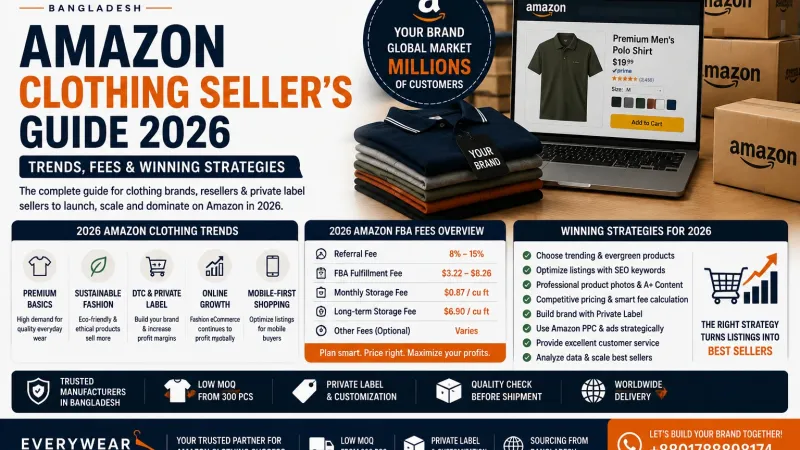
Amazon Clothing Seller's Guide 2026 – Trends, Fees & Winning Strategies
Last updated: August 19, 2026 • [Complete Guide for Amazon Fashion Sellers & Private Label Brands]
Amazon's apparel category is now the #1 category on the platform – overtaking home & garden globally, across the U.S., and even at Target during Prime Day 2026. For sellers, this creates enormous opportunity. But the 2026 playing field has changed dramatically: rising fees, a new returns processing cost, and increasingly aggressive competition from Chinese sellers are reshaping the math on every SKU.
The traditional 500-unit private label model is facing "unprecedented challenges" due to increased FBA fees and advertising costs[reference:0]. Meanwhile, Chinese sellers now represent over 50% of third-party sellers on Amazon, leveraging low-cost manufacturing and rapid supply chains to dominate activewear, basics, and accessories[reference:1].
This guide covers everything you need to know to win in 2026: the new fee structures, return rate realities, top-selling categories, and a manufacturing strategy that protects your margins – starting with low MOQ from 300 pieces.
Why Apparel Is Now Amazon's #1 Category
Apparel, shoes & accessories overtook home & garden as the top-selling category on Amazon globally, across the U.S., and at Target during Prime Day 2026. Europe grew fastest – Amazon sales for EMEA clients rose 16% event over event.
Apparel generates roughly $338 million in monthly sales on Amazon, followed by shoes at about $215 million a month[reference:2]. Within apparel, men's activewear is the most popular subcategory, generating around $95 million monthly[reference:3].
Private label growth is also accelerating. Women's apparel is driving the heavy lifting: Womenswear grew +126% (+$217m), Girls' Apparel grew +132% (+$16m), Menswear +28% (+$50m), and Boys' Apparel +61% (+$10m)[reference:4][reference:5].
Chinese Brands Are Gaining Ground
Chinese sellers are significantly outperforming U.S. brands in categories like sweatsuits and workout sets, according to Market Defense data[reference:6]. About 7,200 men's fashion brands are sold on Amazon[reference:7].
Key Chinese brand presence includes:
- COOFANDY – Men's apparel, activewear, workout sets[reference:8]
- Snowten – Golf pants, suit pants[reference:9]
- Ekouaer – Women's loungewear[reference:10]
- ZEAGOO – Women's apparel[reference:11]
Chinese sellers now represent over 50% of third-party sellers on the platform, leveraging low-cost manufacturing, rapid supply chains, and aggressive pricing[reference:12]. Data shows Chinese sellers dominating revenue share in apparel subcategories like activewear, basics, and accessories[reference:13].
However, the mid-range men's apparel segment ($25-$55) remains an opportunity – no Chinese seller has fully dominated this space yet[reference:14].
The Cost Challenge: Understanding 2026 Amazon Fees
1. Apparel Referral Fee
Amazon charges a 17% referral fee on the total sale price of clothing items (including shipping). In 2026, referral fees on select apparel categories were nudged up: apparel under $20 now carries a 17% referral fee (up from 15%), and items $20-$70 moved to 17% from 16% in most subcategories[reference:15].
2. FBA Fulfillment Fees
FBA fulfillment fees for standard-size clothing range from $3.06 to $4.75 per unit depending on weight, plus an apparel surcharge[reference:16]. The Low-Price FBA discount rose to $0.86[reference:17]. Apparel/shoes with special handling can cost $4.75-$6.10 per unit[reference:18].
3. Returns Processing Fee – The Game-Changer
This is the single biggest change for apparel sellers in 2026. Amazon charges apparel and shoe sellers a return processing fee equal to the full FBA fulfillment fee on every single returned unit – no threshold, no exceptions[reference:19][reference:20]. For other categories, the fee only applies once return rates exceed category-specific thresholds[reference:21].
Apparel and shoes are the highest-return categories on Amazon – clothing commonly runs 20–40% and shoes 17–30%[reference:22][reference:23] – and they're the categories Amazon singled out for the harshest version of its new returns processing fee[reference:24].
Real-world impact:
- At a $6.50 FBA fulfillment fee, a 25% return rate across 400 monthly units means 100 returns – and $650 per month in return processing fees alone[reference:25]
- Apparel and shoes carry a 0% threshold – there's no free band of returns[reference:26]
- A homewares seller with a 6% return rate might pay the fee on only the units above their threshold; an apparel seller pays on all of them[reference:27]
The Frequently Returned Item badge (expanded February 16, 2026) can cut conversions 25–50% with no appeal[reference:28]. This is a compounding margin and ranking liability[reference:29].
The total effective take rate for apparel sellers – including referral fee, FBA, placement, and returns fees – is now 34–38% of sale price[reference:30].
4. FBA Prep Changes (January 1, 2026)
Amazon stopped doing your FBA prep and labeling[reference:31]. Bagging, bubble-wrapping, barcode application, bundling – all of it is now your responsibility[reference:32]. Non-compliant shipments can be refused or disposed of with no reimbursement[reference:33].
Why the Traditional 500-Unit Model Is Becoming Too Risky
The traditional 500-unit private label model is facing "unprecedented challenges" due to increased FBA fees and advertising costs[reference:34]. Some sellers are pivoting to small-batch testing – ordering a few units per style first, validating demand, then scaling[reference:35].
Why this matters:
| Factor | Impact on 500-Unit Model |
|---|---|
| Returns Processing Fee | 20-40% return rate × $4.75+ per return = significant margin erosion |
| FBA Fee Increases | Higher fulfillment costs eat into already thin margins |
| Advertising Costs | Higher CPCs make it harder to launch new products profitably |
| Frequently Returned Badge | Can cut conversions 25-50% with no appeal |
| FBA Prep Responsibility | Additional operational costs and compliance risks |
The smarter approach: start small, validate demand, then scale. This is where low MOQ from 300 pieces becomes a critical competitive advantage.
What's Selling on Amazon in 2026
Top-Selling Products & Categories
| Category | Top Products | Growth/Performance |
|---|---|---|
| Suit Pants | Snowten, Haggar, Coofandy | +168% growth, $461K/month[reference:36] |
| Workout Sets | Coofandy, Uoua, Jmierr | $250,000/month[reference:37] |
| Sweatsuits | Uoua, Jmierr, Riskrole | $312,000/month[reference:38] |
| Compression Tank Tops | Jesido, Eleady, Dalavch | $414,000/month[reference:39] |
| Pleated Shorts | Haggar, Tbmpoy, Plepan | $71,000/month, $27.94 avg price[reference:40] |
Fastest-Growing Products
- Bunny Lulu: +957% growth[reference:41]
- Summer Dresses: +496% growth[reference:42]
- Tank Tops for Women: +420% growth[reference:43]
- Spring Dresses: +216% growth[reference:44]
- Dr Seuss Shirts: +617% growth[reference:45]
Trending Niches for 2026
- Women's nightwear – Strong demand, lower competition[reference:46]
- Cotton co-ord sets – Comfort-focused casual wear[reference:47]
- Kids' clothing – Girls' Apparel +132%[reference:48]
- Seasonal accessories – High demand during specific periods[reference:49]
- Plus-size apparel – Underserved but growing category[reference:50]
- Activewear & loungewear – Continued post-pandemic comfort trend[reference:51]
Niche-focused fashion consistently outperforms generic apparel[reference:52].
How Everywear Bangladesh Helps Amazon Sellers Win in 2026
At Everywear Bangladesh, we understand that the 2026 Amazon landscape requires smarter manufacturing – not just lower costs. Here's how we help Amazon sellers protect their margins and build profitable brands:
1. Low MOQ from 300 Pieces – Test Before You Scale
The traditional 500-unit model is becoming too risky[reference:53]. Everywear Bangladesh supports low MOQ production starting from 300 pieces per design. This allows you to:
- Test product-market fit with minimal risk
- Validate demand before committing to larger orders
- Manage cash flow more effectively
- Iterate based on customer feedback without massive inventory write-offs
2. Quality Control – Reduce Returns at the Source
With apparel return rates running 20-40%, quality is your best defense against returns and the new returns processing fee[reference:54][reference:55]. Our quality control process includes:
- Fabric inspection – Before cutting begins
- In-line sewing inspection – Throughout production
- Printing and embroidery verification – Accurate artwork placement
- Final AQL inspection – Comprehensive quality check with measurable pass/fail thresholds
- Video-call inspection – Verify your order before shipment
3. Private Label Manufacturing – Build Your Brand
We help you create a unique brand identity that stands out from Chinese sellers[reference:56]:
- Custom woven labels – Your brand name and logo
- Printed neck labels – Professional brand presentation
- Hang tags – Branded marketing materials
- Custom poly bags – Professional packaging for Amazon FBA
- Branded cartons – Consistent brand experience
4. US Cotton Zero-Tariff – Save on Import Duties
Under the Agreement on Reciprocal Trade (ART) signed between the US and Bangladesh in February 2026, garments made with US-origin cotton or man-made fibres enter the US market at a zero reciprocal tariff rate. This can save US Amazon sellers approximately 19% in tariffs – directly improving your margins.
5. Shipping to Amazon Warehouses
We coordinate shipping to Amazon fulfillment centers across the USA, with proper FBA prep compliance – bagging, labeling, and packaging that meets Amazon's 2026 requirements:
- Sea freight – Most economical for bulk orders (25-35 days)
- Air freight – Faster option for urgent restocking (8-12 days)
- Courier services – Perfect for samples and small shipments (3-5 days)
- Export documentation – Commercial invoices, packing lists, certificates of origin
- Amazon FBA prep – Polybagging and labeling support
6. End-to-End Support – One Accountable Partner
You deal with Everywear directly – not multiple factories or middlemen. We provide:
- Dedicated account manager – Your single point of contact
- Regular production updates – Photos and progress reports
- 24/7 WhatsApp support – For urgent queries
- Transparent pricing – No hidden costs
- Factory visits and virtual tours – Upon request
7. Amazon-Friendly Product Categories
We manufacture products that are proven sellers on Amazon in 2026:
- T-Shirts and Oversized T-Shirts
- Hoodies and Sweatshirts
- Polo Shirts
- Blank T-Shirts for Customization
- Etsy-Style Custom Apparel
- Streetwear Collections
Contact Everywear Bangladesh on WhatsApp
Frequently Asked Questions
1. What is the Amazon clothing referral fee in 2026?
Amazon charges a 17% referral fee on the total sale price of clothing items. In 2026, apparel under $20 moved to 17% (up from 15%), and items $20-$70 moved to 17% from 16% in most subcategories[reference:57].
2. What is the returns processing fee for apparel sellers in 2026?
Amazon charges apparel and shoe sellers a return processing fee equal to the full FBA fulfillment fee on every single returned unit – no threshold, no exceptions[reference:58][reference:59]. At a $6.50 fulfillment fee, a 25% return rate across 400 monthly units means $650 per month in return processing fees alone[reference:60].
3. What is the return rate for apparel on Amazon?
Apparel is the highest-return category on Amazon – clothing commonly runs 20–40% and shoes 17–30%[reference:61][reference:62]. This is why apparel sellers face the harshest version of the returns processing fee.
4. What is the total effective fee rate for apparel sellers in 2026?
The total effective take rate for apparel sellers – including referral fee (17%), FBA fulfillment (~$3.06-$4.75/unit), placement fees, and returns fees – is now 34–38% of sale price[reference:63].
5. What are the top-selling clothing categories on Amazon in 2026?
Top performers include: Suit pants (+168% growth, $461K/month), Workout sets ($250K/month), Sweatsuits ($312K/month), Compression tank tops ($414K/month), and Pleated shorts ($71K/month)[reference:64].
6. What is the "Frequently Returned" badge and why does it matter?
The Frequently Returned Item badge (expanded February 16, 2026) can cut conversions 25–50% with no appeal[reference:65]. Once triggered, it's a compounding margin and ranking liability[reference:66].
7. How can I reduce returns on Amazon clothing?
Clear pictures and accurate size charts are the best ways to stop customers from returning items[reference:67]. Focus on: accurate sizing, high-quality images that represent the product, detailed fabric descriptions, and consistent quality.
8. What happened to Amazon FBA prep services in 2026?
On January 1, 2026, Amazon stopped doing your FBA prep and labeling. Bagging, bubble-wrapping, barcode application, bundling – all of it is now your responsibility[reference:68]. Non-compliant shipments can be refused or disposed of with no reimbursement[reference:69].
9. Why should I choose Bangladesh for Amazon clothing manufacturing?
Bangladesh offers low MOQ from 300 pieces, competitive pricing (10-15% lower than China), a skilled workforce of 4 million workers, 290+ LEED-certified green factories, and the US Cotton Clause for zero tariff on US-origin cotton garments.
10. How does low MOQ help Amazon sellers in 2026?
The traditional 500-unit private label model is facing "unprecedented challenges" due to increased FBA fees and advertising costs[reference:70]. Low MOQ (300 pieces) allows you to test products with minimal risk, validate demand, manage cash flow, and iterate based on customer feedback before scaling.
11. Are Chinese brands dominating Amazon clothing?
Chinese sellers now represent over 50% of third-party sellers on Amazon and dominate activewear, basics, and accessories[reference:71]. Major brands include COOFANDY, Snowten, Ekouaer, and ZEAGOO[reference:72]. However, the mid-range men's apparel segment ($25-$55) remains an opportunity[reference:73].
12. What is the US Cotton Clause and how does it benefit Amazon sellers?
Under the Agreement on Reciprocal Trade (ART), garments made with US-origin cotton or man-made fibres enter the US market at a zero reciprocal tariff rate. This can save US Amazon sellers approximately 19% in tariffs – directly improving margins.
13. How can Everywear Bangladesh help me compete with Chinese sellers?
Everywear Bangladesh offers low MOQ from 300 pieces, private label manufacturing, quality control, US Cotton Zero-Tariff savings, and end-to-end support. This allows you to build a unique brand with competitive pricing and quality that stands out from Chinese mass-market sellers[reference:74].
14. What is the return processing fee rate card for apparel in 2026?
The return processing fee mirrors your outbound fulfillment fee. For small standard (under 1 lb): ~$3.06; large standard (1-2 lb): ~$4.75; apparel/shoes special handling: $4.75-$6.10[reference:75].
15. What is the minimum budget to start selling clothing on Amazon in 2026?
Most private label sellers launch with $3,000 to $5,000. However, with low MOQ from 300 pieces, you can test a product with lower initial inventory investment. Key costs: professional seller account ($39.99/month), samples ($50-$150), initial inventory (300+ pieces), shipping ($200-$500), photography ($200-$500), and initial PPC ($500-$1,000).
Conclusion
Amazon's apparel category is now the #1 category on the platform – a massive opportunity for sellers who can navigate the new 2026 landscape.
Success requires understanding the new reality: higher fees, returns processing costs, aggressive Chinese competition, and the death of the 500-unit model. The winning strategy is to start small, validate demand, and scale intelligently.
At Everywear Bangladesh, we help Amazon sellers succeed with low MOQ from 300 pieces, private label manufacturing, quality control, and US Cotton Zero-Tariff savings. Our team is ready to help you build a profitable clothing brand on Amazon.
Contact Everywear Bangladesh on WhatsApp
About the Author
Written by the Everywear Bangladesh Research & Sourcing Team
The Everywear Bangladesh editorial team combines deep industry expertise in Bangladesh's Ready-Made Garment (RMG) sector with practical experience in international apparel sourcing, supply chain management, and Amazon FBA selling. Our team includes former garment factory managers, sourcing professionals, and e-commerce specialists who have helped hundreds of Amazon sellers launch their clothing brands.
Our mission is to provide accurate, data-driven, and actionable content that helps fashion entrepreneurs, Amazon sellers, and global brands make informed sourcing decisions. We leverage real-time data from Amazon Seller Central, the Bangladesh Garment Manufacturers and Exporters Association (BGMEA), Export Promotion Bureau (EPB), and other authoritative sources to ensure our insights reflect the latest industry developments.
Everywear Bangladesh is committed to promoting responsible, transparent, and sustainable garment manufacturing practices while helping businesses navigate the complexities of international apparel sourcing.
Connect with Everywear Bangladesh:
- Website: everywearbd.com
- WhatsApp: +8801788898174
- Facebook: facebook.com/everywearbd
- LinkedIn: Everywear Bangladesh Ltd
References
- SellerForge.ai, "The 2026 Returns-Fee Margin Defense Playbook for Apparel and Footwear Sellers," June 16, 2026[reference:76]
- SellerForge.ai, "Amazon's 2026 FBA Fee Overhaul and the End of FBA Prep," June 2, 2026[reference:77]
- SellerView.ai, "FBA Fee Calculator: Understanding Return Processing Fees," 2026[reference:78]
- SellerView.ai, "Amazon FBA Calculator: The True Cost of One Return," 2026[reference:79]
- Feedvisor, "Amazon FBA Returns Processing Fees: The Complete 2026 Guide," February 19, 2026[reference:80]
- WWD.com, "By the Numbers: Chinese Brands Make Inroads in Menswear Sales on Amazon," April 17, 2026[reference:81]
- Kamcity.com, "Thought Amazon's Private Label Is Dead?" 2026[reference:82]
- Ecomcalctools.com, "Amazon Clothing Seller Fees 2026: Apparel Category Guide," April 22, 2026[reference:83]
- Amzprep.com, "Best Products to Sell on Amazon in 2026: Data by Category," 2026[reference:84]
- Ecommerce Times, "How to Navigate Amazon's 2026 Fee Restructure Without Killing Your Margins," May 27, 2026[reference:85]
Related Resources
GEO Landing Pages
- USA Buyers: Wholesale Garments from Bangladesh
- UK Buyers: Wholesale Garments from Bangladesh
- Europe Buyers: Wholesale Clothing from Bangladesh
Blog Posts
- Amazon Fashion Sellers: Source Clothing from Bangladesh
- How to Start a Clothing Brand on Amazon FBA – Step-by-Step Guide 2026
- Private Label T-Shirt Manufacturer Bangladesh – Complete Guide 2026
- Low MOQ Clothing Manufacturer Bangladesh
- Private Label Clothing Manufacturing Bangladesh – Complete Brand Guide 2026
- Clothing Suppliers from Bangladesh: The Ultimate Guide 2026
This guide is updated regularly. Last reviewed: August 19, 2026. For sourcing solutions tailored to your Amazon brand, contact Everywear Bangladesh on WhatsApp.
Everywear Bangladesh Ltd. – Bangladesh's First RMG Wholesale Marketplace | 300 Pcs Custom Orders | Export Quality Garments
WhatsApp: +8801788898174 • Website: everywearbd.com
Leave a comment