





Polo Shirt Manufacturer Bangladesh: The Ultimate 2026 Sourcing Guide
Last Updated: November 1, 2026 | By: Everywear Bangladesh Research & Sourcing Team
Quick Answer: How Do You Source Premium Polo Shirts from Bangladesh?
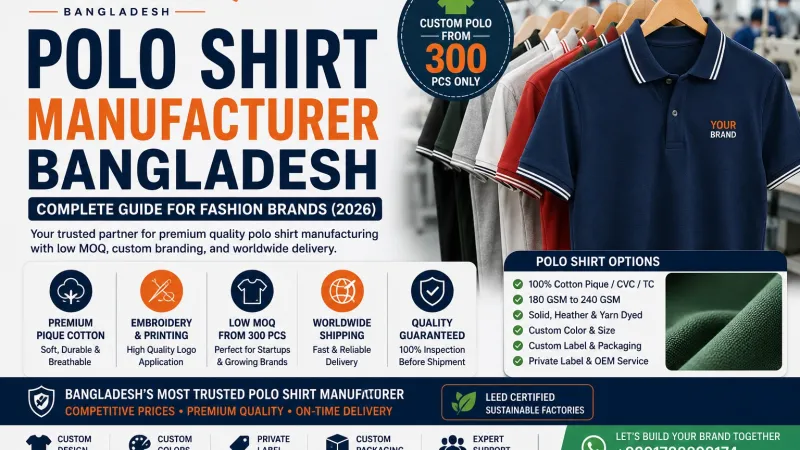
To source premium polo shirts from Bangladesh, you must specify a heavyweight cotton pique (220-240 GSM) with a flat-knit collar, interfaced placket, and side vents. The critical challenge is MOQ: traditional factories demand 3,000+ pieces, but EVERYWEAR BANGLADESH – BANGLADESH FIRST RMG WHOLESALE MARKETPLACE offers custom manufacturing from just 300 pieces. We manage the entire process—from yarn spinning and dyeing to embroidery, AQL 2.5 QC, and global shipping.
Why is Bangladesh the Global Capital for Polo Shirt Manufacturing?
Bangladesh is the global capital for polo shirt manufacturing because the country has perfected the entire knitwear supply chain—from spinning cotton yarn to knitting, dyeing, and complex embroidery. While China and Vietnam produce polos, Bangladesh offers the most competitive FOB pricing for high-volume orders.
According to the Bangladesh Garment Manufacturers and Exporters Association (BGMEA), the country is home to over 4,500 export-oriented factories and 4 million skilled workers. For polo shirts specifically, Bangladesh manufactures for globally recognized brands including Ralph Lauren, Lacoste, Tommy Hilfiger, and Hugo Boss.
Beyond cost, Bangladesh leads the world in sustainable garment manufacturing. The country houses 290 LEED-certified green factories, meaning US and EU brands can source premium polos with a significantly lower carbon footprint. Furthermore, the 2026 US-Bangladesh Agreement on Reciprocal Trade (ART) means that polos made with US-origin cotton enter the US at a 0% tariff, saving buyers up to 19% in duties.
The Anatomy of a Premium Polo Shirt: What Are You Actually Paying For?
A premium polo shirt is defined by its anatomical components. A cheap polo and a luxury polo may look similar on a screen, but they differ drastically in construction. If you are manufacturing for a premium brand, you must specify these exact components in your Tech Pack.
1. The Collar: Flat-Knit vs. Self-Fabric
The collar is the most important part of a polo shirt. It determines whether the shirt looks crisp and formal or cheap and floppy.
- Flat-Knit Collar (Premium): The collar is knitted separately on a dedicated flat-knitting machine. This creates a structured, dense fabric that holds its shape after multiple washes. Everywear insists on flat-knit collars for all premium orders.
- Self-Fabric Collar (Cheap): The collar is cut from the same fabric as the body of the shirt. Because the fabric is knitted for the body (not for structure), the collar will curl and lose its shape after the first wash. We strictly prohibit this for brands building long-term reputation.
- Collar Tipping: This is a contrast color added to the edge of the collar and cuffs. It is a classic "Old Money" aesthetic and requires precise cutting and sewing.
- Collar Stays: Small plastic inserts placed inside the collar to keep it perfectly sharp. Often found in high-end golf polos.
2. The Placket
The placket is the opening at the neck where the buttons sit. A premium placket must be interfaced (fused with a stiffening material) to prevent it from wrinkling or gaping.
- 2-Button Placket: The standard for casual polos.
- 3-Button Placket: More formal, often used in golf and corporate uniforms.
- Hidden (Covered) Placket: The buttons are hidden under a flap of fabric for a minimalist, modern look. This requires extra fabric and highly skilled operators.
3. The Side Vents
Side vents are small slits at the bottom hem. They are crucial for two reasons: they allow the shirt to be worn untucked comfortably, and they prevent the hem from tearing. Premium polos use a reinforced "kissing stitch" or "bartack" at the top of the vent to prevent it from ripping.
4. The Cuffs and Sleeves
Like the collar, premium cuffs should be ribbed or flat-knit to grip the arm slightly and prevent them from stretching out. The sleeve length is critical for the "Old Money" aesthetic—it should hit mid-bicep, not below the elbow.
The Fabric Masterclass: Understanding Yarn Counts and GSM
Many buyers only ask for "100% Cotton." This is a massive mistake. The quality of your polo shirt is determined by the Yarn Count and the Fabric Weight (GSM).
What is GSM (Grams per Square Meter)?
GSM is the weight of the fabric. A higher GSM means a thicker, heavier, and more durable fabric.
| GSM Range | Feel & Drape | Best Use Case |
|---|---|---|
| 160 - 180 GSM | Lightweight, sheer, breathable. | Budget polos, tropical climates, giveaways. |
| 180 - 200 GSM | Standard weight, classic retail feel. | Corporate uniforms, everyday retail. |
| 220 - 240 GSM | Heavyweight, structured, luxurious. | Premium fashion brands, golf apparel, Old Money. |
The Secret of Yarn Counts (20s, 30s, 40s)
Yarn count refers to the thickness of the individual threads used to knit the fabric. It is usually expressed in "Single" (S) or "Double" (2-ply).
- 20s Single (20S): A thicker, coarser yarn. It is durable but feels rougher. Often used for cheap, heavy hoodies.
- 30s Single (30S): The industry standard for t-shirts and standard polos. A good balance of softness and durability.
- 40s Single (40S): A finer, smoother yarn. Used for premium, lightweight t-shirts and luxury polos.
- Combed vs. Carded Cotton: "Combed" cotton has gone through an extra brushing process to remove short fibers and impurities. This makes the fabric significantly softer, smoother, and more durable. Always insist on Combed Cotton for premium polos.
Pique vs. Interlock vs. Jersey
Pique is the classic polo fabric with a waffle-like texture. Interlock is a double-knit fabric that is smooth on both sides (like a luxury dress shirt). Jersey is a single-knit fabric that is stretchy and soft (like a t-shirt). For premium polos, Pique is the standard, but Interlock is used for high-end, formal polos.
The 6-Step Polo Shirt Manufacturing Process
Manufacturing a polo shirt is significantly more complex than manufacturing a t-shirt. It requires specialized machinery and highly skilled operators. Here is the exact process your factory goes through.
Step 1: Yarn Spinning & Knitting
The raw cotton is spun into yarn. The yarn is then fed into circular knitting machines (for the body) and flat-knitting machines (for the collar and cuffs). This is where the GSM and texture (Pique) are determined.
Step 2: Dyeing and Finishing
The "greige" fabric is dyed to your specific Pantone color. Premium factories use Reactive Dyeing, which bonds the color molecules to the fabric fibers, ensuring the color does not fade after washing. We always provide "Lab Dips" (fabric swatches) for your approval before bulk dyeing.
Step 3: Cutting
The fabric is laid out in multiple layers and cut using a cutting machine. Precision is critical—the fabric grain must be perfectly straight, or the polo will twist after washing.
Step 4: Placket & Collar Prep
This is the most complex stage. The placket is fused with interlining (a stiffening material) using a heat press. The collar is knitted separately and attached to the neckline. If the operator is inexperienced, the collar will be asymmetrical or the placket will wrinkle.
Step 5: Sewing & Assembly
Operators use industrial sewing machines (Overlock, Flatlock, Single Needle) to assemble the shirt. The side vents and hem are finished with a coverstitch machine to prevent unraveling.
Step 6: Embroidery, Finishing, and QC
Your logo is embroidered onto the left chest or sleeve. The garments are then trimmed, ironed, measured, and inspected before being polybagged.
The Decoration Masterclass: Embroidery vs. Printing for Polo Shirts
The decoration is what transforms a blank polo shirt into a branded, sellable product. Because polo shirts are inherently more formal than t-shirts, the decoration method must match the garment's premium aesthetic.
Embroidery: The Gold Standard for Polos
Embroidery is the most popular decoration for polo shirts because it adds texture, depth, and a highly professional look. At Everywear, we use multi-head computerized embroidery machines that can handle up to 15 colors simultaneously.
| Embroidery Type | How It's Made | Best For |
|---|---|---|
| Flat Embroidery | Standard stitching flat against the fabric. | Corporate logos, school crests, left-chest branding. |
| 3D Puff Embroidery | A layer of foam is placed under the stitches, creating a raised effect. | Streetwear brands, bold logos, modern fashion. |
| Appliqué Embroidery | A piece of fabric is cut and sewn onto the shirt, then stitched around the edges. | Large logos, varsity-style designs, retro branding. |
| Chenille Embroidery | A soft, looped yarn that creates a fuzzy, textured patch. | Luxury brands, premium casualwear, vintage aesthetics. |
The Secret to Great Embroidery: Stitch Density and Backing. A cheap factory will use a low stitch count (making the logo look thin and cheap) and no backing material (causing the logo to scratch the wearer's chest). Everywear requires a minimum stitch density and a soft-cut backing for all left-chest embroidery.
Printing: When and Where to Use It
While embroidery is king for the left chest, printing is often used for large graphics on the back of the polo, or for modern streetwear designs.
- Screen Printing: The most cost-effective method for large orders. We use plastisol inks for vibrant, long-lasting colors.
- DTG (Direct-to-Garment): Best for complex, photo-realistic designs or small batches. It uses water-based inks that soak into the fabric.
- Puff Printing: Creates a raised, 3D texture similar to 3D puff embroidery, but with ink instead of thread.
The MOQ Economics: Why 300 Pieces is the Magic Number
The biggest barrier for emerging brands is the Minimum Order Quantity (MOQ). Traditional polo factories in Bangladesh require 1,000 to 3,000 pieces per color. Why? Because of the fixed costs of setting up a production line.
However, Everywear Bangladesh has engineered a solution to offer a 300-piece MOQ. To understand how we do it, you must understand the math behind fabric minimums.
The Fabric Mill Trap
A polo shirt factory does not knit its own yarn. It buys fabric from a fabric mill. The fabric mill requires a minimum order of 500 to 1,000 kilograms of dyed fabric per color.
A standard polo shirt weighs about 0.25 kg. Therefore, 1,000 kg of fabric yields 4,000 polo shirts. If you only want 300 pieces, the factory is left with 925 kg of fabric they cannot use. They will either reject your order or charge you a "fabric deadstock penalty."
How Everywear Solves This
Everywear acts as an aggregator. We have 700+ verified factory partners. We pool together multiple 300-piece orders that use the same fabric quality and color. By combining these small orders into one massive fabric purchase, we meet the mill's minimum, but each individual brand only has to pay for their 300 pieces.
This is how we make premium manufacturing accessible. You can read the full breakdown on our How Garment Factories Calculate MOQ page.
Why Everywear Bangladesh is Your Ideal Polo Sourcing Partner
EVERYWEAR BANGLADESH – BANGLADESH FIRST RMG WHOLESALE MARKETPLACE
We do not just connect you to a factory; we act as your managed sourcing department. From the first fabric swatch to the final delivery at your warehouse, we handle the complexity so you can focus on marketing and sales.
| What We Offer | What This Means for Your Polo Brand |
|---|---|
| 300-Piece MOQ | Test your premium polo designs without committing to 3,000 pieces of dead stock. |
| Flat-Knit Collar Guarantee | We explicitly enforce flat-knit collars and interfaced plackets on every order. No curled collars. |
| Managed QC & Video Verification | Pre-production, in-line, and final AQL 2.5 inspections. Video call verification before shipment. |
| Private Label & Embroidery | Custom woven labels, printed neck tags, left-chest embroidery, and branded polybags. |
| US Cotton Zero-Tariff | For US-bound orders, we source US-origin cotton to qualify for 0% reciprocal tariffs. |
Quality Control: The AQL 2.5 Inspection Process
Quality Control (QC) is the difference between a profitable brand and a customer service nightmare. At Everywear, we do not rely on the factory's internal QC team. We send our own inspectors to the factory floor.
The 3-Stage Inspection
- Pre-Production (Fabric Check): We test the fabric for shrinkage, colorfastness, and GSM accuracy before a single piece is cut.
- In-Line Inspection: While the shirts are being sewn, our inspectors check the placket alignment, collar symmetry, and stitch density.
- Final AQL 2.5 Inspection: Once the order is packed, we use the ANSI/ASQ Z1.4 standard (AQL 2.5) to randomly pull samples. We check for measurement accuracy, loose threads, embroidery defects, and packaging quality.
The Video Verification
For international buyers, we offer a live video call during the final inspection. You can direct our camera operator to show you the collars, the plackets, and the packaging. We do not ship your order until you are satisfied.
Lead Times, Shipping, and Logistics
Understanding the timeline of your polo order is critical for planning your marketing calendar. Here is the realistic timeline for a 300-piece custom polo order.
| Stage | Duration | What Happens |
|---|---|---|
| Sampling | 7-14 Days | We produce a physical sample and ship it via DHL for your approval. |
| Bulk Production | 30-45 Days | Fabric knitting, dyeing, cutting, sewing, and embroidery. |
| QC & Packing | 3-5 Days | AQL inspection, polybagging, and cartonization. |
| Air Freight | 8-12 Days | Fast delivery to your warehouse or Amazon FBA center. |
| Sea Freight | 25-35 Days | Economical delivery for larger orders. |
Frequently Asked Questions (FAQ)
1. What is the best fabric for a premium polo shirt?
The best fabric is 100% Cotton Pique between 220-240 GSM. This heavier weight gives the polo a structured drape and a luxurious feel suitable for premium brands.
2. Why do cheap polo collars curl?
Cheap polo collars curl because they use a "self-fabric" collar (cut from the body fabric) instead of a "flat-knit" collar (knitted separately). Everywear only uses flat-knit collars for premium quality.
3. Can I order custom polo shirts with a 300-piece MOQ?
Yes. Everywear Bangladesh specializes in 300-piece MOQ manufacturing. Traditional factories require 1,000+, but we aggregate orders to make small runs possible.
4. How much does a custom polo shirt cost?
FOB pricing ranges from $4.00 to $8.50 depending on fabric, GSM, and embroidery complexity. Visit our Polo Money Page for a full pricing breakdown.
5. What is the difference between a 2-button and 3-button placket?
A 2-button placket is more casual and common for everyday polos. A 3-button placket is more formal and often used for golf or premium corporate wear.
6. Can you match a specific Pantone color for my polos?
Yes. We require a Pantone TCX or TPX code. We will produce a physical lab dip (fabric swatch) for your approval before dyeing the bulk fabric.
7. What is the lead time for 300 custom polo shirts?
Sampling takes 7-14 days. Bulk production takes 30-45 days. Shipping adds 8-12 days (air) or 25-35 days (sea).
8. Do you offer organic cotton polo shirts?
Yes. We offer GOTS-certified organic cotton pique, perfect for sustainable fashion brands targeting the EU market.
9. Can I get a sample before placing a bulk order?
Yes, sampling is highly recommended. We will produce a physical sample of your polo design and ship it to you for approval before bulk production.
10. Do you offer collar tipping?
Yes. Collar tipping (a contrast color on the edge of the collar and cuffs) is a popular premium detail we can add to your polo design.
11. What is the US Cotton Clause for polo shirts?
Under the 2026 US-Bangladesh trade agreement, polos made with US-origin cotton enter the US at a 0% tariff, saving you ~19% on import duties.
12. Can you embroider my brand logo on the left chest?
Yes. Left-chest flat embroidery is our most popular decoration. We will provide a digital stitch-out or physical sample for your approval.
13. How do I start ordering custom polo shirts from Everywear?
Simply message us on WhatsApp at +8801788898174. Tell us your target quantity (min 300 pcs), fabric preference (GSM), and design details. Our team will guide you through sampling and production.
14. What is the difference between Pique and Interlock fabric?
Pique has a textured honeycomb weave that is breathable and classic for polos. Interlock is smoother, thicker, and more stable, offering a refined finish for luxury polos.
15. Do you offer plus-size polos?
Yes. We can manufacture polos up to 5XL or larger. We use graded patterns to ensure the fit is proportional across all sizes.
16. How do you ensure the buttons don't fall off?
Our AQL 2.5 inspection includes a "pull test" on buttons to ensure they are securely sewn. We can also use reinforced stitching for extra durability.
17. Can you handle Amazon FBA prep for polo shirts?
Yes. We provide full FBA prep, including polybagging with a suffocation warning, FNSKU labeling, and cartonization according to Amazon's requirements.
18. What are your payment terms?
Standard terms are 50% deposit upon order confirmation (after sample approval) and 50% balance before shipment (after video verification).
19. Are your factories compliant with EU regulations?
Yes. We only work with factories holding BSCI, WRAP, or SEDEX certifications. We also provide the necessary documentation for EU DPP compliance.
20. How do I start the process with Everywear Bangladesh?
Simply message us on WhatsApp at +8801788898174. Tell us your target quantity (min 300 pcs), fabric preference, and design. Our team will guide you through sampling and production.
About the Author
Written by the Everywear Bangladesh Research & Sourcing Team
The Everywear Bangladesh editorial team combines deep industry expertise in Bangladesh's Ready-Made Garment (RMG) sector with practical experience in international apparel sourcing, supply chain management, and Amazon FBA selling. Our team includes former garment factory managers, sourcing professionals, and e-commerce specialists who have helped hundreds of global brands launch their clothing lines with low MOQs.
Connect with Everywear Bangladesh:
- Website: everywearbd.com
- WhatsApp: +8801788898174
- Facebook: facebook.com/everywearbd
- LinkedIn: Everywear Bangladesh Ltd
Explore More from Everywear Bangladesh
Discover more valuable resources to grow your fashion business with Bangladesh RMG wholesale:
- Polo T-Shirt Manufacturer Bangladesh (Money Page)
- T-Shirt Manufacturer Bangladesh (300 Pcs MOQ)
- Low MOQ Clothing Manufacturer Bangladesh
- How Garment Factories Calculate MOQ
- Private Label Clothing Manufacturing Bangladesh
- USA Buyers: Wholesale Garments from Bangladesh
- UK Buyers: Wholesale Garments from Bangladesh
Conclusion
Sourcing premium polo shirts from Bangladesh is the smartest move for fashion brands, corporate buyers, and golf apparel companies. The country offers world-class pique cotton, advanced embroidery, and sustainable manufacturing.
The only barrier has been the high MOQ—until now. Everywear Bangladesh provides 300-piece MOQ manufacturing with strict quality control, ensuring your polo collars don't curl and your plackets are perfectly aligned.
Contact Everywear Bangladesh on WhatsApp
EVERYWEAR BANGLADESH – BANGLADESH FIRST RMG WHOLESALE MARKETPLACE
300 Pcs Custom Orders | Export Quality Garments
WhatsApp: +8801788898174 • Website: everywearbd.com
Leave a comment