





Bangladesh's RMG Exports to EU Plunge 16.43% in H1 2026 – What Buyers Need to Know
Last Updated: August 17, 2026
Bottom Line Up Front
Bangladesh's ready-made garment exports to the European Union fell 16.43% year-on-year to approximately €8.64 billion during January–June 2026. The decline was significantly larger than the EU apparel market's overall contraction. For European fashion brands, retailers, wholesalers and importers, the data does not mean Bangladesh should be abandoned as a sourcing destination. Instead, it highlights the importance of supplier selection, production resilience, lead-time management, product positioning and long-term sourcing strategy.
Bangladesh has spent decades building one of the world's largest ready-made garment manufacturing ecosystems. The European Union remains one of its most important export destinations. Yet the latest 2026 trade data has delivered a warning signal: Bangladesh RMG exports to the EU have fallen sharply while several competing sourcing countries have proved more resilient.
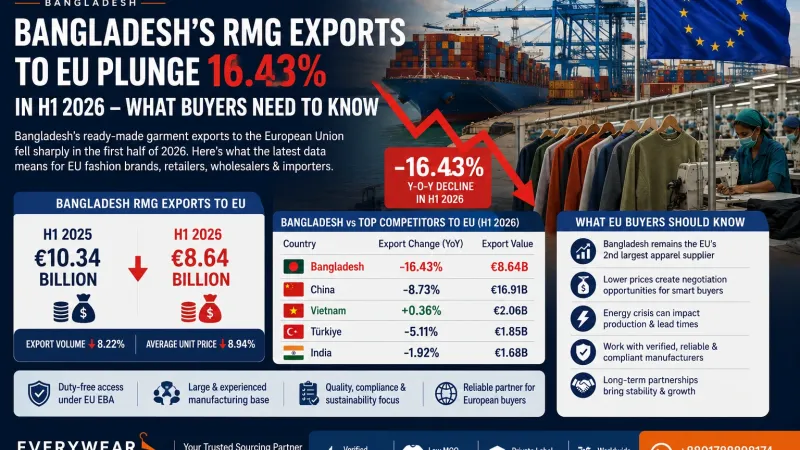
According to Eurostat data reported in August 2026, Bangladesh's apparel exports to the EU declined 16.43% year-on-year to €8.64 billion in H1 2026. During the same period, the EU's total apparel imports from the global market declined by approximately 9.70%.
That difference matters.
Bangladesh's decline was not simply the result of weaker European fashion demand. The data points to a combination of price pressure, lower export volumes, energy-related production challenges, stronger competition, changing sourcing strategies and uncertainty surrounding Bangladesh's future trade preferences.
For EU buyers, the more useful question is therefore not simply, "Is Bangladesh losing exports?"
The better question is: What does this change mean for my sourcing strategy in 2026 and beyond?
This guide examines the numbers, the competitive landscape and the practical implications for European apparel buyers sourcing from Bangladesh.
The Numbers: What Happened to Bangladesh RMG Exports to the EU in H1 2026?
The headline figure is significant: Bangladesh's apparel exports to the European Union fell 16.43% year-on-year during the first six months of 2026.
Export earnings declined from approximately €10.34 billion in H1 2025 to €8.64 billion in H1 2026.
| Indicator | H1 2025 | H1 2026 | Change |
|---|---|---|---|
| Bangladesh RMG exports to EU | Approximately €10.34 billion | Approximately €8.64 billion | -16.43% |
| EU total apparel imports | Higher than H1 2026 | Approximately €41.10 billion | -9.70% |
| Bangladesh export volume | Baseline | Lower | -8.22% |
| Average export unit price | Baseline | Lower | -8.94% |
The volume and price data is particularly important. Bangladesh did not simply sell fewer garments. It also achieved a lower average price per kilogram.
Export volume declined by approximately 8.22%, while average unit prices declined by approximately 8.94%.
This creates a double pressure on export earnings: fewer garments are being shipped, and the average value of those garments has also fallen.
For buyers, however, the situation has another side. Lower average export prices can create opportunities for companies that know how to negotiate responsibly and select efficient manufacturers without sacrificing product quality.
The key is understanding why the prices are falling and whether the manufacturer can maintain production reliability at those price levels.
Why Are Bangladesh's RMG Exports to Europe Falling?
There is no single explanation for the 16.43% decline. The current situation is better understood as a combination of market demand, competitive pricing, production constraints and trade-policy uncertainty.
1. Weaker European Apparel Demand
The EU apparel market itself contracted during the first half of 2026. Total EU apparel imports declined by approximately 9.70%.
That means Bangladesh is operating inside a difficult demand environment. European consumers have become more price-conscious, while retailers are managing inventory carefully and reducing unnecessary stock exposure.
For manufacturers, this creates pressure from both sides: brands want competitive prices while consumers are demanding value.
2. Bangladesh Is Facing Stronger Competition
Bangladesh is no longer competing only against traditional apparel exporters. European buyers increasingly compare Bangladesh with Vietnam, China, India, Türkiye, Pakistan, Cambodia and other manufacturing destinations.
Each country has different strengths.
- Bangladesh: strong cotton apparel manufacturing, large-scale production and competitive pricing.
- Vietnam: strong performance in higher-value apparel, synthetic products and integrated manufacturing.
- China: broad raw-material access, enormous manufacturing capacity and aggressive pricing.
- Türkiye: geographic proximity to Europe and shorter lead times for many European buyers.
- India: large textile and apparel ecosystem with growing product diversification.
This competitive environment means Bangladesh needs to compete on more than FOB price.
3. Energy and Production Challenges
Energy availability has become an important concern for Bangladesh's manufacturing sector in 2026.
Gas shortages, electricity reliability and higher operating costs can affect production schedules, particularly for factories that depend heavily on stable industrial energy supplies.
For international buyers, the problem is not simply higher production costs. The larger concern is delivery reliability.
A factory that cannot operate consistently may struggle to maintain the lead time originally promised to a European buyer.
4. Trade Preference Uncertainty
Trade preferences are another important consideration for European buyers.
Bangladesh currently benefits from the European Union's Everything But Arms (EBA) arrangement as a Least Developed Country. The European Commission states that Bangladesh will continue benefiting from EBA preferences during the transition period, with the current framework providing continued access at least through the end of 2029.
The future trade arrangement therefore remains an important issue for long-term sourcing decisions, particularly for brands planning multi-year supplier agreements.
Smart buyers should not wait until a policy change occurs. They should model future landed costs in advance.
5. Buyers Are Becoming More Strategic
European retailers have become more sophisticated about supplier risk.
Instead of asking only, "Who offers the lowest FOB price?", professional sourcing teams increasingly ask:
- Can this factory maintain production during an energy shortage?
- How quickly can the supplier respond to changes?
- Can the manufacturer support smaller replenishment orders?
- Is the quality consistent between production batches?
- Can the supplier provide proper export documentation?
- Can the supplier meet European compliance requirements?
- What happens if production is delayed?
This is why the quality of the sourcing relationship can be more important than the supplier's initial quotation.
Bangladesh vs Vietnam in the EU Apparel Market: What Buyers Should Watch
Vietnam has become one of the most closely watched competitors to Bangladesh in the global apparel industry.
During H1 2026, Vietnam's apparel exports to the EU showed much stronger resilience than Bangladesh's. The source data indicates Vietnam's EU apparel exports increased approximately 0.36% to €2.06 billion.
| Indicator | Bangladesh | Vietnam |
|---|---|---|
| EU export performance | -16.43% | +0.36% |
| Average/unit price trend | Declined | Increased |
| Strategic strength | Scale and competitive cotton apparel | Higher-value and diversified apparel |
The lesson is not that Vietnam has replaced Bangladesh.
Rather, the data shows that European sourcing is becoming more diversified and more competitive.
Vietnam's ability to command higher unit prices also demonstrates the opportunity for Bangladesh to move beyond basic commodity apparel into higher-value products.
For Bangladesh manufacturers, the next stage of competitiveness will increasingly involve product development, technical apparel, synthetic and blended fabrics, sustainability, faster response times and stronger supply-chain management.
For buyers, this creates a more interesting sourcing landscape: Bangladesh can remain highly competitive for core apparel categories while Vietnam and other countries may be attractive for selected higher-value or speed-sensitive products.
What the 16.43% Decline Means for EU Clothing Buyers
A decline in national export statistics does not automatically mean every Bangladesh garment factory is experiencing the same problem.
This distinction is extremely important for buyers.
Bangladesh has thousands of factories with different levels of energy resilience, technology, compliance, financial strength, product specialization and export experience.
Risk 1: Longer Lead Times
Production disruptions can translate into delayed shipment dates.
European brands should therefore build realistic production buffers into their buying calendar instead of relying on the shortest theoretical factory lead time.
Risk 2: Factory-Level Energy Exposure
Not every factory has the same energy infrastructure.
Before placing a major order, buyers should ask whether the manufacturer has backup power generation, energy-management systems and contingency procedures.
Risk 3: Price Volatility
Lower export prices may look attractive, but buyers should avoid assuming that every low quotation represents a sustainable manufacturing cost.
A very low quotation followed by production delays, quality issues or fabric substitutions can ultimately cost more than a slightly higher but reliable quotation.
Opportunity: Better Negotiating Conditions
For buyers with strong sourcing discipline, the current market can create opportunities.
Factories competing for international orders may be more willing to discuss:
- Competitive FOB pricing
- Flexible production quantities
- Product development support
- Private-label manufacturing
- Fabric alternatives
- Packaging customization
- Repeat-order pricing
- Long-term sourcing agreements
The strongest opportunity is therefore not simply to "buy cheaper". It is to build a better supplier relationship while the market is undergoing adjustment.
What EU Buyers Should Do When Sourcing Clothing from Bangladesh in 2026
The current market requires a more structured sourcing process. European buyers should evaluate suppliers using both commercial and operational criteria.
1. Verify the Manufacturer Before Ordering
Do not select a factory based only on photographs, a marketplace listing or the cheapest quotation.
Verify production capability, product specialization, compliance documentation, previous export experience and quality-control procedures.
2. Request Samples Before Bulk Production
A proper pre-production sample helps verify fabric, GSM, construction, measurements, trims, printing, embroidery, labels and finishing.
For private-label clothing brands, the sample approval stage is one of the most important controls in the entire manufacturing process.
3. Confirm Production Capacity
Ask the supplier how many units can realistically be produced per month and whether the factory has sufficient capacity during peak seasons.
4. Check Energy Resilience
In the current Bangladesh RMG environment, buyers should specifically ask about backup generators, alternative energy arrangements and production-continuity plans.
5. Plan Shipping Earlier
Do not build your inventory calendar around the best-case production scenario.
Include time for fabric sourcing, sample approval, production, quality inspection, documentation, port handling and international freight.
6. Think Beyond FOB Price
The correct sourcing calculation is the total landed cost, not simply the factory quotation.
Landed cost can include manufacturing, packaging, inspection, freight, insurance, customs, duties, compliance requirements and potential delay costs.
7. Diversify Within Bangladesh
A buyer does not necessarily need to abandon Bangladesh to reduce risk.
A smarter strategy can be to maintain relationships with multiple qualified Bangladesh manufacturers across different product categories.
This creates a local supplier portfolio rather than depending entirely on one factory.
Bangladesh's EU Tariff Advantage Still Matters to Buyers
One of Bangladesh's most important advantages in the European market remains its preferential access under the EU's Everything But Arms framework.
The European Commission identifies Bangladesh as the largest beneficiary under the EU's EBA arrangement. The scheme provides duty-free and quota-free access for eligible exports from Least Developed Countries, subject to the applicable rules of origin and other requirements.
The European Commission's current GSP framework also provides a transition period for countries graduating from LDC status. Bangladesh is scheduled to graduate from LDC status, but the EU framework provides continued EBA benefits during the transition period, currently extending at least through the end of 2029.
This means European buyers should distinguish between current tariff conditions and future tariff scenarios.
For a buyer signing a multi-season contract, it is sensible to model both scenarios.
| Buyer consideration | Why it matters |
|---|---|
| Current EBA treatment | Supports Bangladesh's landed-cost competitiveness in the EU. |
| Rules of origin | Buyers should ensure products satisfy applicable preferential-origin requirements. |
| Post-graduation planning | Important for multi-year sourcing contracts and long-term pricing. |
| GSP+ possibility | A potential future pathway depending on eligibility and compliance. |
For this reason, Bangladesh remains commercially relevant to European buyers even during a period of export decline.
Why Bangladesh Can Still Be a Strong Clothing Sourcing Destination for Europe
A decline in exports should not be confused with a collapse of manufacturing capability.
Bangladesh remains one of the world's largest apparel manufacturing hubs, with decades of experience supplying international fashion brands and retailers.
The country's manufacturing ecosystem is particularly strong in:
- T-shirts
- Oversized T-shirts
- Hoodies
- Sweatshirts
- Polo shirts
- Denim apparel
- Knitwear
- Sportswear
- Activewear
- Workwear
- Uniforms
- Private-label clothing
- OEM apparel
- Custom garment manufacturing
Bangladesh is also increasingly investing in sustainability, product diversification, synthetic and man-made fibre capacity, higher-value apparel and advanced manufacturing.
For European brands, this creates an important distinction:
The country-level export decline is a reason to improve supplier selection, not necessarily a reason to abandon Bangladesh.
How Everywear Bangladesh Helps European Buyers Navigate the Changing Market
For smaller European brands and growing retailers, the biggest challenge is often not finding a garment factory. It is finding the right manufacturer, verifying the product, managing communication and controlling the sourcing process from beginning to shipment.
This is where Everywear Bangladesh operates differently from a conventional open supplier directory.
Everywear Bangladesh works as a managed sourcing partner between international buyers and Bangladesh's garment manufacturing ecosystem.
What Buyers Can Get Through Everywear Bangladesh
- Bangladesh garment manufacturer sourcing
- Private-label clothing manufacturing
- OEM garment production
- Custom apparel development
- Low-MOQ manufacturing from approximately 300 pieces for selected products
- Ready-to-ship garment sourcing
- Fabric sourcing
- Sample development
- Quality-control coordination
- Custom labels and packaging
- Production monitoring
- Export documentation support
- Worldwide shipping coordination
- EU-focused sourcing support
The company's operating model is built around a simple principle:
"You deal with us. We deal with the factories."
This gives international buyers one accountable sourcing relationship rather than forcing them to coordinate independently with multiple factories.
For smaller brands that cannot maintain their own sourcing office in Dhaka, this can significantly simplify the process of developing and manufacturing products in Bangladesh.
What Should European Buyers Expect During the Rest of 2026?
The remainder of 2026 is likely to remain a period of adjustment for Bangladesh's apparel industry.
Short-Term Outlook
The June data provides at least a small indication that the situation may not continue deteriorating at the same pace. Bangladesh's apparel exports to the EU showed a modest year-on-year improvement in June, although the full H1 result remained deeply negative.
That suggests buyers should watch monthly data rather than interpreting the H1 decline as a permanent trend.
Medium-Term Outlook
The industry's competitiveness will depend on several factors:
- Energy availability
- Production efficiency
- Product diversification
- MMF capacity
- Factory compliance
- Logistics performance
- EU trade preferences
- European consumer demand
- Competitor pricing
Bangladesh's ability to move from volume-led manufacturing toward more diversified, value-added apparel will be especially important.
Frequently Asked Questions
1. Why did Bangladesh's RMG exports to the EU fall 16.43% in H1 2026?
The decline reflects several factors rather than one single cause. These include weaker EU apparel demand, stronger competition from countries such as China and Vietnam, lower Bangladeshi export prices, reduced export volume, energy and production challenges, and uncertainty surrounding future trade preferences.
2. How much did Bangladesh export garments to the EU in H1 2026?
Bangladesh exported approximately €8.64 billion worth of apparel to the European Union during January–June 2026, representing a 16.43% year-on-year decline.
3. Is Bangladesh still an important clothing supplier to Europe?
Yes. Bangladesh remains one of the EU's largest external apparel suppliers and has a deeply established manufacturing ecosystem. The H1 2026 decline indicates increased competitive pressure rather than the disappearance of Bangladesh as a sourcing destination.
4. Is Bangladesh still competitive for European clothing buyers?
Yes. Bangladesh remains highly competitive in many cotton-based and large-volume apparel categories. However, buyers should evaluate factories individually because energy resilience, quality, lead times and product specialization vary significantly between manufacturers.
5. Why is Vietnam performing better than Bangladesh in the EU market?
Vietnam has developed strong capabilities in higher-value apparel, synthetic products, diversified manufacturing and supply-chain integration. During H1 2026, Vietnam's EU apparel exports showed positive growth while Bangladesh's exports declined sharply.
6. What is the EU tariff situation for Bangladesh garments?
Bangladesh currently benefits from the EU's Everything But Arms arrangement as an LDC, providing duty-free and quota-free access for eligible exports subject to the relevant rules. The European Commission's current GSP framework provides a transition period for LDC graduates, with Bangladesh continuing to benefit from EBA preferences at least through the end of 2029.
7. How is the Bangladesh energy crisis affecting European buyers?
Energy constraints can affect factory operating hours, production schedules and shipment timing. Buyers should therefore check whether individual manufacturers have backup power and contingency plans before placing time-sensitive orders.
8. Should European brands stop sourcing clothing from Bangladesh?
Not necessarily. The more effective approach is supplier diversification and stronger due diligence. Buyers can continue sourcing from Bangladesh while selecting manufacturers based on quality, compliance, energy resilience, production capacity and delivery performance.
9. Can small European clothing brands manufacture in Bangladesh?
Yes. Bangladesh is increasingly accessible to smaller fashion businesses through sourcing partners and manufacturers offering lower minimum order quantities. Everywear Bangladesh supports selected custom manufacturing projects starting from approximately 300 pieces per design.
10. Can I source private-label clothing from Bangladesh for Europe?
Yes. Bangladesh manufacturers can produce private-label T-shirts, hoodies, sweatshirts, streetwear, activewear, sportswear, uniforms, knitwear and other customized apparel. Buyers should approve samples and specifications before bulk production.
11. What happened to Bangladesh's export volume and unit prices?
During H1 2026, export volume declined approximately 8.22%, while average unit prices declined approximately 8.94%. The combination of lower volume and lower prices explains why the overall export-value decline was so significant.
12. What should EU buyers do now?
EU buyers should evaluate suppliers individually, confirm production capacity, check energy resilience, approve samples, plan realistic lead times, monitor trade-policy developments, diversify suppliers and calculate total landed cost rather than comparing FOB prices alone.
Conclusion: Bangladesh's EU Export Decline Is a Warning – Not the End of the Opportunity
Bangladesh's 16.43% decline in RMG exports to the European Union during H1 2026 deserves serious attention from every international apparel buyer.
The country's export performance was weaker than the overall EU apparel market, and the combination of falling volume and falling unit prices demonstrates that Bangladesh is facing meaningful competitive pressure.
At the same time, the numbers should not be interpreted as evidence that Bangladesh has suddenly become an unsuitable manufacturing destination.
Bangladesh still has enormous manufacturing capacity, an experienced apparel workforce, established export infrastructure, competitive production costs and one of the world's deepest garment manufacturing ecosystems.
The real change is that buyers need to become more selective.
The best sourcing strategy in 2026 is not simply choosing the country with the lowest quotation. It is choosing the right manufacturer, building production resilience, controlling quality, planning logistics and understanding the trade environment.
For European fashion brands, wholesalers, retailers and private-label businesses, Bangladesh can remain an important part of a diversified sourcing strategy.
At Everywear Bangladesh, we help international buyers navigate that process by connecting them with Bangladesh's garment manufacturing ecosystem while providing sourcing coordination, quality-control support, product development and logistics assistance.
Looking to Source Clothing from Bangladesh for the European Market?
Talk to Everywear Bangladesh about wholesale garments, private-label clothing, OEM manufacturing and custom apparel production.
Contact Everywear Bangladesh on WhatsAppAbout the Author
Written by the Everywear Bangladesh Research & Sourcing Team
The Everywear Bangladesh editorial and sourcing team combines practical experience in Bangladesh's Ready-Made Garment industry with expertise in international apparel sourcing, private-label manufacturing, wholesale exports and global supply-chain management.
Our content focuses on helping fashion brands, retailers, wholesalers, importers and eCommerce businesses understand Bangladesh's apparel industry and make better sourcing decisions.
We use industry data, trade information and practical sourcing knowledge to create buyer-focused content covering Bangladesh garment manufacturers, RMG exports, apparel trade, tariffs, sustainability, manufacturing and international sourcing.
Everywear Bangladesh Ltd.
House No: 165/1, West Agargaon, Shere-Bangla-Nagar, Dhaka, Bangladesh
Phone / WhatsApp: +8801788898174
References and Data Sources
- Eurostat – European Union trade and apparel import statistics, January–June 2026.
- European Commission – EU Trade Relations with Bangladesh and Everything But Arms information.
- European Commission – Generalised Scheme of Preferences and transition arrangements for LDC graduation.
- Bangladesh Garment Manufacturers and Exporters Association (BGMEA) – Bangladesh RMG industry information.
- Bangladesh Knitwear Manufacturers and Exporters Association (BKMEA) – Industry and export information.
- Export Promotion Bureau (EPB), Bangladesh – Export statistics and RMG export data.
- The Daily Star – Bangladesh RMG exports to EU fall 16.43% in January–June 2026.
- The Business Standard – Bangladesh apparel exports to EU fall 16.43% year-on-year in H1 2026.
- Dhaka Tribune – Bangladesh apparel exports to EU decline in H1 2026.
Related Resources for International Buyers
Europe Buyers
Bangladesh Apparel Sourcing Guides
- Clothing Suppliers from Bangladesh
- Bangladesh Garment Industry Guide
- Private Label Clothing Manufacturing Bangladesh
- Custom Garment Manufacturing Bangladesh 2026 Guide
- Low MOQ Clothing Manufacturer Bangladesh
Related 2026 Bangladesh RMG News
- Bangladesh RMG Exports to US Fall 5.58% – What Buyers Need to Know
- Bangladesh Secures Lowest US Tariff at 10% – How Buyers Save 2.5% Over Vietnam
- Bangladesh vs Vietnam – The Race for Second Place in Global Apparel Exports
- US Tariff Guide for Bangladesh Garment Imports 2026
- Sustainable Clothing Manufacturing in Bangladesh: The Green Revolution
Leave a comment