





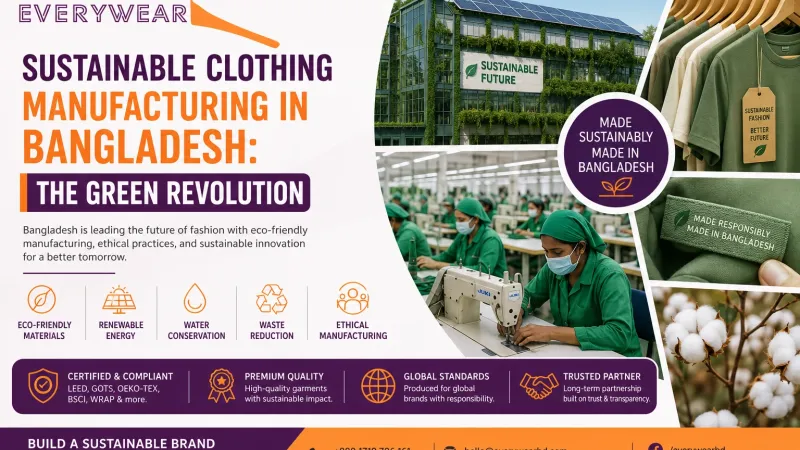
Sustainable Clothing Manufacturing in Bangladesh: The Green Revolution (2026)
Last updated: July 30, 2026
The global fashion industry is undergoing one of its biggest transformations in history. For decades, apparel sourcing decisions were based mainly on price, production capacity, and delivery time. Today, international buyers expect far more from their manufacturing partners. Sustainability, ethical production, environmental responsibility, and transparent supply chains have become essential requirements rather than optional advantages.
Consumers are increasingly choosing brands that prioritize eco-friendly materials, ethical labor practices, and environmentally responsible production. Governments are introducing stricter sustainability regulations, investors are evaluating Environmental, Social, and Governance (ESG) performance, and major retailers are demanding greater transparency throughout the supply chain.
As a result, clothing brands worldwide are searching for manufacturers capable of meeting these expectations while maintaining competitive pricing and exceptional product quality.
Bangladesh has emerged as one of the strongest answers to this challenge.
Known globally as one of the largest Ready-Made Garment (RMG) manufacturing countries, Bangladesh has transformed its apparel industry into a global leader in sustainable clothing production. Today, the country is home to many of the world's highest-rated green garment factories, producing millions of garments for internationally recognized fashion brands while continuously reducing environmental impact.
Modern Bangladesh clothing manufacturers now combine advanced manufacturing technologies, internationally recognized compliance certifications, renewable energy solutions, wastewater recycling systems, and sustainable fabric sourcing to create environmentally responsible apparel for businesses around the world.
Whether you operate a Shopify store, WooCommerce fashion business, Amazon brand, Walmart Marketplace store, Etsy shop, Faire wholesale business, or independent fashion label, partnering with a sustainable clothing manufacturer Bangladesh provides long-term competitive advantages that extend well beyond production costs.
This comprehensive guide explains why Bangladesh is leading the green revolution in apparel manufacturing and why thousands of international businesses continue choosing clothing suppliers from Bangladesh for sustainable private label clothing production.
Why Sustainability Has Become the Future of Global Fashion
Sustainability has evolved from a marketing trend into one of the most important business strategies within the global apparel industry.
Fashion brands are no longer evaluated solely by the products they sell. Customers increasingly want to understand how garments are manufactured, where fabrics originate, how workers are treated, and what environmental impact each product creates before reaching store shelves.
This shift is reshaping global apparel sourcing.
International retailers now prioritize manufacturers capable of demonstrating responsible production through internationally recognized certifications, transparent supply chains, and measurable environmental improvements.
Several factors continue driving this transformation:
- Rising consumer awareness
- Government sustainability regulations
- Corporate ESG commitments
- Investor expectations
- Carbon reduction initiatives
- Circular fashion strategies
- Ethical sourcing requirements
- Environmental certifications
Brands unable to demonstrate responsible manufacturing may experience reduced customer trust, declining sales, and increased pressure from retail partners.
Meanwhile, businesses investing in sustainable manufacturing often enjoy stronger customer loyalty, higher perceived product value, improved brand reputation, and greater access to international retail markets.
For businesses sourcing private label clothing from Bangladesh, sustainability also creates a competitive advantage by allowing products to appeal to environmentally conscious consumers without sacrificing affordability or manufacturing quality.
Bangladesh's garment industry has recognized this global shift and continues investing heavily in green manufacturing technologies that reduce environmental impact while improving production efficiency.
Instead of viewing sustainability as an additional expense, many manufacturers now see it as an opportunity to improve operational performance while strengthening long-term relationships with international buyers.
What Is Sustainable Clothing Manufacturing?
Sustainable clothing manufacturing refers to producing apparel using environmentally responsible processes while maintaining ethical labor standards, efficient resource management, and long-term economic sustainability.
Rather than focusing exclusively on production speed and manufacturing costs, sustainable factories evaluate every stage of apparel production to reduce environmental impact and improve operational efficiency.
This approach begins with raw material sourcing and continues throughout the entire manufacturing process.
Sustainable Raw Materials
Environmentally responsible production starts with selecting fabrics that reduce ecological impact.
Popular sustainable materials include:
- Organic Cotton
- Recycled Cotton
- Recycled Polyester (rPET)
- Bamboo Fiber
- TENCEL Lyocell
- Modal
- Hemp Fabrics
- Better Cotton Initiative (BCI) Cotton
Many Bangladesh clothing manufacturers now offer these materials for both wholesale production and private label manufacturing.
Energy-Efficient Manufacturing
Modern garment factories invest in technologies that reduce electricity consumption while maintaining consistent production quality.
Examples include:
- Automated Cutting Systems
- Energy-Efficient Sewing Machines
- LED Factory Lighting
- Smart Production Monitoring
- Heat Recovery Systems
- High-Efficiency Boilers
These improvements lower operational costs while reducing carbon emissions.
Water Conservation
Textile manufacturing traditionally consumes significant amounts of water.
Leading sustainable garment manufacturers Bangladesh now minimize water consumption through:
- Water Recycling Plants
- Rainwater Harvesting
- Low Liquor Ratio Dyeing
- Water Monitoring Systems
- Efficient Washing Technologies
These initiatives help preserve valuable natural resources while reducing production costs.
Waste Reduction
Responsible factories continually improve material utilization by reducing production waste through:
- Digital Pattern Optimization
- Automated Fabric Layout Planning
- Fabric Recycling Programs
- Packaging Reduction
- Textile Waste Recovery
Every improvement contributes to more sustainable apparel production while increasing manufacturing efficiency.
LEED Certification: The Gold Standard for Green Factories
What Is LEED?
LEED (Leadership in Energy and Environmental Design) is a globally recognized green building certification system developed by the U.S. Green Building Council (USGBC). It evaluates factories based on several criteria: transformation performance, energy efficiency, water management, waste management, and environmental performance.
LEED certifications are awarded at four levels:
| Level | Points Required | Significance |
|---|---|---|
| Certified | 40-49 points | Basic green building standards |
| Silver | 50-59 points | Significant sustainability achievements |
| Gold | 60-79 points | High-level environmental performance |
| Platinum | 80+ points | World-class sustainability leadership |
Bangladesh's LEED Leadership
Bangladesh's journey toward green manufacturing began in 2011. Since then, the country has achieved remarkable progress.
2024 Achievement:
- 207 LEED-certified garment factories
- 13 of the global top 15 LEED green factories located in Bangladesh
2025 Achievement:
- 38 new LEED certifications in a single year—the highest ever recorded globally
- Of these, 22 achieved Platinum, 11 Gold, and 5 Silver
- Total reached 270 LEED-certified factories, including 114 Platinum and 137 Gold facilities
2026 Achievement (as of July):
- 20 new LEED certifications so far this year
- Total now stands at 290 LEED-certified factories
- Includes 125 Platinum-rated and 145 Gold-rated facilities
Among the world's top 100 highest-scoring LEED-certified factories, 69 are located in Bangladesh, including 18 of the top 20.
World-Record Performances
In January 2026, Hams Garments Limited, a Gazipur-based factory, achieved USGBC LEED Platinum certification with a score of 108 out of 110—setting a global record as the highest-rated LEED-certified RMG factory in the world. The BGMEA held a special reception to honor this achievement, with industry leaders celebrating this milestone as a symbol of Bangladesh's commitment to green industrialization.
In July 2026, Canvas Garments Pvt. Ltd. in Chattogram earned Platinum certification with 90 points under the LEED O+M: Existing Buildings v4.1 rating system. Matrix Sweaters Ltd. in Gazipur also achieved Platinum with 88 points.
What Makes a LEED-Certified Factory Different?
According to industry experts, a green factory reduces energy usage by approximately 40 percent and water consumption by more than 30 percent while emitting less carbon. These factories implement best practices across technology, production processes, physical infrastructure, corporate management, and social and environmental sustainability.
Even though green factories may initially incur higher setup costs, they significantly reduce operational costs over time through efficiency savings.
A typical LEED-certified factory incorporates advanced technologies such as:
- Motion Sensor Lighting
- High-Efficiency Motors
- Heat Recovery Systems
- Solar Energy Panels
- Rainwater Collection
- Waste Segregation Programs
- Intelligent Air Circulation
- Building Automation Systems
The result is reduced operating costs, improved worker comfort, and significantly lower environmental impact.
These factories also create healthier working environments through improved ventilation, increased natural daylight, and better indoor air quality.
For clothing brands committed to sustainability, partnering with LEED-certified Bangladesh manufacturers demonstrates responsible sourcing while strengthening corporate sustainability reporting.
Why Bangladesh Is Becoming the Global Leader in Sustainable Clothing Manufacturing
Bangladesh has invested billions of dollars into modernizing its Ready-Made Garment industry.
The country's transformation extends far beyond increasing production capacity.
Manufacturers have embraced environmentally responsible construction, renewable energy, advanced wastewater treatment systems, sustainable production technologies, and internationally recognized compliance standards.
Today, Bangladesh operates one of the largest concentrations of LEED-certified garment factories anywhere in the world.
This achievement reflects years of continuous investment in green manufacturing infrastructure.
Bangladesh's sustainable manufacturing success is built upon several key strengths.
World-Class Green Garment Factories
Modern export-oriented factories incorporate:
- Energy-Efficient Building Design
- Natural Lighting Systems
- Intelligent Ventilation
- Solar Energy
- Rainwater Collection
- Wastewater Recycling
- Environmentally Friendly Construction Materials
These features significantly reduce environmental impact while creating healthier workplaces for employees.
International Sustainability Certifications
Professional clothing suppliers from Bangladesh increasingly maintain internationally recognized certifications, including:
- LEED Platinum
- LEED Gold
- OEKO-TEX Standard 100
- GOTS
- WRAP
- BSCI
- SEDEX
- ISO 9001
- ISO 14001
These certifications demonstrate commitment to environmental responsibility, quality assurance, workplace safety, and ethical manufacturing practices.
Advanced Manufacturing Technology
Modern Bangladesh garment factories continue investing in:
- Automated Cutting Machines
- Computerized Pattern Development
- Digital Fabric Inspection
- AI-Assisted Production Planning
- Smart Inventory Management
- Advanced Quality Control Systems
These technologies improve production consistency while minimizing material waste and reducing energy consumption.
For international buyers searching for sustainable clothing manufacturers, Bangladesh offers a unique combination of manufacturing experience, environmental responsibility, competitive pricing, and world-class production capabilities.
Rather than choosing between affordability and sustainability, businesses can achieve both by partnering with experienced Bangladesh garment manufacturers committed to responsible apparel production.
Renewable Energy and Carbon Reduction
Current Status
Despite its leadership in green buildings, Bangladesh's RMG sector faces challenges in renewable energy adoption. According to a study published in May 2026, only 3.0 percent of surveyed RMG factories meet their energy needs through renewable sources, with solar power being the only form of renewable energy currently in use.
The energy mix remains heavily dependent on traditional sources: 61.5 percent of used energy comes from the national grid and 35.5 percent from captive generation.
The Path Forward
However, momentum is building. Bangladesh has set ambitious targets to cut 22 percent carbon emissions by 2030 and 30 percent by 2041. The core emphasis is on producing and using renewable and green energy in place of traditional energy and efficient use of energy resources.
Several initiatives are driving this transition:
- H&M Group, Pran Group, and IFC have teamed up to advance renewable electricity adoption in the RMG sector
- Swisscontact and BGMEA have formed a strategic partnership to promote sustainable, inclusive growth
- The InSPIRE initiative (2025-2029) is designed to accelerate the green transformation of Bangladesh's RMG sector, specifically targeting small and medium-sized factories
- A new project supported by the Danish Embassy aims to collect energy data from 500 factories and develop a sustainable energy pathway plan
Industry leaders are also calling for gas tariff reform to eliminate the two-tiered system, ensuring fairness and encouraging investment in renewable energy. BGMEA has engaged with partners like GGI and SOLshare to discuss advancing decarbonization across the RMG sector.
Common sustainability initiatives include:
- Rooftop Solar Power
- Energy-Efficient Machinery
- LED Factory Lighting
- Variable Frequency Drives
- Heat Recovery Boilers
- Smart Energy Monitoring
- High Efficiency Compressors
- Green Building Design
Factories also optimize production layouts to reduce unnecessary machine operation, transportation, and material handling.
These operational improvements lower overall energy consumption while improving manufacturing productivity.
For global fashion brands with ambitious carbon reduction targets, partnering with a sustainable apparel manufacturer Bangladesh helps strengthen ESG reporting and demonstrates commitment to responsible sourcing.
As international regulations continue evolving, manufacturers investing in renewable energy today will remain highly competitive within the global apparel supply chain.
For international buyers, partnering with factories that are actively transitioning to renewable energy demonstrates a commitment to long-term sustainability and aligns with evolving global regulations.
Sustainable Materials and Certifications
Organic Cotton and GOTS
Bangladesh has emerged as a significant producer of organic cotton garments. The country now hosts more than 1,500 GOTS-certified organic textile facilities.
GOTS (Global Organic Textile Standard) certification ensures that textiles are produced using organic fibers and meet strict environmental and social criteria throughout the supply chain. This includes:
- No use of toxic pesticides or synthetic fertilizers in cotton farming
- Water conservation and responsible wastewater treatment
- Safe working conditions and fair labor practices
- Traceability from farm to finished garment
Manufacturers in Bangladesh are increasingly adopting organic cotton, recycled polyester, and other sustainable materials in their production lines. Common eco-friendly materials include organic cotton, hemp, and recycled fibers that reduce reliance on synthetic fabrics and conventional cotton farming methods—which are known for their heavy pesticide usage.
Organic cotton remains one of the most requested materials because it is grown using environmentally responsible agricultural practices that reduce synthetic pesticide use and improve soil health.
Recycled polyester has also become increasingly popular among sportswear and activewear brands because it transforms post-consumer plastic waste into durable performance fabrics.
Many private label brands now combine organic cotton with recycled polyester to produce garments that balance sustainability, comfort, durability, and affordability.
Bangladesh textile mills continue expanding their sustainable fabric collections to meet growing international demand from eco-conscious clothing brands.
This enables buyers to develop premium apparel collections while supporting environmentally responsible manufacturing practices.
Other Certifications
Beyond LEED and GOTS, Bangladesh manufacturers maintain various internationally recognized certifications:
| Certification | Focus Area |
|---|---|
| WRAP | Workplace safety and ethical manufacturing |
| BSCI | Social compliance and supply chain responsibility |
| SEDEX | Ethical trade and responsible sourcing |
| OEKO-TEX Standard 100 | Product safety and absence of harmful substances |
| ISO 9001 | Quality management systems |
| ISO 14001 | Environmental management systems |
The Growing Demand for Sustainable Materials
As international buyers, regulators, and consumers increasingly demand lower environmental footprints, Bangladeshi manufacturers are proactively aligning with evolving standards such as carbon efficiency, water stewardship, energy optimization, and climate-resilient infrastructure.
For fashion brands and Faire wholesale sellers, sourcing from factories with these certifications provides a competitive advantage in markets where consumers demand transparency and sustainability.
Eco-Friendly Dyeing and Finishing Technologies
Textile dyeing traditionally consumes significant amounts of water, chemicals, and energy.
To reduce environmental impact, many Bangladesh garment manufacturers have adopted cleaner dyeing technologies that improve efficiency while maintaining color consistency.
Examples include:
- Low Liquor Ratio Dyeing
- Digital Color Management
- Water Recycling Systems
- Eco-Friendly Chemicals
- Automatic Chemical Dosing
- Heat Recovery Equipment
- Enzyme Washing
- Ozone Washing
These technologies reduce water consumption while improving production quality.
Automatic chemical dosing systems also improve color consistency by minimizing human error during production.
For international buyers seeking eco-friendly clothing manufacturers, these improvements provide greater confidence that garments are produced according to responsible environmental standards.
Water Conservation and Wastewater Treatment
Water conservation has become one of the most important priorities within sustainable apparel manufacturing.
Traditional textile processing requires large volumes of water during dyeing, washing, finishing, and garment treatment.
Recognizing this challenge, Bangladesh's garment industry has invested heavily in technologies that reduce freshwater consumption while improving wastewater management.
Modern export-oriented factories now operate advanced Effluent Treatment Plants (ETPs) that clean industrial wastewater before it is released into the environment.
These systems help remove dyes, chemicals, suspended solids, and contaminants while enabling significant amounts of water to be reused within manufacturing operations.
Many sustainable factories also implement:
- Rainwater Harvesting
- Water Recycling Plants
- Smart Water Monitoring
- Low Water Washing Technologies
- Closed Loop Water Systems
- Automatic Leak Detection
These initiatives dramatically reduce freshwater consumption while lowering operational costs.
Responsible water management has become an important requirement for many international fashion brands because water scarcity continues affecting textile manufacturing worldwide.
Bangladesh manufacturers that invest in water conservation technologies position themselves as preferred partners for global brands seeking sustainable long-term sourcing solutions.
Circular Economy and Waste Management
The Circular Transition
Bangladesh's RMG sector is exploring circular production models to remain competitive in an evolving global landscape. Circular fashion aims to eliminate waste and pollution, circulate products and materials at their highest value, and regenerate nature.
Key circular practices being adopted include:
- Waste reduction through efficient cutting and pattern-making
- Recycling and upcycling of fabric waste
- Water recycling in washing and dyeing processes
- Chemical management to reduce hazardous substance use
- Extended producer responsibility for end-of-life products
Effluent Treatment and Water Management
Many RMG factories have implemented sustainability measures, including effluent treatment plants (ETPs) that treat wastewater before discharge. Proper water management is now essential to maintaining competitiveness in the global market.
The BGMEA has emphasized the need for strong governance in waste management. Industry leaders have noted that compliance with labor laws, ensuring a safe working environment, efficient water management, and strong governance in waste management are now essential to maintaining competitiveness in the global market.
Textile Recycling
Textile manufacturers are expanding their capabilities in:
- Fabric Recycling
- Yarn Recycling
- Cutting Waste Recovery
- Recycled Polyester Production
- Circular Textile Development
- Zero Waste Manufacturing
- Closed-Loop Production Systems
Many factories now recover fabric offcuts generated during garment production and convert them into recycled fibers for future collections.
International brands increasingly request recycled materials because they reduce dependence on virgin raw materials while lowering environmental impact.
Innovation within Bangladesh's textile sector continues accelerating through investment in automation, digital manufacturing, AI-assisted production planning, and resource optimization technologies.
These advancements position Bangladesh not only as one of the world's largest apparel exporters but also as one of the industry's most innovative sustainable manufacturing hubs.
The Business Case for Circularity
Circular practices not only reduce environmental impact but also create business value. By minimizing waste, recycling materials, and optimizing resource use, manufacturers can reduce costs and improve profitability. For buyers, partnering with circular manufacturers ensures a more resilient and future-proof supply chain.
As governments strengthen environmental regulations and consumers continue demanding responsible fashion, manufacturers capable of supporting circular production will remain at the forefront of global apparel sourcing.
Ethical Manufacturing, Worker Welfare, and International Compliance
Sustainability is not limited to reducing carbon emissions or conserving natural resources. A truly sustainable garment industry also prioritizes the people who manufacture the products. Ethical labor practices, workplace safety, employee well-being, and international compliance have become essential pillars of modern apparel manufacturing.
Over the past decade, Bangladesh has made significant progress in strengthening its Ready-Made Garment (RMG) sector through improved factory infrastructure, stricter compliance standards, enhanced worker safety programs, and greater transparency across the supply chain. These improvements have helped position Bangladesh as one of the world's most trusted sourcing destinations for international apparel brands.
Today, leading Bangladesh clothing manufacturers operate under internationally recognized compliance frameworks that demonstrate responsible manufacturing practices.
Common certifications include:
- WRAP (Worldwide Responsible Accredited Production)
- BSCI (Business Social Compliance Initiative)
- SEDEX (Supplier Ethical Data Exchange)
- ISO 9001 Quality Management
- ISO 14001 Environmental Management
- OEKO-TEX Standard 100
- GOTS (Global Organic Textile Standard)
These certifications help buyers evaluate whether manufacturers meet internationally accepted standards for labor rights, workplace safety, environmental management, and product quality.
Professional clothing suppliers from Bangladesh regularly undergo independent third-party audits to maintain these certifications. Audit processes evaluate fire safety systems, structural integrity, employee training, occupational health standards, emergency preparedness, documentation procedures, working conditions, and environmental compliance.
For international brands, working with compliant manufacturers significantly reduces sourcing risks while strengthening corporate sustainability initiatives.
Ethical manufacturing also improves long-term business performance.
Factories with better working environments generally experience:
- Higher Employee Retention
- Better Product Quality
- Lower Production Errors
- Increased Productivity
- Stronger Customer Confidence
- Improved International Reputation
These benefits create value for both manufacturers and buyers, making ethical production an essential component of sustainable apparel sourcing rather than simply a regulatory requirement.
The Business Case for Sustainable Sourcing
Why Sustainability Matters for Buyers
For international buyers sourcing clothing from Bangladesh, sustainability is not just an ethical choice—it is a strategic business decision.
1. Regulatory Compliance
The European Union is implementing stricter regulations on imported goods, including carbon pricing mechanisms and digital transparency frameworks. Sourcing from sustainable factories helps buyers comply with these regulations.
2. Consumer Demand
Consumers increasingly expect fashion brands to demonstrate environmental responsibility. Sourcing from sustainable factories provides a marketing advantage and builds brand trust.
3. Risk Reduction
Factories with strong environmental and social compliance are less likely to face disruptions from regulatory actions, labor disputes, or reputational damage.
4. Cost Efficiency
Green factories reduce energy and water consumption, leading to lower operational costs over time. These savings can be passed on to buyers.
5. Long-Term Partnership
Manufacturers investing in sustainability are more likely to be stable, forward-thinking partners capable of supporting long-term growth.
LEED Certification as a Strategic Advantage
Industry experts have stated that LEED certification has evolved into a strategic competitive advantage for the industry and serves as a sustainability benchmark.
This achievement represents a deeper transition and preparation for the next phase of global sustainability requirements, such as EU regulations, carbon pricing mechanisms, and digital transparency frameworks, while still delivering at scale.
The record-breaking performance of 2025 sends a powerful message to the world: Bangladesh is not just the largest apparel exporter, it is increasingly one of the greenest and most future-ready.
Why Shopify, WooCommerce, Amazon, Walmart Marketplace, Etsy, and Faire Sellers Choose Sustainable Bangladesh Manufacturers
The rapid growth of eCommerce has transformed how clothing brands source apparel.
Entrepreneurs can now launch fashion businesses from virtually anywhere in the world using platforms such as Shopify, WooCommerce, Amazon, Walmart Marketplace, Etsy, and Faire Wholesale.
However, online competition has also intensified.
Thousands of sellers often compete within the same product categories, making differentiation increasingly difficult.
This is why many successful online brands are transitioning from generic wholesale products toward sustainable private label manufacturing.
Working directly with experienced Bangladesh garment manufacturers allows businesses to create unique collections that competitors cannot easily replicate.
Sustainable sourcing also enhances marketing opportunities.
Brands can communicate meaningful value propositions including:
- Ethical Manufacturing
- Organic Cotton Products
- Recycled Fabrics
- Eco-Friendly Packaging
- Responsible Supply Chains
- Environmentally Conscious Production
- Certified Manufacturing Partners
These messages resonate strongly with modern consumers, particularly younger demographics who increasingly consider sustainability when making purchasing decisions.
Bangladesh manufacturers also provide flexibility for growing eCommerce brands by supporting:
- Low MOQ Production
- Product Sampling
- Seasonal Collections
- Custom Fabric Development
- Private Label Manufacturing
- OEM Production
- Worldwide Shipping
- Export Documentation
This flexibility allows startups to scale gradually while maintaining product consistency and strengthening their brand identity.
Whether selling through Shopify, Amazon FBA, WooCommerce, Walmart Marketplace, Etsy, TikTok Shop, or Faire Wholesale, partnering with a sustainable clothing manufacturer Bangladesh provides a long-term competitive advantage.
Challenges and the Path Forward
Renewable Energy Adoption
The biggest challenge remains renewable energy adoption. Only 3 percent of RMG factories currently use renewable energy. High costs, limited rooftop space, and policy bottlenecks are slowing adoption across the sector.
However, initiatives like the InSPIRE program and partnerships with global brands and development organizations are addressing these barriers.
LDC Graduation
Bangladesh is approaching graduation from the least developed country (LDC) category in November 2026. This transition will bring both opportunities and challenges. The sustainability of growth increasingly depends on how well the sector adopts environmentally friendly practices.
The Pipeline of Green Factories
According to industry insiders, 550 factories are now awaiting USGBC LEED certification. This indicates that the green revolution is accelerating, not slowing down.
Continued Leadership
Industry observers believe the scale and quality of LEED certifications achieved place Bangladesh in a leadership position, not merely responding to global sustainability demands, but actively shaping the future standards of responsible apparel manufacturing.
How Everywear Bangladesh Supports Sustainable Clothing Manufacturing
At Everywear Bangladesh, sustainability is integrated into the sourcing process rather than treated as an optional service.
Our objective is to help international buyers connect with experienced export-oriented manufacturers that prioritize quality, transparency, environmental responsibility, and long-term business partnerships.
We support businesses throughout every stage of apparel manufacturing.
Our services include:
- Product Development
- Sustainable Fabric Sourcing
- Organic Cotton Garments
- Recycled Fabric Solutions
- Private Label Manufacturing
- OEM Clothing Production
- Pattern Making
- Sample Development
- Bulk Manufacturing
- Quality Assurance
- Printing and Embroidery
- Sustainable Packaging
- Export Documentation
- Worldwide Logistics
Our manufacturing partners specialize in producing:
- Blank T-Shirts
- Oversized T-Shirts
- Heavyweight T-Shirts
- Hoodies
- Sweatshirts
- Sportswear
- Activewear
- Polo Shirts
- Corporate Uniforms
- Streetwear
- Fashion Basics
- Kidswear
Whether you are launching a sustainable startup clothing brand or expanding an established international fashion business, Everywear Bangladesh helps simplify apparel sourcing while supporting responsible manufacturing practices that meet modern global expectations.
Our goal is to build long-term partnerships based on trust, quality, consistency, and sustainable growth—helping businesses create apparel that is better for their customers, their brand, and the future of the fashion industry.
Contact Everywear Bangladesh on WhatsApp
Frequently Asked Questions
1. Why is Bangladesh considered a leader in sustainable clothing manufacturing?
Bangladesh has invested heavily in environmentally responsible garment production over the last decade. The country is home to many of the world's highest-rated LEED-certified garment factories and continues improving energy efficiency, water conservation, renewable energy adoption, worker safety, and sustainable textile production. These advancements have made Bangladesh one of the leading destinations for sustainable apparel manufacturing.
2. What sustainable fabrics can Bangladesh clothing manufacturers produce?
Professional Bangladesh garment manufacturers produce a wide range of sustainable fabrics, including:
- Organic Cotton
- Recycled Cotton
- Recycled Polyester (rPET)
- Bamboo Fabric
- TENCEL Lyocell
- Modal
- Hemp Blends
- Better Cotton Initiative (BCI) Cotton
3. Do Bangladesh manufacturers support sustainable private label clothing production?
Yes. Many experienced Bangladesh clothing manufacturers specialize in sustainable private label production. Buyers can customize garments using eco-friendly fabrics, recycled materials, sustainable printing methods, biodegradable packaging, woven labels, embroidery, and branded accessories while maintaining international quality standards.
4. Which certifications should buyers look for when choosing a sustainable garment manufacturer?
Reliable manufacturers often maintain internationally recognized certifications, including:
- LEED Platinum
- LEED Gold
- GOTS
- OEKO-TEX Standard 100
- WRAP
- BSCI
- SEDEX
- ISO 9001
- ISO 14001
5. What is the US cotton zero-tariff advantage?
Under the Agreement on Reciprocal Trade (ART) signed between Bangladesh and the United States, garments made with US-origin cotton enter the US market duty-free. This combines sustainability with significant cost savings for US buyers.
6. Is sustainable manufacturing more expensive?
While green factories may initially incur higher setup costs, they significantly reduce operational costs over time through energy and water savings. For buyers, these efficiencies can translate into competitive pricing.
7. What is the future of sustainable manufacturing in Bangladesh?
With 550 factories awaiting LEED certification and continued investment in renewable energy and circular production, Bangladesh's green revolution is accelerating. The country is positioning itself as the world's most future-ready apparel manufacturing hub.
8. How can I start sourcing sustainable clothing from Bangladesh?
Contact Everywear Bangladesh to discuss your requirements. We can connect you with LEED-certified factories, assist with product development and sampling, manage quality control, and coordinate worldwide shipping.
9. Why should international brands choose Everywear Bangladesh?
Everywear Bangladesh helps fashion brands, wholesalers, retailers, and eCommerce businesses connect directly with experienced export-oriented manufacturers across Bangladesh. Our services include product development, sustainable fabric sourcing, private label manufacturing, OEM production, quality assurance, packaging development, export documentation, and worldwide logistics. Whether your brand requires low MOQ production or large-scale wholesale manufacturing, we provide factory-direct solutions built on transparency, quality, and long-term partnership.
10. What products can Bangladesh manufacturers produce sustainably?
Bangladesh manufacturers produce a comprehensive range of apparel sustainably, including T-shirts, oversized T-shirts, hoodies, sweatshirts, polo shirts, sportswear, activewear, streetwear, women's apparel, kidswear, corporate uniforms, and fully customized private label collections.
Conclusion
The global apparel industry is entering a new era where sustainability is no longer a competitive advantage—it is becoming the standard for responsible business. Fashion brands, retailers, wholesalers, and eCommerce businesses are increasingly expected to demonstrate environmental responsibility, ethical sourcing, and transparent manufacturing throughout their supply chains.
Bangladesh has successfully positioned itself at the forefront of this transformation.
From world-class LEED-certified garment factories and renewable energy initiatives to advanced wastewater treatment systems, sustainable textile innovation, and internationally recognized compliance certifications, the country's Ready-Made Garment (RMG) industry continues to set new benchmarks for responsible apparel manufacturing.
For businesses searching for a Bangladesh clothing manufacturer, clothing suppliers from Bangladesh, private label clothing manufacturer Bangladesh, or sustainable apparel manufacturer, Bangladesh offers a combination of expertise, scalability, competitive pricing, and environmental responsibility that few manufacturing destinations can match.
Whether you are launching a startup clothing brand, expanding a Shopify store, managing a WooCommerce fashion business, selling through Amazon FBA, Walmart Marketplace, Faire Wholesale, Etsy, or supplying wholesale retailers worldwide, choosing a sustainable manufacturing partner helps future-proof your business while strengthening customer trust.
At Everywear Bangladesh, we believe sustainability and profitability should grow together. Our mission is to connect international buyers with reliable, export-oriented Bangladesh garment manufacturers capable of producing premium-quality apparel through ethical, environmentally responsible, and transparent manufacturing practices.
As sustainability continues shaping the future of fashion, businesses that invest in responsible sourcing today will be better positioned to build stronger brands, increase customer loyalty, and compete successfully in the global apparel market for years to come.
Related Resources
GEO Landing Pages
- USA Buyers: Wholesale Garments from Bangladesh
- UK Buyers: Wholesale Garments from Bangladesh
- Europe Buyers: Wholesale Clothing from Bangladesh
- Africa Buyers: Wholesale Garments from Bangladesh
Blog Posts
- US Tariff Guide for Bangladesh Garment Imports (2026)
- Private Label Clothing Manufacturing Bangladesh – Complete Brand Guide 2026
- Private Label T-Shirt Manufacturer Bangladesh: Complete Guide 2026
- Clothing Suppliers from Bangladesh: The Ultimate Guide 2026
- Bangladesh Garment Industry Guide 2026
- Low MOQ Clothing Manufacturer Bangladesh
- Faire Wholesale Sellers Guide 2026
- Alibaba Alternative: Direct Sourcing from Bangladesh 2026
- Walmart Marketplace Clothing Sellers Guide
- WooCommerce Store Owners: Clothing from Bangladesh
- Shopify Clothing Manufacturer Bangladesh
- Etsy Clothing Manufacturer Bangladesh
- Amazon Fashion Sellers: Source Clothing from Bangladesh
- Custom Garment Manufacturing Bangladesh 2026 – Guide for Small Brands
- Bangladesh RMG Wholesale Marketplace – How Everywear Works
This guide is updated regularly. Last reviewed: July 30, 2026. For sustainable sourcing solutions tailored to your brand, contact Everywear Bangladesh on WhatsApp.
Everywear Bangladesh Ltd. – Bangladesh's First RMG Wholesale Marketplace | 300 Pcs Custom Orders | Export Quality Garments
WhatsApp: +8801788898174 • Website: everywearbd.com
Leave a comment