





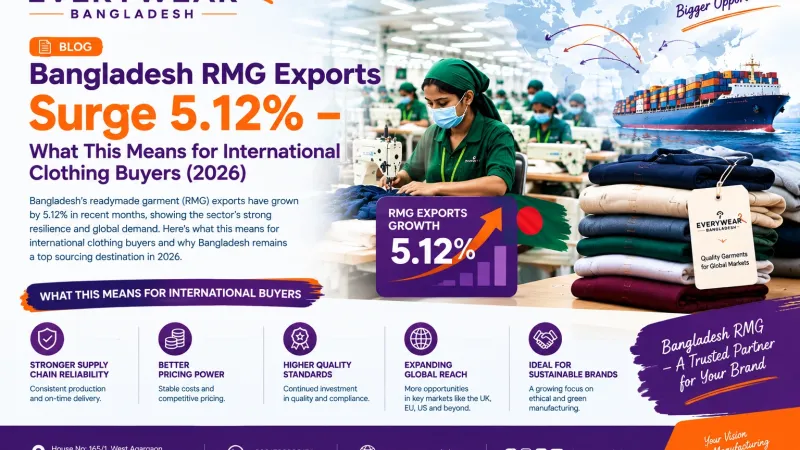
Bangladesh RMG Exports Surge 5.12% – What This Means for International Clothing Buyers (2026)
Last updated: September 13, 2026 • [Complete Analysis for Clothing Brands, Amazon FBA Sellers & Global Importers]
Quick Answer: What Does the 5.12% Export Surge Mean for Your Sourcing Strategy?
Bangladesh's ready-made garment (RMG) exports grew 5.12% year-on-year to $7.5 billion in July-August 2026 – the first two months of fiscal year 2026-27. This is great news for international buyers because it signals a rebounding, resilient, and increasingly competitive sourcing destination. Key highlights: US exports surged 11.42% to $1.61 billion, EU exports grew 2.46% to $3.49 billion, and non-traditional markets grew 6.48%. Simultaneously, the Bangladesh government dropped the knit fabric import ban and the US-Bangladesh trade deal is delivering zero tariffs for US-origin cotton garments. For clothing brands and Amazon FBA sellers, this means better pricing, faster lead times, and stronger supply chain reliability from Bangladesh. The message is clear: now is the time to source from Bangladesh.
Bangladesh's garment industry has defied global headwinds to post its strongest export growth in over a year. According to the latest data from the Export Promotion Bureau (EPB), ready-made garment exports grew 5.12% year-on-year to approximately $7.5 billion in July-August 2026 – the first two months of fiscal year 2026-27[reference:0].
This is significant news for international clothing buyers – and here's why. After a challenging FY26 that saw export declines driven by tariff uncertainty and global economic pressures, Bangladesh's RMG sector is back on a growth trajectory. Knitwear exports rose 6.17% to $4.19 billion, while woven garments grew 3.81% to $3.3 billion[reference:1].
But the story is not just about the headline number. It's about what's driving this growth – and what it means for your sourcing strategy in 2026 and beyond.
The Export Data: Where the Growth Is Coming From
Let's break down the numbers to understand where Bangladesh's RMG exports are growing – and what it means for different buyer segments.
Country-by-Country Performance (July-August 2026)
| Destination | Exports (Jul-Aug 2026) | YoY Change | Market Share |
|---|---|---|---|
| United States | $1.612 billion | +11.42% | 21.52% |
| European Union | $3.49 billion | +2.46% | 46.61% |
| United Kingdom | $916 million | +3.74% | 12.22% |
| Canada | $250 million | +3.37% | 3.33% |
| Non-Traditional Markets | $1.22 billion | +6.48% | Expanding |
Source: Export Promotion Bureau (EPB) data, compiled by Bangladesh Apparel Voice, September 2026[reference:2][reference:3]
Key Insights for Buyers
- US Market Is Booming – Exports to the US surged 11.42% to $1.61 billion, the strongest growth among major destinations. The US now accounts for 21.52% of Bangladesh's total RMG exports – up from 20.30% a year earlier[reference:4]. This is directly linked to the US-Bangladesh trade deal and growing buyer confidence.
- EU Recovery Is Underway – After a difficult FY26 that saw steep declines, EU exports grew 2.46% to $3.49 billion. Spain (+11.61%), the Netherlands (+8.47%), and Sweden (+13.15%) posted strong gains[reference:5].
- Non-Traditional Markets Are Exploding – Turkey saw exports nearly double (+94.68%), Brazil grew 34.37%, and the UAE increased 24.21% – signalling Bangladesh's success in diversifying beyond traditional markets[reference:6].
- Knitwear Is Outperforming – Knitwear exports grew 6.17% versus woven at 3.81% – reflecting strong demand for T-shirts, polo shirts, sweaters, and activewear[reference:7].
The Game-Changer: US-Bangladesh Trade Deal
The single biggest factor driving this export surge is the US-Bangladesh Agreement on Reciprocal Trade (ART), signed in February 2026.
What the Deal Delivers for Buyers
| Benefit | What It Means |
|---|---|
| Zero Tariff on US Cotton Garments | Apparel made with US-origin cotton or man-made fibres enters the US at 0% reciprocal tariff[reference:8] |
| Reduced Tariff Rate | Reciprocal tariff reduced from 20% to 19% for non-qualifying goods[reference:9] |
| Volume Mechanism | A to-be-specified volume of apparel can enter at zero tariff – expected to expand over time[reference:10] |
| Competitive Advantage vs. Vietnam | Vietnam faces 20% tariffs – Bangladesh now has a lower rate and a zero-tariff pathway[reference:11] |
Industry Impact: Bangladesh's RMG exports to the US could grow from $10 billion to $15 billion within two to three years as a result of this deal[reference:12].
Policy Win: Knit Fabric Import Ban Dropped
In a major win for garment exporters, the Bangladesh government abolished the provision that prohibited the import of knit fabrics under the new Import Policy Order 2026-2029[reference:13].
Why This Matters for Buyers
The original restriction – introduced in the gazette published on August 24, 2026 – would have barred export-oriented industries from importing knit fabrics. The BKMEA and BGMEA strongly opposed the move, arguing that domestic knit fabric capacity is not yet sufficient to meet export demand[reference:14].
With the restriction lifted:
- Manufacturers have full sourcing flexibility – they can import the best fabrics for your orders
- Quality and lead times improve – no forced reliance on limited domestic supply
- Costs remain competitive – manufacturers can source from the most cost-effective suppliers
This is a direct benefit for international buyers – you get the right fabric, at the right price, at the right time.
What This Means for Your Sourcing Strategy
The export surge and policy improvements create a compelling opportunity for international clothing buyers.
1. Now Is the Time to Source from Bangladesh
With exports growing, buyer confidence increasing, and trade deals delivering real cost savings, Bangladesh is more competitive than ever. Brands that source from Bangladesh today gain:
- Better pricing – competitive labor costs + zero-tariff benefits
- Faster lead times – full fabric sourcing flexibility
- Stronger supply chain – growing, resilient industry
2. US Buyers: Leverage the US Cotton Clause
If you're selling into the US market, request US-origin cotton for your garments. This qualifies you for the zero reciprocal tariff rate – saving approximately 19% on import duties and directly improving your margins.
3. EU Buyers: Prepare for DPP Compliance Now
While EU exports are recovering, the EU Digital Product Passport (DPP) is coming. Everywear Bangladesh is DPP-ready – with supply chain traceability, quality control data, and certified materials to help you comply.
4. Non-Traditional Markets: New Opportunities
The surge in non-traditional markets – Turkey, Brazil, UAE – signals growing global demand for Bangladeshi garments. Buyers in these markets can leverage Bangladesh's cost advantages to compete more effectively.
How Everywear Bangladesh Helps You Capitalize on This Growth
At Everywear Bangladesh, we're positioned to help you take full advantage of Bangladesh's export resurgence.
1. Low MOQ from 300 Pieces
Start with just 300 pieces per design. Test new styles, validate demand, and scale what works – without overcommitting capital.
2. US Cotton Zero-Tariff Sourcing
We source US-origin cotton for qualifying orders – saving you approximately 19% on import duties.
3. Full Private Label Support
Custom woven labels, printed neck labels, hang tags, poly bags, and branded cartons – everything you need to build a real brand.
4. Rigorous Quality Control
Multi-stage AQL inspection with video-call verification – you see your products before they ship.
5. Direct Shipping to Amazon FBA
We coordinate shipping to Amazon fulfillment centers across the USA, UK, EU, Canada, and Australia – with full FBA prep services.
6. One Accountable Partner
You deal with Everywear directly – not multiple factories. One point of contact, one invoice, complete peace of mind.
Contact Everywear Bangladesh on WhatsApp
Frequently Asked Questions
Everything you need to know about Bangladesh's RMG export surge and what it means for your sourcing.
1. How much did Bangladesh's RMG exports grow in July-August 2026?
Bangladesh's RMG exports grew 5.12% year-on-year to approximately $7.5 billion in July-August 2026 – the first two months of fiscal year 2026-27, according to Export Promotion Bureau data[reference:15].
2. Which markets drove the growth?
The United States led with +11.42% growth to $1.61 billion. The EU grew 2.46% to $3.49 billion, the UK grew 3.74%, and non-traditional markets surged 6.48% – with Turkey nearly doubling[reference:16].
3. What is the US-Bangladesh trade deal and how does it benefit buyers?
The Agreement on Reciprocal Trade (ART) signed in February 2026 provides zero reciprocal tariffs for Bangladeshi garments made with US-origin cotton or man-made fibres. This saves US buyers approximately 19% on import duties[reference:17].
4. What was the knit fabric import ban and why was it dropped?
The Import Policy Order 2026-2029 initially barred export-oriented industries from importing knit fabrics. The BGMEA and BKMEA opposed the restriction, arguing domestic capacity was insufficient. The government abolished the provision on September 9, 2026, restoring full sourcing flexibility for manufacturers[reference:18].
5. Why is this good news for international clothing buyers?
The export surge signals a rebounding, resilient, and increasingly competitive sourcing destination. Combined with the US trade deal and policy wins, buyers get better pricing, faster lead times, and stronger supply chain reliability.
6. Is now a good time to start sourcing from Bangladesh?
Yes – with exports growing, buyer confidence increasing, and trade deals delivering real cost savings, Bangladesh is more competitive than ever. Brands that source now gain a first-mover advantage.
7. What products are driving the growth?
Knitwear grew 6.17% to $4.19 billion – outpacing woven garments at 3.81%. This reflects strong demand for T-shirts, polo shirts, sweaters, and activewear[reference:19].
8. How does Everywear Bangladesh help buyers capitalize on this growth?
Everywear offers low MOQ from 300 pieces, US Cotton Zero-Tariff sourcing, full private label support, rigorous quality control, direct shipping to Amazon FBA, and one accountable partner – everything you need to source with confidence.
9. What are the challenges facing Bangladesh's RMG sector?
Challenges include energy shortages, global geopolitical tensions, and the upcoming LDC graduation (which will require GSP+ qualification for EU market access). However, the sector has demonstrated remarkable resilience – as the July-August growth shows.
10. How can I get started sourcing from Bangladesh?
Contact Everywear Bangladesh on WhatsApp at +8801788898174. Our team will understand your requirements, connect you with verified manufacturers, coordinate samples, manage production and quality control, and handle shipping – all with one point of contact.
Conclusion
Bangladesh's RMG export surge in July-August 2026 is more than just a positive headline – it's a signal that the industry has turned a corner. With 5.12% growth, a booming US market, EU recovery, and non-traditional markets expanding, Bangladesh is more competitive than ever.
The US-Bangladesh trade deal is delivering zero tariffs for US cotton garments. The knit fabric import ban has been dropped, restoring full sourcing flexibility. And buyer confidence is growing.
For international clothing buyers, the message is clear: now is the time to source from Bangladesh. The brands that act today will gain a first-mover advantage – securing better pricing, faster lead times, and stronger supply chain relationships.
At Everywear Bangladesh, we're ready to help you capitalize on this growth. With low MOQ from 300 pieces, US Cotton Zero-Tariff sourcing, full private label support, and one accountable partner, we make sourcing from Bangladesh simple, safe, and profitable.
Contact Everywear Bangladesh on WhatsApp
About the Author
Written by the Everywear Bangladesh Research & Sourcing Team
The Everywear Bangladesh editorial team combines deep industry expertise in Bangladesh's Ready-Made Garment (RMG) sector with practical experience in international apparel sourcing, supply chain management, and Amazon FBA selling. Our team includes former garment factory managers, sourcing professionals, and e-commerce specialists who have helped hundreds of sellers launch their clothing brands.
Our mission is to provide accurate, data-driven, and actionable content that helps fashion entrepreneurs, Amazon sellers, and global brands make informed sourcing decisions.
Connect with Everywear Bangladesh:
- Website: everywearbd.com
- WhatsApp: +8801788898174
- Facebook: facebook.com/everywearbd
- LinkedIn: Everywear Bangladesh Ltd
Related Resources
GEO Landing Pages
- USA Buyers: Wholesale Garments from Bangladesh
- UK Buyers: Wholesale Garments from Bangladesh
- Europe Buyers: Wholesale Clothing from Bangladesh
- Africa Buyers: Wholesale Garments from Bangladesh
Blog Posts
- US Tariff Guide for Bangladesh Garment Imports 2026
- US Cotton Clause – US-Bangladesh Trade Pact Benefits 2026
- Bangladesh RMG Exports Rebound – August 2026 Buyers Guide
- Bangladesh Raises Garment Value-Addition Requirement – Buyers Guide 2026
References
- Export Promotion Bureau (EPB), "RMG Export Data July-August FY2026-27," September 2026
- The Financial Express, "RMG exports grow 5.12pc to $7.5b in July-August," September 9, 2026
- New Age, "RMG exports to major destinations post positive growth in July-August," September 10, 2026
- The Financial Express, "Knit fabrics import prohibition clause dropped," September 9, 2026
- Observer BD, "Garment Exporters Hit Back at Proposed Yarn Restrictions," September 9, 2026
- US Government, "Joint Statement by the United States and Bangladesh on Reaching an Agreement on Reciprocal Trade," February 9, 2026
- The Financial Express, "BGMEA welcomes Bangladesh-US reciprocal tariff deal," February 11, 2026
- Anadolu Agency, "Zero reciprocal tariff for Bangladeshi textiles using US-produced cotton, fiber," February 9, 2026
- BSS News, "Bangladesh participates in 'Ready to Show' Fair in Milan," September 12, 2026
- Dhaka Tribune, "The cotton gambit," May 23, 2026
This guide is updated regularly. Last reviewed: September 13, 2026. For sourcing solutions tailored to your brand, contact Everywear Bangladesh on WhatsApp.
Everywear Bangladesh Ltd. – Bangladesh's First RMG Wholesale Marketplace | 300 Pcs Custom Orders | Export Quality Garments
WhatsApp: +8801788898174 • Website: everywearbd.com
Leave a comment