





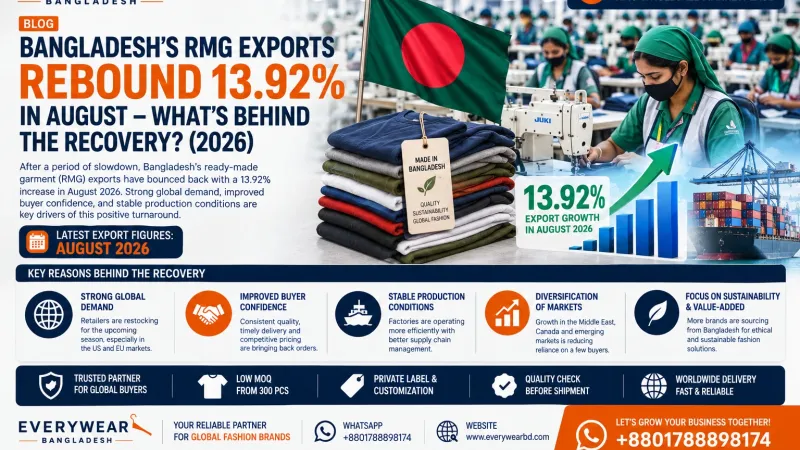
Bangladesh's RMG Exports Rebound 13.92% in August – What's Behind the Recovery? (2026)
Last updated: September 2, 2026 • [Complete Guide for International Apparel Buyers & Sourcing Professionals]
Quick Answer: What's Driving Bangladesh's RMG Export Rebound in August 2026?
Bangladesh's merchandise exports rebounded strongly in August 2026, growing 13.14% year-on-year to $4.43 billion, driven by a surge in ready-made garment (RMG) shipments. The RMG sector, which accounts for the bulk of exports, rose 13.92% to $3.89 billion in August, up from $3.17 billion in August 2025. Knitwear exports jumped 14.88% to $2.03 billion, while woven garments grew 12.70% to $1.57 billion. The United States, Bangladesh's largest export destination, recorded 26.09% growth in August, while the United Kingdom regained its position as the second-largest market. Among emerging markets, exports to Türkiye surged 141.03%, South Korea rose 42.37%, and Saudi Arabia increased 42.09%. The recovery was supported by stronger demand in major markets, increased buyer confidence, expanded production capacity, and rising exports of higher-value products. However, manufacturers note that the growth is partly explained by a low base in August 2025, when exports slumped due to reciprocal tariffs and weaker EU demand.
On September 1, 2026, the Export Promotion Bureau (EPB) released data showing that Bangladesh's merchandise exports rebounded strongly in August, growing 13.14 percent year-on-year to $4.43 billion. This represents a significant turnaround after months of modest or negative growth, with the ready-made garment (RMG) sector leading the recovery.
For international buyers, fashion brands, and sourcing professionals, this rebound signals renewed buyer confidence, stronger demand in key markets, and Bangladesh's continued resilience as a global apparel manufacturing hub. However, the growth also comes with important caveats – including a low base effect and ongoing energy challenges that could affect future performance.
This comprehensive guide examines the numbers behind the rebound, the key drivers of growth, market performance, and what buyers should expect in the coming months.
The Numbers: What Happened in August 2026
Bangladesh's merchandise exports in August 2026 bounced back with 13.14 per cent growth to fetch US$4.42 billion, according to Export Promotion Bureau (EPB) data.
| Metric | August 2025 | August 2026 | Change |
|---|---|---|---|
| Total Merchandise Exports | $3.92B | $4.43B | +13.14% |
| RMG Exports | $3.17B | $3.89B | +13.92% |
| Knitwear | — | $2.03B | +14.88% |
| Woven Garments | — | $1.57B | +12.70% |
Source: Export Promotion Bureau (EPB) data, released September 1, 2026
Non-RMG Sectors Also Show Strong Growth
Several non-RMG sectors also recorded double-digit growth in August, supporting Bangladesh's export diversification efforts:
| Sector | August 2026 Growth | July-August Cumulative Growth |
|---|---|---|
| Jute & Jute Goods | 37.09% | 22.26% |
| Pharmaceuticals | 28.52% | 38.94% |
| Leather & Leather Goods | 24.85% | — |
| Printed Materials | 24.83% | 41.89% |
| Engineering Products | 23.88% | — |
| Other Footwear | 15.29% | 27.32% |
Source: Export Promotion Bureau (EPB) data
Cumulative Performance: July-August 2026
The strong August performance helped lift cumulative export earnings in July-August of the financial year 2026-27 by 5.43 per cent to $9.16 billion from $8.69 billion in the corresponding period of the previous fiscal year.
RMG exports during July-August grew 5.12 per cent to $7.50 billion. Knitwear exports rose 6.17%, while woven garments grew 3.81% during the first two months of FY27.
Why Did Bangladesh's Exports Rebound in August?
Several factors contributed to the strong export performance in August 2026:
1. Low Base Effect
Manufacturers and industry leaders have pointed out that the growth is partly explained by a low base in August 2025. BGMEA President Mahmud Hasan Khan noted that garment exports stood at only $3.17 billion in August last year, following a decline in shipments to the US due to reciprocal tariffs and lower exports to the European Union.
Against this relatively low base, the August 2026 export figure of $3.89 billion shows a higher growth rate, but the underlying performance may not be as strong as the percentage suggests.
2. Stronger Demand in Major Markets
The EPB attributed the export growth to stronger demand in major markets and increased buyer confidence in Bangladesh as a reliable sourcing destination.
Buyers are largely maintaining their orders from Bangladesh despite concerns about the country's prolonged gas crisis. The EPB also noted that expanded production capacity and rising exports of higher-value products contributed to the growth.
3. Strong US Market Performance
Exports to the United States – Bangladesh's largest single-country export market – rose 26.09% in August. During the first two months of FY26-27, exports to the US increased 11.90%.
This is particularly notable given the earlier decline in US-bound shipments. The recovery suggests that US buyers are returning to Bangladesh after a period of cautious ordering.
4. UK Regains Second Position
The United Kingdom regained its position as Bangladesh's second-largest export market, followed by Germany, Spain and the Netherlands. This represents a positive shift for Bangladeshi exporters targeting the European market.
5. Emerging Market Growth
Among emerging markets, Türkiye recorded the highest growth, with exports rising 141.03% in August. Shipments to South Korea increased 42.37%, while exports to Saudi Arabia rose 42.09%.
This diversification into emerging markets is a positive sign for Bangladesh's export resilience, reducing dependence on traditional Western markets.
6. Higher-Value Products
The EPB noted that rising exports of higher-value products and efforts to diversify both products and markets contributed to the performance. This aligns with Bangladesh's strategic shift toward value-added manufacturing.
Market Performance: Where Are the Orders Coming From?
United States: 26.09% Growth
Bangladesh's largest export destination recorded 26.09% growth in August. This is a significant recovery after months of declining exports to the US. For US buyers, this signals that Bangladesh remains a competitive sourcing destination despite energy challenges and global economic uncertainty.
Learn more about US Tariff Guide and US Cotton Clause for tariff savings.
United Kingdom: Regains Second Position
The United Kingdom reclaimed its position as the second-largest export market for Bangladesh. This is particularly noteworthy given the UK's post-Brexit trade landscape and Bangladesh's duty-free access under the DCTS scheme. UK buyers can source with confidence knowing Bangladesh maintains preferential access.
Germany: A Key European Market
Germany, Spain, and the Netherlands rounded out the top five export destinations. For European buyers, Bangladesh's strong performance in these markets reflects continued buyer confidence despite the EU's tightening sustainability regulations. Bangladesh's 290 LEED-certified green factories offer a significant advantage for ESG-conscious European brands.
Explore our Sustainable Manufacturing Guide for more information.
Emerging Markets: Türkiye, South Korea, Saudi Arabia
Exports to Türkiye surged 141.03% in August, while shipments to South Korea and Saudi Arabia increased 42.37% and 42.09% respectively. This diversification demonstrates Bangladesh's growing appeal beyond traditional Western markets.
What This Means for International Buyers
Opportunity 1: Increased Buyer Confidence
The rebound reflects increased buyer confidence in Bangladesh as a reliable sourcing destination. For buyers who may have been considering diversifying away from Bangladesh, the August data suggests that the country remains a resilient and competitive supplier.
Opportunity 2: US Cotton Clause Savings
With US-bound exports rising 26.09% in August, buyers can leverage the US Cotton Clause under the Agreement on Reciprocal Trade (ART) to save up to 19% on tariffs. Garments made with US-origin cotton enter the US market duty-free, providing significant cost savings.
Opportunity 3: Sustainable Sourcing Advantage
With 290 LEED-certified green factories, Bangladesh offers a sustainable sourcing advantage for brands with ESG commitments. As European and US buyers face increasing pressure to meet sustainability targets, Bangladesh's green manufacturing leadership is a significant differentiator.
Challenge 1: Low Base Effect May Mask Structural Issues
Industry leaders have cautioned that the growth is partly explained by a low base in August 2025. The underlying performance may not be as strong as the percentage suggests. BGMEA President Mahmud Hasan Khan noted that "export performance has not improved significantly" despite the higher growth rate.
Challenge 2: Energy Crisis Continues to Disrupt Production
BKMEA President Mohammad Hatem expressed confusion about the export data, noting that production has been hit by gas and power crises at industrial belts across the country. He said he would scrutinise the data further to determine whether it is accurate, as production did not match the export figures.
This disconnect between export data and factory conditions is a concern for buyers. While orders may be increasing, actual production capacity may be constrained by the energy crisis.
Challenge 3: Month-on-Month Decline
Despite the year-on-year growth, EPB data showed that exports fell 6.30% in August from the previous month. Export earnings stood at $4.72 billion in July, compared to $4.43 billion in August. This month-on-month decline suggests that the recovery may be uneven.
Challenge 4: Value Addition Compliance
The government's recent decision to raise the value-addition requirement to 40% under the Import Policy Order 2026-2029 may affect manufacturers' ability to meet export targets. Buyers should work with vertically integrated suppliers who can meet these new requirements.
Read our Value Addition Guide for more details.
How Everywear Bangladesh Helps Buyers Navigate the Recovery
At Everywear Bangladesh, we understand that the August rebound presents both opportunities and challenges for international buyers. Here's how we help:
1. Access to Resilient Manufacturers
We connect you with manufacturers that are best positioned to maintain production despite the energy crisis:
- LEED-certified green factories – 290+ certified facilities with energy-efficient operations
- Factories with backup power – Captive power generation and solar installations
- Diversified locations – Factories across multiple industrial zones to reduce single-point vulnerability
2. US Cotton Zero-Tariff Expertise
We help you maximize the US Cotton Clause benefit under the Agreement on Reciprocal Trade (ART):
- US Cotton Sourcing – We connect you with manufacturers who can source and use US-origin cotton
- Documentation Support – We ensure proper documentation including certificates of origin
- Tariff Savings Calculation – Our team calculates your exact tariff savings – typically $9,500-$10,000 on a $50,000 order
3. Low MOQ from 300 Pieces
With the August rebound potentially leading to increased order volumes, our low MOQ from 300 pieces helps you test new suppliers and products before scaling up:
- Test new suppliers with reduced risk
- Validate demand before committing to large orders
- Manage cash flow effectively
- Adapt quickly to changing market conditions
Learn more about our Low MOQ Manufacturing and Private Label Manufacturing services.
4. Quality Assurance
With production disruptions, quality risks increase. Our quality control process helps ensure your products meet international standards:
- Fabric inspection – Before cutting begins
- In-line sewing inspection – Throughout production
- Printing and embroidery verification – Accurate artwork placement
- Final AQL inspection – Comprehensive quality check
- Video-call inspection – Verify your order before shipment
5. End-to-End Support
You deal with Everywear directly – not multiple factories or middlemen. We provide:
- Dedicated account manager – Your single point of contact
- Regular production updates – Photos and progress reports
- 24/7 WhatsApp support – For urgent queries
- Transparent pricing – No hidden costs
Contact Everywear Bangladesh on WhatsApp
Frequently Asked Questions
Everything you need to know about Bangladesh's August 2026 RMG export rebound and what it means for buyers.
1. How much did Bangladesh's RMG exports grow in August 2026?
Bangladesh's RMG exports grew 13.92% year-on-year to $3.89 billion in August 2026, up from $3.17 billion in August 2025. Total merchandise exports rose 13.14% to $4.43 billion.
2. Which apparel segments performed best in August 2026?
Knitwear exports increased by 14.88% to $2.03 billion, while woven garments rose by 12.70% to $1.57 billion. Both segments recorded strong growth, with knitwear outperforming woven garments.
3. Which countries are Bangladesh's top export destinations?
The United States remained Bangladesh's largest export destination with 26.09% growth in August. The United Kingdom regained its position as the second-largest market, followed by Germany, Spain, and the Netherlands.
4. How did emerging markets perform for Bangladesh exports?
Exports to Türkiye surged 141.03% in August, while shipments to South Korea rose 42.37% and Saudi Arabia increased 42.09%. This demonstrates Bangladesh's growing diversification into emerging markets.
5. Is the August rebound sustainable?
The rebound is partly explained by a low base in August 2025, when exports slumped due to reciprocal tariffs and weaker EU demand. BGMEA President Mahmud Hasan Khan noted that "export performance has not improved significantly" despite the higher growth rate. Additionally, the ongoing energy crisis continues to disrupt production.
6. Why is there a disconnect between export data and factory production?
BKMEA President Mohammad Hatem noted that production has been hit by gas and power crises at industrial belts across the country. He said production did not match the export figures, suggesting that the data may reflect orders placed earlier or shipments from existing inventory rather than current production levels.
7. What does the August rebound mean for US buyers?
US exports rose 26.09% in August, signaling renewed buyer confidence. US buyers can also leverage the US Cotton Clause to save up to 19% on tariffs for garments made with US-origin cotton. However, buyers should be aware of the energy crisis and its potential impact on lead times and production consistency.
8. What does the rebound mean for European buyers?
The United Kingdom regained its position as the second-largest export market, while Germany, Spain, and the Netherlands remain key destinations. European buyers should note that Bangladesh's 290 LEED-certified green factories offer a sustainable sourcing advantage for brands with ESG commitments.
9. How did non-RMG sectors perform in August 2026?
Several non-RMG sectors recorded double-digit growth: jute and jute goods (+37.09%), pharmaceuticals (+28.52%), leather and leather goods (+24.85%), printed materials (+24.83%), engineering products (+23.88%), and other footwear (+15.29%).
10. What are the key takeaways from the August 2026 export data?
Key takeaways: (1) RMG exports rebounded strongly with 13.92% growth, (2) the US market led the recovery with 26.09% growth, (3) emerging markets showed exceptional growth (Türkiye +141.03%), (4) non-RMG sectors contributed to diversification, and (5) the low base effect and ongoing energy crisis mean the recovery may not be as strong as the percentages suggest.
11. What is the cumulative export performance for July-August 2026?
Cumulative export earnings in July-August of FY27 grew 5.43% to $9.16 billion. RMG exports during this period grew 5.12% to $7.50 billion. Knitwear exports rose 6.17%, while woven garments grew 3.81%.
12. How can Everywear Bangladesh help me source from Bangladesh during this recovery?
Everywear Bangladesh offers access to resilient manufacturers (LEED-certified factories, backup power), US Cotton zero-tariff expertise, low MOQ from 300 pieces to test new suppliers, quality assurance to maintain standards during production disruptions, and end-to-end support with one accountable partner.
13. Should buyers be concerned about the energy crisis affecting future orders?
Yes. Despite the export rebound, BKMEA President Mohammad Hatem noted that production has been hit by gas and power crises. The disconnect between export data and factory conditions is a concern. Buyers should work with manufacturers that have backup power and energy-efficient operations to ensure production continuity.
14. What is the US Cotton Clause and how can it benefit my sourcing?
Under the Agreement on Reciprocal Trade (ART), garments made with US-origin cotton enter the US market at a zero reciprocal tariff rate. This can save US buyers approximately 19% in tariffs. Everywear Bangladesh can help you source US cotton garments and handle all documentation and compliance.
15. What should buyers do to prepare for the rest of 2026?
Buyers should: (1) Communicate with suppliers about production capacity and lead times, (2) Build buffer time into inventory planning due to energy disruptions, (3) Consider the US Cotton Clause for tariff savings, (4) Work with vertically integrated suppliers who can meet the new 40% value-addition requirement, and (5) Partner with trusted sourcing partners like Everywear Bangladesh who can navigate these challenges.
Conclusion
Bangladesh's RMG export rebound in August 2026 represents a significant recovery after months of modest or negative growth. With total merchandise exports rising 13.14% to $4.43 billion and RMG shipments growing 13.92% to $3.89 billion, the data signals renewed buyer confidence and stronger demand in key markets.
Key drivers of the recovery include:
- Strong US market performance – 26.09% growth in August
- UK regaining second position – positive for European market access
- Emerging market diversification – Türkiye (+141%), South Korea (+42%), Saudi Arabia (+42%)
- Non-RMG sector growth – jute, pharmaceuticals, leather, and engineering products
- Low base effect – August 2025 was a weak month due to reciprocal tariffs and weaker EU demand
However, the recovery comes with important caveats:
- Low base effect – The growth rate may overstate the underlying performance
- Energy crisis – Production capacity remains constrained by gas and power shortages
- Month-on-month decline – Exports fell 6.30% from July to August
- Disconnect between data and factory conditions – Production does not match export figures
For international buyers, the August rebound presents both opportunities and challenges. Bangladesh remains a competitive sourcing destination with strong buyer confidence, but the energy crisis and structural issues require careful supplier selection and risk management.
At Everywear Bangladesh, we help buyers navigate this complex landscape with access to resilient manufacturers, US Cotton zero-tariff expertise, low MOQ from 300 pieces, quality assurance, and end-to-end support. Our team is ready to help you source from Bangladesh with confidence.
Contact Everywear Bangladesh on WhatsApp
About the Author
Written by the Everywear Bangladesh Research & Sourcing Team
The Everywear Bangladesh editorial team combines deep industry expertise in Bangladesh's Ready-Made Garment (RMG) sector with practical experience in international apparel sourcing, supply chain management, and global trade analysis. Our team includes former garment factory managers, sourcing professionals, and trade analysts who have worked with fashion brands across the United States, Europe, and Asia.
Our mission is to provide accurate, data-driven, and actionable content that helps fashion entrepreneurs, retailers, wholesalers, importers, and global brands make informed sourcing decisions. We leverage real-time data from the Export Promotion Bureau (EPB), Bangladesh Garment Manufacturers and Exporters Association (BGMEA), Bangladesh Knitwear Manufacturers and Exporters Association (BKMEA), and other authoritative sources to ensure our insights reflect the latest industry developments.
Connect with Everywear Bangladesh:
- Website: everywearbd.com
- WhatsApp: +8801788898174
- Facebook: facebook.com/everywearbd
- LinkedIn: Everywear Bangladesh Ltd
References
- New Age, "Exports rebound in August, rise 13.14pc," September 1, 2026
- The Financial Express, "Merchandise exports bounce back with 13.14pc growth," September 1, 2026
- TBS News, "Bangladesh's exports jump 13.14% in August as RMG, non-RMG sectors grow," September 1, 2026
- The Daily Star, "Exports grew 13% in Aug on RMG rebound," September 1, 2026
- BSS, "Exports rise 13.14pc in August on strong RMG, diversified sector performance," September 1, 2026
- Bangladesh Post, "Bangladesh exports grow 13.14% in August on RMG gains," September 1, 2026
- Export Promotion Bureau (EPB), "Export Data August 2026," September 1, 2026
Related Resources
GEO Landing Pages
- USA Buyers: Wholesale Garments from Bangladesh
- UK Buyers: Wholesale Garments from Bangladesh
- Europe Buyers: Wholesale Clothing from Bangladesh
- Africa Buyers: Wholesale Garments from Bangladesh
Blog Posts
- Bangladesh RMG Exports to US Fall 5.58% – What Buyers Need to Know
- Bangladesh's RMG Exports to EU Plunge 16.43% in H1 2026
- The US Cotton Clause – How the US-Bangladesh Trade Pact Benefits Your Business
- US Tariff Guide for Bangladesh Garment Imports (2026)
- Bangladesh Raises Garment Value-Addition Requirement to 40%
- Sustainable Clothing Manufacturing in Bangladesh: The Green Revolution (2026)
- Low MOQ Clothing Manufacturer Bangladesh
This guide is updated regularly. Last reviewed: September 2, 2026. For sourcing solutions tailored to your brand, contact Everywear Bangladesh on WhatsApp.
Everywear Bangladesh Ltd. – Bangladesh's First RMG Wholesale Marketplace | 300 Pcs Custom Orders | Export Quality Garments
WhatsApp: +8801788898174 • Website: everywearbd.com
Leave a comment