





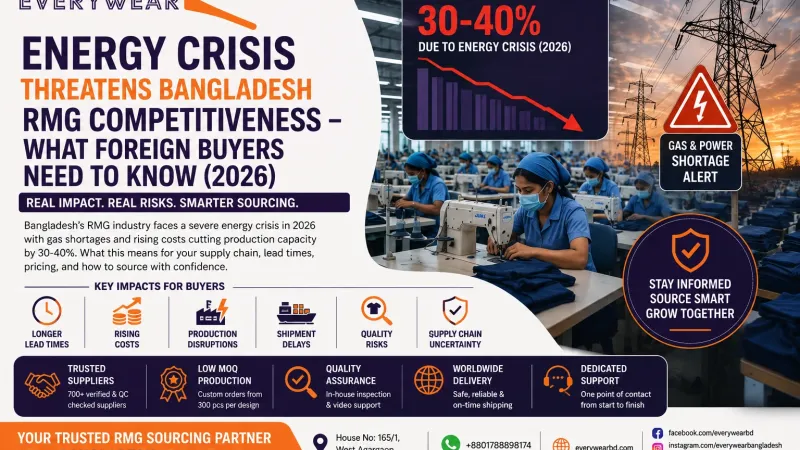
Energy Crisis Threatens Bangladesh RMG Competitiveness – What Foreign Buyers Need to Know (2026)
Last updated: August 10, 2026 • Complete Guide for US, UK, EU, Africa & Global Apparel Buyers
Bangladesh's ready-made garment (RMG) industry is facing a serious energy challenge in 2026. Gas shortages, electricity disruptions, rising operating costs and supply-chain uncertainty have created new risks for international fashion brands and importers sourcing from Bangladesh.
For foreign buyers, however, the important question is not simply whether Bangladesh is experiencing an energy crisis. The real question is: what does the energy crisis mean for garment production, lead times, prices, quality and shipment reliability – and how can buyers reduce those risks?
Industry leaders reported that factory production capacity was significantly affected during the latest gas shortage, with some reports putting the reduction at around 30–40 percent in severely affected production areas. Earlier in 2026, the Bangladesh Garment Manufacturers and Exporters Association (BGMEA) had already reported a 25–30 percent decline in production capacity because of inadequate gas and electricity supply.
The situation is therefore more complicated than a temporary factory shutdown. Bangladesh's apparel sector is dealing with a combination of immediate energy disruption and longer-term structural issues involving domestic gas production, imported LNG dependence, infrastructure, logistics, production costs and energy resilience.
At the same time, Bangladesh remains one of the world's largest apparel manufacturing hubs, with a deeply established export ecosystem serving the United States, European Union, United Kingdom, Canada, Australia, Africa and other global markets.
This guide explains what foreign buyers need to know before placing their next apparel order with a Bangladesh clothing manufacturer or clothing supplier from Bangladesh.
Quick Answer for Foreign Buyers
Bangladesh's 2026 energy crisis can create production delays, higher operating costs and greater lead-time uncertainty, particularly for factories and industrial zones experiencing severe gas or electricity shortages. However, the crisis does not mean that all Bangladesh garment manufacturers are equally affected or that buyers should automatically leave the country.
The smarter approach is to evaluate factory-level energy resilience, backup power, production capacity, quality control, lead-time planning, factory location, supplier diversification and communication before placing a bulk order.
Why Is Bangladesh's RMG Industry Facing an Energy Crisis in 2026?
Energy has always been a critical input for Bangladesh's textile and apparel manufacturing ecosystem. Garment production itself may not consume as much gas as spinning, dyeing, washing or textile processing, but the wider apparel supply chain depends heavily on stable electricity and gas availability.
When energy supply becomes unreliable, the effect moves through the entire manufacturing chain.
A factory may have sufficient sewing machines, workers and raw materials but still be unable to operate efficiently if electricity is unavailable or gas pressure is too low for supporting production processes.
In April 2026, BGMEA reported that inadequate gas and electricity supply was already causing factories to experience a 25–30 percent decline in production capacity. The association specifically highlighted disruptions in major industrial zones such as Gazipur and Ashulia and called for uninterrupted energy supply to sustain RMG production.
The situation intensified during July and August after one of Bangladesh's floating LNG terminals at Moheshkhali was taken offline following a technical incident. The affected terminal normally contributes a substantial volume of regasified LNG to the national gas system.
Reuters reported that gas supplies began improving after a partial restart of the affected terminal in early August, with an initial recovery of approximately 115 million cubic feet per day. Full restoration was still being worked on at that stage.
This distinction is important for international buyers.
The immediate disruption can improve faster than the underlying structural problem.
Even if LNG supply returns to normal, Bangladesh still faces longer-term challenges related to declining domestic gas production, dependence on imported LNG, infrastructure investment and the cost of maintaining reliable industrial energy supplies.
For a fashion buyer planning a six-month or twelve-month sourcing strategy, that means energy resilience should become part of supplier evaluation rather than something considered only after a production delay occurs.
What caused the latest disruption?
The latest crisis has been linked to several overlapping factors:
- Reduced domestic natural-gas availability
- Dependence on imported LNG
- Temporary disruption at an LNG regasification facility
- Low gas pressure in industrial areas
- Electricity and load-shedding problems
- Higher fuel costs for backup generators
- Global geopolitical pressure on energy markets
- Long-standing underinvestment in domestic gas exploration
The result is a manufacturing environment where some factories can continue operating relatively normally while others experience substantial production restrictions.
That difference between factories is exactly why buyers should avoid treating the entire Bangladesh RMG sector as one single supply source.
The Numbers: How Serious Is the Bangladesh Garment Energy Problem?
The most useful way to understand the crisis is to separate the different measurements reported during 2026.
| Indicator | Reported Impact | Buyer Meaning |
|---|---|---|
| RMG production capacity impact reported in April | 25–30% | Production schedules can become less predictable |
| Severely affected production areas during the August gas crunch | Up to around 30–40% | Some factories may require additional production time |
| Gas supply disruption from affected LNG terminal | Approximately 450 MMcfd initially affected | Industrial gas pressure and power generation were affected |
| Initial gas recovery after partial LNG restart | About 115 MMcfd | Short-term supply conditions began improving |
| Energy-cost increase reported by industry sources | 65–75% | Potential pressure on factory margins and FOB pricing |
These figures should not be interpreted as meaning that every Bangladesh clothing factory is operating at 60–70 percent capacity.
That would be an inaccurate generalisation.
Energy impact varies by factory location, industrial zone, machinery requirements, access to backup power, captive generation, solar systems, gas pressure and the factory's ability to reorganise production schedules.
For buyers, this is a critical distinction.
The correct question is not "Is Bangladesh affected?" The correct question is "How resilient is my selected Bangladesh garment manufacturer?"
How Does the Energy Crisis Affect Bangladesh Clothing Manufacturers?
The first impact is production continuity.
Garment manufacturing is a time-sensitive operation. A typical order moves through fabric procurement, fabric inspection, cutting, sewing, printing or embroidery, washing where required, finishing, quality control, packing and export documentation.
A disruption at one stage can affect every stage after it.
For example, if a washing facility operates below capacity because of energy shortages, finished garments can remain waiting for washing. If washing is delayed, final inspection is delayed. If inspection is delayed, packing is delayed. If packing is delayed, the shipment booking may be missed.
Therefore, a seemingly small energy disruption can eventually become a logistics problem for the international buyer.
1. Longer production lead times
Factories may need additional days to complete orders when operating hours are reduced or production lines are repeatedly interrupted.
This matters particularly for:
- Fast-fashion brands
- Seasonal collections
- Holiday inventory
- Limited-edition drops
- Private-label launches
- Urgent replenishment orders
- Marketplace sellers with strict inventory schedules
2. Higher production costs
When factories compensate for unreliable grid electricity or gas supply through diesel generators or other backup systems, operating costs increase.
Those costs can eventually influence FOB prices, especially if energy shortages continue for an extended period.
For buyers comparing suppliers only by quoted unit price, this creates a problem.
A supplier offering a very low initial quotation may not necessarily provide the lowest final landed cost if production delays, emergency freight, missed selling windows or inconsistent quality occur later.
3. Pressure on production consistency
Repeated production interruptions can create additional quality-control pressure.
Quality problems do not automatically result from an energy shortage, but disrupted production schedules can increase the risk of rushed finishing, compressed inspection windows and production bottlenecks.
This is why buyers should strengthen their quality-control process during periods of supply-chain disruption.
4. Shipment scheduling risk
International apparel orders operate according to vessel schedules, freight bookings, warehouse receiving dates and retail launch calendars.
Missing a planned shipment can create additional costs even if the garments are eventually completed.
For international buyers, the energy crisis therefore needs to be viewed as a lead-time management issue, not merely an electricity issue.
Does the Energy Crisis Mean Buyers Should Stop Sourcing Garments from Bangladesh?
No.
That would be an unnecessarily broad conclusion.
Bangladesh remains one of the world's most established apparel manufacturing ecosystems. Its RMG sector has decades of export experience, extensive factory capacity, a large skilled workforce and established relationships with global apparel buyers.
The current energy crisis creates additional sourcing risk, but it does not eliminate the country's manufacturing advantages.
In fact, periods of disruption can make supplier selection more sophisticated.
Instead of asking:
"Is Bangladesh cheap?"
buyers should ask:
"Which Bangladesh supplier can deliver the quality, price, capacity and reliability my business needs under current conditions?"
This is a much more useful sourcing question.
Bangladesh remains particularly attractive for categories where the country has deep production expertise, including:
- T-shirts
- Knitwear
- Hoodies
- Sweatshirts
- Denim
- Basic apparel
- Private-label clothing
- Streetwear
- Uniforms
- Casualwear
- Selected sportswear and activewear categories
The important change is that buyers should place greater emphasis on supplier resilience.
What Should Foreign Buyers Check Before Choosing a Bangladesh Garment Manufacturer?
This is perhaps the most important section of this guide.
If you are sourcing from Bangladesh in 2026, your supplier evaluation should go beyond price, MOQ and product photographs.
Ask the manufacturer or sourcing partner specific operational questions.
Energy Resilience Checklist
- Does the factory have backup generators?
- How long can production continue during grid interruptions?
- Does the facility have captive power generation?
- Does the factory use rooftop solar or other renewable-energy systems?
- Is the factory located in an area currently experiencing severe gas-pressure problems?
- Does the factory have alternative arrangements for critical production processes?
- Does the supplier have access to more than one production facility?
Production Checklist
- What is the factory's monthly production capacity?
- How much capacity is currently committed to existing orders?
- What is the realistic lead time rather than the quoted ideal lead time?
- Can production be moved between facilities if necessary?
- What happens if energy disruption affects the original production schedule?
Quality-Control Checklist
- Is there an independent or internal QC team?
- Are fabric inspections performed before cutting?
- Are measurements checked during sewing?
- Are printing and embroidery inspected?
- Is final inspection completed before packing?
- Can buyers receive production photographs or video updates?
- Can a pre-shipment inspection be arranged?
Communication Checklist
- Who is responsible for communicating production updates?
- How frequently are updates provided?
- Will the buyer be informed immediately if production falls behind?
- Can the supplier provide revised ETAs?
- Can the buyer communicate directly through WhatsApp or another reliable channel?
These questions are particularly important for first-time buyers searching for clothing suppliers from Bangladesh.
Why Backup Power and Renewable Energy Matter for Bangladesh Apparel Factories
The current energy crisis is also accelerating an important discussion about the future of Bangladesh garment manufacturing.
Energy resilience is no longer simply an operational issue.
It is becoming part of the competitiveness equation.
A factory with energy-efficient machinery, backup generation, solar capacity, modern building design and efficient production systems may be better positioned to handle disruptions than a factory that depends entirely on uninterrupted grid supply.
This is one reason why sustainability and supply-chain resilience increasingly overlap.
Bangladesh has developed a strong reputation for green garment factories. The country has one of the world's largest concentrations of LEED-certified apparel facilities.
However, buyers should avoid assuming that every LEED-certified factory automatically has unlimited energy independence.
Certification and operational resilience are related but not identical.
When evaluating a supplier, ask what energy systems are actually operating at the facility.
Useful questions include:
- How much electricity comes from the grid?
- How much backup generation is available?
- Is solar generation installed?
- How is generator fuel secured during shortages?
- Which production processes require gas?
- What is the factory's contingency plan?
For brands with ESG requirements, this approach also provides a better picture of real sustainability performance rather than relying only on a certification logo.
How the Energy Crisis Can Affect Clothing Prices in Bangladesh
International buyers often ask whether Bangladesh garment prices will increase because of the energy crisis.
The honest answer is: potentially, but the effect depends on the product, factory and duration of the disruption.
Energy is one component of apparel manufacturing costs. If factories must spend more on diesel, backup electricity, alternative fuel or overtime, their operating costs increase.
Other costs may also move at the same time, including:
- Labour
- Financing
- Raw materials
- Transportation
- Packaging
- Utilities
- Port and logistics expenses
However, buyers should not automatically accept a large price increase without understanding its basis.
A professional supplier should be able to explain what has changed in the cost structure.
For example, if a T-shirt quotation increases, the buyer can ask whether the change comes from:
- Fabric cost
- Energy cost
- Labour cost
- Printing or embroidery
- Packaging
- Freight
- Exchange-rate movement
This creates a more transparent negotiation process.
For small brands, this is especially important because a small change in unit cost can significantly affect gross margin.
Bangladesh vs Vietnam and Other Apparel Manufacturing Countries During the Energy Crisis
Bangladesh is not operating in isolation.
Global apparel buyers are constantly comparing Bangladesh with Vietnam, India, Indonesia, Cambodia, China and Turkey.
The energy crisis therefore matters because it interacts with other competitive factors.
| Factor | Bangladesh | Buyer Consideration |
|---|---|---|
| Apparel manufacturing scale | Very strong | Deep supplier ecosystem |
| Basic knitwear | Very strong | Major sourcing advantage |
| Low-cost production | Competitive | Energy disruption can reduce the advantage |
| Lead times | Needs improvement in some categories | Important for fast-fashion buyers |
| MMF capacity | Growing | Important diversification opportunity |
| Green manufacturing | Strong | Important for ESG-focused brands |
| Energy resilience | Varies significantly by factory | Must be evaluated supplier by supplier |
Bangladesh's competitive position therefore depends on more than simply having the lowest manufacturing price.
The country's long-term competitiveness will increasingly depend on reliable energy, logistics, product diversification, shorter lead times, technology adoption and sustainable manufacturing.
For foreign buyers, that means Bangladesh should remain part of a diversified sourcing strategy rather than being evaluated solely on its current energy disruption.
Why Bangladesh's Energy Crisis Could Become a Long-Term Competitiveness Issue
The immediate gas shortage may improve, but the structural question remains.
Bangladesh has become increasingly dependent on imported LNG as domestic gas production declines.
This creates exposure to global energy prices, international shipping conditions and geopolitical disruptions.
For the apparel industry, this matters because global buyers expect three things simultaneously:
- Competitive pricing
- Reliable production
- Predictable delivery
If energy costs remain elevated or energy supply becomes unpredictable, factories may face greater difficulty providing all three at the same time.
This could particularly affect price-sensitive orders where manufacturers operate on thin margins.
It may also accelerate investment in:
- Solar energy
- Energy-efficient machinery
- Captive power generation
- Energy management systems
- Waste-heat recovery
- Efficient boilers
- Modern building systems
- Alternative energy sources
For Bangladesh's apparel industry, the energy crisis could therefore become a catalyst for a more resilient manufacturing model.
Are Foreign Buyers Moving Orders Away from Bangladesh?
There is evidence that some international buyers are reconsidering sourcing strategies because of the combination of energy uncertainty, geopolitical risk and delivery concerns.
That should not be confused with a wholesale abandonment of Bangladesh.
Large global apparel supply chains rarely move billions of dollars of production from one country to another overnight.
Factories, supplier relationships, raw-material networks, compliance systems, skilled workers, financing arrangements and logistics infrastructure all take years to build.
Instead, buyers are more likely to:
- Reduce dependency on one factory
- Add secondary suppliers
- Shift urgent orders to alternative production countries
- Increase inventory buffers
- Require stronger production reporting
- Evaluate factory-level energy resilience
- Split production between countries
This is a much more realistic interpretation of current sourcing behaviour.
For Bangladesh, the challenge is therefore not simply retaining orders. It is demonstrating to international buyers that the country can provide predictable manufacturing performance despite temporary disruptions.
What Should US Buyers Know About the Bangladesh Energy Crisis?
US buyers face an additional layer of complexity because Bangladesh's apparel exports to the United States are already experiencing competitive pressure in 2026.
Bangladesh retained its position as a major apparel supplier to the US, but recent export data show that the market is becoming increasingly competitive.
Vietnam, Cambodia and Indonesia have strengthened their positions in several apparel categories, while Bangladesh continues working to improve lead times, MMF capacity and production competitiveness.
US buyers should therefore evaluate Bangladesh suppliers using a broader landed-cost model.
Do not compare only:
Factory A: $3.20 per garment
against:
Factory B: $3.35 per garment.
Instead compare:
- FOB price
- Production lead time
- Shipping cost
- Potential delay risk
- Quality-control cost
- Inspection cost
- Inventory carrying cost
- Tariff treatment
- Replenishment speed
- Supplier reliability
This produces a much more realistic total-cost comparison.
US buyers should also review the latest US-Bangladesh trade and tariff provisions before finalising a purchase because trade rules can change and specific preferential provisions may depend on product classification, origin requirements and the applicable agreement.
What UK and European Buyers Should Consider
UK and European fashion buyers should take a similar approach.
Bangladesh remains a major apparel sourcing destination for European brands, particularly for knitwear, basic garments and large-volume production.
However, buyers operating seasonal collections should build realistic production buffers into their purchasing calendar.
Instead of placing a purchase order immediately before a required launch date, buyers should consider:
- Earlier sample approval
- Earlier fabric booking
- Production buffer days
- Pre-shipment inspection
- Alternative production capacity
- Early freight booking
- Contingency inventory
This becomes even more important for businesses selling through Shopify, WooCommerce, Amazon, Etsy, Walmart Marketplace, TikTok Shop or independent retail channels where inventory availability directly affects sales performance.
What Africa and Emerging-Market Buyers Should Consider
Africa represents a different sourcing opportunity.
Many African wholesalers, retailers and fashion entrepreneurs are looking for competitive apparel products but may purchase smaller quantities than traditional multinational buyers.
For these buyers, the biggest risk is often not only factory production capacity but also the lack of transparent supplier information, international payment confidence and logistics coordination.
This is where a managed sourcing model can become valuable.
Instead of dealing with an unknown factory, buyers can work through a sourcing partner that coordinates:
- Supplier identification
- Product verification
- Quality control
- Order coordination
- Production monitoring
- Documentation
- Shipping
For smaller African brands and wholesalers, this can reduce the operational burden associated with international apparel sourcing.
How Everywear Bangladesh Helps Buyers Manage Sourcing Risk
Everywear Bangladesh approaches apparel sourcing differently from an open supplier directory.
The objective is to give international buyers a single accountable sourcing partner while connecting them with Bangladesh's established garment manufacturing ecosystem.
The model is particularly relevant during periods of supply-chain uncertainty because buyers should not have to independently manage every factory relationship, production update and quality-control issue.
Everywear Bangladesh supports buyers with:
- Bangladesh garment sourcing
- Wholesale apparel sourcing
- Private-label manufacturing
- OEM garment production
- Custom garment development
- Low-MOQ manufacturing
- Product sourcing
- Quality checking
- Production coordination
- Export documentation
- International shipping coordination
For custom manufacturing, Everywear Bangladesh works with orders starting from 300 pieces per design, making the service relevant to smaller fashion brands that may not meet the minimum requirements of larger factories.
The practical advantage is accountability.
You deal with Everywear. Everywear coordinates with the manufacturing side.
This model is designed to reduce the information gap that international buyers often face when searching for Bangladesh clothing manufacturers through multiple disconnected channels.
For buyers concerned about the 2026 energy crisis, supplier selection can also include questions about factory location, production resilience, backup power, capacity and contingency planning before an order is confirmed.
What Buyers Should Do Before Placing Their Next Bangladesh Apparel Order
The energy crisis does not mean buyers need to stop sourcing from Bangladesh.
It means buyers should improve their sourcing process.
1. Ask for a realistic production timeline
Do not accept a generic lead-time statement. Ask when production can actually start, what materials are already available and how much capacity the factory currently has.
2. Ask about backup energy
Confirm whether the factory has generators, captive power, solar systems or alternative arrangements.
3. Approve samples earlier
Sample approval delays can compound production delays. Finalise specifications, measurements, colours and artwork before the production window becomes tight.
4. Keep production buffers
If your normal schedule allows 30 days, do not plan your entire business around receiving the goods exactly on day 30.
5. Use quality control during production
Do not wait until the shipment reaches your warehouse to discover problems.
6. Maintain supplier diversification
For important collections, consider having a primary and secondary production option.
7. Monitor the energy situation
Ask your supplier for updates rather than relying exclusively on news headlines.
8. Compare landed cost, not only FOB price
A slightly higher unit price from a more resilient supplier may produce a lower total business cost if the supplier consistently meets deadlines and quality requirements.
9. Use a sourcing partner when necessary
For buyers without an established Bangladesh supplier network, a managed sourcing partner can reduce communication, verification and production-monitoring challenges.
What Is the Outlook for Bangladesh RMG Competitiveness in 2026 and Beyond?
The outlook is mixed but not negative.
Bangladesh's apparel industry is under pressure from multiple directions:
- Energy insecurity
- Higher production costs
- Lead-time competition
- Limited MMF capacity
- Global demand uncertainty
- Geopolitical disruptions
- Changing trade policies
- LDC graduation-related challenges
At the same time, the country retains major structural advantages.
- Large-scale apparel manufacturing expertise
- Established international buyer relationships
- Strong knitwear capability
- Competitive manufacturing costs
- Large skilled workforce
- Strong sustainability credentials
- Extensive textile and apparel ecosystem
- Growing product diversification
The next stage of Bangladesh's RMG competitiveness will therefore depend on how effectively the industry addresses its structural weaknesses.
Energy reliability will be one of the most important.
Product diversification will be another.
Lead-time improvement, logistics investment, renewable energy adoption and stronger supplier-level risk management will also become increasingly important.
For foreign buyers, this means Bangladesh should not be viewed as a static sourcing destination.
It is an evolving manufacturing ecosystem.
Frequently Asked Questions
1. Is the Bangladesh energy crisis affecting garment production in 2026?
Yes. Bangladesh's RMG industry has experienced significant disruption from gas and electricity shortages during 2026. BGMEA reported a 25–30 percent decline in production capacity earlier in the year, while industry reports during the August gas crunch indicated that severely affected factories could experience production reductions of around 30–40 percent. The impact varies by factory, location and backup-energy capability.
2. Should foreign buyers stop sourcing clothing from Bangladesh because of the energy crisis?
No. The energy crisis increases sourcing risk, but it does not mean that every Bangladesh clothing manufacturer is equally affected. Bangladesh remains a major global apparel manufacturing hub. Buyers should evaluate individual suppliers based on energy resilience, production capacity, quality control, lead times and contingency planning rather than abandoning the entire country.
3. How can I check whether a Bangladesh garment factory is reliable during the energy crisis?
Ask about backup generators, captive power, solar energy, current production capacity, factory location, lead-time buffers, quality-control procedures and contingency plans. You should also request realistic production schedules and regular production updates before placing a large order.
4. Will Bangladesh clothing prices increase because of the energy crisis?
They can increase if factories face substantially higher fuel and operating costs, but the effect varies by manufacturer and product. Buyers should ask suppliers to explain any price adjustment and compare fabric, labour, energy, packaging, logistics and other cost components rather than accepting an unexplained increase.
5. Is Bangladesh still competitive compared with Vietnam?
Bangladesh remains highly competitive in several apparel categories, particularly knitwear and basic garments. Vietnam has advantages in areas such as logistics, lead times and certain value-added and man-made-fibre categories. The right choice depends on product type, order quantity, required delivery time, target market and total landed cost.
6. Does a LEED-certified garment factory have better energy resilience?
LEED certification demonstrates investment in sustainable building and operational practices, but it should not automatically be treated as proof of complete energy independence. Buyers should separately ask whether the factory has backup power, solar generation, energy-efficient systems and contingency arrangements.
7. How long will Bangladesh's energy crisis last?
The immediate gas shortage began improving after partial restoration of an affected LNG terminal in early August 2026. However, the broader structural challenges involving domestic gas production, LNG dependence and energy infrastructure will take longer to resolve. Buyers should therefore distinguish between short-term recovery and long-term energy resilience.
8. Can small clothing brands still manufacture in Bangladesh during the energy crisis?
Yes. Small brands can continue sourcing from Bangladesh, but they should allow adequate production buffers and select suppliers carefully. Managed sourcing can also help smaller brands that do not have their own factory network or local quality-control team.
9. What should I ask a Bangladesh clothing supplier before placing an order?
Ask about MOQ, fabric availability, production capacity, lead time, backup power, factory location, quality-control procedures, sample approval, printing or embroidery capabilities, inspection procedures, packaging, export documentation and shipping arrangements. These questions become particularly important during periods of energy disruption.
10. Can Everywear Bangladesh help foreign buyers source during the energy crisis?
Yes. Everywear Bangladesh provides sourcing and manufacturing coordination for international buyers looking for Bangladesh apparel suppliers. Buyers can discuss product requirements, custom manufacturing, private-label production, low-MOQ orders, quality control and shipping arrangements with the Everywear team before production is confirmed.
Conclusion: Bangladesh Is Facing an Energy Challenge, Not the End of Its Apparel Industry
The 2026 energy crisis has exposed one of the most important vulnerabilities in Bangladesh's apparel manufacturing ecosystem.
Reliable energy is not simply an infrastructure issue.
It directly affects production capacity, factory costs, lead times, shipment schedules and international buyer confidence.
The latest disruption also demonstrates why foreign buyers should avoid treating Bangladesh's entire RMG industry as one uniform production base. The operational impact varies significantly between factories.
Some manufacturers may experience serious disruption while others continue operating with backup power, renewable energy systems, better infrastructure and stronger contingency planning.
That creates an important opportunity for professional sourcing.
The future of sourcing from Bangladesh will increasingly depend on choosing the right supplier, not simply choosing the country with the lowest quoted price.
International buyers should therefore evaluate energy resilience, production capacity, quality control, lead times, supplier communication and contingency planning before placing their next order.
Bangladesh still possesses enormous strengths: an established RMG ecosystem, experienced manufacturers, skilled workers, strong knitwear capabilities, competitive production costs and a growing sustainable-manufacturing base.
The country's next competitive chapter will depend on solving energy reliability while simultaneously improving logistics, product diversification, MMF capacity, technology adoption and supply-chain resilience.
For US, UK, European, African, Canadian, Australian and Middle Eastern buyers, the practical message is simple:
Do not panic. Do not ignore the risk. Source smarter.
Work with suppliers that can demonstrate resilience, communicate honestly and provide measurable production visibility.
At Everywear Bangladesh, our goal is to make that sourcing process easier by connecting international buyers with Bangladesh's apparel manufacturing ecosystem while supporting product sourcing, custom manufacturing, quality control and export coordination.
If you are currently reviewing your Bangladesh sourcing strategy for 2026–2027, now is the right time to evaluate your supplier network, production buffers and contingency plans.
Bangladesh's energy challenge is real. So is the country's manufacturing opportunity.
The buyers who understand both sides of that equation will be better positioned to make informed sourcing decisions.
Contact Everywear Bangladesh on WhatsApp
About Everywear Bangladesh
Everywear Bangladesh Ltd. is a Bangladesh-focused RMG sourcing and wholesale marketplace connecting international buyers with Bangladesh's apparel manufacturing ecosystem.
Everywear supports international fashion brands, wholesalers, retailers, importers and eCommerce businesses looking for ready-to-ship garments, custom apparel, private-label manufacturing and OEM production.
For custom manufacturing, Everywear Bangladesh supports orders from 300 pieces per design, providing an option for smaller brands and businesses that may struggle to meet the minimum order requirements of larger factories.
The Everywear sourcing model is designed around accountability, supplier coordination, quality checking and international buyer support rather than simply providing a directory of factories.
Core sourcing services include:
- Bangladesh wholesale garments
- Custom garment manufacturing
- Private-label clothing manufacturing
- OEM apparel production
- Low-MOQ clothing manufacturing
- Ready-to-ship garments
- Quality control and product checking
- Production coordination
- Export documentation
- Worldwide shipping coordination
Popular product categories include:
- T-shirts
- Oversized T-shirts
- Blank T-shirts
- Hoodies
- Sweatshirts
- Polo shirts
- Streetwear
- Sportswear
- Activewear
- Children's apparel
- Corporate uniforms
- Fashion basics
Everywear Bangladesh's mission is to make Bangladesh apparel sourcing more accessible, transparent and manageable for international buyers.
Related GEO Resources for International Buyers
- USA Buyers – Buy Wholesale Garments from Bangladesh
- UK Buyers – Wholesale Garments from Bangladesh
- Europe Buyers – Wholesale Clothing from Bangladesh
- Africa Buyers – Wholesale Garments from Bangladesh
Related Bangladesh RMG & Apparel Sourcing Guides
- Bangladesh RMG Exports to US Fall 5.58% – What Buyers Need to Know (2026)
- Bangladesh vs Vietnam – The Race for Second Place in Global Apparel Exports (2026)
- Sustainable Clothing Manufacturing in Bangladesh: The Green Revolution (2026)
- US Tariff Guide for Bangladesh Garment Imports (2026)
- The US Cotton Clause: How the US-Bangladesh Trade Pact Benefits Your Business
- Clothing Suppliers from Bangladesh: The Ultimate Guide 2026
- Bangladesh Garment Industry Guide 2026
- Private Label Clothing Manufacturing Bangladesh – Complete Brand Guide 2026
- Low MOQ Clothing Manufacturer Bangladesh
Sources & References
- Bangladesh Garment Manufacturers and Exporters Association (BGMEA), "Call for Uninterrupted Energy Supply in RMG Sector," April 13, 2026.
- Reuters, "Bangladesh gas supplies improve after LNG terminal restarts," August 6, 2026.
- bdnews24.com, "Gas crunch cuts garment output by 40% as BGMEA warns of wider industry strain," August 5, 2026.
- The Financial Express, "A few RMG factories declare unscheduled holidays," August 4, 2026.
- The Financial Express, "Gas, power crisis forces DBL Group to shut garment factories," August 3, 2026.
- BSS, "BGMEA refutes report of factory closure over gas, power crisis," August 4, 2026.
- The Business Standard, "Gas crunch cripples industries, threatens export orders," July 30, 2026.
- The Daily Star, "Industries reel under gas crisis," July 2026.
- BGMEA, "BGMEA Delegation Meets Hon'ble Prime Minister," July 22, 2026.
- QIMA, "Q3 2026 Supply Chain Barometer," July 2026.
- US Office of Textiles and Apparel (OTEXA), US apparel import data, 2026.
- Bangladesh Garment Manufacturers and Exporters Association (BGMEA), Bangladesh RMG industry information.
Author Information
Written by the Everywear Bangladesh Research & Sourcing Team
The Everywear Bangladesh editorial team produces practical, data-driven content covering Bangladesh's Ready-Made Garment (RMG) industry, apparel manufacturing, international sourcing, wholesale garments, private-label production and global fashion supply chains.
Our content is designed to help fashion brands, retailers, wholesalers, importers and eCommerce businesses make better sourcing decisions by combining industry developments with practical buyer guidance.
We review information from Bangladesh's garment-industry organisations, trade data, international apparel-market sources and reputable business publications when preparing industry-focused content.
Last Updated: August 10, 2026
Everywear Bangladesh Ltd.
Bangladesh First RMG Wholesale Marketplace | Custom Garment Manufacturing from 300 Pieces per Design
Address: House No: 165/1, West Agargaon, Shere-Bangla-Nagar, Dhaka, Bangladesh
WhatsApp: +8801788898174
Website: everywearbd.com
Facebook: Everywear Bangladesh
Instagram: Everywear Bangladesh
LinkedIn: Everywear Bangladesh Ltd.
TikTok: @everywearbangladesh
Article Structured Data
FAQ Structured Data
This article is intended for general business and sourcing information. Energy conditions, trade policies, tariffs, freight conditions and factory operating capacity can change quickly. Buyers should confirm current commercial, customs and production conditions before placing an order.
Leave a comment