





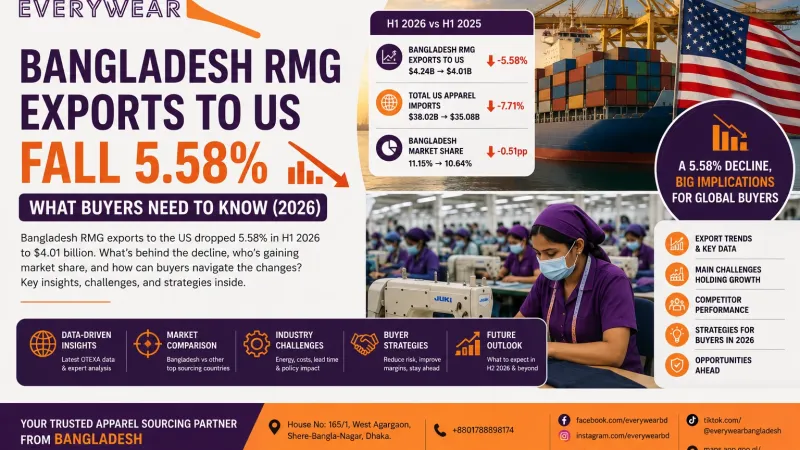
Bangladesh RMG Exports to US Fall 5.58% – What Buyers Need to Know (2026)
Last updated: August 8, 2026 • [Complete Guide for US Fashion Brands, Importers & Sourcing Professionals]
Bangladesh's readymade garment (RMG) exports to the United States declined by 5.58 percent to $4.01 billion in the first half of 2026, down from $4.24 billion in the corresponding period of 2025, according to data released by the Office of Textiles and Apparel (OTEXA) on August 4, 2026.1
This is not just a statistic – it represents a fundamental shift in the global apparel sourcing landscape. For US-based fashion brands, wholesalers, retailers, and importers, understanding why this decline is happening, who is gaining market share, and how to navigate this shifting landscape is critical for supply chain strategy in 2026 and beyond.
While Bangladesh retained its position as the second-largest apparel supplier to the US market by value, accounting for a 10.64 percent market share during the period,2 the decline signals deeper structural challenges that US buyers must understand to make informed sourcing decisions.
This comprehensive guide examines every aspect of the decline: the latest data, competitor performance, domestic challenges (energy crisis, rising costs, lead times), market opportunities, and actionable strategies for US buyers. We analyze the latest OTEXA data, industry expert opinions, and real-world factory conditions to help you navigate this evolving landscape.
Why Did Bangladesh RMG Exports to the US Decline in 2026?
Bangladesh's RMG exports to the US fell 5.58% to $4.01 billion in the first half of 2026. The decline was linked to energy and electricity shortages, higher production costs, longer lead times, limited man-made fibre capacity, infrastructure constraints and weaker US apparel demand. Despite the decline, Bangladesh remained the second-largest apparel supplier to the US with a 10.64% market share.
The Numbers: What Actually Happened in H1 2026
Let's start with the raw data. According to the US Office of Textiles and Apparel (OTEXA):
| Metric | H1 2025 | H1 2026 | Change |
|---|---|---|---|
| Bangladesh RMG Exports to US | $4.24B | $4.01B | -5.58% |
| Total US Apparel Imports | $38.02B | $35.08B | -7.71% |
| Bangladesh Market Share | 11.15% | 10.64% | -0.51 pp |
While Bangladesh's decline of 5.58% was less severe than the overall US apparel import market contraction of 7.71%,3 the country failed to capitalize on China's dramatic decline – a missed opportunity that competitors seized.
Monthly Breakdown: A Story of Recovery
Digging deeper into the monthly data reveals a more nuanced picture:
| Month | 2025 (USD) | 2026 (USD) | Change |
|---|---|---|---|
| January | ~$800M | $792M | -0.91% |
| February | ~$740M | ~$613M | -17.18% |
| March | ~$760M | ~$680M | -10.5% |
| April | ~$730M | ~$650M | -10.9% |
| May | $549M | $582M | +6.04% |
| June | $722M | $764M | +5.74% |
After a difficult first four months – with February exports plunging 17.18 percent year-on-year4 – Bangladesh staged a recovery in May and June.5 This rebound signals a potential turnaround in the second half of 2026, but sustaining this momentum will require addressing deep-rooted structural challenges.
As Mohiuddin Rubel, former director of BGMEA and founder of Bangladesh Apparel Voice, noted: "Bangladesh's return to positive growth in May was an encouraging sign, but sustaining the momentum would require stronger competitiveness, shorter lead times and higher productivity."6
Who Won and Who Lost: The 2026 US Apparel Sourcing Shake-Up
The most striking story of 2026 is not Bangladesh's decline – it's the dramatic reshaping of the entire US apparel import landscape. China, once the undisputed leader, is losing ground at an accelerating pace.
Top Suppliers to the US Market (H1 2026)
| Rank | Country | H1 2026 Exports (USD) | YoY Change | Market Share |
|---|---|---|---|---|
| 1 | Vietnam | $7.85B | +1.33% | 22.51% |
| 2 | Bangladesh | $4.01B | -5.58% | 10.64% |
| 3 | China | $3.57B | -37.65% | 11.34% |
| 4 | Indonesia | $2.33B | +3.67% | 6.33% |
| 5 | Cambodia | $2.13B | +12.61% | 6.77% |
| 6 | India | $2.12B | -25.19% | 5.66% |
Source: OTEXA data, compiled August 20267
Key Observations
1. Vietnam Solidifies Its Leadership
Vietnam dethroned China as the top US apparel supplier, shipping goods worth $7.85 billion between January and June 2026, marking a modest year-on-year growth of 1.33 percent.8 Vietnam's market share now stands at an impressive 22.51 percent, nearly double Bangladesh's share.9
Vietnamese suppliers benefit from shorter lead times, deeper port infrastructure, and geographical proximity to China for raw material sourcing. As BKMEA Executive President Fazlee Shamim Ehsan explained: "Vietnam's deep-sea ports and direct mother vessel connections with the United States enabled shorter delivery times than Bangladesh, giving Vietnamese suppliers a competitive pricing advantage."10
2. Cambodia: The Fastest-Growing Major Supplier
Cambodia led all major supplying nations in percentage growth, with year-on-year exports expanding 12.61 percent to $2.13 billion.11 Cambodia overtook India to become the fourth-largest apparel supplier to the US market.12
Cambodia's success reflects its ability to offer shorter lead times, competitive pricing, and a growing ecosystem of value-added products. For US buyers seeking to diversify away from China, Cambodia has become an increasingly attractive option.
3. Indonesia: Steady Growth in MMF
Indonesia posted gains of 3.67 percent to $2.33 billion, moving ahead of India.13 BGMEA President Mahmud Hasan Khan noted that "Indonesia is doing better because of its manmade fibre-based garment production."14
This highlights a critical gap in Bangladesh's offering: limited capacity in man-made fibre (MMF) garments, which is precisely where much of the demand shifting from China is concentrated.
4. China's Collapse: A Missed Opportunity
China experienced a dramatic decline, with shipments plummeting 37.65 percent to $3.57 billion from $5.72 billion in the corresponding first six months of 2025.15 China lost nearly $2.16 billion worth of RMG exports to the US in just one year.16
Yet Bangladesh captured only a small fraction of this lost market. According to Prothom Alo analysis, "most of China's lost market has been captured by Vietnam, Indonesia and Cambodia."17
5. India's Sharp Decline
India registered a sharp decline in apparel shipments to the US, dropping 25.19 percent to $2.12 billion from $2.83 billion in the first half of last year.18 This suggests India is facing similar competitiveness challenges to Bangladesh, including tariff uncertainties and longer lead times.
Why Is Bangladesh Losing Ground? Five Critical Factors
Exporters and industry leaders have identified five primary reasons for Bangladesh's declining competitiveness in the US market.
1. The Energy Crisis: A Structural Business Risk
Industry representatives have warned that energy insecurity is no longer a temporary disruption for Bangladesh's RMG sector, but a structural business risk affecting factory operations, production continuity, cost competitiveness, and long-term sustainability.19
According to BGMEA leaders, due to insufficient gas and electricity supply, production capacity in factories has declined by 25 to 30 percent.20 Total energy costs increased by 65 to 75 percent, reducing profitability by 25 to 35 percent.21
In August 2026, a number of garment factories in Gazipur and Narayanganj announced three- to four-day unscheduled holidays as manufacturers struggled with persistent gas and electricity shortages.22 DBL Group, one of Bangladesh's largest garment manufacturers, temporarily suspended operations in its five garment-manufacturing units in the Gazipur area due to a prolonged gas and electricity crisis, putting the jobs of around 25,000 workers at risk.23
While the BGMEA later clarified that these were holiday adjustments rather than factory closures,24 the situation underscores the severity of the energy crisis. The BGMEA acknowledged that its member-factories managed to keep only around 60-70 percent of production operational, despite severe shortages of gas and electricity, with support from the government.25
For US buyers, this energy crisis translates into:
- Production delays – extended lead times
- Higher costs – passed on through higher FOB prices
- Inconsistent quality – production disruptions affect consistency
- Supply chain instability – unpredictable factory schedules
2. Lead Times: Bangladesh Falls Behind
Bangladesh continues to lag behind competitors in lead times. Vietnam and Cambodia are ahead of Bangladesh in terms of lead time and value-added products.26
According to BKMEA Executive President Fazlee Shamim Ehsan, "Vietnam's deep-sea ports and direct mother vessel connections with the United States enabled shorter delivery times than Bangladesh, giving Vietnamese suppliers a competitive pricing advantage."27
Vietnam and Indonesia are able to deliver products with lead times of around one month, while Bangladesh's exports have declined mainly because of weaker sourcing and logistics.28
For US buyers serving fast-fashion and seasonal markets, shorter lead times are critical. A difference of even 10-15 days can determine whether a brand can respond to market trends or miss the season entirely.
3. Limited Value-Added and MMF Products
Bangladesh's capability in non-cotton garments remains relatively weak. As a result, the country is not buyers' first choice for such products.29
Many of the orders shifting away from China consist of man-made fibre (MMF) garments, an area where Bangladesh's capacity remains relatively limited.30 Indonesia, by contrast, is doing better because of its MMF-based garment production.31
This is a significant structural gap. The global MMF apparel market is projected to reach $375 billion, and Bangladesh's limited capacity in this segment means the country is missing a major growth opportunity.
4. Rising Production Costs
Bangladesh is losing its competitiveness because of several domestic challenges:
- Higher energy costs – driven by the energy crisis
- Inadequate gas and electricity supply – forcing reliance on expensive alternatives
- Rising bank lending rates – increasing financing costs
- Increasing labour costs – pushing up overall production expenses32
These factors have pushed up overall production expenses, making Bangladesh less competitive against Vietnam, Cambodia, and Indonesia.
5. Geopolitical Uncertainty and Infrastructure Bottlenecks
Exporters attribute the decline to rising geopolitical tensions, US-Iran conflicts, and economic uncertainties weakening demand, which forced American consumers to prioritise essential spending and reduce apparel purchases.33
BGMEA President Mahmud Hasan Khan explained that Vietnam has Chinese investments, which Bangladesh failed to attract due to infrastructure bottlenecks, frequent changes in policies, and political instabilities after the 2024 uprising.34
Though Vietnam and Cambodia depend on imported raw materials, they get those within the shortest possible time from China because of their geographical proximity.35 This proximity gives them a significant advantage in lead times and raw material costs.
The China Opportunity: Why Bangladesh Isn't Capturing It
China's dramatic decline in the US apparel market represents a $2.16 billion opportunity – yet Bangladesh has captured only a small fraction.36
According to Prothom Alo analysis, "Bangladesh failed to capture a significant portion of that lost market. Instead, competitors such as Vietnam, Cambodia and Indonesia increased their exports and took advantage of the opportunity."37
Why is Bangladesh missing this opportunity?
1. Product Mismatch: Much of the business moving out of China consists of man-made fibre (MMF) garments, an area where Bangladesh's capacity remains relatively limited.38 Vietnam, Indonesia, and Cambodia have stronger MMF capabilities.
2. Lead Time Gap: Bangladesh continues to lag behind in fast-fashion orders due to its longer lead times.39 Buyers shifting from China need suppliers who can match China's speed – and Vietnam and Cambodia are better positioned to meet this demand.
3. Infrastructure Bottlenecks: Bangladesh's infrastructure challenges – including port congestion, unreliable power supply, and limited airport cargo capacity – make it less attractive for time-sensitive orders.
4. Limited Value-Added Products: Bangladesh's strength remains in basic knitwear and denim. The orders moving from China include more complex, value-added products that require higher technical capabilities.
5. Political Instability: The 2024 uprising and subsequent political uncertainty have made some buyers hesitant to commit to long-term partnerships with Bangladesh manufacturers.40
What US Buyers Need to Know: Implications and Action Steps
For US fashion brands, wholesalers, retailers, and importers, the shifting landscape creates both challenges and opportunities. Here's what you need to know.
Challenge 1: Price Pressure
Rising energy costs and production expenses in Bangladesh are likely to put upward pressure on FOB prices. The average unit price of Bangladeshi garments on the US market fell to $3.02 per SME in the first half of 2026 from $3.09 per SME a year earlier,41 indicating that manufacturers are absorbing some of the cost increases. However, this may not be sustainable.
What to do: Work with your Bangladesh suppliers to understand their cost structure. Consider locking in prices for longer-term orders to hedge against future increases. Explore the US Cotton Clause benefit (see below) to offset tariff costs.
Challenge 2: Lead Time Extension
Energy shortages are extending lead times. As one report noted, "An unstable energy supply has made continuous production difficult, thereby extending lead times."42
What to do: Build buffer time into your inventory planning. Communicate with your suppliers early and often. Consider air freight for urgent orders (though this increases costs). Work with sourcing partners who can provide real-time production updates.
Challenge 3: Supply Chain Instability
Factory closures (even temporary), production disruptions, and shipping delays create supply chain instability. The energy crisis could worsen during peak production seasons.
What to do: Diversify your supplier base within Bangladesh. Don't rely on a single factory. Work with a sourcing partner who has relationships with multiple factories and can shift production if needed. Consider dual-sourcing strategies (see below).
Opportunity 1: The US Cotton Clause
Under the Agreement on Reciprocal Trade (ART) signed between the United States and Bangladesh in February 2026, garments made with US-origin cotton or man-made fibres enter the US market at a zero reciprocal tariff rate.43
For US buyers, this represents a significant opportunity to offset rising production costs. Depending on product category, the savings can be substantial – potentially $9,500-$10,000 on a $50,000 order.
What to do: Specify US cotton in your manufacturing agreements. Ask your supplier for documentation (cotton purchase invoices, certificates of origin). Work with a sourcing partner who understands the US Cotton Clause and can help you claim the benefit.
Opportunity 2: Sustainable Sourcing
Despite the challenges, Bangladesh remains a world leader in sustainable manufacturing with 290 LEED-certified factories, including 125 Platinum-rated facilities.44 For US buyers with ESG commitments, Bangladesh's green factory ecosystem is a significant advantage.
What to do: Prioritize LEED-certified factories in your sourcing decisions. These factories are more likely to maintain consistent production despite energy challenges, as they have invested in energy-efficient technologies.
Opportunity 3: Dual-Sourcing Strategy
Many successful US brands are adopting a dual-sourcing strategy – sourcing basic, high-volume products from Bangladesh and premium, complex products from Vietnam or other competitors.
What to do: Evaluate your product portfolio. Identify which products are best suited for Bangladesh (knitwear, denim, basic apparel) and which are better sourced from Vietnam (woven, formal wear, activewear, MMF garments).
Opportunity 4: MMF Growth in Bangladesh
Bangladesh is investing in MMF production capacity. In FY25-26, the FY national budget introduced targeted incentives to lower MMF input costs, including reducing import duties on polypropylene yarn from 10 to 5 percent and supplementary duties on specialised fabrics from 20 to 10 percent.45
MMF-based exports reached $3.68 billion, and the MMF share of RMG surged to a record high of 19.0%, up from 11.4% in full-year 2024.46
What to do: Watch for emerging MMF capabilities in Bangladesh. The country is building capacity in activewear, sportswear, and performance apparel – products that are increasingly in demand in the US market.
How Everywear Bangladesh Helps You Navigate the US Market Shift
At Everywear Bangladesh, we understand that navigating the complexities of the US apparel market requires more than just finding a factory – it requires a strategic partner who can help you adapt to changing conditions, mitigate risks, and seize opportunities.
Here is how we help US buyers succeed in the current environment:
1. Direct Access to Verified, Resilient Manufacturers
We connect you with export-oriented Bangladesh clothing manufacturers that are best positioned to weather the current challenges:
- LEED-Certified Green Factories – 290+ certified facilities, including 125 Platinum and 145 Gold-rated. These factories have invested in energy efficiency, making them more resilient to energy shortages.
- Factories with Backup Power – We prioritize factories with captive power generation, ensuring production continuity during gas and electricity shortages.
- Diversified Factory Network – We work with multiple factories across different regions, reducing single-source dependency and allowing us to shift production if needed.
2. US Cotton Zero-Tariff Expertise
We help you maximize the US Cotton Clause benefit under the Agreement on Reciprocal Trade (ART):
- US Cotton Sourcing: We connect you with manufacturers who can source and use US-origin cotton, unlocking zero reciprocal tariff.
- Documentation Support: We ensure proper documentation including certificates of origin, cotton purchase invoices, and traceability records.
- Tariff Savings Calculation: Our team calculates your exact tariff savings – typically $9,500-$10,000 on a $50,000 order.
- Compliance Assurance: We ensure your products meet all Rules of Origin requirements for the zero-tariff benefit.
3. Lead Time Optimization
We understand that lead times are a critical factor for US buyers. Here's how we help you get your products faster:
- Efficient Sample Development: Our experienced pattern makers and sample developers work quickly, reducing sample lead times.
- Fabric Inventory Management: We help you pre-book fabrics or use our partner mills' fabric stocks to reduce sourcing time.
- Parallel Production: Where possible, we overlap production stages to compress timelines.
- Dedicated Production Slots: Our partner factories reserve production capacity for our clients, preventing scheduling delays.
- Real-Time Tracking: We provide weekly production updates so you always know your order's status.
4. Quality Assurance and Risk Mitigation
We minimize your sourcing risks through:
- Verified Factory Credentials: We only partner with BGMEA/BKMEA registered, compliant factories with valid certifications.
- Pre-Production Sample Approval: You approve samples before bulk production begins.
- Quality Control Inspections: We conduct inspections at multiple production stages (fabric inspection, cutting inspection, in-line sewing inspection, final AQL inspection).
- Diverse Factory Network: We work with multiple factories, reducing single-source dependency.
- Insurance Options: We can arrange cargo insurance for your shipments.
5. Sustainable Sourcing Solutions
Bangladesh is a world leader in sustainable manufacturing. We connect you with:
- LEED Platinum and Gold certified factories – the highest standards of environmental responsibility
- GOTS-certified organic textile facilities (1,500+) – for organic cotton garments
- Factories producing sustainable fabrics – Jutton, Jutco, organic cotton, recycled polyester
- Manufacturers with OEKO-TEX, WRAP, BSCI, and SEDEX certifications – demonstrating commitment to quality and ethics
6. End-to-End Sourcing Support
From product development to worldwide delivery, we handle every stage of the sourcing process:
- Product Development – Pattern making, fabric sourcing, sample development
- Private Label Manufacturing – Custom labels, hang tags, packaging, and branding
- Quality Control – In-line and final inspections by experienced professionals
- Export Documentation – Commercial invoices, certificates of origin, packing lists
- Worldwide Logistics – Sea freight, air freight, and door-to-door delivery
7. Transparent Communication and Real-Time Updates
We provide:
- Dedicated account manager for every client
- Regular production updates and photos
- 24/7 WhatsApp support for urgent queries
- Transparent pricing with no hidden costs
- Factory visits and virtual tours upon request
Contact Everywear Bangladesh on WhatsApp
What US Buyers Should Expect in the Coming Months
Based on current data and industry trends, here is what US buyers can expect in the remainder of 2026 and beyond.
Short-Term Outlook (Remainder of 2026)
1. Continued Recovery in Exports
Bangladesh's exports to the US rebounded in May and June 2026, with May exports rising 6.04 percent year-on-year and June exports rising 5.74 percent.47 This positive momentum is likely to continue, supported by:
- Improved order inflows from US buyers
- Seasonal demand for winter and holiday collections
- Continued diversification away from China
As Mohiuddin Rubel noted: "With China's share of the US market shrinking rapidly, Bangladesh has an opportunity to secure additional orders if it can strengthen logistics, enhance compliance and maintain competitive pricing."48
2. Persistent Energy Challenges
However, the energy crisis remains a significant headwind. BGMEA President Mahmud Hasan Khan has called for US investment in Bangladesh's energy sector, particularly LNG infrastructure.49 Until these investments materialize, production disruptions are likely to continue.
3. Price Pressure
Rising energy costs and production expenses will continue to put upward pressure on FOB prices. Buyers should expect price increases of 5-10 percent in the coming quarters.
Medium-Term Outlook (2027-2028)
1. LDC Graduation and EU Tariffs
Bangladesh is scheduled to graduate from LDC status on November 24, 2026. Post-graduation tariffs on garments could rise to 9-12% in the EU alone, with projected export losses of up to $7 billion annually.50 This will likely shift more of Bangladesh's export focus to the US market, potentially increasing competition for US buyers.
2. MMF Capacity Expansion
Bangladesh is investing in MMF production capacity. The country has the potential to capture 12 percent of the projected US$375 billion global MMF apparel market by 2030.51 This will open new product categories for US buyers, including activewear, sportswear, and performance apparel.
3. Sustainability Leadership
Bangladesh's green factory revolution is accelerating. With 550 factories awaiting LEED certification,52 the country is positioning itself as the world's most sustainable apparel manufacturing hub. For US buyers with ESG commitments, this is a significant advantage.
4. Infrastructure Improvements
Bangladesh is making progress on infrastructure development, including port upgrades and power generation capacity. These improvements will gradually reduce lead times and improve supply chain reliability.
What US Buyers Should Do Now
1. Diversify Your Supplier Base
Don't rely on a single factory. Work with multiple suppliers to mitigate risks and ensure production continuity. Everywear Bangladesh can help you build a diversified supplier network.
2. Leverage the US Cotton Clause
Specify US cotton in your manufacturing agreements to claim zero reciprocal tariff. This can offset rising production costs and improve your landed cost competitiveness.
3. Prioritize LEED-Certified Factories
LEED-certified factories have invested in energy efficiency, making them more resilient to energy shortages. They are also better positioned to meet your ESG requirements.
4. Plan for Longer Lead Times
Build buffer time into your inventory planning. Communicate with your suppliers early and often. Consider working with a sourcing partner who can provide real-time production updates.
5. Explore MMF Opportunities
Bangladesh is building MMF capacity. Watch for emerging capabilities in activewear, sportswear, and performance apparel.
6. Partner with a Trusted Sourcing Partner
Navigating the complexities of the US apparel market requires expertise. Partner with a sourcing partner who understands the market, has relationships with resilient manufacturers, and can help you adapt to changing conditions.
Frequently Asked Questions
1. Why did Bangladesh's RMG exports to the US decline in 2026?
Bangladesh's RMG exports to the US fell 5.58% to $4.01 billion in the first half of 2026. The decline was linked to energy and electricity shortages, higher production costs, longer lead times, limited man-made fibre capacity, infrastructure constraints and weaker US apparel demand. Despite the decline, Bangladesh remained the second-largest apparel supplier to the US with a 10.64% market share.
2. How much did Bangladesh export garments to the US in H1 2026?
Bangladesh exported $4.01 billion worth of garments to the United States in the first half of 2026, down from $4.24 billion in H1 2025, representing a 5.58% decline.
3. Is Bangladesh still the second-largest apparel supplier to the US?
Yes. Despite the decline, Bangladesh retained its position as the second-largest apparel supplier to the US market by value, accounting for a 10.64 percent market share during the period.
4. Which countries are gaining US apparel market share from Bangladesh?
Vietnam, Cambodia, and Indonesia are gaining market share. Vietnam's market share reached 22.51%, Cambodia's grew 12.61% to $2.13 billion, and Indonesia's grew 3.67% to $2.33 billion.
5. How is Bangladesh's energy crisis affecting garment production?
Due to insufficient gas and electricity supply, production capacity in factories has declined by 25 to 30 percent. Total energy costs increased by 65 to 75 percent, reducing profitability by 25 to 35 percent. Some factories have announced unscheduled holidays and temporary closures.
6. Why is Vietnam gaining more US apparel orders than Bangladesh?
Vietnam offers shorter lead times (around one month), better infrastructure, deeper port connections, and stronger MMF capabilities. Vietnam's deep-sea ports and direct mother vessel connections with the US enable faster delivery.
7. Why isn't Bangladesh capturing more of China's lost US apparel market share?
Much of the business moving out of China consists of man-made fibre (MMF) garments, an area where Bangladesh's capacity remains limited. Additionally, Bangladesh's longer lead times and infrastructure bottlenecks make it less competitive for fast-fashion orders.
8. What is the US Cotton Clause for Bangladesh garment imports?
Under the Agreement on Reciprocal Trade (ART) between the US and Bangladesh, garments made with US-origin cotton or man-made fibres enter the US market at a zero reciprocal tariff rate. This can save US buyers approximately 19% in tariffs.
9. Can US buyers still source competitively from Bangladesh in 2026?
Yes. Bangladesh remains competitive for basic apparel, knitwear, and denim. The US Cotton Clause offers significant tariff savings, and Bangladesh's 290 LEED-certified factories provide world-class sustainability credentials.
10. What should US fashion brands know before sourcing clothing from Bangladesh?
US brands should understand the energy crisis, plan for longer lead times, leverage the US Cotton Clause for tariff savings, prioritize LEED-certified factories, and consider a dual-sourcing strategy – basic products from Bangladesh, premium from Vietnam.
Conclusion
Bangladesh's RMG exports to the US declined by 5.58% in the first half of 2026, but the story is far more nuanced than a simple statistic. While competitors like Vietnam, Cambodia, and Indonesia gained ground, Bangladesh retained its position as the second-largest apparel supplier to the US market.
The challenges are real and significant: a severe energy crisis, rising production costs, longer lead times, limited MMF capacity, and geopolitical uncertainties. However, Bangladesh also has unique strengths that US buyers can leverage: world-leading sustainable manufacturing (290 LEED-certified factories), the US Cotton Clause for zero reciprocal tariff, competitive pricing, a skilled workforce of 4 million workers, and an unwavering commitment to growth.
For US fashion brands, wholesalers, retailers, and importers, the key to success in this evolving landscape is strategic partnership. By working with a trusted sourcing partner like Everywear Bangladesh, you can:
- Access resilient, LEED-certified manufacturers
- Leverage the US Cotton Clause for significant tariff savings
- Optimize lead times through efficient sample development and production management
- Mitigate risks through diversified factory networks and rigorous quality control
- Source sustainable garments that meet your ESG commitments
- Navigate the complexities of the US apparel market with confidence
At Everywear Bangladesh, we are committed to helping US buyers succeed in this dynamic environment. We believe in Bangladesh's potential to remain competitive and are actively working with our partner factories to address the challenges of energy security, lead times, and product diversification.
The time to act is now. The US market is undergoing a fundamental reshaping, and the buyers who adapt quickly will capture the greatest opportunities.
Contact Everywear Bangladesh on WhatsApp
About the Author
Written by the Everywear Bangladesh Research & Sourcing Team
The Everywear Bangladesh editorial team combines deep industry expertise in Bangladesh's Ready-Made Garment (RMG) sector with practical experience in international apparel sourcing, supply chain management, and global trade analysis. Our team includes former garment factory managers, sourcing professionals, and trade analysts who have worked with fashion brands across the United States, Europe, and Asia.
Our mission is to provide accurate, data-driven, and actionable content that helps fashion entrepreneurs, retailers, wholesalers, importers, and global brands make informed sourcing decisions. We leverage real-time data from the Bangladesh Garment Manufacturers and Exporters Association (BGMEA), Export Promotion Bureau (EPB), World Trade Organization (WTO), US Office of Textiles and Apparel (OTEXA), and other authoritative sources to ensure our insights reflect the latest industry developments.
Everywear Bangladesh is committed to promoting responsible, transparent, and sustainable garment manufacturing practices while helping businesses navigate the complexities of international apparel sourcing.
Connect with Everywear Bangladesh:
- Website: everywearbd.com
- WhatsApp: +8801788898174
- Facebook: facebook.com/everywearbd
- LinkedIn: Everywear Bangladesh Ltd
References
- Office of Textiles and Apparel (OTEXA), US Apparel Import Data, January-June 2026, released August 4, 2026
- New Age, "RMG exports to US fall 5.58pc in Jan-June," August 7, 2026
- Financial Express, "RMG exports to US fall 5.58pc as regional rivals gain," August 7, 2026
- Bangladesh Pratidin, "Bangladesh's apparel exports to US face setback," May 11, 2026
- Textile Today, "OTEXA data shows mixed recovery in US apparel sourcing," July 12, 2026
- Financial Express, "Jan-May apparel exports to US fall over 8pc," July 12, 2026
- Financial Express, "RMG exports to US fall 5.58pc as regional rivals gain," August 7, 2026
- Ibid.
- New Age, "RMG exports to US fall 5.58pc in Jan-June," August 7, 2026
- New Age, "RMG exports to US fall 5.58pc in Jan-June," August 7, 2026
- Financial Express, "RMG exports to US fall 5.58pc as regional rivals gain," August 7, 2026
- New Age, "RMG exports to US fall 5.58pc in Jan-June," August 7, 2026
- Financial Express, "RMG exports to US fall 5.58pc as regional rivals gain," August 7, 2026
- Ibid.
- Ibid.
- Prothom Alo, "RMG exports to US: China rapidly losing market share, Bangladesh unable to capitalise," August 8, 2026
- Ibid.
- Financial Express, "RMG exports to US fall 5.58pc as regional rivals gain," August 7, 2026
- New Age, "Industry leaders warn energy insecurity threatens Bangladesh RMG competitiveness," May 24, 2026
- BSS, "BGMEA leaders seek government's support in ensuring uninterrupted energy supply," April 13, 2026
- Textile Today, "Rising utility costs reshape textile factory profitability," May 26, 2026
- Financial Express, "Few RMG factories declare unscheduled holidays," August 4, 2026
- Ibid.
- BSS, "BGMEA refutes report of factory closure over gas, power crisis," August 4, 2026
- Ibid.
- Financial Express, "RMG exports to US fall 5.58pc as regional rivals gain," August 7, 2026
- New Age, "RMG exports to US fall 5.58pc in Jan-June," August 7, 2026
- Prothom Alo, "RMG exports to US: China rapidly losing market share, Bangladesh unable to capitalise," August 8, 2026
- Ibid.
- Ibid.
- Financial Express, "RMG exports to US fall 5.58pc as regional rivals gain," August 7, 2026
- Ibid.
- Ibid.
- Ibid.
- Ibid.
- Prothom Alo, "RMG exports to US: China rapidly losing market share, Bangladesh unable to capitalise," August 8, 2026
- Ibid.
- Ibid.
- Ibid.
- Financial Express, "RMG exports to US fall 5.58pc as regional rivals gain," August 7, 2026
- New Age, "RMG exports to US fall 5.58pc in Jan-June," August 7, 2026
- Textile Today, "Apparel exports from Bangladesh continue to shrink in March under global pressure," April 4, 2026
- BGMEA, "Bangladesh-US Reciprocal Tariff Agreement," February 2026
- Financial Express, "BD adds 4 more LEED-certified RMG factories," July 2026
- Ministry of Finance, FY2025-26 Budget
- Textile Today, "MMF-based garment exports grow 14.1%, signal structural shift in Bangladesh RMG," February 2026
- New Age, "Bangladesh apparel exports to US fall 8pc in Jan-May," July 24, 2026
- Financial Express, "Jan-May apparel exports to US fall over 8pc," July 12, 2026
- The Daily Star, "BGMEA seeks clarity from US on duty-free access mechanism under trade deal," March 8, 2026
- RAPID Study, "Bangladesh LDC Graduation Impact Analysis," 2025
- Bangladesh Sangbad Sangstha, "Bangladesh can capture 12pc of $375bn global MMF apparel market by 2030," July 2026
- Financial Express, "BD adds 4 more LEED-certified RMG factories," July 2026
Related Resources
GEO Landing Pages
- USA Buyers: Wholesale Garments from Bangladesh
- UK Buyers: Wholesale Garments from Bangladesh
- Europe Buyers: Wholesale Clothing from Bangladesh
- Africa Buyers: Wholesale Garments from Bangladesh
Blog Posts
- US Tariff Guide for Bangladesh Garment Imports (2026)
- The US Cotton Clause: How the US-Bangladesh Trade Pact Benefits Your Business
- Bangladesh vs Vietnam – The Race for Second Place in Global Apparel Exports (2026)
- Sustainable Clothing Manufacturing in Bangladesh: The Green Revolution (2026)
- Jute and Wool – Bangladesh's Next Sustainable Fabric Revolution (2026)
- Clothing Suppliers from Bangladesh: The Ultimate Guide 2026
- Bangladesh Garment Industry Guide 2026
- Low MOQ Clothing Manufacturer Bangladesh
- Alibaba Alternative: Direct Sourcing from Bangladesh 2026
This guide is updated regularly. Last reviewed: August 8, 2026. For sourcing solutions tailored to your brand, contact Everywear Bangladesh on WhatsApp.
Everywear Bangladesh Ltd. – Bangladesh's First RMG Wholesale Marketplace | 300 Pcs Custom Orders | Export Quality Garments
WhatsApp: +8801788898174 • Website: everywearbd.com
Leave a comment