





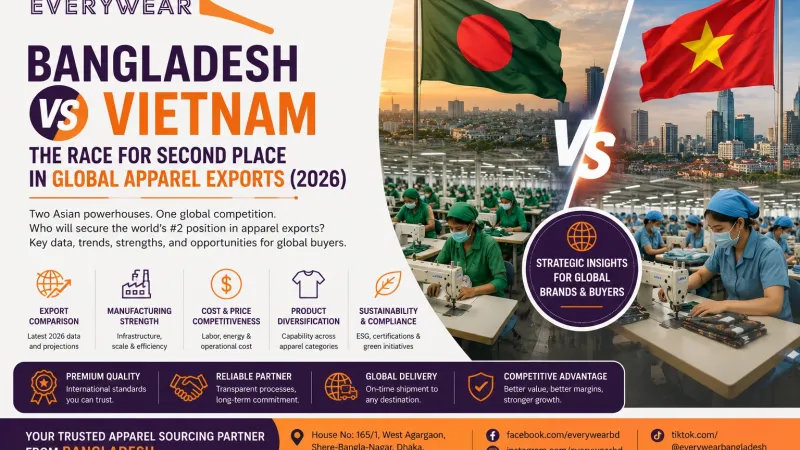
Bangladesh vs Vietnam – The Race for Second Place in Global Apparel Exports (2026)
Last updated: August 2, 2026 • [Complete Guide for Fashion Brands, Importers & Sourcing Professionals]
Former BGMEA President Faruque Hassan recently warned that "By the end of 2026, Vietnam could overtake Bangladesh to become the world's second-largest apparel exporter". This is not a distant prediction – it is a warning that is already unfolding. Vietnam's apparel exports have grown to $39.64 billion against Bangladesh's $38.82 billion, and the gap is narrowing.
Vietnam has already overtaken Bangladesh as the world's second-largest apparel exporter in 2025, with exports reaching $39.64 billion against Bangladesh's $38.82 billion, according to data from the World Trade Organization and national trade bodies.
This is not just a statistic – it represents a fundamental shift in the global apparel sourcing landscape. For international buyers, fashion brands, wholesalers, and sourcing professionals, the choice between Bangladesh and Vietnam has become one of the most critical decisions in supply chain strategy.
This comprehensive guide examines every aspect of this race: market share, labor costs, productivity, trade agreements, tariffs, infrastructure, sustainability, and future outlook. We analyze the latest data, industry trends, and expert opinions to help you make informed sourcing decisions in 2026 and beyond.
The Current State: Vietnam Takes the Lead
The numbers are clear. Vietnam overtook Bangladesh as the world's second-largest apparel exporter in 2025. According to the World Trade Organization and national trade bodies, Vietnam's apparel exports reached $39.64 billion against Bangladesh's $38.82 billion.
The gap is significant and growing. Vietnam's apparel sector achieved a remarkable 10.0% growth year-on-year, while Bangladesh's RMG exports grew at a more modest pace.
US Market Share Comparison
In the crucial US market, Vietnam holds a commanding lead:
| Metric | Vietnam | Bangladesh |
|---|---|---|
| US Apparel Import Share | 22.2% | 11.3% |
| US Apparel Imports (Value) | $16.0B | $8.6B |
| Global Apparel Export Ranking | #2 | #3 |
| Total Apparel Exports (2025) | $39.64B | $38.82B |
| Year-on-Year Growth (2025) | +10.0% | +4.5% |
Vietnam's dominance in the US market is particularly striking. The country holds nearly double the market share of Bangladesh in the world's largest apparel import market.
According to USITC data, Vietnam's apparel exports to the United States increased by approximately $1.5 billion in 2025, while Bangladesh's exports to the US declined by $1.0 billion.
The EU Market: Bangladesh's Stronghold
In the European Union market, Bangladesh maintains a stronger position:
| Metric | Bangladesh | Vietnam |
|---|---|---|
| EU Apparel Import Share | 15.0% | 6.5% |
| EU Apparel Imports (Value) | $19.7B | $8.2B |
| EU Market Ranking | #1 | #4 |
| GSP/EBA Preference | Duty-Free | Duty-Free (GSP) |
Bangladesh remains the dominant supplier to the EU market, with approximately 50.1% of its total apparel exports of $39.3 billion going to the European Union in FY25, according to Export Promotion Bureau (EPB) data.
This dual-market dynamic is crucial for understanding the competitive landscape. Bangladesh's strength in the EU market provides a stable foundation, while Vietnam's growth in the US market represents a significant challenge.
How Everywear Bangladesh Helps You Navigate the Bangladesh vs Vietnam Decision
At Everywear Bangladesh, we understand that choosing between Bangladesh and Vietnam is one of the most critical decisions you will make for your supply chain. We are not just a sourcing partner – we are your strategic ally in navigating the complexities of global apparel sourcing.
Here is how we help you make the right decision and source successfully from Bangladesh:
1. Expert Guidance on Country Selection
Our team of experienced sourcing professionals provides personalized guidance based on your specific product requirements, budget, lead time expectations, and sustainability goals. We help you understand:
- Which products are best sourced from Bangladesh vs Vietnam
- Total landed cost comparison for your specific order
- Lead time implications for your production schedule
- Trade agreement benefits applicable to your products
- Risk assessment and mitigation strategies
2. Direct Access to Verified Bangladesh Manufacturers
We connect you directly with export-oriented Bangladesh garment manufacturers that meet your specific requirements. Our network includes:
- LEED-Certified Green Factories – 290+ certified facilities including Platinum and Gold-rated
- Specialized Manufacturers – Knitwear, denim, woven, activewear, and premium apparel
- Low MOQ Partners – Supporting production from 300 pieces for startups and growing brands
- US Cotton Capable – Factories that can source and use US-origin cotton for zero-tariff benefits
3. US Cotton Zero-Tariff Expertise
Under the Agreement on Reciprocal Trade (ART), garments made with US-origin cotton enter the US market duty-free. We help you:
- Source US-origin cotton for your orders
- Ensure proper documentation and traceability
- Navigate the customs and tariff process
- Maximize savings of up to 19% on reciprocal tariffs
4. Sustainable Sourcing Solutions
Bangladesh is a world leader in sustainable manufacturing with 290 LEED-certified factories. We connect you with:
- LEED Platinum and Gold certified factories
- GOTS-certified organic textile facilities (1,500+)
- Factories producing Jutton, Jutco, and other innovative sustainable fabrics
- Manufacturers with OEKO-TEX, WRAP, BSCI, and SEDEX certifications
5. Full-Service Sourcing Support
From product development to worldwide delivery, we handle every stage of the sourcing process:
- Product Development – Pattern making, fabric sourcing, sample development
- Private Label Manufacturing – Custom labels, hang tags, packaging, and branding
- Quality Control – In-line and final inspections by experienced professionals
- Export Documentation – Commercial invoices, certificates of origin, packing lists
- Worldwide Logistics – Sea freight, air freight, and door-to-door delivery
6. Transparent Communication and Real-Time Updates
We provide:
- Dedicated account manager for every client
- Regular production updates and photos
- 24/7 WhatsApp support for urgent queries
- Transparent pricing with no hidden costs
- Factory visits and virtual tours upon request
7. Risk Mitigation and Quality Assurance
We minimize your sourcing risks through:
- Verified factory credentials and certifications
- Pre-production sample approval process
- In-line quality inspections during production
- Final AQL inspection before shipment
- Comprehensive documentation for compliance
Ready to source from Bangladesh with confidence?
Contact Everywear Bangladesh on WhatsApp
Labor Costs: The Fundamental Advantage
Bangladesh's primary competitive advantage has always been its low labor costs. This remains true, though the gap is narrowing.
Monthly Minimum Wage Comparison
| Country | Monthly Minimum Wage (USD) | Average Monthly Wage (USD) |
|---|---|---|
| Bangladesh | $95 | $120 |
| Vietnam | $180 | $220 |
| China | $280 | $350 |
| India | $120 | $150 |
Bangladesh's minimum wage of approximately $95 per month is significantly lower than Vietnam's $180. This provides a 47% cost advantage in labor-intensive manufacturing.
However, this advantage must be weighed against other factors. According to the International Labour Organization, Bangladesh's labor productivity is lower than Vietnam's, and the higher turnover rate in Bangladesh factories partially offsets the wage advantage.
Labor Productivity Comparison
| Metric | Bangladesh | Vietnam |
|---|---|---|
| Garments per Worker per Day | 40-50 | 50-60 |
| Annual Turnover Rate | 15-20% | 5-10% |
| Skilled Worker Availability | High | Higher |
| English Proficiency | Good | Limited |
Vietnam's higher productivity and lower turnover partially offset Bangladesh's lower wages. According to industry analysts, the total labor cost per garment is comparable between the two countries when productivity is factored in.
How Everywear Bangladesh Bridges the Productivity Gap
At Everywear Bangladesh, we understand that labor cost alone is not enough. Our partner factories invest in training and technology to maximize productivity:
- Skilled Workforce Training: Our partner factories invest in continuous training programs, improving worker efficiency and reducing defects.
- Modern Equipment: We connect you with factories using automated cutting, computerized sewing, and advanced quality control systems.
- Efficient Production Planning: Our experienced production managers optimize workflows to minimize downtime and maximize output.
- Quality-Focused Culture: Our partner factories maintain rigorous quality standards, reducing rework and waste.
This means you get the best of both worlds – Bangladesh's cost advantage with productivity levels that rival Vietnam.
Trade Agreements: Vietnam's Decisive Advantage
This is where Vietnam holds its most significant competitive edge. The country has built an impressive network of free trade agreements (FTAs) that provide preferential market access to key consumer markets.
Vietnam's Trade Agreements
| Trade Agreement | Partners | Status | Tariff Impact |
|---|---|---|---|
| EVFTA | European Union | Active (2020) | Duty-Free |
| CPTPP | 11 Countries | Active (2019) | Duty-Free |
| UKVFTA | United Kingdom | Active (2021) | Duty-Free |
| RCEP | 15 Asia-Pacific Countries | Active (2022) | Tariff Reductions |
| VK FTA | South Korea | Active (2015) | Duty-Free |
| Vietnam-Israel FTA | Israel | Active (2022) | Duty-Free |
Vietnam's FTA network provides duty-free access to the European Union, United Kingdom, Japan, South Korea, and 11 CPTPP countries. This is a significant competitive advantage for buyers seeking to minimize import duties.
Bangladesh's Limited Trade Agreements
Bangladesh's trade agreement portfolio is considerably more limited:
| Trade Agreement | Partners | Status | Tariff Impact |
|---|---|---|---|
| EBA (GSP Plus) | European Union | Active (2013) | Duty-Free |
| SAPTA | South Asia | Active | Limited |
| ART (US) | United States | Active (2026) | 0% with US Cotton |
Bangladesh currently enjoys duty-free access to the EU market through the EBA (Everything But Arms) initiative under GSP Plus. However, the country's LDC graduation in November 2026 threatens this preferential access, with potential tariff increases of 9-12% on apparel exports to the EU.
The recently signed Agreement on Reciprocal Trade (ART) with the United States provides zero-duty access for garments made with US-origin cotton. While significant, this is more limited than Vietnam's comprehensive FTA network.
How Everywear Bangladesh Helps You Maximize Trade Agreement Benefits
While Vietnam has more FTAs, Bangladesh's US Cotton Clause (under ART) offers a unique advantage for US buyers. At Everywear Bangladesh, we help you leverage this benefit:
- US Cotton Sourcing: We connect you with manufacturers who can source and use US-origin cotton, unlocking zero reciprocal tariff.
- Documentation Support: We ensure proper documentation including certificates of origin, cotton purchase invoices, and traceability records.
- Tariff Savings Calculation: Our team calculates your exact tariff savings – typically $9,500-$10,000 on a $50,000 order.
- EU Market Access: We help you navigate the EU market with Bangladesh's current duty-free access and prepare for post-LDC graduation scenarios.
For US buyers, Bangladesh's US Cotton Clause can actually provide better tariff benefits than Vietnam's FTA network for eligible products.
The LDC Graduation Factor: A Game-Changer for Bangladesh
Bangladesh's upcoming graduation from Least Developed Country (LDC) status in November 2026 is one of the most significant challenges facing the country's apparel industry.
According to a RAPID study, Bangladesh's apparel exports to the EU may fall by up to 44% following LDC graduation unless a Free Trade Agreement is signed. This represents a potential loss of approximately $7 billion annually.
What LDC Graduation Means for Buyers
After graduation in 2026, Bangladesh will no longer enjoy duty-free access to the EU market under the EBA initiative. The country will need to negotiate a new trade arrangement to maintain preferential market access.
Without a new agreement, apparel exports to the EU could face tariffs of 9% to 12%, significantly reducing Bangladesh's competitiveness against Vietnam and other competitors.
Vietnam's existing FTA with the EU ensures continued duty-free access, giving it a clear advantage for EU buyers.
Bangladesh's Response: The EU FTA Negotiation
Bangladesh has applied for a three-year deferral of LDC graduation to allow more time to negotiate a bilateral trade agreement with the EU. The newly elected government has prioritised this effort.
The government has also sought support from the EU for a transitional arrangement that would maintain preferential market access during the transition period.
The BGMEA has been actively lobbying for a Free Trade Agreement with the EU to preserve Bangladesh's competitive position in the European market.
How Everywear Bangladesh Prepares You for LDC Graduation
At Everywear Bangladesh, we proactively help our clients prepare for the post-LDC era:
- Tariff Planning: We help you understand potential tariff increases and plan your sourcing strategy accordingly.
- EU FTA Monitoring: Our team tracks negotiations between Bangladesh and the EU, providing you with real-time updates.
- Alternative Sourcing: We can help you diversify your supply chain or adjust product mix to mitigate tariff risks.
- US Market Focus: We help US buyers maximize the US Cotton Clause benefit, which is not affected by LDC graduation.
Product Diversification and Value Addition
The ability to produce a wide range of products, including complex and high-value garments, is a key differentiator between Bangladesh and Vietnam.
Product Categories Comparison
| Product Category | Bangladesh | Vietnam |
|---|---|---|
| Knitwear | Strong | Strong |
| Woven Garments | Moderate | Strong |
| Denim | Strong | Moderate |
| Activewear | Growing | Strong |
| Sportswear | Moderate | Strong |
| Formal Wear | Moderate | Strong |
| High-End Fashion | Limited | Strong |
| Technical Textiles | Limited | Moderate |
Vietnam has a more diversified product portfolio, with particular strength in woven garments, formal wear, activewear, and sportswear. This allows Vietnamese manufacturers to command higher unit prices and serve a broader range of buyers.
Bangladesh remains highly competitive in knitwear, denim, and basic apparel categories. However, the country's limited presence in high-end fashion and technical textiles represents a significant gap.
Unit Price Comparison
The product mix difference is reflected in average unit prices:
| Metric | Bangladesh | Vietnam |
|---|---|---|
| Average Unit Price (USD) | $7.50 | $10.00 |
| Premium Segment Share | 5% | 15% |
| Basic Apparel Share | 70% | 40% |
Vietnam's higher unit prices reflect its greater presence in premium and high-value product categories. For buyers seeking value-added products, Vietnam may be the preferred sourcing destination.
How Everywear Bangladesh Helps You Access Premium Bangladesh Products
Bangladesh is rapidly moving beyond basic apparel. At Everywear Bangladesh, we connect you with manufacturers who are producing premium and innovative products:
- Jute and Wool Innovations: We offer Jutton (80% cotton + 20% jute) and wool garments – premium, sustainable alternatives to traditional apparel.
- Activewear and Performance Apparel: Our partner factories are increasingly producing activewear, sportswear, and performance garments.
- Premium Denim: Bangladesh is a global leader in denim production, with factories capable of producing premium, high-end denim products.
- Organic and Sustainable: With 1,500+ GOTS-certified facilities, we can source organic cotton, recycled polyester, and other sustainable materials.
You don't have to choose between Bangladesh's cost advantage and premium quality – we help you get both.
Sustainability and Green Manufacturing
Both countries have made progress in sustainable manufacturing, but Bangladesh holds a clear lead in green certification.
Sustainability Comparison
| Metric | Bangladesh | Vietnam |
|---|---|---|
| LEED-Certified Factories | 290 | ~100 |
| LEED Platinum | 125 | ~30 |
| GOTS-Certified Facilities | 1,500+ | ~300 |
| Green Building Leadership | World Leader | Moderate |
Bangladesh has a substantial lead in green manufacturing, with 290 LEED-certified factories, including 125 Platinum-rated facilities. The country hosts 69 of the world's top 100 LEED-certified factories and 18 of the top 20.
For buyers with strong sustainability commitments, Bangladesh's green factory ecosystem is a significant advantage.
How Everywear Bangladesh Delivers Sustainable Sourcing
At Everywear Bangladesh, sustainability is integrated into our sourcing process:
- LEED-Certified Factory Network: We connect you with LEED Platinum and Gold certified factories that prioritize environmental responsibility.
- GOTS and OEKO-TEX Certified Production: Access to manufacturers producing organic and certified sustainable garments.
- Sustainable Materials: We offer organic cotton, recycled polyester, Jutton, Jutco, and other eco-friendly fabrics.
- Transparent Supply Chain: We provide visibility into production processes, certifications, and compliance.
- US Cotton Zero-Tariff: Combine sustainability with cost savings through the US Cotton Clause.
For buyers with ESG commitments, Bangladesh's green manufacturing leadership is a significant advantage.
Sourcing Costs: The Bottom Line
For most buyers, total landed cost is the decisive factor. Here's how Bangladesh and Vietnam compare:
Total Cost Comparison (Basic T-Shirt, 10,000 Pieces)
| Cost Component | Bangladesh | Vietnam |
|---|---|---|
| FOB Price (USD/pc) | $2.80 | $3.20 |
| Freight Cost (USD/pc) | $0.30 | $0.25 |
| Import Duty (to US) | $0.50 | $0.55 |
| Total Landed Cost (USD/pc) | $3.60 | $4.00 |
Bangladesh maintains a cost advantage of approximately $0.40 per garment for basic apparel. For a 100,000-piece order, this represents a savings of $40,000.
However, for more complex products, the cost difference narrows.
How Everywear Bangladesh Helps You Minimize Total Landed Cost
Beyond lower FOB prices, we help you reduce every cost component:
- FOB Price: We connect you directly with factories, eliminating intermediary markups. Our MOQ from 300 pieces makes sourcing accessible for all business sizes.
- Freight Cost: We optimize shipping routes and consolidate orders to reduce freight costs.
- Import Duty: We help you maximize US Cotton Clause benefits for zero reciprocal tariff on eligible products.
- Quality Control: Our rigorous QC prevents defective products from reaching you, avoiding costly returns and customer complaints.
We provide transparent, all-inclusive quotes so you know your exact total landed cost before ordering.
Infrastructure and Logistics
Modern infrastructure and efficient logistics are essential for competitive apparel manufacturing. Here, the two countries present different profiles.
Infrastructure Comparison
| Infrastructure Component | Bangladesh | Vietnam |
|---|---|---|
| Port Infrastructure | Developing | Advanced |
| Road Network | Developing | Advanced |
| Power Supply Reliability | Variable | Stable |
| Logistics Performance | Moderate | Strong |
| SEZ Development | Ongoing | Advanced |
Vietnam has invested significantly in port infrastructure, road networks, and power supply reliability. The country's Special Economic Zones (SEZs) are well-developed and attract significant foreign investment.
Bangladesh has made progress in infrastructure development but continues to face challenges with port congestion, power supply reliability, and logistics efficiency.
Logistics Performance Index Comparison
According to the World Bank Logistics Performance Index (2023):
| Metric | Bangladesh | Vietnam |
|---|---|---|
| Overall LPI Score | 2.8 | 3.3 |
| Infrastructure | 2.5 | 3.2 |
| Customs | 2.6 | 3.1 |
| Timeliness | 3.0 | 3.5 |
Vietnam's higher logistics performance score reflects its better infrastructure, more efficient customs processes, and more reliable delivery timelines.
How Everywear Bangladesh Overcomes Infrastructure Challenges
We help you navigate Bangladesh's infrastructure challenges:
- Reliable Logistics Partners: We work with experienced freight forwarders who ensure timely, reliable delivery.
- Export Documentation Support: We handle all export documents, ensuring smooth customs clearance.
- Production Monitoring: We track production closely to prevent delays caused by infrastructure issues.
- Flexible Shipping Options: We offer sea freight, air freight, and courier services based on your urgency and budget.
- Transparent Communication: We provide real-time updates on production and shipping status.
Despite infrastructure challenges, our clients consistently receive their orders on time and in excellent condition.
Lead Time Comparison
Lead time is a critical factor for buyers, particularly those serving fast-fashion and seasonal markets.
Average Lead Times
| Lead Time Component | Bangladesh | Vietnam |
|---|---|---|
| Sample Development | 14-21 days | 10-14 days |
| Fabric Sourcing | 21-28 days | 14-21 days |
| Bulk Manufacturing | 30-45 days | 25-35 days |
| Total Lead Time | 65-94 days | 49-70 days |
Vietnam's shorter lead times are a significant advantage for buyers requiring fast turnaround. The difference is driven by better infrastructure, more efficient logistics, and higher automation levels.
How Everywear Bangladesh Shortens Lead Times
We have implemented several strategies to reduce lead times for our clients:
- Efficient Sample Development: Our experienced pattern makers and sample developers work quickly, reducing sample lead times.
- Fabric Inventory Management: We help you pre-book fabrics or use our partner mills' fabric stocks to reduce sourcing time.
- Parallel Production: Where possible, we overlap production stages to compress timelines.
- Dedicated Production Slots: Our partner factories reserve production capacity for our clients, preventing scheduling delays.
- Real-Time Tracking: We provide weekly production updates so you always know your order's status.
Our goal is to help you receive your orders as quickly as possible without compromising quality.
Risk Assessment
Supply chain risk is an increasingly important consideration for buyers.
Risk Comparison
| Risk Factor | Bangladesh | Vietnam |
|---|---|---|
| Political Stability | Moderate | Higher |
| Labor Unrest Risk | Moderate | Lower |
| Natural Disaster Risk | High | Moderate |
| Supply Chain Disruption | Moderate | Lower |
| Regulatory Risk | Moderate | Lower |
Vietnam generally offers a more stable political environment and lower risk profile, which is attractive for buyers seeking reliable, long-term sourcing relationships.
How Everywear Bangladesh Mitigates Sourcing Risks
We minimize your exposure to sourcing risks through:
- Verified Factory Credentials: We only partner with BGMEA/BKMEA registered, compliant factories with valid certifications.
- Pre-Production Sample Approval: You approve samples before bulk production begins.
- Quality Control Inspections: We conduct inspections at multiple production stages.
- Diverse Factory Network: We work with multiple factories, reducing single-source dependency.
- Export Documentation Support: We ensure all documents are properly prepared to avoid customs issues.
- Insurance Options: We can arrange cargo insurance for your shipments.
Our goal is to provide you with peace of mind – knowing that your supply chain is in experienced, capable hands.
Buyer Decision Matrix: Which Country Should You Choose?
The choice between Bangladesh and Vietnam depends on your specific requirements. Use this decision matrix as a guide:
Choose Bangladesh If:
- Cost is your primary concern – Bangladesh offers 10-15% cost savings on basic apparel
- You need knitwear or denim – Bangladesh is the global leader in these categories
- You prioritize sustainability – Bangladesh has 290 LEED-certified factories
- You are targeting the EU market – Bangladesh has 50%+ market share
- You need low MOQ – Many Bangladesh factories offer MOQ from 300 pieces
- You want US cotton zero-tariff – Under ART, garments with US cotton enter US duty-free
- You need large-scale production – Bangladesh has 4,500+ factories and 4 million workers
Choose Vietnam If:
- You need complex or premium garments – Vietnam excels in woven, formal, and activewear
- You require shorter lead times – Vietnam offers 49-70 days vs 65-94 days
- You are targeting the US market – Vietnam holds 22.2% US market share
- You value trade agreement access – Vietnam has FTAs with EU, UK, Japan, Korea
- You prefer lower political risk – Vietnam has a more stable environment
- You need advanced automation – Vietnam has higher technology adoption
- You want faster sample development – Vietnam offers 10-14 days vs 14-21 days
How Everywear Bangladesh Provides the Best of Both Worlds
You don't have to choose one country exclusively. Many successful brands use a dual-sourcing strategy:
- Basic, High-Volume Products: Source from Bangladesh for cost advantages.
- Premium, Complex Products: Source from Vietnam for quality and versatility.
At Everywear Bangladesh, we help you implement this strategy seamlessly:
- Bangladesh Expertise: We are experts in Bangladesh sourcing, connecting you with the right factories for your needs.
- Quality Assurance: Our QC ensures Bangladesh-sourced products meet international quality standards.
- Flexible MOQ: Whether you need 300 pieces or 30,000, we have the right partner.
- End-to-End Support: From product development to worldwide shipping, we handle everything.
We are your trusted partner for Bangladesh sourcing, helping you maximize the country's advantages while mitigating its challenges.
The Future Outlook: What to Expect by 2030
Industry experts and analysts predict the following trends for both countries:
Bangladesh Projections
- Export Target: $100 billion by 2030 (currently ~$39 billion)
- MMF Share: Expected to grow from 19% to 30% of exports
- LEED Factories: Projected to reach 500+ by 2030
- LDC Graduation: Transitioning out of LDC status with potential EU FTA
- Value Addition: Moving from basic to premium product categories
- Automation: Increasing adoption of Industry 4.0 technologies
- Wool & Jute: Emerging product categories with $1B wool export target
Vietnam Projections
- Export Growth: Continuing 10%+ annual growth trajectory
- Premium Positioning: Increasing share of high-value apparel exports
- FTA Expansion: Pursuing additional trade agreements
- Automation Leadership: Becoming a regional leader in smart manufacturing
- US Market Share: Potential to reach 25%+ of US apparel imports
- Product Diversification: Expanding into technical textiles and performance apparel
Why Choose Everywear Bangladesh as Your Sourcing Partner?
Everywear Bangladesh is more than a sourcing partner – we are your strategic ally in navigating the complex world of global apparel sourcing.
What We Offer:
| Service | How We Help |
|---|---|
| Factory Network | 4,500+ verified factories, 290 LEED-certified |
| Product Categories | Knitwear, Denim, Woven, Activewear, Premium |
| MOQ | From 300 pieces |
| Private Label | Full customization – labels, packaging, branding |
| Quality Control | In-line and final AQL inspections |
| US Cotton | Zero-tariff sourcing under ART |
| Sustainability | LEED, GOTS, OEKO-TEX, BSCI, WRAP |
| Shipping | Sea, Air, Door-to-Door |
| Communication | Dedicated account manager, WhatsApp support |
Contact Everywear Bangladesh on WhatsApp
Frequently Asked Questions
1. Which country is cheaper for apparel sourcing?
Bangladesh is generally 10-15% cheaper than Vietnam for basic apparel. For premium products, the cost difference narrows. Bangladesh's lower labor costs ($95 vs $180 minimum wage) provide a significant advantage for labor-intensive products. At Everywear Bangladesh, we help you maximize these cost advantages while maintaining quality.
2. Which country has better quality?
Both countries produce high-quality garments, but Vietnam has a reputation for better consistency and more advanced manufacturing capabilities. However, Bangladesh's LEED-certified factories (290+) produce world-class quality garments for international brands. Everywear Bangladesh ensures our partner factories meet your quality standards through rigorous pre-production sampling and in-line inspections.
3. Which country has shorter lead times?
Vietnam generally offers shorter lead times (49-70 days vs 65-94 days for Bangladesh). At Everywear Bangladesh, we reduce lead times through efficient sample development, fabric inventory management, parallel production, and dedicated production slots. We help you receive your orders as quickly as possible without compromising quality.
4. Which country is better for sustainability?
Bangladesh is a world leader in sustainable garment manufacturing with 290 LEED-certified factories, including 125 Platinum-rated facilities. The country hosts 69 of the world's top 100 LEED-certified factories. Everywear Bangladesh connects you with these green factories and offers sustainable materials like organic cotton, recycled polyester, Jutton, and Jutco.
5. Which country has better trade agreements?
Vietnam has a more extensive network of FTAs, providing duty-free access to the EU, UK, Japan, South Korea, and 11 CPTPP countries. However, Bangladesh's US Cotton Clause (under ART) provides zero reciprocal tariff for garments with US-origin cotton. Everywear Bangladesh helps you maximize this benefit with proper documentation and traceability.
6. Is Bangladesh still competitive against Vietnam?
Yes, but the competitive landscape is changing. Bangladesh maintains cost advantages, particularly in knitwear and denim, and leads in sustainable manufacturing. However, Vietnam's FTA network, shorter lead times, and product diversification are significant advantages. Everywear Bangladesh helps you leverage Bangladesh's unique advantages while mitigating its challenges.
7. Which country should I choose for EU market sourcing?
Bangladesh has a strong position in the EU market with 50.1% of its exports going to the EU. However, LDC graduation in November 2026 could affect duty-free access. Everywear Bangladesh monitors these developments closely and helps you plan for post-LDC scenarios, including potential EU FTA benefits.
8. Which country should I choose for US market sourcing?
Vietnam has a larger share of the US market (22.2% vs Bangladesh's 11.3%). However, Bangladesh's ART agreement provides zero-duty access for garments with US cotton. Everywear Bangladesh specializes in US cotton sourcing, helping you save 19%+ on reciprocal tariffs while accessing high-quality garments.
9. What about MOQ requirements?
Bangladesh generally offers lower MOQs, with many manufacturers supporting production from 300 pieces. Vietnam's MOQs are typically higher, often starting at 500-1,000 pieces. Everywear Bangladesh specializes in low MOQ sourcing, making Bangladesh ideal for startups and growing brands.
10. How does automation compare between the two countries?
Vietnam has higher automation adoption, with widespread use of automated cutting, CAD/CAM systems, and smart factory technologies. Bangladesh is catching up but remains behind. Everywear Bangladesh connects you with the most technologically advanced factories in Bangladesh, ensuring competitive quality and consistency.
11. Can I use a dual-sourcing strategy?
Yes. Many successful brands use a dual-sourcing strategy – sourcing basic, high-volume products from Bangladesh and premium, complex products from Vietnam. Everywear Bangladesh helps you implement this strategy seamlessly, providing expert guidance on Bangladesh sourcing while you manage other sourcing destinations.
12. How do I get started with Bangladesh sourcing?
Contact Everywear Bangladesh on WhatsApp. Our team will understand your requirements, connect you with verified manufacturers, assist with product development, manage quality control, and coordinate worldwide shipping. We handle everything from concept to delivery.
Conclusion
The Bangladesh vs Vietnam apparel sourcing comparison is not a simple "which is better" question. Both countries offer distinct advantages and serve different buyer needs.
Bangladesh remains the world's largest knitwear exporter and a global leader in sustainable manufacturing. The country's lower labor costs, low MOQ options, US cotton zero-tariff advantage, and strong EU market position make it an attractive sourcing destination for cost-conscious buyers, particularly those seeking basic apparel, knitwear, and denim.
Vietnam offers shorter lead times, better infrastructure, comprehensive FTA network, more advanced automation, and a reputation for higher-quality products. For buyers requiring complex garments, premium products, or faster turnaround, Vietnam is often the preferred choice.
The critical factor to watch is Bangladesh's LDC graduation in November 2026. If the country successfully negotiates a bilateral trade agreement with the EU, it could maintain its competitive position. If not, duty-free access could be lost, and Vietnam's FTA advantage will become even more decisive.
Ultimately, the best sourcing strategy may not involve choosing one country over the other. Many buyers adopt a dual-sourcing strategy, using Bangladesh for basic, high-volume products and Vietnam for premium, complex garments. This approach leverages the strengths of both countries while mitigating supply chain risks.
At Everywear Bangladesh, we believe in Bangladesh's potential to remain competitive. The country's green factory revolution, US cotton clause, and investments in MMF and automation demonstrate a commitment to the future. We invite buyers to explore Bangladesh's unique advantages and partner with us for sustainable, cost-effective apparel sourcing.
Whether you are a startup fashion brand, a growing eCommerce business, or an established retailer, Everywear Bangladesh is your trusted partner for navigating the Bangladesh vs Vietnam decision and sourcing successfully from Bangladesh.
Contact Everywear Bangladesh on WhatsApp
About the Author
Written by the Everywear Bangladesh Research & Sourcing Team
The Everywear Bangladesh editorial team combines deep industry expertise in Bangladesh's Ready-Made Garment (RMG) sector with practical experience in international apparel sourcing, supply chain management, and global trade analysis. Our team includes former garment factory managers, sourcing professionals, and trade analysts who have worked with fashion brands across the United States, Europe, and Asia.
Our mission is to provide accurate, data-driven, and actionable content that helps fashion entrepreneurs, retailers, wholesalers, importers, and global brands make informed sourcing decisions. We leverage real-time data from the Bangladesh Garment Manufacturers and Exporters Association (BGMEA), Export Promotion Bureau (EPB), World Trade Organization (WTO), and other authoritative sources to ensure our insights reflect the latest industry developments.
Everywear Bangladesh is committed to promoting responsible, transparent, and sustainable garment manufacturing practices while helping businesses navigate the complexities of international apparel sourcing.
Connect with Everywear Bangladesh:
- Website: everywearbd.com
- WhatsApp: +8801788898174
- Facebook: facebook.com/everywearbd
- LinkedIn: Everywear Bangladesh Ltd
References
- World Trade Organization, "Global Apparel Trade Statistics 2025"
- BGMEA, "Bangladesh RMG Export Data 2025-26"
- Vietnam Textile and Apparel Association (VITAS), "Vietnam Textile and Garment Export Report 2025"
- US International Trade Commission, "US Apparel Import Data 2025"
- International Labour Organization, "Garment Industry Wage and Productivity Report 2025"
- European Commission, "EU Apparel Import Statistics 2025"
- Export Promotion Bureau (EPB), "Bangladesh Export Data FY2025"
- Ministry of Finance, Bangladesh, "FY2025-26 Budget"
- RAPID Study, "Bangladesh LDC Graduation Impact Analysis, 2025"
- World Bank, "Logistics Performance Index 2023"
- USDA Foreign Agricultural Service, "Cotton Market Report 2026"
- Bangladesh Textile Mills Association, "Industry Data 2026"
- The Daily Star, "Vietnam Overtakes Bangladesh as Second-Largest Apparel Exporter," 2025
- Financial Express, "Bangladesh-Vietnam Trade Competition Analysis," 2026
- Dhaka Tribune, "Faruque Hassan Warns Vietnam Could Overtake Bangladesh," 2026
- Textile Today, "Bangladesh vs Vietnam: The Race for Second Place," 2026
Related Resources
GEO Landing Pages
- USA Buyers: Wholesale Garments from Bangladesh
- UK Buyers: Wholesale Garments from Bangladesh
- Europe Buyers: Wholesale Clothing from Bangladesh
- Africa Buyers: Wholesale Garments from Bangladesh
Blog Posts
- US Tariff Guide for Bangladesh Garment Imports (2026)
- The US Cotton Clause: How the US-Bangladesh Trade Pact Benefits Your Business
- Sustainable Clothing Manufacturing in Bangladesh: The Green Revolution (2026)
- Jute and Wool – Bangladesh's Next Sustainable Fabric Revolution (2026)
- Private Label Clothing Manufacturing Bangladesh – Complete Brand Guide 2026
- Clothing Suppliers from Bangladesh: The Ultimate Guide 2026
- Bangladesh Garment Industry Guide 2026
- Low MOQ Clothing Manufacturer Bangladesh
- Alibaba Alternative: Direct Sourcing from Bangladesh 2026
This guide is updated regularly. Last reviewed: August 2, 2026. For sourcing solutions tailored to your brand, contact Everywear Bangladesh on WhatsApp.
Everywear Bangladesh Ltd. – Bangladesh's First RMG Wholesale Marketplace | 300 Pcs Custom Orders | Export Quality Garments
WhatsApp: +8801788898174 • Website: everywearbd.com
Leave a comment