





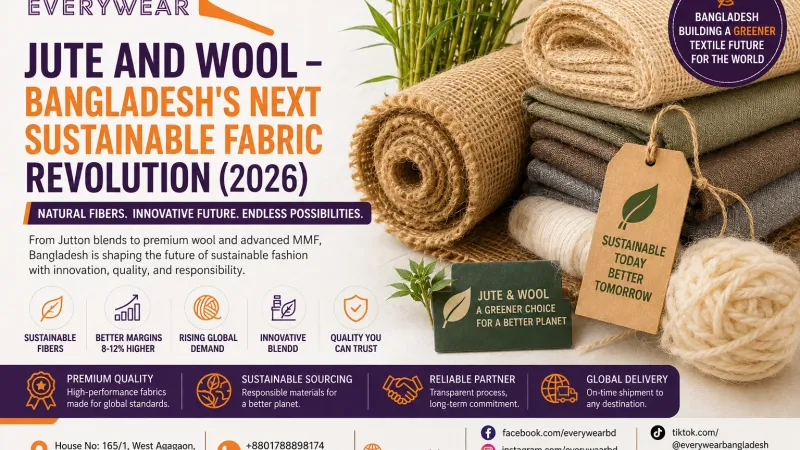
Jute and Wool – Bangladesh's Next Sustainable Fabric Revolution (2026)
Last updated: August 2, 2026 • [Complete Guide for Sustainable Fashion Buyers]
Bangladesh is entering 2026 with a clear contradiction in its textile story. It remains one of the world's largest garment exporters, yet it has almost no footprint in the global wool industry.1 At the same time, the country's $50 billion textile industry2 – which employs approximately 4 million people – has for years depended heavily on imported cotton.3 Now, rising costs and strict sustainability rules are changing the direction.4
Jute, Bangladesh's "golden fiber," is emerging as a smart and sustainable alternative. Wool is opening new premium market opportunities. And man-made fibres (MMF) are driving export growth with a 14.1% increase.5 Together, these three fibres represent the next frontier of Bangladesh's apparel industry – and a significant opportunity for international buyers seeking sustainable, innovative, and cost-effective sourcing solutions.
This comprehensive guide explains why jute, wool, and MMF are reshaping Bangladesh's textile landscape, how blended fabrics like "Jutton" can increase margins by 8% to 12%,6 and why forward-thinking fashion brands are already exploring these sustainable alternatives.
The Problem: Bangladesh's Heavy Reliance on Imported Cotton
Bangladesh is expected to consume 8.1 million bales of cotton in 2026. It remains the world's largest cotton importer, according to the International Cotton Advisory Committee's February 2026 Cotton This Month report.7
Cotton is widely used because it is soft, easy to dye, and scalable for mass products like T-shirts and jeans. However, this dependency comes at a significant cost.
Global cotton prices increased by 25 percent in 2025 due to droughts in the United States and export restrictions in India, according to the USDA Foreign Agricultural Service 2025 Annual Report.8 A mid-sized mill faced an additional cost of $2 million to $3 million per quarter. This cost is either passed to buyers or absorbed as losses.9
Supply disruptions add more pressure. A blockade in the Red Sea delayed shipments by three weeks last year, causing about 20 percent of looms to remain idle, according to the BGMEA Quarterly Review Q1 2026. Factories continued to pay overhead costs while production stopped.10
For international buyers, this means unpredictable pricing, potential delays, and a supply chain vulnerable to global shocks. The solution lies in diversification – and Bangladesh is responding with innovation.
The Solution: Jute – Bangladesh's Homegrown Hero
Jute, the country's golden fiber, is breaking free from cotton's grip.11 Bangladesh carries a rich legacy of jute that dates back centuries, earning the country the title of "Golden Fibre Nation."12 The Bangladeshi jute industry has embraced innovation by developing products like jute-based fabrics, shoes and even bio-degradable ultra-thin poly sheet which is an eco-friendly alternative to conventional plastics.13
But the most exciting development is Jutton – a blend of 80 percent cotton and 20 percent jute.14
What Is Jutton?
Jutton is a type of fabric produced by mixing jute and cotton fibres. The process involves blending jute and cotton fibers in definite proportion to generate a new kind of textile product that can act as a substitute for cotton textile.15 Mills such as Akij Textile Mills in Narayanganj are already producing this yarn for denim and hoodies.16
Early 2026 tests by the Bangladesh Jute Mills Corporation showed strong results:
- 15 percent better insulation than pure cotton17
- Twice as much carbon dioxide captured during cultivation18
- 12 percent cost saving – pure cotton yarn costs around Tk 250 per kilogram, while Jutton costs about Tk 220 per kilogram19
The cost advantage is clear. According to the BGMEA Sustainability Index 2026, blended fabrics like Jutton can increase margins by 8 percent to 12 percent while meeting sustainability targets.20
European Buyers Are Responding Positively
After product demonstrations at trade fairs in Paris, orders for eco-friendly winter products increased by 30 percent from brands like H&M and Primark, according to Textile World Magazine, March 2026.21
This is not just a trend – it is a structural shift. European buyers are actively seeking sustainable alternatives to pure cotton, and Jutton offers the perfect combination of performance, sustainability, and cost-effectiveness.
Jutco: The Next Generation of Jute Innovation
Jutco, a proprietary innovation by Salma Group, is a cottonized jute fiber designed to bridge traditional natural fibers and modern apparel manufacturing.22 Engineered between 2021 and 2024 under the leadership of COO Md. Azhar Ali, the fiber addresses key limitations of raw jute, including coarseness and skin irritation.23
Through advanced chemical and mechanical processing, Jutco achieves a softer, finer structure with moisture management properties comparable to linen, while remaining compatible with standard high-speed cotton spinning systems.24
Produced primarily at Tamijuddin Textile Mills PLC, Jutco is designed for blended applications, typically at 20 to 25 percent with cotton, viscose, or Tencel.25 This enables the development of sustainable, breathable, and durable yarns suitable for global apparel brands such as Levi's and H&M.26
The fiber also offers a cost-effective alternative to imported linen, supporting import substitution by leveraging locally available raw materials.27
Government Support for Jute
The Bangladesh government is actively supporting the jute sector through export incentives. For FY26-27, diversified jute products will receive a 10 percent incentive, while final jute products such as hessian, sacking and CBC will receive 5 percent, and jute yarn and twine will receive 3 percent.28
The government has launched a joint initiative to revitalise Bangladesh's jute sector through stronger economic diplomacy, export promotion and market diversification, announcing the formation of a Joint Working Group (JWG), and plans to organise an international jute expo.29
Bangladesh currently exports jute goods to some 138 countries including China, Iran, Spain, Belgium, and the United States.30
Jute and jute goods recorded a 76.60 percent jump in June and 7.75 percent growth for the year, totalling $883.69 million.31
Wool: Bangladesh's Next Value-Added Apparel Opportunity
While jute offers a sustainable alternative to cotton, wool represents a premium opportunity for Bangladesh to move up the value chain.
Bangladesh has virtually no domestic wool production due to its geography and lack of sheep farming infrastructure. This places the country outside the core global wool supply chain dominated by Australia, China, and New Zealand.32
Instead of production, the opportunity for Bangladesh lies in processing and manufacturing. The focus is on importing raw wool and developing spinning, blending, knitting, and garment manufacturing capacity to serve premium export markets.33
The Woolmark Partnership
The push toward wool gained momentum through industry engagement led by The Woolmark Company in collaboration with the Bangladesh Knitwear Manufacturers and Exporters Association (BKMEA).34
A recent technical seminar in Dhaka highlighted how wool can be integrated into Bangladesh's existing knitwear ecosystem to produce higher-value garments such as premium sweaters, sportswear, and performance apparel.35
BKMEA President Mohammad Hatem said Bangladesh's knitwear sector has built strong global credibility over the years, particularly in cotton-based products, and should now explore premium and differentiated product categories, including wool and wool-rich knitwear.36
"Bangladesh's next stage of growth will not come only from volume. It will come from value addition, product diversification, and stronger innovation," he said at the Woolmark Knitwear Seminar.37
The Economics of Wool
Although wool accounts for only around 1.2% of the global apparel market by volume, it represents nearly 8% by value, highlighting its position as a premium and luxury fiber.38
This disproportionate value-to-volume ratio highlights a lucrative opportunity for manufacturing hubs to move beyond mass-market basics and into the luxury knitwear space, specifically targeting affluent consumer bases in the EU, US, UK, and Japan.39
In FY25, Bangladesh earned $19.7 billion from apparel exports to the European Union (EU), accounting for 50.1% of its total apparel export earnings of $39.3 billion, according to Export Promotion Bureau (EPB) data.40
Bangladesh aims to boost its annual high-end woollen garment exports tenfold to $1 billion in the next five years as Australia, one of the world's largest wool producers, is considering Bangladesh as a potential alternative to China for its wool processing.41
Australian Merino Wool Arrives in Bangladesh
Australian Merino wool and Australian cotton were showcased together for the first time in Bangladesh during the Australian Natural Fiber Seminar in Dhaka on June 22, 2026.42 More than 150 spinners, manufacturers, exporters, and brand representatives attended the event.43
This Australian innovation means Bangladeshi mills can work with Merino wool without significant new capital investment, opening a practical pathway to incorporate Australian wool into mainstream production.44
The wool program has led several Bangladeshi buyers to explore Australian Merino wool for blending with cotton and man-made fibres in export-oriented production.45
Australia and Bangladesh have taken a significant step toward strengthening bilateral cooperation in the textile and apparel sector through a high-level trade mission focused on sustainable natural fibers, product diversification, and innovation.46
Man-Made Fibres (MMF): The Growth Engine
While jute and wool represent the future of sustainable and premium apparel, man-made fibres are already driving export growth.
New data from the Export Promotion Bureau (EPB) shows a significant shift. In the first half of FY2025–26 (July–December), total RMG exports hit $19.36 billion. While overall exports dropped 2.63 percent, MMF products bucked the trend with a 14.1 percent growth.47
MMF-based exports reached $3.68 billion, and the MMF share of RMG surged to a record high of 19.0%, up from 11.4% in full-year 2024 – signaling a structural shift in Bangladesh's RMG exports.48
The $375 Billion Global MMF Opportunity
Bangladesh has the potential to capture 12 percent of the projected US$375 billion global man-made fibre (MMF) apparel market by 2030 through policy reforms, investment promotion and industrial upgrading, according to Bangladesh Foreign Trade Institute (BFTI) Chief Executive Officer Dr Saif Uddin Ahammad.49
"Bangladesh cannot afford to miss this transition. Capturing a meaningful share of the global MMF market is essential for sustaining export growth, strengthening competitiveness and securing the future of the country's apparel industry," Dr Ahammad said.50
According to industry estimates, Bangladesh could generate between US$19 billion and US$20 billion in MMF garment exports over the next five to ten years if existing constraints are addressed and the sector receives adequate policy support.51
Government Support for MMF
Recognising the need to reduce overdependence on cotton, the FY2025–26 national budget introduced targeted incentives to lower MMF input costs. According to the Ministry of Finance:
- Import duties on polypropylene yarn were reduced from 10 to 5 percent52
- Supplementary duties on specialised fabrics were cut from 20 to 10 percent53
These adjustments directly support segments such as sportswear, medical textiles, and technical garments – areas where Bangladesh previously faced cost disadvantages.54
Bangladesh targets $100 billion in apparel exports by 2030. MMF is increasingly positioned as the industry's core growth engine, also critical for export resilience, higher value addition, and long-term competitiveness.55
What This Means for International Buyers
The diversification of Bangladesh's textile industry into jute, wool, and MMF creates significant opportunities for international buyers.
1. Sustainable Sourcing Options
Jute is biodegradable, renewable, and captures twice as much carbon dioxide during cultivation as cotton.56 For brands with ambitious sustainability targets, Jutton and Jutco offer a credible, cost-effective pathway to reducing environmental impact.
Jutton provides 15 percent better insulation than pure cotton, making it ideal for winter wear and eco-friendly collections.57
2. Premium Product Development
Wool opens doors to premium fashion, winterwear, and performance apparel markets, where higher unit prices can offset shrinking margins in commodity knitwear.58
The Woolmark Company partnership is expected to provide technical expertise, access to international wool supply chains, and certification frameworks that can help Bangladesh's knitwear exporters gain credibility in premium markets.59
3. Cost Savings
Jutton yarn costs about 12 percent less than pure cotton yarn – Tk 220 per kilogram compared to Tk 250.60 Blended fabrics like Jutton can increase margins by 8% to 12% while meeting sustainability targets.61
For buyers, this means competitive pricing on sustainable products – a rare combination in today's fashion market.
4. Supply Chain Diversification
By sourcing jute, wool, and MMF garments from Bangladesh, buyers can reduce dependence on cotton and diversify their supply chains. This is particularly important given the volatility of global cotton prices and the risks associated with supply disruptions.
5. Access to Innovation
Bangladesh is at the forefront of textile innovation. From Jutco's cottonized jute fiber to Australian Merino wool blending, the country is developing new materials and manufacturing techniques that are reshaping the global apparel industry.
Buyers who partner with Bangladesh manufacturers today can access these innovations early – gaining a competitive advantage in their target markets.
How to Start Sourcing Jute, Wool, and MMF Garments from Bangladesh
Step 1: Define Your Product Requirements
Before contacting manufacturers, determine which fibre or blend is right for your brand:
- Jutton (80% Cotton + 20% Jute): Sustainable, cost-effective, 15% better insulation
- Jutco Blends (20-25% Jutco + Cotton/Viscose/Tencel): Soft, breathable, comparable to linen
- Wool and Wool Blends: Premium, high-value, 8% of global apparel value
- MMF Garments: Activewear, sportswear, performance apparel – 14.1% export growth
Step 2: Partner with a Trusted Sourcing Partner
Navigating the complexities of sustainable fabric sourcing requires expertise. At Everywear Bangladesh, we connect international buyers with export-oriented manufacturers capable of producing jute blends, wool garments, and MMF apparel.
We can help you:
- Source sustainable fabrics (Jutton, Jutco, organic cotton, recycled polyester)
- Verify proper documentation and certifications
- Ensure compliance with international quality standards
- Navigate the customs and tariff process
Step 3: Request Samples
Before placing a bulk order, always request samples. Evaluate:
- Fabric quality and feel
- Garment measurements
- Printing and embroidery quality
- Overall finishing
Step 4: Place Your Order
Once samples are approved and pricing is confirmed, place your order and agree on a production schedule. Many Bangladesh manufacturers now support MOQ from 300 pieces for selected product categories.
Step 5: Monitor Production and Quality
Stay in communication with your manufacturer throughout production. Request production samples and consider third-party inspection for larger orders.
Step 6: Arrange Shipping
Coordinate shipping with your manufacturer or freight forwarder. Confirm all documentation is correct before shipment.
Frequently Asked Questions
1. What is Jutton?
Jutton is a blend of 80 percent cotton and 20 percent jute. It offers 15 percent better insulation than pure cotton, captures twice as much carbon dioxide during cultivation, and costs about 12 percent less than pure cotton yarn.62 According to the BGMEA Sustainability Index 2026, blended fabrics like Jutton can increase margins by 8 percent to 12 percent while meeting sustainability targets.63
2. What is Jutco?
Jutco is a proprietary cottonized jute fiber developed by Salma Group.64 It addresses key limitations of raw jute, including coarseness and skin irritation, through advanced chemical and mechanical processing.65 Jutco achieves a softer, finer structure with moisture management properties comparable to linen, while remaining compatible with standard high-speed cotton spinning systems.66
3. Can Bangladesh manufacturers produce wool garments?
Yes. Bangladesh is developing wool processing and manufacturing capabilities through partnership with The Woolmark Company and BKMEA.67 The country aims to boost high-end woollen garment exports tenfold to $1 billion in the next five years.68
4. What is the growth potential for MMF garments from Bangladesh?
MMF-based exports grew 14.1 percent in the first half of FY2025–26, reaching $3.68 billion.69 Bangladesh has the potential to capture 12 percent of the US$375 billion global MMF apparel market by 2030.70
5. Is jute fabric suitable for premium fashion?
Yes. Innovations like Jutco are making jute suitable for premium fashion applications. Jutco can be blended with cotton, viscose, or Tencel at 20-25 percent to create sustainable, breathable, and durable yarns suitable for global apparel brands such as Levi's and H&M.71
6. How does Jutton compare to pure cotton?
Jutton offers 15 percent better insulation, captures twice as much carbon dioxide during cultivation, and costs about 12 percent less than pure cotton yarn.72
7. What is the government doing to support jute exports?
The Bangladesh government provides export incentives of up to 10 percent for diversified jute products.73 It has also launched a joint initiative to revitalise the jute sector through economic diplomacy, export promotion, and market diversification, including plans for an international jute expo.74
8. What is the US cotton zero-tariff advantage?
Under the Agreement on Reciprocal Trade (ART), garments made with US-origin cotton or man-made fibres enter the US market duty-free. This applies to jute-cotton blends, MMF garments, and other products containing US-origin fibres. For more details, see our US Cotton Clause guide.
9. Can I source sustainable garments with low MOQ?
Yes. Many Bangladesh manufacturers now support low MOQ production, making it accessible for startups and growing brands. At Everywear Bangladesh, we support production starting from approximately 300 pieces for selected product categories.
10. Why should I choose Bangladesh for sustainable sourcing?
Bangladesh is a global leader in sustainable garment manufacturing with 290 LEED-certified factories, including 125 Platinum-rated and 145 Gold-rated facilities.75 The country is at the forefront of jute innovation, wool processing, and MMF production – offering buyers a unique combination of sustainability, quality, and competitive pricing.
Conclusion
The global apparel industry is undergoing a fundamental transformation. Sustainability is no longer a competitive advantage – it is a requirement. Buyers are seeking alternatives to traditional cotton, and Bangladesh is responding with innovation.
Jute, the "golden fiber," offers a sustainable, cost-effective alternative. Blended fabrics like Jutton can increase margins by 8% to 12% while meeting sustainability targets. Jutco, a cottonized jute fiber, is making jute suitable for premium fashion applications.
Wool offers a premium opportunity for brands seeking higher-value products. With partnership from The Woolmark Company and BKMEA, Bangladesh is developing the capability to produce wool-rich knitwear for luxury and performance markets.
MMF is already driving export growth, with a 14.1% increase in the first half of FY2025–26. Bangladesh has the potential to capture 12% of the US$375 billion global MMF apparel market by 2030.
For international buyers, this means more options, better sustainability, competitive pricing, and access to innovation. The time to explore jute, wool, and MMF sourcing from Bangladesh is now.
At Everywear Bangladesh, we are committed to helping buyers navigate this new landscape. From sustainable fabric sourcing and private label manufacturing to quality control and worldwide shipping, we provide comprehensive support for businesses of all sizes.
Contact Everywear Bangladesh on WhatsApp
References
- Textile Today, "Can wool become Bangladesh's next value-added apparel opportunity?" May 2026
- RMG Bangladesh, "Jute, Bangladesh's homegrown hero, is breaking free from cotton's grip," June 2026
- Ibid.
- Ibid.
- Textile Today, "MMF-based garment exports grow 14.1%, signal structural shift in Bangladesh RMG," February 2026
- BGMEA Sustainability Index 2026
- International Cotton Advisory Committee, "Cotton This Month," February 2026
- USDA Foreign Agricultural Service, Annual Report 2025
- RMG Bangladesh, "Jute, Bangladesh's homegrown hero, is breaking free from cotton's grip," June 2026
- BGMEA Quarterly Review, Q1 2026
- RMG Bangladesh, "Jute, Bangladesh's homegrown hero, is breaking free from cotton's grip," June 2026
- The Financial Express, "Jute can be the new trend," February 2026
- Ibid.
- RMG Bangladesh, "Jute, Bangladesh's homegrown hero, is breaking free from cotton's grip," June 2026
- Banglapedia, "Jutton," 2021
- RMG Bangladesh, "Jute, Bangladesh's homegrown hero, is breaking free from cotton's grip," June 2026
- BJMC Jute Innovation Report, January 2026
- Ibid.
- Bangladesh Textile Mills Association Data
- BGMEA Sustainability Index 2026
- Textile World Magazine, March 2026
- Textile Today, Jutco Fibre Profile
- Salma Group, Jutco Innovation Documentation
- Ibid.
- Ibid.
- Ibid.
- Ibid.
- Bangladesh Bank, Export Incentives Circular, July 2026
- The Financial Express, "Foreign, textile ministries move to boost jute exports," July 2026
- Bangladesh Sangbad Sangstha, "Government plans to boost production, export of jute goods," April 2026
- Bangladesh Sangbad Sangstha, "Bangladesh's June exports surge by 25.91%," July 2026
- Textile Today, "Can wool become Bangladesh's next value-added apparel opportunity?" May 2026
- Ibid.
- Ibid.
- Ibid.
- TBS News, "Bangladesh should now explore premium wool market: Hatem," May 2026
- Ibid.
- The Woolmark Company, Woolmark Knitwear Seminar Presentation, May 2026
- Textile Today, "Can wool become Bangladesh's next value-added apparel opportunity?" May 2026
- Export Promotion Bureau, FY25 Export Data
- TBS News, "Bangladesh eyes $1b in wool garments export with Australia partnership," June 2026
- Textile Today, "Australian Merino wool and cotton showcase together for the first time in Bangladesh," June 2026
- Ibid.
- Austrade, "Australian premium Merino wool lands in Bangladesh," February 2026
- Ibid.
- Textile Focus, "Australia and Bangladesh Strengthen Textile Partnership," July 2026
- Export Promotion Bureau, H1 FY2025-26 Data
- Textile Today, "MMF-based garment exports grow 14.1%, signal structural shift in Bangladesh RMG," February 2026
- Bangladesh Sangbad Sangstha, "Bangladesh can capture 12pc of $375bn global MMF apparel market by 2030," July 2026
- Ibid.
- The Financial Express, "Duty hike may slow MMF transition," June 2026
- Ministry of Finance, FY2025-26 Budget
- Ibid.
- Textile Today, "MMF-based garment exports grow 14.1%, signal structural shift in Bangladesh RMG," February 2026
- Ibid.
- BJMC Jute Innovation Report, January 2026
- Ibid.
- Textile Focus, "Bangladesh Knitwear Industry Explores New Growth Opportunities Through Wool Innovation," May 2026
- Ibid.
- Bangladesh Textile Mills Association Data
- BGMEA Sustainability Index 2026
- Ibid.
- Ibid.
- Textile Today, Jutco Fibre Profile
- Salma Group, Jutco Innovation Documentation
- Ibid.
- Textile Today, "Can wool become Bangladesh's next value-added apparel opportunity?" May 2026
- TBS News, "Bangladesh eyes $1b in wool garments export with Australia partnership," June 2026
- Textile Today, "MMF-based garment exports grow 14.1%, signal structural shift in Bangladesh RMG," February 2026
- Bangladesh Sangbad Sangstha, "Bangladesh can capture 12pc of $375bn global MMF apparel market by 2030," July 2026
- Salma Group, Jutco Innovation Documentation
- BJMC Jute Innovation Report, January 2026
- Bangladesh Bank, Export Incentives Circular, July 2026
- The Financial Express, "Foreign, textile ministries move to boost jute exports," July 2026
- The Financial Express, "BD adds 4 more LEED-certified RMG factories," July 2026
Related Resources
GEO Landing Pages
- USA Buyers: Wholesale Garments from Bangladesh
- UK Buyers: Wholesale Garments from Bangladesh
- Europe Buyers: Wholesale Clothing from Bangladesh
- Africa Buyers: Wholesale Garments from Bangladesh
Blog Posts
- US Tariff Guide for Bangladesh Garment Imports (2026)
- The US Cotton Clause: How the US-Bangladesh Trade Pact Benefits Your Business
- Sustainable Clothing Manufacturing in Bangladesh: The Green Revolution (2026)
- Private Label Clothing Manufacturing Bangladesh – Complete Brand Guide 2026
- Private Label T-Shirt Manufacturer Bangladesh: Complete Guide 2026
- Clothing Suppliers from Bangladesh: The Ultimate Guide 2026
- Bangladesh Garment Industry Guide 2026
- Low MOQ Clothing Manufacturer Bangladesh
This guide is updated regularly. Last reviewed: August 2, 2026. For sustainable sourcing solutions tailored to your brand, contact Everywear Bangladesh on WhatsApp.
Everywear Bangladesh Ltd. – Bangladesh's First RMG Wholesale Marketplace | 300 Pcs Custom Orders | Export Quality Garments
WhatsApp: +8801788898174 • Website: everywearbd.com
Leave a comment