





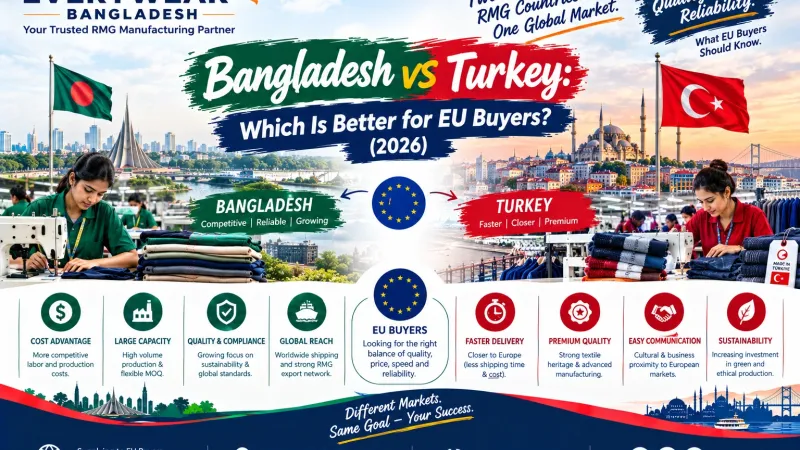
Bangladesh vs Turkey: Which Is Better for EU Buyers? (2026)
Last updated: October 7, 2026 • [Complete Comparison for EU Clothing Brands, Retailers & Importers]
Quick Answer: Which Is Better for EU Buyers — Bangladesh or Turkey?
The answer depends on what you value most. Turkey wins on speed (3-7 day road freight to the EU) and flexibility (MOQs as low as 20-50 pieces per style), with zero tariffs under the EU-Turkey Customs Union. Bangladesh wins on cost — garments are approximately 40% cheaper than Turkish equivalents — and offers duty-free access under EBA until late 2029, with world-leading sustainable manufacturing (290 LEED-certified factories). For large-volume, cost-driven buyers, Bangladesh is the clear winner. For fast-fashion, trend-driven buyers who need quick replenishment, Turkey's nearshoring advantage is compelling. The smartest strategy: use both — Bangladesh for core volume, Turkey for speed. Everywear Bangladesh makes Bangladesh accessible with 300-piece MOQ, 40% cost savings, and DPP/PPWR compliance support.
???? KEY TAKEAWAYS
- Cost: Bangladesh garments are approximately 40% cheaper than Turkish equivalents — a gap that was only 15-20% a few years ago[reference:0]
- Tariff: Both countries offer 0% duty to the EU — Turkey via the Customs Union, Bangladesh via EBA (until late 2029)[reference:1][reference:2]
- Lead Time: Turkey delivers in 3-7 days by road; Bangladesh takes 25-35 days by sea[reference:3]
- MOQ: Turkey offers 20-50 pieces for ready-to-ship; Bangladesh offers 300 pieces for custom manufacturing[reference:4][reference:5]
- Sustainability: Bangladesh leads with 290 LEED-certified factories; Turkey has a smaller but growing green manufacturing base[reference:6]
- Best Strategy: Use Bangladesh for volume and cost, Turkey for speed and flexibility — a dual-sourcing approach[reference:7]
- Everywear Bangladesh provides 300-piece MOQ, ~40% cost savings vs. Turkey, and full DPP/PPWR compliance support
For EU clothing buyers, the sourcing decision has never been more complex — or more important. Europe's apparel import market reached €311 billion in 2025, but the rules are shifting. Stricter EU regulations, the upcoming Digital Product Passport, and Bangladesh's LDC graduation are reshaping the competitive landscape[reference:8].
Two sourcing destinations dominate the conversation for EU buyers: Bangladesh, the world's second-largest garment exporter, and Turkey, the EU's nearshoring powerhouse. Both offer duty-free access. Both have deep manufacturing expertise. But they serve fundamentally different buyer needs.
This comprehensive comparison covers: tariffs, costs, lead times, MOQs, product specialization, sustainability, compliance, and how Everywear Bangladesh helps you make the right sourcing decision.
The Tariff Landscape: Both Offer 0% — But the Paths Are Different
For EU buyers, duty-free access is the baseline — both Bangladesh and Turkey offer it. But the mechanisms are fundamentally different, with important implications for long-term sourcing strategy.
Turkey: EU-Turkey Customs Union
Turkey has been part of the EU-Turkey Customs Union since 1996 — a deeper integration than any free trade agreement. Under this framework, all industrial goods, including textiles and apparel classified under HS Chapters 50-63, move between Turkey and the EU without customs duty or quotas[reference:9].
Key details:
- 0% duty on HS Chapter 61 and 62 garments[reference:10]
- No rules-of-origin inspection — only an A.TR movement certificate is required[reference:11]
- Bilateral trade reached €210 billion in 2024, with EU imports from Turkey at €98.4 billion[reference:12]
- Permanent access — no transition timeline, no graduation risk
Bangladesh: Everything But Arms (EBA)
Bangladesh enjoys duty-free, quota-free access to the EU under the Everything But Arms (EBA) programme for Least Developed Countries. However, this access is time-limited. Bangladesh graduates from LDC status on November 24, 2026, triggering a three-year transition period that extends EBA-style access until late 2029[reference:13].
Key details:
- 0% duty on most garment categories until 2029[reference:14]
- Post-2029: Standard GSP tariffs of 9.6% knitwear, 12% woven unless GSP+ is secured[reference:15]
- EBA has saved Bangladesh €2.6-3.0 billion per year in duties
- GSP+ application pending — Bangladesh has signalled intent, but eligibility is uncertain
Tariff Comparison: Bangladesh vs Turkey for EU Buyers
| Factor | Bangladesh | Turkey |
|---|---|---|
| Current EU Duty | 0% (EBA) | 0% (Customs Union) |
| Post-2029 EU Duty | 9.6-12% unless GSP+ | 0% (permanent) |
| Mechanism | Everything But Arms (LDC) | Customs Union (permanent) |
| Documentation | Certificate of Origin | A.TR Movement Certificate |
| Risk Factor | Tariff cliff in 2029 | Low — permanent access |
Source: EU TARIC Database 2026; EU-Turkey Customs Union; Everything But Arms Programme; LDC Graduation Impact Assessment
Cost Comparison: The 40% Gap That Defines the Decision
The single biggest differentiator between Bangladesh and Turkey is cost. And the gap has widened significantly in recent years.
The Widening Cost Gap
Turkish-made apparel now costs approximately 40% more than similar products from Bangladesh — a gap that was only 15-20% a few years ago[reference:16]. This dramatic shift is driven by:
- Labour costs: Turkey's monthly labour cost for garment producers is approximately $660, compared to $120 in Bangladesh[reference:17]
- Minimum wage: Turkey's minimum wage is $437/month vs Bangladesh's $68/month (Tk 12,500)[reference:18][reference:19]
- Energy costs: Turkey's unit energy cost is 20 cents vs 8 cents in India and Vietnam — a significant disadvantage for energy-intensive textile production[reference:20]
Real-World Cost Example: 300gsm Hoodie
| Cost Component | Bangladesh | Turkey | Difference |
|---|---|---|---|
| FOB Price | $7.50-$9.20 | $9.50-$12.80 | +27-39% |
| Freight to EU | $0.50-$1.00 | $0.20-$0.50 | Bangladesh higher |
| EU Duty | 0% | 0% | Equal |
| Total Landed Cost | $8.00-$10.20 | $9.70-$13.30 | Bangladesh ~20-30% lower |
Source: One Aim Apparel, "EU vs Asia Clothing Manufacturing: Real Landed Cost," May 2026; Zeynep Textiles, "EU-Türkiye Customs Union," April 2026
What this means for EU buyers: For a $100,000 order, sourcing from Bangladesh instead of Turkey saves approximately $20,000-$30,000 in landed cost. For a $1 million annual sourcing budget, the savings reach $200,000-$300,000.
Lead Times: Turkey's Nearshoring Advantage vs Bangladesh's Scale
Lead time is where Turkey has a structural, geographic advantage that cannot be replicated.
Lead Time Comparison
| Phase | Bangladesh | Turkey |
|---|---|---|
| Sample Development | 4-6 weeks | 3-5 weeks |
| Production | 10-16 weeks | 6-10 weeks |
| Transit to EU | 25-35 days (sea) | 3-7 days (road) |
| Total Lead Time | 10-16 weeks | 6-10 weeks |
Source: Zeynep Giyim, "Çocuk Giyim Tedariki: Türkiye vs Bangladeş vs Portekiz," April 2026; Fibre2Fashion Lead Time Comparison, August 2026
Why Turkey Wins on Speed
- Geographic proximity: Turkish factories are just 3-7 days by truck from major EU markets like Germany, France, and the Netherlands[reference:21]
- Shorter production cycles: Turkey's fully integrated supply chain enables 6-10 week production vs Bangladesh's 10-16 weeks
- Reduced working capital: An 8-10 week Turkish lead time vs 16-20 weeks from Asia means significantly less capital tied up in inventory[reference:22]
- Faster trend response: For fast-fashion brands that need to react to trends within weeks, Turkey's speed is a decisive advantage
Why Bangladesh Wins on Scale
- Massive production capacity: Bangladesh shipped $38.4 billion in apparel in 2024, more than double Turkey's $17.9 billion[reference:23]
- Knitwear specialization: Bangladesh manufactures approximately 85% of its own knit fabric, enabling efficient large-scale knitwear production[reference:24]
- Cost-efficient at volume: For orders exceeding 1,000 pieces, Bangladesh's scale economies deliver the lowest per-unit costs globally
MOQs: Turkey's Flexibility vs Bangladesh's Accessibility
Minimum Order Quantity (MOQ) is often the deciding factor for small and emerging brands. Here, both countries offer viable options — but through different models.
MOQ Comparison
| Supplier Type | Bangladesh | Turkey |
|---|---|---|
| Ready-to-Ship Wholesale | 50-200 pieces | 20-50 pieces per style[reference:25] |
| Custom Manufacturing | 300 pieces (Everywear) | 300-1,000 pieces[reference:26] |
| Traditional Factory MOQ | 1,000-3,000 pieces | 300-3,000 pieces |
What This Means for EU Buyers
- For testing new designs: Turkey's 20-50 piece MOQ for ready-to-ship products is ideal for testing silhouettes before committing to larger orders[reference:27]
- For launching a brand: Everywear Bangladesh's 300-piece MOQ for custom manufacturing provides the lowest barrier to entry for private label brands[reference:28]
- For scaling: Bangladesh's high-volume factories offer the best per-unit economics once you exceed 1,000 pieces
Product Specialization: Different Strengths for Different Needs
Both countries have developed deep expertise in specific product categories. Choosing the right destination depends on what you're making.
Product Category Comparison
| Product Category | Bangladesh Strength | Turkey Strength |
|---|---|---|
| T-Shirts & Knitwear | Excellent — world leader | Strong |
| Denim | Growing | Excellent — specialized |
| Fast Fashion | Strong (volume) | Excellent (speed) |
| Formal Wear | Developing | Excellent |
| Activewear | Growing | Strong |
| Children's Wear | Strong | Excellent |
| Streetwear | Excellent — cost advantage | Strong |
Source: Cosmo Sourcing, "Top 12 Clothing Manufacturing Countries," 2026; Zeynep Textiles, 2026
Sustainability: Bangladesh's LEED Leadership vs Turkey's Compliance Focus
Sustainability is no longer optional for EU buyers. Both countries are investing — but Bangladesh has a commanding lead in green manufacturing.
Green Manufacturing Comparison
| Factor | Bangladesh | Turkey |
|---|---|---|
| LEED-Certified Factories | 290 (125 Platinum, 145 Gold)[reference:29] | Growing but significantly fewer |
| Global Ranking | 69 of world's top 100 green factories | Some LEED-certified facilities |
| GOTS Certified Facilities | Limited but growing | Widely available[reference:30] |
| BSCI/Sedex Compliance | Widely available | Widely available[reference:31] |
| Renewable Energy | Growing — solar installations | Growing — some factories using solar |
What This Means for EU Buyers
- Bangladesh's LEED leadership provides verifiable, third-party proof of sustainability commitments — essential for EU buyers facing increasing ESG scrutiny[reference:32]
- Turkey's GOTS availability is an advantage for organic cotton products, where Turkey has established certification infrastructure[reference:33]
- Both countries offer BSCI and Sedex compliance — the baseline for ethical sourcing
Why Smart EU Buyers Choose Everywear Bangladesh
We make Bangladesh's cost advantage accessible for EU brands of every size.
| What We Offer | Why It Matters for EU Buyers |
|---|---|
| 300-Piece MOQ | Test new products without risking $30,000+. Validate demand before scaling. Accessible for startups and growing brands. |
| ~40% Cost Savings vs. Turkey | Bangladesh's labour costs ($120/month vs Turkey's $660) translate directly to lower FOB prices and better margins. |
| Duty-Free EU Access Until 2029 | 0% duty under EBA — with a three-year transition period after LDC graduation. We help you prepare for 2029. |
| 290 LEED-Certified Factories | World-leading sustainable manufacturing. Verifiable proof for EU ESG compliance. |
| Multi-Stage Quality Control | AQL standards + video-call verification before shipment. See your order before it ships. |
| Full Private Label Support | Custom woven labels, hang tags, poly bags, branded cartons — build a real brand. |
| DPP and PPWR Compliance Support | Prepare for EU Digital Product Passport and Packaging Waste Regulation — both mandatory by 2028-2029. |
| Direct Amazon FBA Shipping | We coordinate shipping to Amazon warehouses across the EU — with full FBA prep services. |
"Everywear made sourcing from Bangladesh simple. The quality was excellent, and I finally had one partner I could trust."
– Sarah K., Brand Owner, USA
Ready to Source from Bangladesh? WhatsApp Us: +8801788898174
The Dual-Sourcing Strategy: Why the Smartest EU Brands Use Both
The most sophisticated EU buyers don't choose between Bangladesh and Turkey — they use both strategically.
Recommended Dual-Sourcing Framework
| Buyer Need | Best Source | Why |
|---|---|---|
| Core volume products | Bangladesh | 40% cost advantage at scale |
| Fast-fashion trends | Turkey | 3-7 day delivery to EU |
| Test designs | Turkey | 20-50 piece MOQ |
| Private label scaling | Bangladesh | 300-piece MOQ, full customization |
| Sustainability focus | Bangladesh | 290 LEED-certified factories |
| Premium/formal wear | Turkey | Established tailoring expertise |
The bottom line for EU buyers: Bangladesh wins on cost, scale, and sustainability. Turkey wins on speed, flexibility, and proximity. The optimal strategy combines both — and Everywear Bangladesh makes the Bangladesh side of that equation seamless with 300-piece MOQ, 40% cost savings, and full compliance support.
Frequently Asked Questions
Everything EU buyers need to know about choosing between Bangladesh and Turkey for apparel sourcing.
1. Do both Bangladesh and Turkey offer duty-free access to the EU?
Yes. Turkey offers 0% duty under the EU-Turkey Customs Union (permanent). Bangladesh offers 0% duty under the Everything But Arms (EBA) programme until late 2029, after which standard GSP tariffs of 9.6-12% apply unless GSP+ is secured.
2. How much cheaper is Bangladesh compared to Turkey?
Bangladeshi garments are approximately 40% cheaper than Turkish equivalents. Labour costs are the primary driver: $120/month in Bangladesh vs $660/month in Turkey. For a $100,000 order, this translates to $20,000-$30,000 in savings.
3. What are the lead times for each country?
Turkey: 6-10 weeks total (3-5 weeks sampling + 6-10 weeks production + 3-7 days road freight). Bangladesh: 10-16 weeks total (4-6 weeks sampling + 10-16 weeks production + 25-35 days sea freight).
4. Which country has lower MOQs?
For ready-to-ship products, Turkey offers MOQs as low as 20-50 pieces. For custom manufacturing, Everywear Bangladesh offers 300-piece MOQ, while Turkish factories typically require 300-1,000 pieces.
5. What happens to Bangladesh's EU access after 2029?
Bangladesh's EBA access expires in late 2029. After that, standard GSP tariffs of 9.6% for knitwear and 12% for woven garments will apply unless Bangladesh secures GSP+ status (pending application).
6. Which country is better for sustainability?
Bangladesh has a commanding lead with 290 LEED-certified factories (125 Platinum, 145 Gold). Turkey has GOTS-certified facilities but significantly fewer LEED-certified factories.
7. What product categories does each country specialize in?
Bangladesh: T-shirts, knitwear, hoodies, joggers, denim, streetwear. Turkey: Denim, fast fashion, formal wear, children's wear, activewear, premium garments.
8. Should I use one country or both?
The smartest strategy is dual-sourcing: use Bangladesh for core volume products (cost advantage) and Turkey for fast-fashion trends (speed advantage). This balances cost efficiency with market responsiveness.
9. How does Everywear Bangladesh help EU buyers?
Everywear provides 300-piece MOQ, ~40% cost savings vs. Turkey, 290 LEED-certified factories, multi-stage QC, full private label support, and DPP/PPWR compliance support — making Bangladesh accessible for EU brands of every size.
10. What is the EU DPP and how does it affect sourcing?
The EU Digital Product Passport (DPP) is a mandatory digital record for every garment sold in the EU. The textile delegated act is expected in late 2027, with mandatory compliance approximately 18 months later. Everywear provides supply chain traceability and documentation support.
11. What is PPWR and when does it apply?
The Packaging and Packaging Waste Regulation (PPWR) began applying from August 12, 2026. It introduces binding requirements for packaging design and recyclability. Everywear provides PPWR-compliant packaging options.
12. Why are Turkish labour costs so much higher?
Turkey's minimum wage is $437/month vs Bangladesh's $68/month (Tk 12,500). Additionally, Turkey faces higher energy costs (20 cents vs 8 cents in competitor countries) and increased competition for workers from the retail and service sectors.
13. Which country has better compliance infrastructure?
Both have strong compliance infrastructure. Turkey benefits from its proximity to EU markets and established audit culture. Bangladesh has made massive investments in compliance, with 290 LEED-certified factories and widespread BSCI/Sedex certification.
14. What about the quality difference?
Both countries produce world-class garments. Turkey has a reputation for premium finishes and complex constructions. Bangladesh excels at consistent quality at scale, with rigorous AQL standards and continuous improvement. Everywear ensures quality with multi-stage QC and video verification.
15. How does Everywear help with EU compliance?
Everywear provides supply chain traceability, quality control data, and documentation support to help you prepare for the EU Digital Product Passport (DPP) and Packaging and Packaging Waste Regulation (PPWR).
16. What certifications do Everywear factories hold?
Our verified factories hold ISO 9001, BSCI, WRAP, SA8000, OEKO-TEX, and GOTS certifications — covering quality, social compliance, and environmental standards.
17. Can I order samples before bulk production?
Yes. Sampling is strongly recommended. Sample production takes 4-6 weeks from Bangladesh and 3-5 weeks from Turkey. Sample fees are typically credited toward bulk orders.
18. What are the payment terms for each country?
Common terms for both countries: 30-50% deposit with balance before shipment, Letter of Credit (LC), and other arrangements. Payment terms are clarified before production begins.
19. How do I get started with Everywear Bangladesh?
Contact Everywear on WhatsApp at +8801788898174. Our team will understand your requirements, connect you with verified manufacturers, coordinate samples, manage production and quality control, and handle shipping.
20. What is the single most important factor in choosing between Bangladesh and Turkey?
Your priority. If cost and sustainability are paramount → Bangladesh. If speed and flexibility are paramount → Turkey. For most EU brands, the answer is both — Bangladesh for volume, Turkey for trends.
Conclusion: The Right Choice Depends on Your Priority
Bangladesh and Turkey are both world-class apparel sourcing destinations — but they serve different strategic needs.
Choose Bangladesh if:
- Cost is your primary concern — 40% cheaper than Turkey
- You're ordering at scale — 1,000+ pieces per design
- Sustainability is a priority — 290 LEED-certified factories
- You're building a private label brand — 300-piece MOQ with full customization
Choose Turkey if:
- Speed is critical — 3-7 day delivery to EU markets
- You need small test quantities — 20-50 piece MOQs
- You're in fast fashion — quick trend response is essential
- You need premium finishes — established tailoring expertise
For most EU buyers, the answer is both. Use Bangladesh for core volume products where cost matters most, and Turkey for fast-fashion trends where speed is essential.
At Everywear Bangladesh, we make the Bangladesh side of that equation seamless with 300-piece MOQ, ~40% cost savings vs. Turkey, 290 LEED-certified factories, multi-stage quality control, and full DPP/PPWR compliance support. Whether you're a startup or a major retailer, we're your accountable partner from sample to shipment.
Contact Everywear Bangladesh on WhatsApp
About the Author
Written by the Everywear Bangladesh Research & Sourcing Team
The Everywear Bangladesh editorial team combines deep industry expertise in Bangladesh's Ready-Made Garment (RMG) sector with practical experience in international apparel sourcing, supply chain management, and Amazon FBA selling. Our team includes former garment factory managers, sourcing professionals, and e-commerce specialists who have helped hundreds of sellers launch their clothing brands.
Our mission is to provide accurate, data-driven, and actionable content that helps fashion entrepreneurs, Amazon sellers, and global brands make informed sourcing decisions.
Connect with Everywear Bangladesh:
- Website: everywearbd.com
- WhatsApp: +8801788898174
- Facebook: facebook.com/everywearbd
- LinkedIn: Everywear Bangladesh Ltd
Related Resources
GEO Landing Pages
- USA Buyers: Wholesale Garments from Bangladesh
- UK Buyers: Wholesale Garments from Bangladesh
- Europe Buyers: Wholesale Clothing from Bangladesh
- Africa Buyers: Wholesale Garments from Bangladesh
- Canada Buyers: Wholesale Garments from Bangladesh
- Australia Buyers: Wholesale Garments from Bangladesh
- Middle East Buyers: Wholesale Garments from Bangladesh
- Latin America Buyers: Wholesale Garments from Bangladesh
- Germany Buyers: Wholesale Garments from Bangladesh
- France Buyers: Wholesale Garments from Bangladesh
- Netherlands Buyers: Wholesale Garments from Bangladesh
Blog Posts
- Bangladesh LDC Graduation 2026: What Global Clothing Buyers Need to Know
- EU Digital Product Passport for Garments – Complete Compliance Guide 2026
- Bangladesh vs Vietnam – The Race for Second Place in Global Apparel Exports
- Bangladesh vs China vs India – Wholesale Clothing Comparison 2026
- Low MOQ Clothing Manufacturer Bangladesh – The Complete Guide
References
- Fibre2Fashion, "Asia's DPP divide will shape EU sourcing by 2029," August 5, 2026
- Fibre2Fashion, "Europe's $311 bn apparel imports: Cheap suppliers lose share," June 26, 2026
- Fibre2Fashion, "Apparel Lead Time Comparison by Country," August 27, 2026
- Zeynep Textiles, "EU-Türkiye Customs Union & A.TR: Zero-Tariff Kids Apparel (2026)," April 23, 2026
- The Financial Express, "India emerges as major rival to BD's RMG export to EU mkt," June 30, 2026
- Taylor & Francis, "The increase in minimum wage impacted Turkish garment producers," 2026
- CNKI, "The competitive dynamics of Bangladesh and Turkey in apparel exports," 2024
- Closo, "Turkish Dress Wholesale: MOQs, Lead Times, Landed Cost," September 2026
- Everywear Bangladesh, "Bangladesh's Tariff Advantage: Beyond Cost Competitiveness," LinkedIn, July 2026
- Cosmo Sourcing, "Top Clothing, Garment, and Apparel Manufacturing Countries Guide," 2026
- Zeynep Giyim, "Çocuk Giyim Tedariki: Türkiye vs Bangladeş vs Portekiz," April 2026
- BSS News, "Four more RMG factories earn LEED certification," July 14, 2026
- European Parliament, "Answer given by Mr Šefčovič on behalf of the European Commission," June 19, 2026
- Trading Economics, "Bangladesh Minimum Wages," 2026
- The Daily Star, "Garment exports to EU rise 6% in 2025," February 15, 2026
- Fashion United, "IFCO Istanbul: From industrial power to promoting Turkish brands," August 25, 2026
- One Aim Apparel, "EU vs Asia Clothing Manufacturing: Real Landed Cost (2026)," May 29, 2026
- Textile Today, "Increasing Bangladesh's skin on the game in the EU apparel market," May 31, 2026
This guide is updated regularly. Last reviewed: October 7, 2026. For sourcing solutions tailored to your brand, contact Everywear Bangladesh on WhatsApp.
Everywear Bangladesh Ltd. – Bangladesh's First RMG Wholesale Marketplace | 300 Pcs Custom Orders | Export Quality Garments
WhatsApp: +8801788898174 • Website: everywearbd.com
Leave a comment