





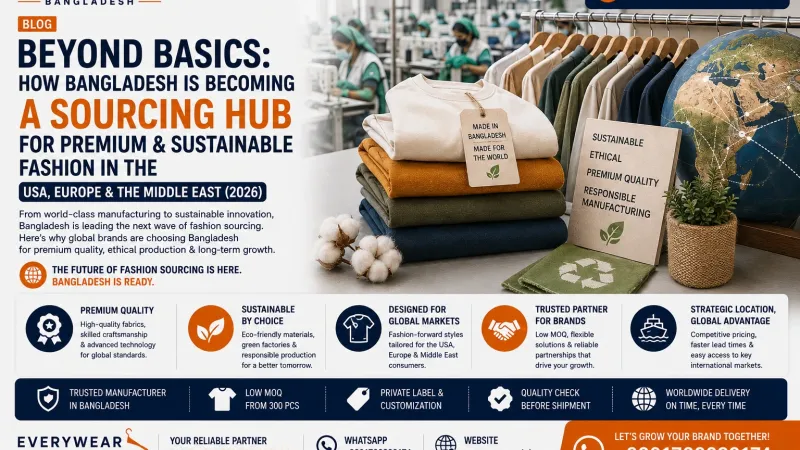
Beyond Basics: How Bangladesh Is Becoming a Sourcing Hub for Premium & Sustainable Fashion in the USA, Europe & the Middle East (2026)
Last updated: August 27, 2026 • [Complete Guide for Fashion Brands, Retailers & Sourcing Professionals]
Quick Answer: Is Bangladesh Still Just a Source for Basic Apparel?
No. Bangladesh is rapidly evolving from a low-cost manufacturer into a global hub for premium, sustainable, and high-value fashion. With 290 LEED-certified green factories—the most in the world—and a growing capability in premium fabrics like Australian Merino wool and heritage materials, the country is attracting brands from the USA, Europe, and the Middle East who seek quality, sustainability, and value. As the industry targets $100 billion in exports by 2030, it is shifting from volume-driven to value-driven growth, making it a strategic partner for brands looking to build a premium, ethical, and resilient supply chain.
For decades, Bangladesh's ready-made garment (RMG) industry was synonymous with one thing: volume. It was the world's factory for affordable basics, powering the fast-fashion boom with its unmatched scale and low costs. However, the narrative is changing dramatically. In 2026, Bangladesh is not just the world's second-largest garment exporter; it is quietly becoming a hub for premium, sustainable, and high-value fashion.
This transformation is being driven by a confluence of factors: a massive investment in green manufacturing, a strategic pivot towards value-added products, the adoption of premium natural fibres, and a growing demand from discerning markets in the USA, Europe, and the Middle East for ethical, high-quality apparel. For fashion brands, retailers, and sourcing professionals, this evolution represents a significant opportunity to partner with a manufacturing powerhouse that can now deliver on quality, sustainability, and innovation.
This guide explores how Bangladesh is moving "beyond basics" and why it is becoming the preferred sourcing destination for the next generation of global fashion.
1. The New Narrative: From 'Volume' to 'Value'
The Bangladesh of 2026 is not the Bangladesh of a decade ago. The industry has recognized that to achieve its ambitious goal of $100 billion in exports by 2030, it must move beyond low-cost mass production and capture higher-value global markets.[reference:0] This shift from a volume-driven to a value-driven model is the cornerstone of its new strategy.
Industry leaders, like the Bangladesh Garment Manufacturers and Exporters Association (BGMEA), are actively urging manufacturers to produce high-end fashion products by leveraging local heritage materials and advanced manufacturing techniques.[reference:1] This is not just a aspiration; it's a necessity. With global demand for sustainable and natural fibres rising, Bangladesh is strategically positioned to diversify into technologically advanced and premium apparel segments.[reference:2]
This commitment is reflected in the numbers. Despite a challenging global trade environment, Bangladesh's apparel exports to the United States rose by 2.63 percent to $7.74 billion in FY26, increasing its total export share to over 20%.[reference:3] In July 2026 alone, exports to the US reached $918.74 million, marking a positive growth of 0.25% year-on-year.[reference:4] This resilience in a key Western market underscores the sustained confidence of US buyers in Bangladesh's manufacturing capabilities.
2. Sustainability: The Cornerstone of Premium Sourcing
Sustainability is no longer a "nice-to-have" for fashion brands; it is a sourcing condition. For buyers in Europe and the USA, it's a non-negotiable requirement. Bangladesh has positioned itself as a global leader in this area, turning a regulatory challenge into a powerful competitive advantage.
2.1. World-Leading Green Manufacturing
Bangladesh now boasts 290 LEED-certified RMG factories, the highest number of any country, including 125 Platinum-rated and 145 Gold-rated facilities.[reference:5][reference:6] This is not a niche achievement; it's a systemic transformation of the industry's environmental footprint.
One of the world's highest-scoring LEED factories, Hams Garments Limited, achieved a platinum certification with a score of 108 out of 110,[reference:7] demonstrating that Bangladeshi manufacturers are not just participating in the green building movement, but leading it. For brands with ambitious ESG goals, partnering with a LEED-certified factory in Bangladesh provides a tangible, verifiable way to reduce their supply chain's environmental impact.
2.2. Meeting EU Regulatory Standards
For European buyers, compliance with the EU's stringent regulations is paramount. With nearly 60% of Bangladesh's garment exports bound for Europe, the industry is acutely aware of the high stakes.[reference:8]
The EU's Ecodesign for Sustainable Products Regulation (ESPR), set to take full effect in 2026,[reference:9] and the Packaging and Packaging Waste Regulation (PPWR), enforced from August 12, 2026,[reference:10] are reshaping how apparel is exported to Europe. Bangladesh is proactively adapting, with initiatives like the partnership between DigiProd Pass and BGMEA to equip the RMG industry for full EU compliance.[reference:11]
This commitment to compliance positions Bangladesh as a trusted and sustainable sourcing partner for the European Union.[reference:12] For brands, it means less risk and a smoother path to meeting their own regulatory obligations.
3. Premium Materials: Wool, Heritage, and Innovation
To move beyond basics, you need premium materials. Bangladesh is aggressively expanding its capabilities in this area, moving beyond traditional cotton to embrace high-value and sustainable fibres.
3.1. The Wool Opportunity
A significant milestone was the joint debut of Australian Merino wool and cotton in Bangladesh.[reference:13] This marks a major step in the industry's push to diversify exports and move into premium, value-added textile markets.[reference:14]
The Woolmark Company has recognized Bangladesh's strong potential to manufacture and export wool-based knitwear.[reference:15] As the world's second-largest garment exporter,[reference:16] Bangladesh is now increasingly focusing on sustainable and value-added apparel manufacturing.[reference:17] The country's existing RMG infrastructure can be leveraged to process Australian wool and produce higher-value products.[reference:18]
3.2. Heritage Materials & Innovation
Beyond wool, BGMEA is urging local manufacturers to produce high-end fashion using local heritage materials to aid diversification.[reference:19] Industry leaders are also championing the use of low-water-consumption materials and alternative fibers like bamboo as potential solutions to reduce water dependency.[reference:20]
This innovation is critical. Bangladesh's share in value-added global apparel segments is currently lower than its overall share,[reference:21] but the direction of travel is clear. The industry is actively closing this gap by investing in new materials and technologies.
4. Targeting Key Markets: A Region-Specific Strategy
The premium and sustainable sourcing narrative resonates differently across key markets. Here's how Bangladesh's evolution directly addresses the needs of buyers in the USA, Europe, and the Middle East.
4.1. United States: Quality, Value & The US Cotton Clause
For US buyers, the "value" equation is changing. While price remains a factor, the focus is shifting to quality, reliability, and long-term partnership. Bangladesh's move into premium products meets this demand.
Bangladesh currently exports roughly $9-10 billion of RMG products annually to the US,[reference:22] with a market share of around 8-9%. The country has the potential to increase this share to 12-15% in the medium term, unlocking an additional $5 billion in export earnings.[reference:23]
A key competitive advantage is the US Cotton Clause under the Agreement on Reciprocal Trade (ART). This allows garments made with US-origin cotton to enter the US market duty-free, providing significant cost savings.[reference:24] This benefit, combined with sustainable manufacturing, makes Bangladesh an increasingly compelling sourcing partner for US brands.
4.2. Europe: ESG Compliance & Trusted Partnership
The European market is the single most important destination for Bangladesh's RMG exports, representing a $19.06 billion opportunity in FY2025-26, equal to 49.25% of the country's total exports.[reference:25] Europe's focus on sustainability and regulation is a perfect match for Bangladesh's strengths.
As discussed, Bangladesh's investment in LEED-certified factories and its commitment to EU compliance positions it as a trusted sourcing partner for Germany and the wider EU.[reference:26] For European brands under pressure to meet ESG targets, Bangladesh offers a scalable, compliant, and cost-effective solution.
4.3. The Middle East: A New Frontier for Premium Fashion
The Middle East represents a significant and growing opportunity for Bangladesh. As the region's fashion market expands, there is increasing demand for high-quality, premium apparel. Bangladesh is strategically positioning itself to meet this demand.
Efforts to boost exports to Saudi Arabia are a clear example. The Commerce Minister has urged sector-based plans to expand Bangladesh's export footprint in the Saudi market.[reference:27] There is significant potential for ready-made garments tailored to local consumer preferences,[reference:28] with estimates suggesting exports to Saudi Arabia could reach $1 billion by 2027.[reference:29]
Shipments to the United Arab Emirates have already risen by 16.56% to $168.22 million in one period,[reference:30] demonstrating the market's receptivity. As Bangladesh continues to develop its premium manufacturing capabilities, the Middle East is poised to become a major growth engine.
5. How Everywear Bangladesh Bridges the Gap
At Everywear Bangladesh, we understand that navigating the shift toward premium and sustainable sourcing requires more than just a factory. It requires a strategic partner who understands the nuances of the evolving global market. We bridge the gap between your brand's ambitions and Bangladesh's manufacturing capabilities.
5.1. Access to Resilient, LEED-Certified Manufacturers
We connect you with a network of verified, export-oriented manufacturers, including many of Bangladesh's world-leading LEED-certified green factories. This ensures your supply chain is not only sustainable but also resilient and compliant with international standards.
5.2. Expertise in Premium Materials & Product Development
Our network is expanding its capabilities in premium materials, including organic cotton, Australian Merino wool, and other sustainable fibres. We support you through the entire product development cycle, from tech pack creation and fabric sourcing to sample development and bulk production.
5.3. Private Label & Brand Building
We help you build a distinctive brand identity through full private label support, including custom labels, hang tags, and packaging. Whether you're a startup or an established brand, we can help you create products that reflect your unique value proposition.
5.4. Low MOQ from 300 Pieces
Testing premium products doesn't have to mean massive upfront investment. Our low MOQ of 300 pieces per design allows you to test new concepts in the USA, European, or Middle Eastern markets with reduced risk, validating demand before scaling up.
5.5. EU & US Compliance Support
Navigating complex regulations can be a barrier. We help you ensure your products meet the latest EU (ESPR, PPWR) and US (US Cotton Clause) compliance requirements, reducing risk and smoothing the path to market.
5.6. End-to-End Support – One Accountable Partner
You deal with Everywear directly – not multiple factories or middlemen. We provide a dedicated account manager, regular production updates, and 24/7 WhatsApp support, ensuring transparency and accountability throughout the entire sourcing journey.
Contact Everywear Bangladesh on WhatsApp
Frequently Asked Questions
Everything you need to know about sourcing premium and sustainable fashion from Bangladesh.
1. Is Bangladesh still just a source for basic, low-cost apparel?
No. Bangladesh is rapidly evolving into a hub for premium, sustainable, and high-value fashion. With a focus on value-added products, advanced manufacturing, and world-leading green factories, it is attracting brands from the USA, Europe, and the Middle East who seek quality, sustainability, and innovation.
2. How many LEED-certified garment factories does Bangladesh have?
Bangladesh now has 290 LEED-certified RMG factories, the highest number of any country. This includes 125 Platinum-rated and 145 Gold-rated facilities.
3. Why is sustainability becoming a key factor in sourcing from Bangladesh?
Sustainability is a sourcing condition for many international brands, especially in Europe and the USA. Bangladesh's investment in green manufacturing and compliance with EU regulations like the ESPR and PPWR makes it a trusted and compliant sourcing partner, reducing risk for buyers.
4. Is Bangladesh capable of manufacturing premium products with high-quality materials?
Yes. Bangladesh is expanding its capabilities in premium materials, including Australian Merino wool, organic cotton, and other sustainable fibres. The industry is actively moving into value-added segments and is working with partners like The Woolmark Company to produce higher-value products.
5. What is the US Cotton Clause and how does it benefit buyers?
The US Cotton Clause is a provision under the US-Bangladesh Agreement on Reciprocal Trade (ART). It allows garments made with US-origin cotton to enter the US market duty-free, providing significant cost savings for American buyers and making Bangladesh a more competitive sourcing destination.
6. What is Bangladesh's export target for the RMG sector?
Bangladesh has an ambitious target of reaching $100 billion in garment exports by 2030. Achieving this goal requires a shift from volume-driven to value-driven growth, focusing on premium and diversified products.
7. How is Bangladesh preparing for EU compliance regulations like the ESPR and PPWR?
Bangladesh is proactively preparing for EU regulations. Initiatives like the partnership between DigiProd Pass and BGMEA are equipping the RMG industry for full compliance with the ESPR. The industry is also adapting to the PPWR to ensure seamless exports to the European market.
8. What is the outlook for Bangladesh's apparel exports to the USA?
The outlook is positive. Bangladesh exported roughly $9-10 billion to the US in FY26, with exports rising 2.63% to $7.74 billion. The country has the potential to increase its market share from 8-9% to 12-15%, unlocking an additional $5 billion in export earnings.
9. How important is the European market for Bangladesh's RMG exports?
The European Union is Bangladesh's largest goods-trade partner. Apparel exports to the EU reached $19.06 billion in FY2025-26, accounting for 49.25% of Bangladesh's total RMG exports. It is a critical and highly valued market.
10. Is the Middle East a growing market for Bangladesh's RMG exports?
Yes. The Middle East represents a significant growth opportunity. Shipments to the UAE rose by 16.56%, and exports to Saudi Arabia are projected to reach $1 billion by 2027. The government is actively seeking to expand its export footprint in the region with products tailored to local preferences.
11. What is the potential for wool and other premium fibres in Bangladesh?
The potential is significant. The introduction of Australian Merino wool opens new horizons for premium, value-added textile markets. The Woolmark Company has recognized Bangladesh's strong potential to manufacture and export wool-based knitwear, which can command higher prices and margins.
12. What is the MOQ for custom manufacturing with Everywear Bangladesh?
Everywear Bangladesh supports low MOQ production from 300 pieces per design. This allows brands to test premium products in new markets with reduced risk and lower upfront investment.
13. How does Everywear Bangladesh ensure quality for premium products?
We maintain rigorous quality standards through a comprehensive process: fabric inspection, in-line sewing inspection, printing and embroidery verification, final AQL inspection, and video-call inspection before shipment. This ensures your premium products meet international quality standards.
14. Does Everywear Bangladesh offer private label services for building a brand?
Yes. We offer full private label support, including custom woven labels, printed neck labels, hang tags, custom poly bags, and branded cartons. This helps you build a distinctive brand identity that resonates with your target market in the USA, Europe, or the Middle East.
15. Why should a fashion brand choose Bangladesh for its premium line?
Brands should choose Bangladesh for its unique combination of scale, sustainability, and evolving quality. It offers access to world-leading green factories, a skilled workforce, competitive pricing, and a growing capability in premium materials. This makes it a strategic partner for building a resilient, ethical, and high-quality supply chain.
Conclusion
The narrative of Bangladesh's RMG industry is being rewritten. It is no longer just the world's factory for cheap basics; it is evolving into a strategic hub for premium, sustainable, and high-value fashion. With a record number of green factories, a proactive approach to EU compliance, and a growing capability in premium materials like wool, Bangladesh is meeting the demands of the most discerning markets in the USA, Europe, and the Middle East.
For fashion brands, this transformation represents a significant opportunity. Partnering with Bangladesh allows you to access a reliable, scalable, and increasingly sophisticated manufacturing base that can deliver on quality, sustainability, and innovation. The shift from volume to value is not just an industry trend; it is a fundamental change that is positioning Bangladesh as a key player in the future of global fashion.
At Everywear Bangladesh, we are at the forefront of this evolution. We help brands navigate the complexities of premium sourcing, connect with resilient, LEED-certified manufacturers, and build supply chains that are built for the future.
Contact Everywear Bangladesh on WhatsApp
About the Author
Written by the Everywear Bangladesh Research & Sourcing Team
The Everywear Bangladesh editorial team combines deep industry expertise in Bangladesh's Ready-Made Garment (RMG) sector with practical experience in international apparel sourcing, supply chain management, and global trade analysis. Our team includes former garment factory managers, sourcing professionals, and trade analysts who have worked with fashion brands across the United States, Europe, and the Middle East.
Our mission is to provide accurate, data-driven, and actionable content that helps fashion entrepreneurs, retailers, wholesalers, importers, and global brands make informed sourcing decisions. We leverage real-time data from the Bangladesh Garment Manufacturers and Exporters Association (BGMEA), Export Promotion Bureau (EPB), and other authoritative sources to ensure our insights reflect the latest industry developments.
Connect with Everywear Bangladesh:
- Website: everywearbd.com
- WhatsApp: +8801788898174
- Facebook: facebook.com/everywearbd
- LinkedIn: Everywear Bangladesh Ltd
References
- Bangladesh Textile Journal, "Australian Merino wool and cotton debut jointly in Bangladesh, opening new horizons for premium sustainable textiles," June 24, 2026
- Bangladesh Sangbad Sangstha (BSS), "Bangladesh RMG exports slip 1.64% to $38.70bn in FY26," July 7, 2026
- BGMEA, "Bangladesh–United States Tariff Agreement: BGMEA's Initial Response and Appreciation," February 10, 2026
- Dhaka Tribune, "The cotton gambit," May 23, 2026
- The Financial Express, "BD adds 4 more LEED-certified RMG factories," July 15, 2026
- The Financial Express, "Muktadir seeks sector-based proposals to boost exports to Saudi Arabia," August 15, 2026
- New Age, "Heritage materials could aid RMG diversification: BGMEA," April 7, 2026
- Observer BD, "Bangladesh eyes premium global fashion market through wool innovation," May 11, 2026
- Textile Focus, "Bangladesh Knitwear Industry Explores New Growth Opportunities Through Wool Innovation," May 12, 2026
- Textile Today, "Bangladesh leads in green factories, but a price premium is still missing," April 6, 2026
- Textile Today, "Innovation is now a sourcing condition," May 16, 2026
- The Daily Star, "Exports snap 8-month decline with 33% surge in April," May 4, 2026
- TBS News, "Bangladesh beats China to become 2nd largest RMG supplier to US," March 17, 2026
Related Resources
GEO Landing Pages
- USA Buyers: Wholesale Garments from Bangladesh
- UK Buyers: Wholesale Garments from Bangladesh
- Europe Buyers: Wholesale Clothing from Bangladesh
- Africa Buyers: Wholesale Garments from Bangladesh
Blog Posts
- Sustainable Clothing Manufacturing in Bangladesh: The Green Revolution (2026)
- Jute and Wool – Bangladesh's Next Sustainable Fabric Revolution (2026)
- Clothing Suppliers from Bangladesh: The Ultimate Guide 2026
- Private Label Clothing Manufacturing Bangladesh – Complete Brand Guide 2026
This guide is updated regularly. Last reviewed: August 27, 2026. For premium sourcing solutions tailored to your brand, contact Everywear Bangladesh on WhatsApp.
Everywear Bangladesh Ltd. – Bangladesh's First RMG Wholesale Marketplace | 300 Pcs Custom Orders | Export Quality Garments
WhatsApp: +8801788898174 • Website: everywearbd.com
Leave a comment