





FOB vs CIF vs DDP: Incoterms Explained for Clothing Buyers (2026)
Last Updated: October 17, 2026 | By: Everywear Bangladesh Research & Sourcing Team
What Do FOB, CIF, and DDP Actually Mean for Clothing Buyers?
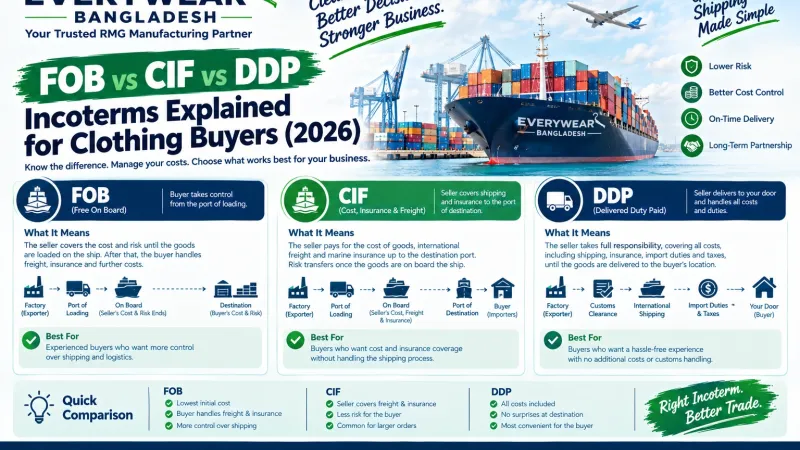
The Incoterm you choose determines who pays for what, who bears risk, and where your cost and control begin and end. FOB (Free On Board) means the factory delivers goods to the port and loads them onto the vessel — you pay freight, insurance, and import clearance. CIF (Cost, Insurance, Freight) means the factory also pays ocean freight and basic insurance to your destination port, but risk still transfers at the origin port. DDP (Delivered Duty Paid) means the factory handles everything — freight, insurance, duties, taxes, and delivery to your warehouse. FOB is the most common Incoterm for Bangladesh garment imports because it gives buyers full control over freight and customs clearance.
Why Incoterms Matter More Than You Think
Most new buyers focus only on the unit price quoted by the factory. Experienced buyers focus on total cost per delivered piece. The difference between these two numbers is where Incoterms live.
A garment quoted at $8 FOB from Bangladesh and a garment quoted at $10 CIF from the same factory are not directly comparable. The FOB price excludes ocean freight, insurance, import clearance, duties, and inland delivery. The CIF price includes ocean freight and basic insurance to your port — but still excludes import clearance, duties, taxes, and delivery to your warehouse.
This is also where sourcing country comparisons get misleading. A garment that is 20% cheaper FOB from one country can end up costing more landed once duty is added, because trade agreements and tariff schedules vary enormously by country of origin. Bangladesh's LDC status gives it preferential market access that China and, to a lesser extent, Vietnam do not have in most major destinations.
FOB (Free On Board): The Industry Standard
FOB means the seller is responsible for the goods until they are loaded onto the vessel at the port of export. The seller pays for transportation to the port, export clearance, and loading onto the ship. The buyer pays for ocean freight, insurance, import clearance, and delivery to their warehouse.
Risk transfer: Risk transfers from seller to buyer when the goods cross the ship's rail at the port of export. If goods are damaged during ocean transit, the buyer bears the loss.
FOB pricing from Bangladesh: FOB price from Bangladesh typically ranges from $5 to $15 per garment depending on complexity. This price includes fabric, production, and delivery to the Chittagong port. It does not include ocean freight to your destination.
Example: A factory quotes FOB Chittagong at $8 per shirt. The factory delivers the shirts to the port and loads them onto the ship. You pay ocean freight from Chittagong to your port, insurance, customs duty, and delivery to your warehouse.
Why FOB works for scaling brands: FOB is the most transparent structure. You see fabric cost (based on GSM and yarn type), trim cost, labor cost, and packaging cost. There is no hidden logistics markup. You negotiate freight directly, optimize container loading, and reduce cost per unit. FOB is best for brands that have a freight forwarder or are ready to appoint one.
CIF (Cost, Insurance, and Freight): Less Work, Less Control
CIF means the seller pays for cost, insurance, and freight to the named destination port. The seller is responsible for goods until they reach the destination port. The buyer pays for import clearance, customs duties, and delivery from the port to their warehouse.
Risk transfer: Risk transfers from seller to buyer when the goods are loaded onto the vessel at the port of export. This is the same risk transfer point as FOB. The seller buys insurance on your behalf, but if goods are damaged during transit, the buyer must file the insurance claim.
Why CIF can cost more: CIF prices are typically higher than FOB because the seller adds a margin on freight and insurance. Factories often use standard carriers rather than optimized routes, and you lose flexibility on consolidation and rate negotiation. Insurance under CIF is minimal. If there is damage, claims are slow and coverage may not reflect actual garment value.
When CIF makes sense: First-time buyers with no freight partner. Small orders below container volume. Testing a new supplier. CIF simplifies logistics for buyers who lack freight forwarding experience.
Example: A factory quotes CIF Los Angeles at $10 per shirt. The factory pays ocean freight from Chittagong to Los Angeles and buys insurance. You pay customs duty, import clearance, and delivery from Los Angeles port to your warehouse.
DDP (Delivered Duty Paid): The Hands-Off Option
DDP means the seller is responsible for delivering the goods to the named place of destination. The seller pays for all costs including freight, insurance, customs duties, taxes, and delivery. The buyer has no responsibility for import procedures.
Risk transfer: Risk transfers from seller to buyer when the goods are delivered to the named destination. This is the most buyer-friendly Incoterm in terms of responsibility.
Why DDP prices are the highest: The seller assumes maximum responsibility — production, freight, import duty, customs clearance, and last-mile delivery. DDP is useful when you want complete logistics simplicity. The seller handles everything from factory to your warehouse.
Where DDP gets risky: DDP requires accurate HS codes, proper duty calculation, and compliance with local regulations. Many DDP offers in the market are not fully compliant. They may underdeclare value, use third-party importers, or bypass proper tax handling. That is not sustainable for serious brands.
Example: A factory quotes DDP your warehouse at $15 per shirt. The factory pays ocean freight, insurance, customs duty, and delivery. You receive the shirts at your warehouse with no further logistics involvement.
FOB vs CIF vs DDP: Practical Comparison
| Factor | FOB | CIF | DDP |
|---|---|---|---|
| Cost Transparency | High | Medium | Low |
| Freight Control | Full | Limited | None |
| Risk Level | Medium | Medium | Low (if done correctly) |
| Lead Time Control | High | Medium | Low |
| Best For | Scaling brands | New buyers | E-commerce / small teams |
| Hidden Costs | Minimal | Freight markup | Duty/tax bundling |
| Who Pays Freight | Buyer | Seller | Seller |
| Who Pays Insurance | Buyer | Seller (basic) | Seller |
| Who Pays Import Duty | Buyer | Buyer | Seller |
| Risk Transfers At | Port of shipment | Port of shipment | Delivery destination |
Which Incoterm Should You Choose?
Choose FOB if: You are a scaling brand, you have or are ready to appoint a freight forwarder, you want full cost transparency, and you want to control freight rates and container loading.
Choose CIF if: You are a first-time buyer with no freight partner, you are placing a small order below container volume, or you are testing a new supplier and want to simplify logistics.
Choose DDP if: You want complete logistics simplicity, you are an e-commerce brand with a small team, or you are a first-time buyer who wants to avoid import complexity. But only if the factory is fully compliant and transparent about HS codes and duty calculation.
What Does Everywear Bangladesh Bring to the Table?
We provide managed sourcing support across all three Incoterms — so you can choose the right term for your business model.
| What We Offer | What This Means for Your Business |
|---|---|
| FOB Support | We coordinate with your freight forwarder, prepare export documentation, and ensure goods are loaded on time at Chittagong port. |
| CIF Support | We arrange ocean freight and basic insurance to your destination port, with transparent pricing and no hidden markup. |
| DDP Support | We handle freight, insurance, customs clearance, duties, and last-mile delivery to your warehouse — with full compliance and accurate HS code classification. |
| 700+ Verified Factories | Every factory holds active BGMEA membership, valid export licenses, and verified compliance certifications. |
| 300-Piece MOQ | Test new designs without committing $30,000+ in inventory. |
| Multi-Stage Quality Control | Pre-production, in-line, final AQL inspection, plus video-call verification before shipment. |
| Full Private Label Support | Custom woven labels, printed tags, hang tags, poly bags, and branded cartons. |
| US Cotton Zero-Tariff Sourcing | Save approximately 19% on US import duties with US-origin cotton garments. |
| Direct Amazon FBA Shipping | Full FBA prep including polybagging, FNSKU labeling, and cartonization. |
| One Accountable Partner | One point of contact, one invoice, one quality standard. When something needs fixing, we fix it. |
Frequently Asked Questions
What is the most common Incoterm for clothing imports from Bangladesh?
FOB is the most common Incoterm for clothing imports from Bangladesh. It gives buyers full control over freight and customs clearance and is the most transparent pricing structure.
Is FOB or CIF cheaper?
FOB is usually cheaper on paper because it excludes freight and insurance. But FOB requires you to arrange and pay for freight separately. CIF includes freight and insurance in the price but often adds a margin. The cheaper option depends on your freight rates and your ability to manage logistics.
What does DDP mean in garment sourcing?
DDP means Delivered Duty Paid. The seller handles production, freight, insurance, customs clearance, duties, taxes, and delivery to your warehouse. You receive the goods with no further logistics involvement. DDP prices are the highest because the seller assumes maximum responsibility.
Who pays customs duty under FOB?
Under FOB, the buyer pays customs duty and import clearance. The seller is responsible only for delivering goods to the port and loading them onto the vessel.
Can I use FOB if I don't have a freight forwarder?
Yes, but you will need to appoint one. FOB requires you to arrange ocean freight, insurance, and import clearance. If you do not have a freight forwarder, CIF or DDP may be simpler for your first order.
What are the risks of DDP?
The main risk is non-compliance. Many DDP offers underdeclare value, use third-party importers, or bypass proper tax handling. This can lead to customs audits, reclassification penalties, and goods stuck in customs. Always work with a compliant sourcing partner.
How do I start sourcing from Bangladesh with Everywear?
Contact our team on WhatsApp at +8801788898174. We will review your requirements, recommend the right Incoterm for your business, connect you with verified factories, and manage production, quality control, and shipping.
Conclusion
Incoterms are not legal jargon — they are the framework that determines your landed cost, your risk exposure, and your control over logistics. FOB gives you transparency and control. CIF gives you convenience at a cost. DDP gives you simplicity at a premium.
The right choice depends on your experience, your order volume, and your appetite for managing logistics. For scaling brands, FOB is the industry standard. For first-time buyers, CIF or DDP may be the safer entry point.
Everywear Bangladesh supports all three Incoterms with managed sourcing, transparent pricing, and full compliance. Whether you are placing your first 300-piece order or scaling to multiple containers per month, we help you choose the right term and execute it correctly.
Contact Everywear Bangladesh on WhatsApp
About the Author
Written by the Everywear Bangladesh Research & Sourcing Team
The Everywear Bangladesh editorial team combines deep industry expertise in Bangladesh's Ready-Made Garment sector with practical experience in international apparel sourcing, supply chain management, and Amazon FBA selling. Our team includes former garment factory managers, sourcing professionals, and e-commerce specialists who have helped hundreds of sellers launch and scale their clothing brands.
Connect with Everywear Bangladesh:
- Website: everywearbd.com
- WhatsApp: +8801788898174
- Facebook: facebook.com/everywearbd
- LinkedIn: Everywear Bangladesh Ltd
Related Resources
GEO Landing Pages
- USA Buyers: Wholesale Garments from Bangladesh
- UK Buyers: Wholesale Garments from Bangladesh
- Europe Buyers: Wholesale Clothing from Bangladesh
- Africa Buyers: Wholesale Garments from Bangladesh
- Canada Buyers: Wholesale Garments from Bangladesh
- Australia Buyers: Wholesale Garments from Bangladesh
- Middle East Buyers: Wholesale Garments from Bangladesh
- Latin America Buyers: Wholesale Garments from Bangladesh
- Germany Buyers: Wholesale Garments from Bangladesh
- France Buyers: Wholesale Garments from Bangladesh
- Netherlands Buyers: Wholesale Garments from Bangladesh
Blog Posts
- Factory Vetting Checklist: 12 Steps to Verify a Bangladesh Garment Manufacturer
- How Garment Factories Actually Calculate MOQ: The Pricing Logic Buyers Never See
- Top 10 Clothing Manufacturers in Bangladesh: Complete 2026 Directory
- Bangladesh T-Shirt Supplier: Complete Wholesale Guide 2026
- Low MOQ Clothing Manufacturer Bangladesh – The Complete Guide
References
- SDF Clothing, "FOB vs CIF vs DDP: Incoterms Explained for Fashion Brand Buyers," September 2026
- Reely Apparel, "FOB, CIF, or DDP? Understanding Incoterms for Apparel Sourcing," April 2026
- Indetexx, "FOB vs CIF for Used Clothing Imports: A Buyer's Quote Checklist," September 2026
- Cargolo, "Incoterms 2020 – Vollständige Übersicht," April 2026
- International Chamber of Commerce, "Incoterms 2020 Rules," 2026
- SDF Clothing, "Garment Cost Calculator – FOB & Landed Cost," June 2026
- The Loadstar, "Bangladesh garment shippers struggle as liners prioritise lucrative China cargo," August 2026
- Fibre2Fashion, "US Cotton Clause: The Real Price of Zero-Duty Apparel," February 2026
This guide is updated regularly. Last reviewed: October 17, 2026. For sourcing solutions tailored to your brand, contact Everywear Bangladesh on WhatsApp.
Everywear Bangladesh Ltd. – Bangladesh's First RMG Wholesale Marketplace | 300 Pcs Custom Orders | Export Quality Garments
WhatsApp: +8801788898174 • Website: everywearbd.com
Leave a comment