





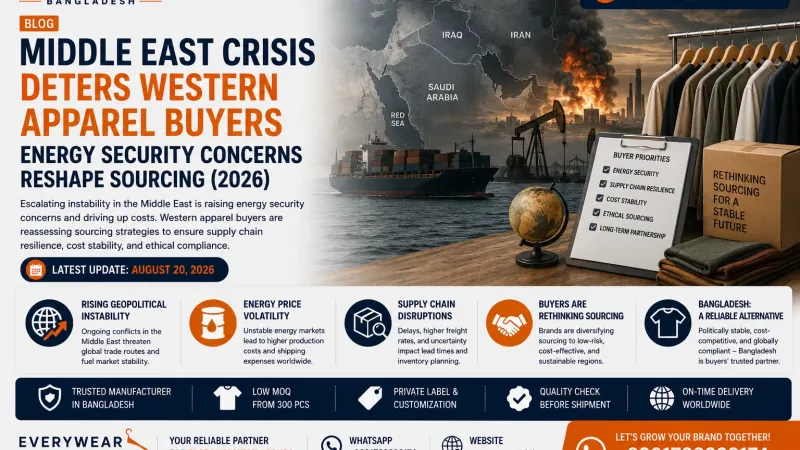
Middle East Crisis Disrupts Bangladesh Garment Sourcing: A 2026 Buyer's Guide
Last updated: August 29, 2026 • [Complete Guide for Fashion Brands, Importers & Sourcing Professionals]
Quick Answer: How Is the Middle East Crisis Affecting Bangladesh Garment Sourcing?
Iran's closure of the Strait of Hormuz since February 28, 2026 has triggered a severe, ongoing energy crisis across Bangladesh's garment industry, and some Western apparel buyers are shifting orders to China, India, and Turkey over concerns about factory reliability. QIMA's Q3 2026 Supply Chain Barometer found that nearshoring and reshoring still account for only 11% of EU and 7% of North American sourcing volumes — so buyers who spent years diversifying away from China are, in many cases, moving orders back to it rather than nearshoring closer to home. As of late August 2026, more than 900 of Bangladesh's roughly 1,800 textile mills remain shut or running far below capacity, with factory utilisation across the sector down to 30–35% against the 80% mills need to stay commercially viable. Buyers who work with sourcing partners that have backup power, factories spread across multiple industrial zones, and transparent production reporting are best positioned to keep orders on schedule.
Status as of August 29, 2026: The Strait of Hormuz remains effectively closed to normal commercial shipping roughly six months after the crisis began — a ceasefire framework reached in mid-June 2026 has not held. Inside Bangladesh, reporting through late August shows gas supply beginning to stabilise in places even as electricity shortages deepen elsewhere, so the situation is genuinely mixed and changing week to week rather than moving in one direction. Treat every figure below as a snapshot, and verify current factory-level status directly with your sourcing partner before placing time-sensitive orders.
For international buyers who spent the past five years diversifying manufacturing away from China, the 2026 Iran war and the resulting closure of the Strait of Hormuz have exposed a blind spot: sourcing was diversified, but energy supply wasn't. Bangladesh, Vietnam, and other "China-plus-one" destinations all lean on the same Gulf shipping lanes for fuel, so when the strait closed, their factories lost power at the same time buyers needed them most.
This guide walks through what's actually happening in Bangladesh's garment sector, why some buyers are pulling back, what the disruption is costing exporters, and — importantly — how buyers can keep sourcing from Bangladesh reliably despite it.
What Is Happening? The Crisis Behind the QIMA Report
On February 28, 2026, the United States and Israel struck Iran, and Iran responded by closing the Strait of Hormuz — the narrow waterway that roughly a fifth of the world's oil, and virtually all of Qatar's LNG exports, pass through. Six months on, the strait remains effectively closed to normal commercial traffic: a ceasefire framework reached in mid-June 2026 has not held, and several major container lines continue to reroute around the Cape of Good Hope rather than risk the Gulf.
The apparel-sourcing fallout from that closure is the subject of QIMA's Q3 2026 Supply Chain Barometer, published July 13, 2026. Its central finding: over the past five years, Western brands diversified where they manufacture — away from China and into Bangladesh, Vietnam, and similar hubs — but not where their factories get their energy from. Bangladesh and Vietnam both depend heavily on imported Middle Eastern fuel, so when that fuel stopped moving, the "alternative to China" turned out to carry the same exposure.
Rather than nearshoring to Europe or North America, QIMA found that many buyers simply redirected orders back to China, whose manufacturing base is comparatively insulated because it runs largely on domestic coal and renewable power.
QIMA Report: Key Findings
| Metric | Finding |
|---|---|
| China's Inspection Share (NA buyers) | Rose to 35% in Q2 2026 — highest since 2024 |
| European Southeast Asia Demand | Swung from +14% growth (April) to -5% contraction (June) |
| European China Demand | Ended the quarter up +10% year-on-year |
| Nearshoring/Reshoring Share (EU) | Just 11% of service volumes in Q2 2026 |
| Nearshoring/Reshoring Share (North America) | Just 7% of service volumes in Q2 2026 |
QIMA's own framing is blunt: Western nearshoring capacity still doesn't have the scale to meaningfully cut dependence on Asia, so when a shock like Hormuz hits, buyers' fastest lever isn't reshoring — it's shifting between Asian suppliers, and increasingly, back toward China as "a stable, reliable sourcing partner during times of global uncertainty."
Why Are Western Buyers Diverting Orders?
Exporters and industry leaders point to several compounding factors.
1. Energy Security Concerns
The dominant driver is fear of prolonged power and gas shortages. Bangladesh Chamber of Industries President Anwar-Ul-Alam Chowdhury has said buyers have warned Bangladesh could face severe electricity shortages within two to three months, quoting them as telling him plainly that the country's power situation was becoming untenable — and that head-office management was discouraging placing large new orders with Bangladesh in the meantime.
The effect shows up directly in order books. Expected export orders have slowed sharply, several large buying houses have sent formal warnings, and securing new work orders has become measurably harder through the middle of 2026.
2. Orders Shifting to India and Other Countries
Bangladeshi garment exporters report that some foreign buyers are actively shifting orders to India and other countries over fears tied to the energy crisis, with industry leaders confirming that a portion of that volume has already started moving.
3. Fuel Shortages and Supply Chain Disruption
Bangladesh's garment industry runs on imported energy, imported raw materials, imported logistics capacity, and foreign consumer demand — and every one of those pillars has come under pressure from the conflict and its shipping disruptions. Global carriers are rerouting vessels, absorbing war-risk insurance premiums, and adjusting schedules, which for Bangladeshi exporters means:
- Higher container freight charges
- Longer transit times
- Shipment delays
- Increased reliance on costly airfreight
- Greater uncertainty in lead-time planning
4. Energy Costs and Inflation
The conflict has pushed up energy costs and fed inflation across Bangladesh's main export markets, softening demand for clothing in Europe, the US, and parts of Asia. LNG prices have nearly doubled since the crisis began, and cargoes have remained hard to secure even after the government relaxed procurement rules and offered higher prices to suppliers.
5. The August 2026 Reality on the Ground
The clearest evidence of how deep this cuts is what's happening in Bangladesh's industrial belts right now. Reporting through the second half of August 2026 shows more than 900 of Bangladesh's roughly 1,800 textile mills shut down or running far below capacity, with several major manufacturers halting production entirely — one of the country's largest conglomerates shut all of its factories after gas and electricity supply collapsed in mid-August. Industry figures say primary textile mills need around 80% capacity utilisation to stay commercially viable; most are currently running at 30–35%. Bangladesh Chamber of Industries leadership has said plainly that textile mills are already losing buyers over delayed deliveries, and that buyer confidence — not just this month's output — is the bigger, slower-to-repair casualty.
The Impact on Bangladesh's RMG Industry
Export Decline
Bangladesh's RMG exports to the United States fell 5.75% year-on-year to $4.01 billion during January–June 2026, according to OTEXA data. Apparel exports to the EU fell to $1.55 billion in January 2026, a sharp 25.25% decline compared with a year earlier. In February 2026, RMG export earnings stood at $2.81 billion — a 13.21% decline from $3.24 billion in February 2025, marking a seventh straight month of negative growth. Exporters have warned that a prolonged US-Israel-Iran conflict would significantly compound the damage to the country's exports.
Cost Increases
| Cost Type | Increase |
|---|---|
| Raw Material Costs | Surged 32% |
| Yarn Costs | Rose 17–18% |
| Freight Costs (Dhaka–Chattogram) | Up ~20%, to Tk 50,000 from Tk 38,000 |
| Regional Shipping Costs | Up over 140% |
| LNG Prices | Nearly doubled |
Production Disruption
Due to insufficient gas and electricity supply, production capacity at many factories has fallen 25–30% from normal levels — and as the August update above shows, some individual factories and mills are running well below even that. Industry leaders describe energy insecurity as no longer a temporary disruption for Bangladesh's RMG sector, but a structural business risk touching factory operations, production continuity, cost competitiveness, and long-term sustainability. Small and mid-sized manufacturers appear especially exposed: one mid-sized garment factory owner in Gazipur described cutting to a single shift just to cover fuel and utility costs after gas supply to his factory tightened.
What This Means for Western Buyers
Challenge 1: Supply Chain Reliability
The crisis has exposed the risk of relying on manufacturing hubs that depend on imported Middle Eastern fuel. Buyers who diversified away from China now find their alternative suppliers exposed to the same upstream energy risk — which is precisely why QIMA concluded that manufacturers had few practical alternatives once factories in Bangladesh, Vietnam, and other Asian economies came under fuel-shortage pressure at the same time.
Challenge 2: Rising Costs
With raw material costs surging, freight costs climbing, and energy prices spiking, FOB prices from Bangladesh are under real upward pressure — while buyers face a market where consumers are unlikely to absorb higher retail prices during a period of broader economic uncertainty.
Challenge 3: Order Delays and Cancellations
Western retailers are expected to cut apparel orders by up to 10% next season, and many international buyers have already postponed or scaled back orders over concerns about on-time delivery.
Challenge 4: Shift in Buyer Behavior
European buyers in particular have begun shifting toward closer, more predictable alternatives — at Texhibition Istanbul in March 2026, European buyers cited near-shore advantage and shipping uncertainty as their main reasons for expanding work with Turkish producers.
Challenge 5: The "China-Plus-One" Dilemma
QIMA's report is direct about this: buyers diversified production away from China without diversifying energy exposure, leaving manufacturing hubs across South and Southeast Asia vulnerable to the same upstream shock. The practical result is that many companies have redirected orders back to China, whose manufacturing base held up comparatively well.
Opportunity: Strategic Sourcing Partnerships
The crisis is severe, but not every supplier is equally exposed. Buyers working with sourcing partners that have the following are meaningfully better positioned to weather it:
- Energy-resilient factory networks — captive power generation, solar installations
- Diversified locations — factories spread across multiple industrial zones
- Alternative fuel capability — the ability to switch to diesel or biomass
- Strong buyer relationships — transparent communication and accountability
How Everywear Bangladesh Helps Buyers Navigate the Crisis
At Everywear Bangladesh, we built our sourcing model around exactly this kind of disruption risk. Here's how we help international buyers protect their supply chains through the current energy crisis:
1. Energy-Resilient Supplier Network
- LEED-Certified Green Factories — 290+ certified facilities that have already invested in energy efficiency
- Factories with Backup Power — captive power generation, solar installations, and diesel alternatives
- Diversified Locations — factories across multiple industrial zones to avoid single-point failure
2. Real-Time Supply Chain Intelligence
We track the energy situation daily and share real-time updates with clients, covering:
- Energy availability by industrial zone
- Factory production status
- Lead-time adjustments
- Alternative sourcing options
3. Alternative Sourcing Solutions
When energy disruptions hit production, we help you:
- Shift production to factories with better energy access
- Explore alternative manufacturing locations within Bangladesh
- Adjust order quantities and timelines to match real production capacity
4. Cost Mitigation
- Transparent pricing — no hidden costs
- Factory-direct sourcing — no intermediary markups
- Volume discounts — competitive pricing on larger orders
- US Cotton Zero-Tariff — save up to 19% on tariffs with US-origin cotton
5. Quality Assurance
Production disruption raises quality risk. Our QC process is built to catch problems before they ship:
- Fabric inspection — before cutting begins
- In-line sewing inspection — throughout production
- Printing and embroidery verification — accurate artwork placement
- Final AQL inspection — comprehensive pre-shipment check
- Video-call inspection — verify your order before it ships
6. Low MOQ from 300 Pieces — Test Before You Scale
With supply chain uncertainty this high, inventory risk matters more than ever. Everywear Bangladesh supports low-MOQ production from 300 pieces per design, so you can:
- Test products before committing to large orders
- Validate demand without a heavy inventory bet
- Manage cash flow more carefully
- Adapt quickly as supply conditions change
7. End-to-End Support — One Accountable Partner
You work with Everywear directly — not a chain of factories or middlemen:
- Dedicated account manager — a single point of contact
- Regular production updates — photos and progress reports
- 24/7 WhatsApp support — for urgent queries
- Transparent pricing — no hidden costs
Contact Everywear Bangladesh on WhatsApp
Frequently Asked Questions
Everything you need to know about the Middle East crisis and its impact on apparel sourcing from Bangladesh.
1. What is happening with Western apparel buyers and Bangladesh?
The Middle East crisis is steering some Western apparel buyers away from Bangladesh over energy security concerns. QIMA's Q3 2026 Supply Chain Barometer found that years of sourcing diversification were undermined once fuel shortages spread across South and Southeast Asia following the closure of the Strait of Hormuz in late February 2026.
2. Why are Western buyers returning to China?
Rather than accelerating nearshoring or reshoring, many buyers simply redirected orders back to China, whose manufacturing sector held up comparatively well because its industrial energy mix leans heavily on domestic coal and renewables. China's share of North American buyers' inspection volumes rose to 35% in Q2 2026 — the highest level since 2024.
3. Are orders actually shifting away from Bangladesh?
Yes. Bangladeshi garment exporters report that some foreign buyers are shifting orders to India and other countries over fears tied to the energy crisis, and Bangladesh Chamber of Industries leadership has confirmed that a portion of that volume has already started moving.
4. How much have Bangladesh's exports declined?
RMG exports to the US fell 5.75% year-on-year to $4.01 billion during January–June 2026 (OTEXA data). Exports to the EU fell to $1.55 billion in January 2026, a 25.25% decline. February 2026 RMG earnings stood at $2.81 billion, down 13.21% year-on-year.
5. What is the QIMA report and why does it matter?
QIMA's Q3 2026 Supply Chain Barometer, published July 13, 2026, draws on the firm's product inspection and factory audit data. It found that the Hormuz fuel crisis exposed a major weakness in the "China-plus-one" sourcing strategy: alternative manufacturing countries remain heavily dependent on the same vulnerable Middle Eastern energy supplies.
6. How is the energy crisis affecting Bangladesh's garment industry?
Due to insufficient gas and electricity supply, production capacity at many factories fell 25–30% earlier in 2026, and by late August, over 900 of Bangladesh's roughly 1,800 textile mills were shut or running far below capacity, with sector-wide utilisation down to 30–35% against the 80% needed to stay commercially viable. Industry leaders describe this as a structural risk to the sector, not a temporary blip.
7. What has happened to shipping and logistics costs?
They've risen sharply. Regional shipping costs are up over 140%, Dhaka–Chattogram freight is up around 20%, and carriers rerouting around the Cape of Good Hope are adding roughly 10–14 days to affected voyages.
8. How are raw material prices affected?
Raw material costs for apparel exporters have surged 32%. Cotton prices have risen, pushing yarn costs up 17–18%, and polyester and other man-made fibres rose roughly 10–15% shortly after the conflict escalated.
9. Is Bangladesh still a reliable sourcing destination?
Bangladesh remains one of the world's largest apparel manufacturing hubs, but this crisis has genuinely exposed vulnerabilities — this isn't a case of buyer overreaction. The practical answer is partner-dependent: buyers working with factories that have backup power, diversified locations, and honest reporting are far better insulated than buyers sourcing from a single, grid-dependent facility. Former BKMEA President Fazlul Hoque has acknowledged that Bangladesh's momentum in attracting production relocating from China has been partially set back by the crisis.
10. What are Western buyers doing?
Retailers are expected to cut apparel orders by up to 10% next season, and many buyers have postponed or scaled back orders over delivery concerns. European buyers in particular have begun shifting toward closer alternatives like Turkey.
11. How are factory owners coping with the crisis?
Unevenly. Some have scaled back to a single shift to cover fuel and utility costs; others, including at least one major conglomerate, shut all of their factories in mid-August 2026 after gas and electricity supply collapsed. Diesel generators are widely used as a backup, but diesel access is itself rationed through BGMEA cards.
12. What is the "China-plus-one" strategy, and why is it struggling here?
"China-plus-one" means diversifying production into a second country — commonly Bangladesh or Vietnam — alongside China. QIMA's report found that while buyers diversified production, they didn't diversify energy exposure: Bangladesh and Vietnam both lean on Middle Eastern fuel imports, so a Hormuz-driven shock hit the "plus-one" almost as hard as it would have hit China.
13. How can Everywear Bangladesh help buyers navigate this crisis?
Everywear Bangladesh offers an energy-resilient supplier network (LEED-certified factories, backup power, diversified locations), real-time supply chain intelligence, alternative sourcing solutions, cost mitigation (transparent pricing, US Cotton Zero-Tariff), rigorous quality assurance, low MOQ from 300 pieces, and end-to-end support through one accountable partner.
14. What should buyers do now?
Five practical steps: (1) talk directly with suppliers about current production status and realistic lead times, (2) build buffer time into inventory planning, (3) diversify across factories in different industrial zones — and ideally countries, (4) work with sourcing partners who have genuine energy resilience, not just a claim of it, and (5) check in on the situation regularly rather than assuming it's static.
15. Has Bangladesh's gas and power crisis improved as of August 2026?
Not clearly, and the picture is mixed. Reporting through late August 2026 shows gas supply beginning to stabilise in some areas even as electricity shortages deepen in others — so factories may see relief on one input while still struggling on another. With 900+ mills still affected and sector utilisation at 30–35%, buyers should treat this as an evolving, week-to-week situation rather than one with a fixed end date.
16. What is the long-term outlook for Bangladesh's RMG industry?
It depends heavily on how the industry addresses its energy vulnerabilities. Analysts, including CPD research director Khondaker Golam Moazzem, argue that dependence on imported LNG isn't sustainable long-term, and recommend diversifying energy sources, expanding fuel storage capacity, and accelerating renewable adoption. Mustafizur Rahman of the Centre for Policy Dialogue has characterised the recent pickup in buyers returning to China as a temporary adjustment rather than a permanent reversal of diversification strategy.
Conclusion
The Middle East crisis is reshaping global apparel sourcing in ways few anticipated six months ago. QIMA's Q3 2026 Supply Chain Barometer names the fundamental weakness plainly: buyers diversified production away from China without diversifying the energy that production depends on.
As a result, some Western buyers are returning to China, whose manufacturing base has proven comparatively resilient, while others are shifting toward India and Turkey. For Bangladesh, this is a genuinely difficult stretch — the industry runs on imported energy, imported raw materials, and imported logistics capacity, all of which are under real pressure from the conflict.
But the crisis also draws a sharp line between suppliers. Manufacturers with energy-efficient operations, captive power generation, diversified locations, and honest, consistent communication are meaningfully better positioned to keep production — and deliveries — on track.
At Everywear Bangladesh, we help buyers work with exactly that kind of supplier: energy-resilient factory networks, real-time intelligence, alternative sourcing options, and end-to-end accountability. If you're reassessing your Bangladesh sourcing strategy right now, we're glad to walk through your specific situation.
Contact Everywear Bangladesh on WhatsApp
About the Author
Written by the Everywear Bangladesh Research & Sourcing Team
The Everywear Bangladesh editorial team combines deep industry expertise in Bangladesh's Ready-Made Garment (RMG) sector with practical experience in international apparel sourcing, supply chain management, and global trade analysis. Our team includes former garment factory managers, sourcing professionals, and trade analysts who have worked with fashion brands across the United States, Europe, and Asia.
Our mission is to provide accurate, data-driven, and actionable content that helps fashion entrepreneurs, retailers, wholesalers, importers, and global brands make informed sourcing decisions. We draw on data from the Bangladesh Garment Manufacturers and Exporters Association (BGMEA), the Export Promotion Bureau (EPB), QIMA, and other named, checkable sources to keep this guide accurate as the situation develops.
Connect with Everywear Bangladesh:
- Website: everywearbd.com
- WhatsApp: +8801788898174
- Facebook: facebook.com/everywearbd
- LinkedIn: Everywear Bangladesh Ltd
References
- New Age, "ME crisis deters potential Western RMG buyers," August 10, 2026
- QIMA, "Q3 2026 Barometer: Hormuz Fuel Crisis Exposes the Limits of Supply Chain Diversification", July 13, 2026
- The Daily Star, "RMG exports brace for a gathering storm," April 17, 2026
- The Daily Star, "Sluggish RMG exports unlikely to rebound in coming months," July 26, 2026
- Bonik Barta, "War-driven global supply shocks push Bangladesh garment makers to seek price rises," April 25, 2026
- bdnews24.com, "'Your country won't have electricity in 2-3 months'," April 22, 2026
- Observer BD, "Buyers shift orders amid energy crisis fears: BCI president," April 23, 2026
- RMG Bangladesh, "Impact of Iran War and Beyond: A New Stress Test for Bangladesh RMG Industry," June 2026
- New Age, "Industry leaders warn energy insecurity threatens Bangladesh RMG competitiveness," May 29, 2026
- Anadolu Agency, "Iran war tightens squeeze on Bangladesh's garment engine," March 27, 2026
- TBS News, "Strangled lifeline: What the Middle East crisis means for Bangladesh's RMG industry," March 13, 2026
- The Financial Express, "Apparel exporters' raw-material costs surge 32pc," March 13, 2026
- New Age, "Apparel exports to major destinations fall in July-Feb," June 4, 2026
- New Age, "Power crunch deepens even as gas crisis begins to ease," August 26, 2026
- The Business Standard, "Over 900 textile mills shut as gas supply shows no sign of improvement," August 2026
- Congressional Research Service, "The Strait of Hormuz: Security Developments and Impacts on Oil, Gas, and Other Commodities," August 2026
Related Resources
GEO Landing Pages
- USA Buyers: Wholesale Garments from Bangladesh
- UK Buyers: Wholesale Garments from Bangladesh
- Europe Buyers: Wholesale Clothing from Bangladesh
- Africa Buyers: Wholesale Garments from Bangladesh
Blog Posts
- Energy Crisis Threatens Bangladesh RMG Competitiveness – What Foreign Buyers Need to Know
- Gas Crisis Shuts 80% of Narsingdi Textile Mills – What Buyers Need to Know
- Bangladesh RMG Exports to US Fall 5.58% – What Buyers Need to Know
- Bangladesh's RMG Exports to EU Plunge 16.43% in H1 2026 – What Buyers Need to Know
- Clothing Suppliers from Bangladesh: The Ultimate Guide 2026
This guide is updated regularly as the situation develops. Last reviewed: August 29, 2026. For sourcing solutions tailored to your brand, contact Everywear Bangladesh on WhatsApp.
Everywear Bangladesh Ltd. – Bangladesh's First RMG Wholesale Marketplace | 300 Pcs Custom Orders | Export Quality Garments
WhatsApp: +8801788898174 • Website: everywearbd.com