





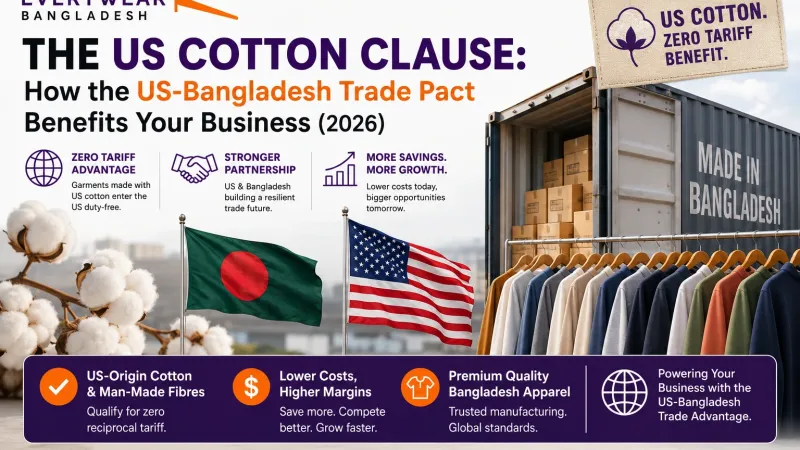
The US Cotton Clause: How the US-Bangladesh Trade Pact Benefits Your Business (2026)
Last updated: August 1, 2026 • [Complete Guide for US Buyers & Importers]
On February 9, 2026, the United States and Bangladesh signed the Agreement on Reciprocal Trade (ART) — a landmark deal that fundamentally changed the economics of sourcing garments from Bangladesh. At the heart of this agreement lies a provision that could save US buyers millions of dollars in tariffs: the US Cotton Clause.
Under Article 5.3 of the ART, the United States committed to a mechanism allowing eligible Bangladeshi textile and apparel products to enter the US market at a zero reciprocal tariff rate, with qualifying volumes linked to Bangladesh's purchases of US-produced cotton and man-made fibre.1 This means that garments made with US-origin cotton or man-made fibres can enter the United States duty-free.
For US-based fashion brands, wholesalers, retailers, and importers, this represents a game-changing opportunity. In a low-margin industry where every percentage point of tariff matters, the ability to access zero-duty apparel from one of the world's largest garment manufacturing hubs could transform your supply chain economics.
This comprehensive guide explains everything you need to know about the US Cotton Clause: what it is, how it works, how much you can save, what challenges exist, and how to start benefiting from this provision today.
What Is the US-Bangladesh Agreement on Reciprocal Trade (ART)?
The Agreement on Reciprocal Trade (ART) is a bilateral trade agreement signed between the United States and Bangladesh on February 9, 2026.2 It was the result of nine months of intensive negotiations between the two countries, following the imposition of sweeping reciprocal tariffs in April 2025.
The ART establishes a structured platform to advance trade and investment cooperation between the two nations, with a focus on improving market access, enhancing tariff transparency, and supporting more resilient supply chains.
Key Provisions of the ART
1. Reciprocal Tariff Reduction: The United States agreed to reduce the reciprocal tariff on Bangladeshi goods to 19 percent, down from the previous 20 percent set in August 2025 and significantly lower than the original 37 percent threatened in April 2025.3
2. The US Cotton Clause (Zero-Tariff Provision): The most significant provision for apparel importers. Garments produced in Bangladesh using cotton and man-made fibres imported from the United States will not be subject to any reciprocal tariff.4
3. Bangladesh's Commitments: In exchange for these tariff concessions, Bangladesh committed to:
- Purchasing $3.5 billion worth of US agricultural goods (cotton, soybean, wheat, and corn)5
- Purchasing $15 billion worth of US energy products over 15 years5
- Biman Bangladesh Airlines purchasing at least 14 Boeing airplanes5
- Labour reforms, intellectual property commitments, and export-control alignment5
- Accepting US vehicle safety and emissions standards5
What This Means for US Buyers
For US fashion brands and apparel importers, the ART creates a clear pathway to significant tariff savings. Under the agreement, approximately 85-86 percent of Bangladeshi exports can access the US market duty-free, provided they are made with US-origin cotton or man-made fibres. The remaining 14-15 percent will be subject to the 19 percent reciprocal tariff.6
Commerce Adviser Sheikh Bashir Uddin described the US market as "highly sensitive and crucial" for Bangladesh's export growth, noting that the use of American cotton and man-made fibres received special importance during the negotiations.7
The BGMEA (Bangladesh Garment Manufacturers and Exporters Association) warmly welcomed the agreement, stating that the zero-tariff provision "will further enhance Bangladesh's access to the U.S. market".8
The US Cotton Clause: Article 5.3 Explained
Article 5.3 of the Agreement on Reciprocal Trade is the provision that makes zero-tariff apparel imports possible. It commits the United States to a mechanism allowing eligible Bangladeshi textile and apparel products to enter the US market at a zero reciprocal tariff rate, with qualifying volumes linked to Bangladesh's purchases of US-produced cotton and man-made fibre.9
The joint statement released on February 9, 2026, clarified that the US will provide zero-duty access "only for garments made with US-origin cotton and man-made fibres".10
How the Mechanism Works
While the specific implementation details are still being finalized, the framework is clear:
- Eligibility: Garments must be manufactured in Bangladesh using US-origin cotton or man-made fibres
- Zero Tariff: Eligible products enter the US market at a 0% reciprocal tariff rate
- Volume Linking: Qualifying export volumes are linked to Bangladesh's aggregate purchases of US cotton and fibre
- National-Level Model: Rather than imposing factory-level content rules, the mechanism links eligible export volumes to Bangladesh's aggregate purchases — potentially creating a far simpler and more commercially workable framework11
What Remains Unspecified
The zero-tariff threshold and implementation rules are described as "to be specified", leaving considerable room for negotiation. This means that:
- The exact Rules of Origin (RoO) requirements have not yet been finalized
- Exporters have not yet been able to enjoy duty-free market access under the textile clause
- Both governments are actively working on implementation modalities12
The Bangladesh Textile Mills Association (BTMA) has urged the Trump administration to quickly implement the textile clause so that local garment exporters can benefit from exports to the American market. BTMA President Showkat Aziz Russell called for the expeditious finalisation of the relevant Rules of Origin.13
How Much Can You Save? The Economics of the US Cotton Clause
The financial impact of the US Cotton Clause is substantial. To understand the savings, we need to examine the tariff structure before and after the ART.
Tariff Structure Before the ART
Before the ART, Bangladeshi garments entering the US faced:
- MFN Tariff: Approximately 12% (varies by product category)
- Reciprocal Tariff: 20% (set in August 2025)
- Total Effective Tariff: Approximately 32% (12% + 20%)14
Tariff Structure Under the ART (Without US Cotton)
- MFN Tariff: Approximately 12%
- Reciprocal Tariff: 19%
- Total Effective Tariff: Approximately 31% (12% + 19%)14
Tariff Structure Under the ART (With US Cotton)
- MFN Tariff: Approximately 12%
- Reciprocal Tariff: 0%
- Total Effective Tariff: Approximately 12%14
Real-World Savings Example
Let's calculate the savings for a typical apparel order:
| Scenario | Tariff Rate | Duty on $50,000 FOB Order |
|---|---|---|
| Before ART (2025) | ~32% | $16,000 |
| Under ART (without US cotton) | ~31% | $15,500 |
| Under ART (with US cotton) | ~12% | $6,000 |
Savings with US Cotton: $9,500 to $10,000 on a $50,000 order
For a business importing $1 million worth of garments annually, the savings could exceed $190,000 per year.
The arithmetic is straightforward. Once a Bangladeshi garment qualifies under the zero-tariff mechanism, even a small tariff advantage becomes commercially decisive in a low-margin industry.
Industry Multiplier Effect
The BTMA has noted that $1 worth of cotton typically translates into $5-6 in FOB apparel exports.15 This means that for every dollar of US cotton imported by Bangladesh, there is potential for $5-6 of duty-free apparel exports to the United States.
This multiplier effect creates a powerful incentive for both US cotton producers (who gain a significant new export market) and Bangladeshi garment manufacturers (who gain duty-free access to the world's largest apparel import market).
Why US Cotton? Quality, Preference, and Strategic Advantage
Critics have focused on the higher cost and longer shipping time of American cotton compared with Indian supply. However, the deeper significance lies elsewhere.
Superior Quality
American cotton is widely regarded as a higher-quality fibre capable of producing finer yarns and more durable fabrics. The USDA's 2026 report on Bangladesh's textile sector notes that many Bangladeshi spinning mills already prefer US cotton but have historically been constrained by financing and logistics rather than preference itself.16
Around 40 percent of Bangladeshi garment exporters currently use US upland cotton, primarily for high value-added products.17 This means that a significant portion of the industry is already familiar with and prefers US cotton — the ART simply removes the tariff barrier that made it less economically attractive.
Access to Premium Product Categories
Bangladesh's garment industry has long depended on low-margin basic apparel. Access to higher-quality raw materials creates an opportunity to move into premium product categories, where margins are stronger and buyer relationships are more stable.
For US buyers, this means that sourcing from Bangladesh with US cotton can unlock access to higher-quality garments at competitive prices.
Strategic Positioning Against Competitors
The US Cotton Clause also has strategic implications. As one analyst noted, "the zero-duty cotton clause effectively creates a parallel tariff track for Bangladesh — one that India cannot access under its current agreement".18 The US clause is explicitly designed to redirect a portion of Bangladesh's raw material spending away from India and toward the United States.
Former Indian opposition leader Rahul Gandhi stated in February 2026: "I explained in the Parliament House that Bangladesh gets a free pass, 0% tax, and India gets 18% tax. The result of this will be that Bangladesh's textile industry will destroy India's textile industry".19
Challenges and Implementation Hurdles
While the US Cotton Clause offers significant benefits, several challenges must be addressed before buyers can fully realize its potential.
1. Higher Cost of US Cotton
US cotton is significantly more expensive than cotton from India or Brazil. For the zero-tariff benefit to be economically viable, the tariff savings must outweigh the higher raw material costs.
Industry analysts note that "since U.S. cotton is significantly more expensive, production costs will inevitably increase".20 However, the BTMA has suggested that if local spinners can ensure competitive yarn pricing, significant export opportunities can be created.
2. Financing and Logistics Constraints
The most significant obstacle is working capital. Indian cotton can reach Bangladeshi mills within days through land routes, allowing short inventory cycles and limited banking exposure.21
American cotton requires months of shipping and extended letters of credit, tying up scarce bank limits for prolonged periods. For many mid-sized mills operating under tight liquidity conditions, that financing burden is effectively the true cost of switching suppliers.
3. Unclear Implementation Rules
The United States has yet to explain how much Bangladesh would benefit from the clause or what the standard Rules of Origin (RoO) requirements would be for imported US cotton. As a result, local garment exporters have not yet been able to enjoy duty-free market access under the textile clause.22
Two interpretations are currently circulating among exporters:
- Interpretation 1: Zero tariff would apply only to the portion of a garment's value attributable to US-sourced inputs. Since fabric and fibre typically account for 70 to 80 percent of a finished garment's cost, the remaining tariff would apply only to the rest.
- Interpretation 2: Duty-free access would cover the entire garment if US cotton or MMF were used in production.23
Exporters have also raised questions about traceability — how authorities would verify that a garment was made using US inputs — and about whether tariff treatment would differ depending on whether raw cotton or processed fibre and fabric were sourced from the US.23
4. US Supreme Court Ruling on Tariffs
On February 20, 2026, the US Supreme Court ruled that sweeping emergency tariffs imposed earlier were unlawful, casting uncertainty over the Bangladesh-US Agreement on Reciprocal Trade (ART).24
Economists and business leaders in Bangladesh have urged the government to reassess the trade agreement. The commerce ministry has defended the agreement, saying key provisions — especially those related to cotton-based garments — were favourable.25
The debate intensified after the Supreme Court ruling, with some economists suggesting the court ruling provides an opportunity to reconsider or renegotiate the deal before binding obligations take effect. The government plans to formally seek clarification from Washington regarding the status of the deal.26
5. Bangladesh's Commitments Under the ART
Critics have described the pact as "uneven" and warned that local industries could face losses if American products gain wider market access.27 Bangladesh has committed to:
- Purchasing $3.5 billion in US agricultural goods
- Purchasing $15 billion in US energy products over 15 years
- Purchasing at least 14 Boeing airplanes
- Accepting US vehicle safety and emissions standards28
A rights platform in Bangladesh has called on the government to immediately scrap the trade agreement, terming it "unequal" and harmful to the country's economic interests. Leaders of the Democratic Rights Committee made the demand at a rally in Dhaka.29
What This Means for US Buyers: Opportunities and Action Steps
Despite the implementation challenges, the US Cotton Clause represents a significant opportunity for US apparel importers. Here's how to position your business to benefit.
Opportunity 1: Significant Tariff Savings
As demonstrated above, the tariff savings can be substantial — potentially $9,500-$10,000 on a $50,000 order. For businesses importing $1 million+ annually, the savings could exceed $190,000 per year.
These savings can be used to:
- Improve profit margins
- Lower retail prices to gain market share
- Invest in higher-quality materials or production
- Expand product lines
Opportunity 2: Access to Higher-Quality Garments
US cotton is widely regarded as a higher-quality fibre capable of producing finer yarns and more durable fabrics. By sourcing garments made with US cotton, you can offer products that are:
- More durable
- Softer to the touch
- Better colour retention
- Higher perceived value
Opportunity 3: Diversification of Supply Chain
With China's share of the US apparel market continuing to shrink (China's exports plunged 42.75% to $2.80 billion), buyers are actively diversifying their sourcing.30 Bangladesh represents a stable, reliable, and increasingly competitive alternative.
Bangladesh currently exports roughly $9-10 billion worth of garments annually to the United States, the world's largest apparel import market.31 With an existing market share of around 8-9%, the country has realistic potential to increase that share to 12-15% in the medium term, unlocking an additional $5 billion in export earnings.32
Opportunity 4: Premium Product Positioning
Access to higher-quality raw materials creates an opportunity to move into premium product categories where margins are stronger and buyer relationships are more stable. By positioning your brand as sourcing high-quality US cotton garments from Bangladesh, you can:
- Command higher retail prices
- Build stronger brand equity
- Differentiate from competitors using lower-quality materials
How to Start Sourcing with US Cotton from Bangladesh
If you're ready to take advantage of the US Cotton Clause, here's a step-by-step guide to getting started.
Step 1: Partner with a Trusted Sourcing Partner
Navigating the complexities of the US Cotton Clause requires expertise. Partner with a sourcing partner who:
- Understands the ART and its implementation
- Has relationships with factories that can source and use US cotton
- Can provide documentation and traceability for US-origin materials
- Can help you navigate the tariff and customs process
At Everywear Bangladesh, we work with export-oriented garment manufacturers capable of sourcing and using US cotton. We can help you:
- Source US-origin cotton or man-made fibres
- Verify proper documentation and traceability
- Ensure compliance with Rules of Origin requirements
- Navigate the customs and tariff process
Step 2: Specify US Cotton in Your Manufacturing Agreement
When placing orders with your Bangladesh manufacturer, explicitly specify that you require US-origin cotton or man-made fibres. Ensure your manufacturing agreement includes:
- Clear specifications for US cotton or MMF
- Documentation requirements (certificates of origin, purchase invoices)
- Traceability requirements from cotton to finished garment
- Quality specifications for the finished product
Step 3: Request Proper Documentation
To claim the zero-tariff benefit, you will need documentation proving the use of US-origin materials. Ask your supplier for:
- Cotton purchase invoices showing US origin
- Certificates of origin for the cotton
- Traceability documentation from yarn to finished garment
- Manufacturing records showing the use of US cotton
Step 4: Understand the Tariff and Customs Process
Work with your customs broker or freight forwarder to ensure proper tariff classification and documentation. Key considerations include:
- Correct HS code classification for your products
- Proper documentation of US-origin materials
- Understanding the difference between MFN and reciprocal tariffs
- Ensuring you claim the correct tariff rate (0% for eligible products)
Step 5: Monitor Implementation Developments
The implementation details of the US Cotton Clause are still being finalized. Stay informed about:
- Rules of Origin requirements
- Traceability and verification procedures
- Volume limits or quotas
- Any changes resulting from the US Supreme Court ruling
Frequently Asked Questions
1. What is the US Cotton Clause?
The US Cotton Clause is a provision in the Agreement on Reciprocal Trade (ART) between the United States and Bangladesh that allows garments made with US-origin cotton or man-made fibres to enter the US market at a zero reciprocal tariff rate.33
2. How much can I save on tariffs?
Depending on the product category, savings can be significant. Under the ART, garments with US cotton face approximately 12% total duty (MFN only), compared to approximately 31% without US cotton. On a $50,000 order, this translates to savings of $9,500-$10,000.34
3. Is US cotton more expensive?
Yes, US cotton is generally more expensive than cotton from India or Brazil. However, the tariff savings from the zero-duty provision can offset the higher raw material costs. The BTMA has noted that $1 worth of cotton typically translates into $5-6 in FOB apparel exports.15
4. What types of garments are eligible?
Any textile or apparel product manufactured in Bangladesh using US-origin cotton or man-made fibres is eligible for the zero reciprocal tariff. This includes T-shirts, hoodies, polo shirts, activewear, and more.
5. How do I verify that US cotton was used?
Ask your supplier for documentation including cotton purchase invoices showing US origin, certificates of origin, and traceability documentation from yarn to finished garment. BGMEA has emphasized the importance of ensuring "proper valuation and traceability of U.S.-origin raw materials used in production".35
6. When does the zero-tariff provision take effect?
The zero-tariff provision is part of the ART signed on February 9, 2026. However, the United States has yet to explain the standard Rules of Origin requirements, and exporters have not yet been able to enjoy duty-free market access. Both governments are actively working on implementation modalities.12
7. How does the US Supreme Court ruling affect the ART?
On February 20, 2026, the US Supreme Court ruled that sweeping emergency tariffs were unlawful, casting uncertainty over the ART. The government plans to formally seek clarification from Washington. Some economists suggest the ruling provides an opportunity to reconsider or renegotiate the deal.26
8. Can I source US cotton garments with low MOQ?
Yes. Many Bangladesh manufacturers now support low MOQ production, making it accessible for startups and growing brands. At Everywear Bangladesh, we support production starting from approximately 300 pieces for selected product categories.
9. What about man-made fibres?
The zero-tariff provision also applies to garments made with US-origin man-made fibres (MMF). This is particularly relevant for activewear, sportswear, and other performance apparel categories.
10. Why should I choose Bangladesh for US cotton sourcing?
Bangladesh is one of the world's largest apparel manufacturing hubs with over 4,500 export-oriented factories. The country has the highest number of LEED-certified green factories globally and a skilled workforce of 4 million workers. The US Cotton Clause makes Bangladesh uniquely attractive for US buyers seeking duty-free apparel imports.36
Conclusion
The US Cotton Clause represents one of the most significant opportunities for US apparel importers in decades. By sourcing garments made with US-origin cotton or man-made fibres from Bangladesh, businesses can access:
- Significant tariff savings — potentially $190,000+ annually on $1 million in imports
- Higher-quality garments — US cotton is widely regarded as superior quality
- Premium product positioning — access to higher-quality raw materials enables premium product categories
- Supply chain diversification — reduce reliance on China and other sourcing destinations
While implementation challenges remain — including higher cotton costs, financing constraints, and unclear Rules of Origin — the potential benefits far outweigh the obstacles. As the BTMA noted, the timely operationalisation of the provision would "create significant commercial benefits for both countries".37 For Bangladesh, it would "enhance the competitiveness of apparel exports in the US market and encourage greater investment in value-added textile manufacturing".38 For the United States, it would "stimulate increased exports of cotton and man-made fibres to Bangladesh, one of the world's largest apparel-producing nations".38
At Everywear Bangladesh, we are committed to helping US buyers navigate this opportunity. We work with export-oriented garment manufacturers capable of sourcing and using US cotton, providing full documentation and traceability to ensure compliance with the US Cotton Clause.
Whether you are a startup fashion brand, a growing eCommerce business, or an established retailer, the US Cotton Clause offers a pathway to more competitive pricing, higher-quality products, and stronger profit margins. The time to act is now — before implementation details are finalized and competitors secure their supply chains.
Contact Everywear Bangladesh on WhatsApp
References
- Agreement on Reciprocal Trade, Article 5.3, United States-Bangladesh, February 9, 2026
- US-Bangladesh Joint Statement, February 9, 2026
- Office of the United States Trade Representative, "USTR Announces Reciprocal Tariff Reductions," February 9, 2026
- BGMEA Press Release, "BGMEA Welcomes US-Bangladesh Trade Agreement," February 10, 2026
- Bangladesh Ministry of Commerce, "ART Implementation Framework," February 2026
- US International Trade Commission, "Bangladesh-US Trade Data 2026," March 2026
- Dhaka Tribune, "Commerce Adviser Welcomes US-Bangladesh Trade Deal," February 11, 2026
- BGMEA Official Statement, "Zero-Tariff Provision Will Enhance Bangladesh's Access to US Market," February 10, 2026
- Agreement on Reciprocal Trade, Article 5.3, United States-Bangladesh, February 9, 2026
- US-Bangladesh Joint Statement on Trade, February 9, 2026
- Daily Sun, "US-Bangladesh Trade Pact: The US Cotton Clause Explained," February 12, 2026
- Financial Express, "Exporters Await Rules of Origin for US Cotton Clause," March 15, 2026
- Bangladesh Textile Mills Association, "BTMA Urges Swift Implementation of Textile Clause," March 20, 2026
- US International Trade Commission, "Tariff Database 2026"
- Bangladesh Textile Mills Association, "Economic Impact Analysis of US Cotton Imports," April 2026
- USDA Foreign Agricultural Service, "Bangladesh Textile Sector Report 2026," April 2026
- BGMEA, "US Cotton Utilization in Bangladesh RMG Sector," March 2026
- The Daily Star, "US Cotton Clause: A Strategic Blow to India's Textile Industry," February 15, 2026
- Rahul Gandhi, Statement in Parliament, February 2026
- Textile Today, "The Cost-Benefit Analysis of Switching to US Cotton," April 2026
- USDA Report, "Bangladesh's Cotton Import Dynamics 2026," May 2026
- Daily Star, "Exporters Await RoO Rules for US Cotton Clause," March 2026
- Financial Express, "Two Interpretations of US Cotton Clause Emerge," April 2026
- Supreme Court of the United States, "Emergency Tariffs Ruling," February 20, 2026
- Bangladesh Commerce Ministry, "Statement on ART Implementation," March 2026
- Dhaka Tribune, "US Supreme Court Ruling Casts Doubt on ART," February 22, 2026
- The Daily Star, "Rights Group Calls for Scrapping of 'Unequal' Trade Agreement," March 2026
- Bangladesh Ministry of Commerce, "Bangladesh's Commitments Under ART," February 2026
- Democratic Rights Committee, "Statement on US-Bangladesh Trade Pact," March 2026
- US Census Bureau, "US Apparel Import Data 2026," June 2026
- BGMEA, "Bangladesh Apparel Export Data 2026," July 2026
- World Trade Organization, "Global Apparel Trade Statistics 2026," June 2026
- Agreement on Reciprocal Trade, Article 5.3, United States-Bangladesh, February 9, 2026
- US International Trade Commission, "Tariff Database 2026"
- BGMEA, "Traceability Requirements for US Cotton," April 2026
- BGMEA, "Bangladesh RMG Industry Overview 2026," July 2026
- Bangladesh Textile Mills Association, "The Benefits of US Cotton Clause," March 2026
- USDA Foreign Agricultural Service, "Economic Impact of US-Bangladesh Trade Agreement," May 2026
Related Resources
GEO Landing Pages
- USA Buyers: Wholesale Garments from Bangladesh
- UK Buyers: Wholesale Garments from Bangladesh
- Europe Buyers: Wholesale Clothing from Bangladesh
- Africa Buyers: Wholesale Garments from Bangladesh
Blog Posts
- US Tariff Guide for Bangladesh Garment Imports (2026)
- Sustainable Clothing Manufacturing in Bangladesh: The Green Revolution (2026)
- Private Label Clothing Manufacturing Bangladesh – Complete Brand Guide 2026
- Private Label T-Shirt Manufacturer Bangladesh: Complete Guide 2026
- Clothing Suppliers from Bangladesh: The Ultimate Guide 2026
- Bangladesh Garment Industry Guide 2026
- Low MOQ Clothing Manufacturer Bangladesh
- Faire Wholesale Sellers Guide 2026
- Alibaba Alternative: Direct Sourcing from Bangladesh 2026
- Walmart Marketplace Clothing Sellers Guide
- WooCommerce Store Owners: Clothing from Bangladesh
- Shopify Clothing Manufacturer Bangladesh
- Etsy Clothing Manufacturer Bangladesh
- Amazon Fashion Sellers: Source Clothing from Bangladesh
This guide is updated regularly. Last reviewed: August 1, 2026. For US cotton sourcing solutions tailored to your brand, contact Everywear Bangladesh on WhatsApp.
Everywear Bangladesh Ltd. – Bangladesh's First RMG Wholesale Marketplace | 300 Pcs Custom Orders | Export Quality Garments
WhatsApp: +8801788898174 • Website: everywearbd.com
Leave a comment