





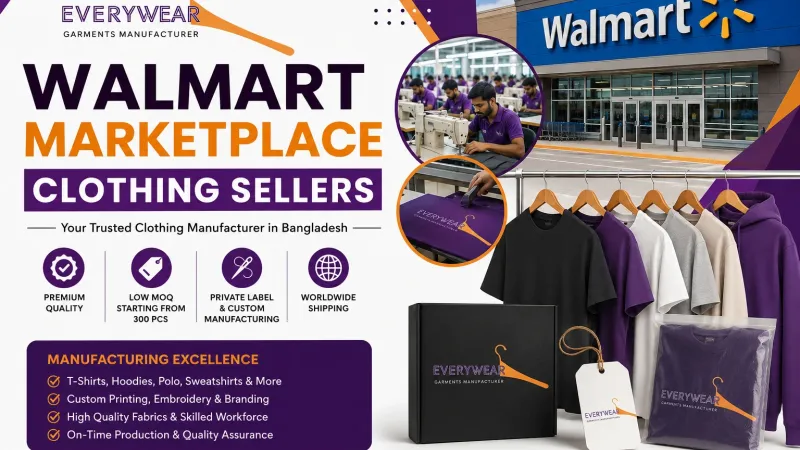
Walmart Marketplace Clothing Sellers: Complete Guide to Finding the Best Clothing Manufacturer in Bangladesh (2026)
Last Updated: 23 July 2026
Author: Everywear Bangladesh Editorial Team
Why More Walmart Marketplace Sellers Are Sourcing Clothing from Bangladesh
The global eCommerce landscape continues to evolve, and Walmart Marketplace has rapidly become one of the fastest-growing online selling platforms for apparel businesses. Thousands of entrepreneurs, private label brands, wholesalers, and established retailers are expanding their businesses by selling clothing through Walmart Marketplace because of its growing customer base, lower competition than some other marketplaces, and increasing trust among consumers.
However, success on Walmart Marketplace depends on more than simply listing products. The quality of your garments, manufacturing consistency, pricing strategy, and supply chain efficiency directly influence customer reviews, repeat purchases, and long-term profitability.
This is why many successful Walmart Marketplace clothing sellers are choosing Bangladesh as their preferred sourcing destination.
Bangladesh has become one of the world's leading apparel manufacturing countries, supplying garments to internationally recognized fashion retailers, department stores, supermarkets, sportswear brands, and private label businesses. The country's Ready-Made Garment (RMG) industry combines skilled craftsmanship, competitive manufacturing costs, advanced production facilities, and decades of export experience.
Whether you are launching a new clothing brand or expanding an existing Walmart Marketplace business, partnering with an experienced clothing manufacturer in Bangladesh provides several advantages:
- Competitive factory pricing
- Premium-quality garment production
- Low Minimum Order Quantity (MOQ) options
- Private label manufacturing
- OEM and custom apparel production
- Advanced printing and embroidery services
- Reliable export documentation
- Worldwide shipping support
- Sustainable manufacturing capabilities
Instead of relying on trading companies with limited production control, many Walmart sellers now work directly with manufacturers to gain better pricing, improved quality assurance, and greater flexibility during product development.
This guide explains everything you need to know about sourcing clothing from Bangladesh for Walmart Marketplace and how choosing the right manufacturing partner can help grow your apparel business.
Understanding Walmart Marketplace Clothing Requirements
Selling clothing on Walmart Marketplace involves more than uploading attractive product photos. Walmart emphasizes customer satisfaction, product consistency, fast fulfillment, and accurate product information. Sellers who fail to meet these expectations often struggle with poor reviews, returns, and reduced marketplace visibility.
A reliable clothing manufacturer plays a critical role in meeting these standards.
Before production begins, sellers should understand the key factors that influence success on Walmart Marketplace.
Consistent Product Quality
Customers expect garments to match the images and descriptions displayed online. Inconsistent stitching, incorrect sizing, poor fabric quality, or defective printing can quickly damage seller ratings.
Experienced manufacturers implement strict quality control processes throughout production, ensuring each garment meets predefined specifications.
Accurate Size Consistency
One of the biggest reasons for clothing returns is inconsistent sizing.
Professional manufacturers develop standardized size charts using accurate grading techniques to ensure every production batch maintains consistent measurements across all sizes.
Durable Fabric Selection
Product durability significantly impacts customer satisfaction.
High-quality manufacturers recommend suitable fabrics based on the intended product category, including:
- 100% Cotton
- Organic Cotton
- Cotton-Spandex Blends
- French Terry
- Fleece
- Interlock Knit
- Single Jersey
- Rib Knit
- Polyester Performance Fabric
Selecting the appropriate fabric improves customer reviews while reducing return rates.
Professional Branding
Private label branding allows sellers to build long-term brand recognition.
Manufacturing services typically include:
- Woven Labels
- Printed Neck Labels
- Hang Tags
- Custom Packaging
- Poly Bags
- Barcode Labels
- Care Labels
Professional branding helps distinguish products from generic marketplace listings.
Production Reliability
Inventory shortages can negatively affect Walmart Marketplace performance.
Experienced manufacturers maintain organized production schedules, enabling sellers to restock inventory consistently and reduce stockout risks.
Why Bangladesh Is the Best Manufacturing Destination for Walmart Marketplace Sellers
Bangladesh has earned its reputation as one of the largest apparel exporting countries through decades of investment, workforce development, and manufacturing expertise. Today, the country supplies garments to internationally recognized retailers, fashion brands, supermarkets, and online marketplaces.
For Walmart Marketplace sellers, Bangladesh offers a unique combination of affordability, scalability, and manufacturing excellence.
Competitive Manufacturing Costs
Factory-direct sourcing enables sellers to reduce production costs while maintaining quality standards.
Lower production costs improve profit margins and create more flexibility for advertising, promotions, and marketplace pricing strategies.
Highly Skilled Workforce
Bangladesh employs millions of experienced garment professionals specializing in:
- Pattern Making
- Sample Development
- Fabric Cutting
- Sewing
- Screen Printing
- Embroidery
- Washing
- Finishing
- Quality Inspection
- Packaging
This skilled workforce enables manufacturers to produce everything from basic apparel to premium fashion collections.
Complete Textile Supply Chain
Bangladesh benefits from an integrated textile ecosystem, allowing manufacturers to source fabrics, trims, accessories, and packaging materials locally for many product categories.
This integrated supply chain contributes to shorter lead times and more efficient production planning.
Global Export Experience
Manufacturers in Bangladesh routinely export apparel to:
- United States
- Canada
- United Kingdom
- Germany
- France
- Italy
- Spain
- Netherlands
- Australia
- Middle East
- Africa
Their familiarity with international shipping documentation, customs procedures, and buyer requirements simplifies the export process for global customers.
Increasing Focus on Sustainability
Many Bangladeshi factories continue investing in environmentally responsible manufacturing practices, including:
- Water-saving dyeing technologies
- Solar energy integration
- Waste reduction programs
- Energy-efficient machinery
- Sustainable fabric sourcing
- International compliance certifications
As consumers increasingly value responsible production, these initiatives create additional value for Walmart Marketplace brands.
How Everywear Bangladesh Helps Walmart Marketplace Sellers Scale Faster
Launching a successful clothing business on Walmart Marketplace requires more than simply finding a factory. Sellers need a manufacturing partner capable of supporting product development, maintaining quality standards, and adapting to changing market demands.
Everywear Bangladesh provides end-to-end apparel manufacturing solutions designed specifically for growing fashion businesses.
Our services include:
- Private Label Clothing Manufacturing
- OEM Apparel Production
- Custom Clothing Manufacturing
- Blank Apparel Manufacturing
- Oversized Streetwear Manufacturing
- Hoodie Manufacturing
- Sweatshirt Manufacturing
- Polo Shirt Manufacturing
- Sportswear Manufacturing
- Uniform Production
We also support brands with:
- Fabric sourcing
- Product development
- Sample creation
- Pattern making
- Size grading
- Screen printing
- Puff printing
- High-density printing
- Silicone printing
- Embroidery
- Washing
- Quality assurance
- Packaging
- Worldwide export documentation
Unlike many suppliers that require extremely high production volumes, Everywear Bangladesh offers low MOQ options starting from 300 pieces on selected products, making it easier for Walmart Marketplace sellers to test new designs before scaling production.
Our experienced production team works closely with buyers throughout the manufacturing process, ensuring clear communication, reliable timelines, and consistent product quality.
Whether you operate a startup clothing brand or manage a growing multi-channel apparel business, Everywear Bangladesh provides flexible manufacturing solutions tailored to your business goals.
Clothing Products You Can Manufacture for Walmart Marketplace
One of the biggest advantages of sourcing from Bangladesh is the ability to manufacture a wide variety of apparel products under one production network. This allows Walmart Marketplace sellers to expand their product catalog while maintaining consistent quality and branding.
Popular product categories include:
Basic Apparel
- Crew Neck T-Shirts
- V-Neck T-Shirts
- Blank T-Shirts
- Long Sleeve T-Shirts
- Tank Tops
- Polo Shirts
Streetwear
- Oversized T-Shirts
- Heavyweight Cotton T-Shirts
- Graphic Tees
- Boxy Fit T-Shirts
- Oversized Hoodies
- Sweatshirts
- Joggers
- Cargo Pants
Activewear
- Gym T-Shirts
- Compression Wear
- Running Shorts
- Performance Hoodies
- Sports Jerseys
- Training Apparel
Casual Fashion
- Fashion Hoodies
- Zip Hoodies
- Crewneck Sweatshirts
- Shorts
- Lounge Sets
- Tracksuits
Children's Apparel
- Kids T-Shirts
- School Uniforms
- Babywear
- Family Matching Sets
Corporate & Promotional Apparel
- Staff Uniforms
- Event T-Shirts
- Company Polo Shirts
- Promotional Clothing
- Hospitality Uniforms
- Retail Uniforms
With private label manufacturing, sellers can customize fabrics, colors, sizing, trims, labels, packaging, and branding to create unique products that stand out on Walmart Marketplace instead of competing solely on price.
Choosing the Right Clothing Manufacturer for Walmart Marketplace
Finding a clothing manufacturer is easy. Finding the right manufacturing partner that can consistently deliver quality, maintain deadlines, support your brand growth, and understand Walmart Marketplace standards is much more challenging.
Many new Walmart Marketplace sellers make the mistake of selecting suppliers based solely on the lowest quotation. While low pricing may seem attractive, poor quality, delayed production, inconsistent sizing, and communication problems often lead to negative customer reviews, increased return rates, and lost sales.
Instead of focusing only on cost, evaluate manufacturers based on long-term value and production capabilities.
Look for Industry Experience
Experience matters in garment manufacturing.
Manufacturers that have worked with international buyers understand global quality expectations, technical specifications, packaging requirements, and export documentation.
Ask questions such as:
- How many years have you been exporting garments?
- Which countries do you currently supply?
- What clothing categories do you specialize in?
- Have you worked with private label brands before?
Factories with proven export experience usually have stronger production planning and better quality management systems.
Evaluate Product Specialization
Every factory has strengths.
Some specialize in knitwear, while others focus on woven garments, sportswear, or fashion apparel.
If your Walmart Marketplace business focuses on oversized streetwear, working with a manufacturer experienced in heavyweight cotton garments will generally produce better results than choosing a factory that mainly manufactures uniforms.
Popular manufacturing categories include:
- Heavyweight T-Shirts
- Oversized Streetwear
- Blank Apparel
- Hoodies
- Sweatshirts
- Sportswear
- Polo Shirts
- Activewear
- Corporate Uniforms
- Kids Apparel
Selecting a manufacturer that specializes in your product category improves consistency and production efficiency.
Review Quality Control Procedures
Quality control should never be an afterthought.
Professional manufacturers perform inspections throughout the production process instead of waiting until garments are finished.
Typical quality checkpoints include:
- Fabric inspection
- Pattern verification
- Cutting inspection
- Inline sewing inspection
- Printing inspection
- Embroidery inspection
- Final garment measurement
- Needle detection (where applicable)
- Packaging inspection
- Final shipment audit
These inspections help reduce defects and ensure every shipment meets buyer expectations.
Understand Minimum Order Quantity (MOQ)
MOQ is one of the biggest concerns for Walmart Marketplace startups.
Some factories require thousands of pieces per design, which may not be practical for smaller brands.
Choosing a manufacturer that offers flexible MOQ options allows you to:
- Test new collections
- Launch seasonal products
- Introduce multiple colors
- Reduce inventory investment
- Validate customer demand before scaling
Everywear Bangladesh supports low MOQ production starting from 300 pieces for selected products, making it easier for growing brands to enter the market with lower financial risk.
Communication Matters
Manufacturing is a collaborative process.
Delayed responses or unclear communication can create expensive production mistakes.
Choose manufacturers that provide:
- Fast quotations
- Technical guidance
- Sample updates
- Production progress reports
- Shipment notifications
- Clear timelines
Strong communication helps prevent misunderstandings while building long-term business relationships.
Step-by-Step Clothing Manufacturing Process for Walmart Marketplace Sellers
Understanding the production workflow helps Walmart sellers manage expectations and avoid unnecessary delays.
Although each manufacturer may have slightly different procedures, the overall process generally follows these stages.
Step 1 – Product Consultation
Production begins with understanding your product requirements.
Share information such as:
- Product type
- Design concept
- Target customer
- Fabric preference
- GSM
- Colors
- Size range
- Logo placement
- Printing method
- Quantity
- Packaging requirements
The more detailed your product specifications, the smoother the manufacturing process becomes.
Step 2 – Fabric Selection
Choosing the right fabric directly affects product quality and customer satisfaction.
Common options include:
- 100% Cotton
- Organic Cotton
- Single Jersey
- Interlock Knit
- French Terry
- Fleece
- Cotton Polyester Blend
- Heavyweight Cotton
- Performance Polyester
Fabric weight (GSM) should match the intended product category.
For example:
- Basic T-Shirts: 160–180 GSM
- Premium Fashion T-Shirts: 220–260 GSM
- Oversized Streetwear: 240–300 GSM
- Hoodies: 320–450 GSM
Selecting the correct fabric ensures comfort, durability, and consistent product performance.
Step 3 – Sampling
Before mass production begins, manufacturers create product samples for approval.
The sample allows buyers to evaluate:
- Fit
- Measurements
- Fabric quality
- Printing
- Embroidery
- Color accuracy
- Stitching
- Label placement
- Packaging
Any necessary revisions are completed before bulk production starts.
Approving samples significantly reduces production risks.
Step 4 – Bulk Production
Once samples receive approval, production moves into bulk manufacturing.
Typical production stages include:
- Fabric inspection
- Fabric cutting
- Panel preparation
- Sewing
- Printing
- Embroidery
- Washing
- Thread trimming
- Ironing
- Measurement verification
- Quality inspection
- Folding
- Packing
Production timelines depend on product complexity and order volume but generally range from 20 to 45 days.
Step 5 – Final Inspection
Before shipment, garments undergo comprehensive quality inspections.
Inspectors verify:
- Measurements
- Stitch quality
- Fabric consistency
- Printing durability
- Embroidery accuracy
- Color matching
- Label placement
- Packaging quality
Final inspections reduce defects while ensuring the shipment meets agreed specifications.
Step 6 – Packaging and Export
After inspection, garments are packed according to buyer requirements.
Packaging may include:
- Individual Poly Bags
- Custom Printed Bags
- Barcode Labels
- Size Stickers
- Hang Tags
- Carton Marking
- Export Cartons
Manufacturers also prepare export documents, including:
- Commercial Invoice
- Packing List
- Certificate of Origin
- Bill of Lading
- HS Code Documentation
Professional export handling ensures smooth international shipping.
Quality Control Tips for Walmart Marketplace Success
One negative review can discourage dozens of potential buyers. Maintaining excellent product quality is essential for long-term success on Walmart Marketplace.
Successful brands establish clear quality standards before production begins.
Key quality practices include:
- Request pre-production samples
- Approve all fabrics before cutting
- Confirm measurement specifications
- Test print durability
- Verify embroidery positioning
- Review packaging samples
- Conduct final inspections
- Maintain production records
- Perform random batch inspections
- Build long-term relationships with trusted manufacturers
Investing in quality control often costs far less than managing returns, refunds, and negative marketplace feedback.
Private Label vs White Label: Which Is Better for Walmart Marketplace?
Many Walmart Marketplace sellers ask whether they should choose private label or white label manufacturing.
While both options allow businesses to sell under their own brand, they serve different purposes.
Private Label Manufacturing
Private label products are manufactured exclusively for your brand.
You can customize:
- Fabric
- Fit
- Colors
- Labels
- Packaging
- Printing
- Embroidery
- Accessories
This approach helps build a unique brand identity and reduces direct competition.
White Label Manufacturing
White label products are standardized garments that multiple businesses can purchase and rebrand.
Advantages include:
- Faster production
- Lower development costs
- Simpler inventory planning
However, product differentiation is limited because other sellers may offer similar items.
Which Option Is Best?
For sellers focused on building a long-term apparel brand on Walmart Marketplace, private label manufacturing is generally the stronger strategy. It allows greater control over product quality, brand identity, customer experience, and pricing while helping establish a distinctive position in a competitive marketplace.
Shipping Clothing from Bangladesh to Walmart Marketplace Sellers Worldwide
One of the biggest concerns for Walmart Marketplace sellers is ensuring products arrive on time, in excellent condition, and at a competitive landed cost. Manufacturing high-quality garments is only half the equation—the logistics process is equally important.
Bangladesh has developed into one of the world's largest apparel export hubs, supported by experienced freight forwarders, international shipping lines, cargo airlines, customs brokers, and export professionals. This mature export ecosystem enables clothing manufacturers to ship products efficiently to buyers across North America, Europe, the United Kingdom, Australia, the Middle East, and Africa.
Whether you operate a startup apparel brand or manage a growing Walmart Marketplace business, understanding the shipping process helps you plan inventory, reduce delays, and maintain healthy stock levels.
Air Freight
Air freight is the preferred option for urgent orders, product launches, restocking fast-selling items, or replacing inventory quickly.
Advantages include:
- Fast delivery
- Lower transit time
- Reduced inventory shortages
- Faster marketplace restocking
- Better for premium apparel
Air freight works particularly well for:
- Product samples
- Small production runs
- Seasonal collections
- Limited edition launches
- New product testing
Although air freight costs more than sea freight, the faster turnaround often justifies the investment when maintaining marketplace rankings and customer satisfaction is critical.
Sea Freight
Sea freight remains the most cost-effective solution for bulk apparel shipments.
Most large Walmart Marketplace sellers prefer sea freight because it significantly lowers shipping costs per garment.
Benefits include:
- Lower transportation costs
- Suitable for high-volume orders
- Better profit margins
- Environmentally efficient
- Reliable container shipping
Proper production planning allows sellers to use sea freight while maintaining adequate inventory throughout the year.
Door-to-Door Shipping
Many international buyers prefer door-to-door shipping because it simplifies logistics management.
Instead of coordinating multiple service providers, manufacturers or logistics partners manage:
- Export documentation
- Customs clearance
- Ocean or air transportation
- Local delivery
- Import coordination
This approach saves time while reducing administrative complexity for growing apparel businesses.
Export Documentation
Professional garment exporters prepare all necessary shipping documentation before dispatching goods.
Typical export documents include:
- Commercial Invoice
- Packing List
- Certificate of Origin
- Bill of Lading or Air Waybill
- HS Code Documentation
- Export Declaration
- Inspection Reports (when required)
Accurate documentation helps prevent customs delays and supports smoother international trade.
Product Customization Options for Walmart Marketplace Sellers
One advantage of manufacturing directly with an experienced clothing supplier is the ability to fully customize products instead of selling generic apparel.
Customization allows brands to create unique collections that stand out from competitors while increasing perceived value and customer loyalty.
Fabric Selection
Choosing the right fabric is the foundation of a successful clothing line.
Available options often include:
- 100% Cotton
- Combed Cotton
- Organic Cotton
- Cotton-Spandex Blend
- Single Jersey
- Interlock Knit
- French Terry
- Fleece
- Heavyweight Cotton
- Performance Polyester
The fabric should align with your target customer, product positioning, and intended retail price.
Printing Techniques
Modern garment manufacturers offer multiple printing methods depending on the design and product category.
Popular printing options include:
- Screen Printing
- Plastisol Printing
- Water-Based Printing
- Puff Printing
- High-Density Printing
- Silicone Printing
- Heat Transfer Printing
- Sublimation Printing
- Direct-to-Film (DTF)
- Direct-to-Garment (DTG)
Selecting the appropriate printing technique improves durability, color vibrancy, and overall product quality.
Embroidery Services
Embroidery enhances the premium appearance of garments and is commonly used for:
- Polo Shirts
- Hoodies
- Sweatshirts
- Caps
- Corporate Apparel
- Uniforms
Manufacturers can produce:
- Flat Embroidery
- 3D Puff Embroidery
- Appliqué Embroidery
- Patch Embroidery
- Satin Stitch Embroidery
Professional embroidery contributes to a more premium brand image.
Custom Branding
Private label brands can customize nearly every component of their products.
Branding options include:
- Woven Neck Labels
- Printed Neck Labels
- Heat Transfer Labels
- Hang Tags
- Size Labels
- Care Labels
- Custom Poly Bags
- Printed Packaging
- Tissue Paper
- Thank You Cards
- Barcode Stickers
- QR Codes
These details create a professional unboxing experience while reinforcing brand identity.
Common Mistakes Walmart Marketplace Clothing Sellers Should Avoid
Even experienced entrepreneurs can make costly sourcing mistakes. Understanding these common pitfalls can save time, money, and protect your marketplace reputation.
Choosing Suppliers Based Only on Price
The cheapest supplier is rarely the best long-term partner.
Extremely low pricing may indicate:
- Lower fabric quality
- Poor stitching
- Weak quality control
- Production delays
- Communication issues
Instead, evaluate suppliers based on reliability, experience, and consistent quality.
Skipping Sample Approval
Approving a production sample before bulk manufacturing is essential.
Without a sample, sellers risk receiving garments with:
- Incorrect measurements
- Wrong fabric
- Color inconsistencies
- Printing defects
- Branding errors
A small investment in sampling helps avoid expensive production mistakes.
Ignoring Quality Control
Assuming every garment will meet specifications without inspections is a significant risk.
Implement quality checkpoints throughout production to identify issues early and maintain consistent standards.
Ordering Too Much Inventory Initially
New Walmart Marketplace sellers often overestimate demand.
Starting with manageable production quantities allows businesses to:
- Test customer response
- Gather reviews
- Improve product listings
- Refine sizing
- Optimize inventory management
Once demand is validated, production can be scaled confidently.
Neglecting Brand Identity
Competing solely on price creates a race to the bottom.
Strong branding through custom labels, premium packaging, consistent product quality, and professional presentation helps build customer trust and encourages repeat purchases.
Why Everywear Bangladesh Is a Trusted Manufacturing Partner for Walmart Marketplace Sellers
Choosing the right manufacturing partner is one of the most important decisions for any apparel business. Everywear Bangladesh combines industry expertise, flexible production capabilities, and export experience to support clothing brands at every stage of growth.
Our services include:
- Private Label Clothing Manufacturing
- Custom Apparel Manufacturing
- OEM & ODM Production
- Blank Apparel Manufacturing
- Oversized T-Shirts
- Hoodies & Sweatshirts
- Polo Shirts
- Sportswear
- Streetwear
- Uniform Manufacturing
We also provide:
- Product Development
- Fabric Sourcing
- Sample Development
- Pattern Making
- Custom Printing
- Premium Embroidery
- Quality Assurance
- Packaging Solutions
- Export Documentation
- Worldwide Shipping Support
Why Brands Choose Everywear Bangladesh
- Low MOQ starting from 300 pieces on selected products
- Experienced export team
- Transparent communication
- Premium-quality fabrics
- Modern production facilities
- Competitive factory pricing
- Reliable production schedules
- End-to-end manufacturing support
- Worldwide delivery
- Long-term partnership approach
Whether you're launching your first Walmart Marketplace clothing brand or expanding an established business, Everywear Bangladesh helps simplify sourcing while maintaining quality, efficiency, and scalability.
Success Tips for Growing Your Walmart Marketplace Clothing Business
Success on Walmart Marketplace doesn't happen by chance—it requires a combination of quality products, reliable manufacturing, optimized listings, and excellent customer service.
Here are practical strategies to support long-term growth:
- Focus on building a recognizable private label brand.
- Invest in premium fabrics and consistent quality.
- Create professional product photography.
- Optimize titles and descriptions with relevant keywords.
- Maintain accurate inventory levels.
- Respond quickly to customer inquiries.
- Encourage authentic customer reviews.
- Introduce new collections based on market trends.
- Build long-term relationships with trusted manufacturers.
- Continuously improve products using customer feedback.
Brands that prioritize quality, consistency, and customer experience are more likely to achieve sustainable success on Walmart Marketplace.
How Everywear Bangladesh Supports Walmart Marketplace Clothing Sellers
Finding the right clothing manufacturer is only one part of building a successful Walmart Marketplace business. The real advantage comes from working with a manufacturing partner that understands product development, branding, production management, quality assurance, and international shipping.
At Everywear Bangladesh, we help startups, growing brands, wholesalers, importers, and established retailers manufacture premium apparel directly from Bangladesh's Ready-Made Garment (RMG) industry.
Instead of simply producing garments, we provide complete apparel manufacturing solutions from concept to delivery.
Our Manufacturing Services
We specialize in manufacturing a wide variety of clothing products, including:
- Blank T-Shirts
- Heavyweight T-Shirts
- Oversized T-Shirts
- Streetwear Apparel
- Hoodies
- Sweatshirts
- Polo Shirts
- Joggers
- Shorts
- Sportswear
- Activewear
- Uniforms
- Corporate Clothing
- Promotional Apparel
- Children's Clothing
- Fashion Basics
Whether you're launching a private label clothing brand or expanding your Walmart Marketplace product catalog, our production team works closely with you throughout the manufacturing process.
Product Development Services
Developing a successful clothing line requires more than manufacturing.
Our product development services include:
- Product Consultation
- Fabric Recommendations
- Pattern Making
- Sample Development
- Size Grading
- Color Matching
- Printing Recommendations
- Packaging Consultation
These services help ensure your finished garments align with your brand identity and customer expectations.
Fabric Options
Everywear Bangladesh offers a wide range of fabric choices suitable for different apparel categories.
Popular fabrics include:
- 100% Cotton
- Organic Cotton
- Combed Cotton
- Single Jersey
- Interlock
- French Terry
- Fleece
- Cotton Polyester Blend
- Polyester
- Spandex Blends
- Performance Fabrics
We help buyers select the most appropriate fabric based on product type, target audience, and budget.
Printing & Embroidery
Brand identity is essential for long-term success on Walmart Marketplace.
Our decoration capabilities include:
- Plastisol Printing
- Water-Based Printing
- High Density Printing
- Puff Printing
- Silicone Printing
- Rubber Printing
- Screen Printing
- Heat Transfer Printing
- DTF Printing
Embroidery Services:
- Flat Embroidery
- 3D Puff Embroidery
- Applique Embroidery
- Patch Embroidery
Private Label Branding
Private label manufacturing allows you to build your own clothing brand instead of selling generic products.
Customization options include:
- Woven Labels
- Neck Labels
- Hang Tags
- Care Labels
- Size Labels
- Custom Packaging
- Poly Bags
- Barcode Stickers
- QR Codes
- Brand Inserts
Building a professional private label brand increases customer trust and encourages repeat purchases.
Quality Assurance
Quality remains one of the biggest factors affecting Walmart Marketplace seller performance.
Everywear Bangladesh follows strict quality control procedures throughout production.
Inspection stages include:
- Fabric Inspection
- Cutting Inspection
- Inline Sewing Inspection
- Printing Inspection
- Embroidery Inspection
- Measurement Verification
- Final Quality Inspection
- Packing Inspection
This structured approach minimizes defects while maintaining consistent production standards.
Worldwide Shipping Support
Our export team supports international buyers by preparing all required shipping documentation.
Services include:
- Commercial Invoice
- Packing List
- Certificate of Origin
- Bill of Lading
- Export Documentation
- Customs Support
- Freight Coordination
We assist buyers shipping to:
- USA
- Canada
- United Kingdom
- European Union
- Australia
- Middle East
- Africa
Whether you require air freight, sea freight, or door-to-door delivery, our logistics partners help ensure efficient international shipping.
Why International Buyers Choose Everywear Bangladesh
Our mission is to make garment sourcing from Bangladesh simple, transparent, and reliable.
Why brands choose us:
✔ Low MOQ starting from 300 pieces (selected products)
✔ Premium fabric sourcing
✔ Factory-direct pricing
✔ Complete private label manufacturing
✔ OEM & ODM production
✔ Professional product development
✔ Modern production facilities
✔ Experienced export team
✔ Fast communication
✔ Worldwide shipping support
✔ Long-term manufacturing partnership
Whether you're an entrepreneur launching your first clothing brand or an established Walmart Marketplace seller looking to scale, Everywear Bangladesh provides flexible manufacturing solutions designed for sustainable business growth.
Contact Everywear Bangladesh
Everywear Bangladesh
Bangladesh's Trusted Clothing Manufacturing & RMG Wholesale Partner
???? Address
House No: 165/1,West Agargaon,Shere-Bangla-Nagar.
Dhaka, Bangladesh
☎ Phone & WhatsApp
+8801788898174
???? Website
https://facebook.com/everywearbd
https://instagram.com/everywearbd
https://linkedin.com/company/everywear-bangladesh-ltd
???? Google Maps
https://maps.app.goo.gl/RSvpL7EmHWaWHH68A
Conclusion
Selling clothing on Walmart Marketplace presents significant opportunities for businesses that prioritize quality, branding, and reliable sourcing. While marketplace competition continues to grow, sellers who invest in premium products, consistent manufacturing, and a strong private label strategy are well positioned for long-term success.
Bangladesh remains one of the world's leading apparel manufacturing destinations, offering experienced craftsmanship, advanced production capabilities, competitive pricing, and a well-established export infrastructure. By partnering with a trusted clothing manufacturer, sellers can reduce sourcing risks, improve product consistency, and build a recognizable brand that customers trust.
Everywear Bangladesh is committed to helping Walmart Marketplace sellers achieve these goals through end-to-end manufacturing services, flexible production options, professional product development, and reliable global shipping support.
Whether you're launching a new apparel brand or scaling an existing business, we are ready to help turn your ideas into high-quality garments that stand out in today's competitive online marketplace.
Frequently Asked Questions
1. Can I start selling clothing on Walmart Marketplace with a low MOQ?
Yes. Everywear Bangladesh offers low MOQ production starting from 300 pieces for selected products, allowing startups and small brands to test new collections before scaling.
2. What clothing products can Everywear Bangladesh manufacture?
We manufacture T-shirts, oversized T-shirts, hoodies, sweatshirts, polo shirts, sportswear, activewear, uniforms, streetwear, children's clothing, promotional apparel, and many other custom garments.
3. Does Everywear Bangladesh provide private label clothing manufacturing?
Yes. We offer complete private label manufacturing, including custom labels, hang tags, packaging, printing, embroidery, and branding solutions tailored to your business.
4. Which countries does Everywear Bangladesh export to?
We export garments worldwide, including the United States, Canada, the United Kingdom, Europe, Australia, the Middle East, and Africa.
5. Why should Walmart Marketplace sellers source clothing from Bangladesh?
Bangladesh offers competitive manufacturing costs, skilled labor, high-quality apparel production, extensive export experience, flexible manufacturing options, and one of the world's strongest Ready-Made Garment (RMG) industries, making it an ideal sourcing destination for Walmart Marketplace sellers.
Related Blog Posts
- Bangladesh RMG Wholesale Blog
- Shopify Clothing Manufacturer Bangladesh
- TikTok Shop Clothing Supplier Bangladesh
- Wholesale Clothing Suppliers for eBay Sellers Bangladesh
- Amazon Fashion Sellers Source Clothing from Bangladesh
- How to Start a Streetwear Brand with Bangladesh Manufacturers
- Low MOQ Clothing Manufacturer Bangladesh
- Import Clothes from Bangladesh – USA, UK, EU & Africa
- Buy Wholesale Garments from Bangladesh – Step by Step Guide
- Custom Garment Manufacturing Bangladesh 2026 Guide for Small Brands
- Bangladesh RMG Wholesale Marketplace – How Everywear Works
- Bangladesh vs China vs India Wholesale Clothing 2026
- Private Label Clothing Manufacturing Bangladesh – Complete Brand Guide 2026
- Oversized T-Shirt Manufacturer Bangladesh
- Etsy Clothing Manufacturer Bangladesh
- Oversized Hoodie Manufacturer Bangladesh
- Blank T-Shirt Manufacturer Bangladesh
- US Tariff Guide for Bangladesh Garment Imports 2026
- Clothing Suppliers from Bangladesh: The Ultimate Guide 2026
- Bangladesh Garment Industry Guide 2026