





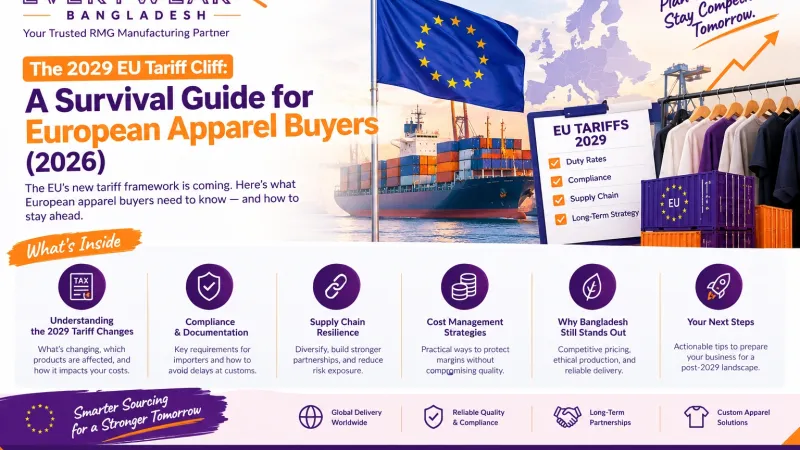
The 2029 EU Tariff Cliff: A Survival Guide for European Apparel Buyers (2026)
Last Updated: October 17, 2026 | By: Everywear Bangladesh Research & Sourcing Team
What Is the EU Tariff Cliff for Bangladesh Apparel and When Does It Hit?
Bangladesh graduates from Least Developed Country (LDC) status in November 2026. The EU grants a three-year transition period, allowing duty-free access under the Everything But Arms (EBA) scheme to continue until November 2029. After that date, unless Bangladesh secures GSP+ status, Bangladeshi garments will face MFN tariffs of approximately 9.6% to 12.5% entering the EU. This is the "tariff cliff" — a sudden cost increase that will directly impact landed prices for European apparel buyers. Planning for this transition requires understanding the GSP+ pathway, compliance deadlines (DPP, unsold inventory ban), and sourcing strategies that mitigate risk.
What Is the 2029 EU Tariff Cliff and Why Does It Matter?
The tariff cliff is not a hypothetical scenario. It is a legislated timeline that will alter the cost structure of every European apparel buyer sourcing from Bangladesh.
Bangladesh's LDC graduation was confirmed by the United Nations for November 2026. Under the EU's Everything But Arms (EBA) arrangement, LDC exports enter the EU duty-free. The EU has committed to a three-year transition period, meaning EBA benefits continue until November 2029 [reference:0]. After that, the standard Generalised Scheme of Preferences (GSP) applies.
For apparel, the difference between EBA and standard GSP is significant. Standard GSP tariffs on garments range from 9.6% for knitwear to 12.5% for woven apparel [reference:1][reference:2]. On a $100,000 shipment, that is an additional $9,600 to $12,500 in duties — a direct hit to margins.
The only way to avoid this cliff is for Bangladesh to qualify for GSP+, which restores duty-free access in exchange for ratifying and implementing 32 international conventions on human rights, labour rights, environment, and good governance. Bangladesh has stepped up implementation of these conventions, but GSP+ is not guaranteed [reference:3].
Why Is Bangladesh's EU Market Share Already Declining?
Even before the tariff cliff, Bangladesh is losing ground in the EU market. This context matters because it affects buyer confidence and supplier competitiveness.
Recent Eurostat data shows Bangladesh's share of EU apparel imports fell from 24.4% in January-April 2025 to 21.9% in the same period of 2026 [reference:4]. Total EU apparel imports also fell nearly 10% year-on-year to €33.84 billion [reference:5].
In the first half of 2026, Bangladesh's apparel exports to the EU plunged 16.43% year-on-year to €8.64 billion, with its market share dropping to about 21% from 22.7% [reference:6]. This decline is steeper than that of any other major supplier [reference:7].
Several factors are driving this: an energy crisis in Bangladesh, buyers developing alternative sourcing destinations, and competition from India and Vietnam [reference:8]. For European buyers, this means supplier reliability and cost competitiveness are already under pressure — and the tariff cliff will intensify these challenges.
What Is the GSP+ Pathway and How Likely Is It?
GSP+ is the European Union's special incentive arrangement for sustainable development and good governance. It offers zero tariffs on approximately 66% of EU tariff lines for vulnerable developing countries that ratify and implement 27 international conventions (the number has been cited as 32 in some Bangladesh government statements) [reference:9].
For Bangladesh, GSP+ is the only realistic pathway to maintaining duty-free access after 2029. The government has finalised a plan and is implementing the required conventions [reference:10]. Recent labour reforms have helped, and Bangladesh has met most requirements [reference:11].
However, GSP+ is not automatic. The European Commission must review and confirm eligibility, and there are parliamentary questions about democratic deficit and human rights concerns that could affect the decision [reference:12]. The EU has also introduced a double-transformation requirement for GSP+ eligibility, and a minimum value addition of 40% may be required [reference:13].
For buyers, the practical takeaway is this: plan for both scenarios. Do not assume GSP+ will be secured. Build flexibility into your sourcing contracts and cost models.
What Other Compliance Deadlines Are Converging with the Tariff Cliff?
The tariff cliff is not the only regulatory change facing European apparel buyers. Two other deadlines will reshape sourcing requirements in the same timeframe.
EU Digital Product Passport (DPP)
The DPP is a mandatory digital record for every garment sold in the EU. The Textiles Delegated Act is expected in 2027, with mandatory compliance likely in 2028-2029 [reference:14]. This means that just as the tariff cliff hits, buyers will also need to ensure every product has a compliant DPP containing verified data on fibre composition, durability, substances of concern, and end-of-life management.
EU Ban on Destroying Unsold Apparel
From 19 July 2026, large companies in the EU are banned from destroying unsold apparel, clothing accessories, and footwear [reference:15]. Medium-sized companies must comply by 2030 [reference:16]. This ban makes overproduction more costly and increases the importance of accurate demand forecasting and flexible, low-MOQ production models.
Together, these compliance requirements mean that European buyers must demand more from their Bangladeshi suppliers — not just on price, but on data transparency, traceability, and production flexibility.
How Should European Buyers Adapt Their Sourcing Strategies?
The tariff cliff and converging compliance deadlines require a proactive, not reactive, approach. Here are the strategies that European buyers should implement now.
1. Stress-Test Landed Costs with the 2029 Tariff Scenario
Build a cost model that includes a 9.6-12.5% duty scenario for 2029 onwards. This will show you which products remain viable and which may need to be sourced elsewhere or re-priced. Use the tariff data to negotiate pricing with suppliers and to plan your margin structure.
2. Prioritise Suppliers with GSP+ Readiness
Ask your Bangladeshi suppliers about their compliance with the 32 conventions required for GSP+. Suppliers that are prepared for GSP+ will be more resilient and better positioned to maintain duty-free access. This is a new dimension of supplier vetting that goes beyond quality and capacity.
3. Diversify with a "China + Bangladesh + One" Strategy
Do not abandon Bangladesh, but do not rely on it exclusively. Consider a portfolio approach: Bangladesh for volume basics where cost is critical, and alternative destinations (India, Vietnam, Turkey) for higher-value or time-sensitive products. The EU-India and EU-Vietnam FTAs are already putting pressure on Bangladesh's competitiveness [reference:17].
4. Shift to Low-MOQ, Flexible Production Models
The EU's unsold inventory ban makes overproduction expensive. Low-MOQ manufacturing (300 pieces per design) allows you to test demand, reduce excess stock, and adapt to trends without committing to large volumes. This is a structural solution to both the compliance ban and the tariff cliff.
5. Demand DPP-Ready Data from Suppliers
Start collecting the data required for the Digital Product Passport now. Ask suppliers for fibre composition, durability test results, and chain-of-custody documentation. Suppliers who can provide this data will be your preferred partners when DPP becomes mandatory.
How Everywear Bangladesh Helps EU Buyers Navigate the Tariff Cliff
We provide the operational and compliance support that European buyers need to protect margins through 2029 and beyond.
| What We Offer | What This Means for Your Business |
|---|---|
| 300-Piece MOQ | Test new designs and manage inventory without overcommitting capital. This aligns with the EU's unsold inventory ban and reduces exposure to tariff cost increases. |
| GSP+ Readiness Support | We help suppliers implement the documentation and compliance processes required for GSP+ eligibility, improving the chances of maintaining duty-free access after 2029. |
| DPP and PPWR Compliance Data | We provide fibre composition, durability test results, and chain-of-custody documentation so you can build DPP-compliant records for every product. |
| Multi-Stage Quality Control | Pre-production, in-line, final AQL inspection, plus video-call verification before shipment. |
| US Cotton Zero-Tariff Sourcing | For US-bound orders, we source US-origin cotton to qualify for zero reciprocal tariffs under the US-Bangladesh Trade Agreement. |
| 700+ Verified Factories | Every factory holds active BGMEA membership, valid export licenses, and verified compliance certifications. |
| Direct Amazon FBA Shipping | Full FBA prep including polybagging, FNSKU labeling, and cartonization. |
| One Accountable Partner | One point of contact, one invoice, one quality standard. When something needs fixing, we fix it. |
Frequently Asked Questions
When exactly does the EU tariff cliff hit for Bangladesh apparel?
The EU's EBA duty-free access for Bangladesh continues until November 2029 under a three-year transition period following LDC graduation in November 2026. From late 2029, standard GSP tariffs apply unless GSP+ is secured.
What tariff rate will apply to Bangladeshi garments after 2029?
Standard GSP MFN tariffs on apparel range from 9.6% for knitwear to 12.5% for woven garments. Some reports cite a flat rate of around 12% for apparel.
What is GSP+ and how likely is Bangladesh to get it?
GSP+ is a special EU scheme that provides zero tariffs in exchange for implementing 32 international conventions. Bangladesh has stepped up implementation, but GSP+ is not guaranteed and depends on EU review of human rights and governance criteria.
What is the EU Digital Product Passport and when does it apply?
The DPP is a mandatory digital record for every garment sold in the EU. The Textiles Delegated Act is expected in 2027, with mandatory compliance likely in 2028-2029.
What is the EU ban on destroying unsold apparel?
From 19 July 2026, large companies in the EU are banned from destroying unsold clothing, accessories, and footwear. Medium-sized companies must comply by 2030. This makes overproduction costly and increases the importance of low-MOQ production.
How can European buyers prepare for the tariff cliff?
Buyers should stress-test landed costs with a 9.6-12.5% duty scenario, prioritise suppliers with GSP+ readiness, diversify sourcing, shift to low-MOQ models, and demand DPP-ready data from suppliers.
How does Everywear Bangladesh help with GSP+ readiness?
Everywear works with suppliers to implement the documentation and compliance processes required for GSP+ eligibility, and provides DPP-ready data for every order. Contact us on WhatsApp to discuss your requirements.
Conclusion
The 2029 EU tariff cliff is not a distant problem. It is a legislated deadline that will change the economics of sourcing from Bangladesh. European apparel buyers who prepare now — by stress-testing costs, prioritising GSP+ ready suppliers, diversifying sourcing, and shifting to low-MOQ models — will be positioned to protect margins and maintain supply chain stability.
Those who wait until 2029 will face higher costs, supplier disruption, and compliance gaps. The time to act is now.
Everywear Bangladesh provides the operational and compliance support that European buyers need to navigate this transition. From 300-piece MOQ to DPP-ready documentation and GSP+ readiness support, we help you build a resilient sourcing strategy for the post-2029 landscape.
Contact Everywear Bangladesh on WhatsApp
About the Author
Written by the Everywear Bangladesh Research & Sourcing Team
The Everywear Bangladesh editorial team combines deep industry expertise in Bangladesh's Ready-Made Garment sector with practical experience in international apparel sourcing, supply chain management, and Amazon FBA selling. Our team includes former garment factory managers, sourcing professionals, and e-commerce specialists who have helped hundreds of sellers launch and scale their clothing brands.
Connect with Everywear Bangladesh:
- Website: everywearbd.com
- WhatsApp: +8801788898174
- Facebook: facebook.com/everywearbd
- LinkedIn: Everywear Bangladesh Ltd
Related Resources
GEO Landing Pages
- Europe Buyers: Wholesale Clothing from Bangladesh
- Germany Buyers: Wholesale Garments from Bangladesh
- France Buyers: Wholesale Garments from Bangladesh
- Netherlands Buyers: Wholesale Garments from Bangladesh
- UK Buyers: Wholesale Garments from Bangladesh
Blog Posts
- EU Digital Product Passport for Garments – Complete Compliance Guide 2026
- Bangladesh LDC Graduation 2026: What Global Clothing Buyers Need to Know
- FOB vs CIF vs DDP: Incoterms Explained for Clothing Buyers (2026)
- Factory Vetting Checklist: 12 Steps to Verify a Bangladesh Garment Manufacturer
- Low MOQ Clothing Manufacturer Bangladesh – The Complete Guide
References
- UNESCAP, "Trade preferences for Asia-Pacific Least Developed Countries and developing economies: 2026 updates," May 2026
- Textile Today, "Increasing Bangladesh's skin on the game in the EU apparel market," May 2026
- Fibre2Fashion, "Bangladesh's EU Apparel trade is entering a new competitive cycle," August 2026
- European Parliament, "Parliamentary question E-001708/2026 on GSP+ eligibility for Bangladesh," April 2026
- New Age, "Govt steps up implementation of 32 conventions for EU GSP+," October 2026
- The Financial Express, "BD import policy incompatible with new EU, US trade rules," June 2026
- European Commission, "DPP timeline 2026–2030: Every product, every deadline," October 2026
- DLA Piper, "Product regulation and compliance update series - July 2026," August 2026
- Textile Today, "Bangladesh's next export challenge is winning the race for supply chain agility," July 2026
- New Age, "Bangladesh apparel exports to EU fall 16.4pc in Jan–Jun," October 2026
This guide is updated regularly. Last reviewed: October 17, 2026. For sourcing solutions tailored to your brand, contact Everywear Bangladesh on WhatsApp.
Everywear Bangladesh Ltd. – Bangladesh's First RMG Wholesale Marketplace | 300 Pcs Custom Orders | Export Quality Garments
WhatsApp: +8801788898174 • Website: everywearbd.com
Leave a comment