





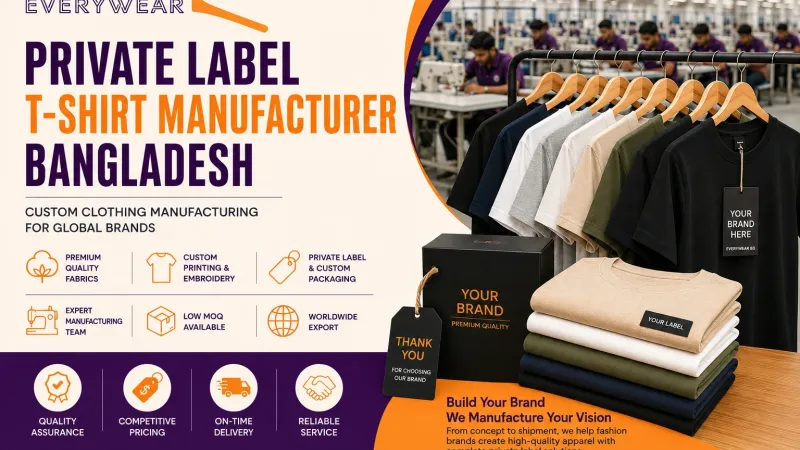
Private Label T-Shirt Manufacturer Bangladesh: Build Your Clothing Brand with Confidence
Launching a successful clothing brand starts with one of the most important business decisions you will ever make—choosing the right manufacturing partner. Whether you are building a premium streetwear label, a Shopify fashion store, an Amazon private label business, an Etsy clothing brand, or a wholesale apparel company, your manufacturer's capabilities directly influence your product quality, customer satisfaction, and long-term profitability.
Over the last two decades, Bangladesh has transformed into one of the world's leading apparel manufacturing hubs. Today, global fashion retailers, independent clothing brands, distributors, and startups source millions of garments from Bangladesh every month because of its manufacturing expertise, competitive pricing, skilled workforce, and strong export infrastructure.
Private label manufacturing has become increasingly popular because it allows businesses to create unique apparel collections under their own brand name instead of selling generic wholesale products. Rather than competing solely on price, businesses can develop distinctive products that build customer loyalty and long-term brand value.
If you are searching for a reliable Private Label T-Shirt Manufacturer Bangladesh, this guide will walk you through everything you need to know—from choosing fabrics and GSM to printing techniques, quality control, packaging, production timelines, and international shipping.
Whether you need premium heavyweight oversized T-shirts, luxury cotton basics, fashion-forward streetwear, promotional apparel, or custom corporate uniforms, understanding how private label manufacturing works will help you make better sourcing decisions and avoid costly mistakes.
At Everywear Bangladesh, we help fashion brands, startups, wholesalers, distributors, and retailers source premium-quality private label garments through our Bangladesh RMG Wholesale Marketplace. Instead of offering one-size-fits-all manufacturing, we connect buyers with carefully selected export-oriented factories that specialize in the products they need.
Our goal is simple: make custom garment manufacturing transparent, reliable, and accessible for businesses of every size.
Quick Answer: What Is a Private Label T-Shirt Manufacturer?
A Private Label T-Shirt Manufacturer is a garment manufacturer that produces custom T-shirts for businesses under the buyer's own brand name rather than selling products under the manufacturer's brand.
Private label manufacturing typically includes:
• Custom garment production
• Brand labels
• Woven neck labels
• Printed neck labels
• Hang tags
• Custom packaging
• Size labels
• Care labels
• Custom colors
• Fabric selection
• Screen printing
• Embroidery
• Custom sizing
• OEM production
The finished products are manufactured exclusively for your business and sold under your own brand identity.
Unlike purchasing ready-made wholesale products, private label manufacturing gives you complete control over your designs, branding, quality standards, and customer experience.
Why Private Label T-Shirts Are Growing Faster Than Traditional Wholesale Apparel
Consumer purchasing habits have changed dramatically over the past decade.
Instead of buying generic clothing, customers increasingly prefer brands with unique identities, premium quality, and authentic stories.
This shift has created tremendous opportunities for entrepreneurs and fashion businesses to launch their own clothing labels without owning manufacturing facilities.
Private label manufacturing allows businesses to:
• Create exclusive products
• Build long-term customer loyalty
• Increase profit margins
• Control product quality
• Differentiate from competitors
• Develop premium branding
• Expand product collections
• Scale production as demand grows
Rather than competing with thousands of sellers offering identical wholesale products, private label brands create original collections that customers recognize and trust.
For Shopify stores, Amazon brands, TikTok Shop sellers, Instagram fashion businesses, and boutique retailers, private label manufacturing has become one of the most effective ways to build a sustainable apparel business.
Why Bangladesh Is One of the World's Best Countries for Private Label T-Shirt Manufacturing
Bangladesh has earned its reputation as one of the largest apparel exporting countries through decades of investment, innovation, and manufacturing excellence.
The country exports billions of dollars' worth of garments annually to markets including:
• United States
• United Kingdom
• Germany
• France
• Italy
• Spain
• Canada
• Australia
• Netherlands
• Belgium
• Japan
• South Korea
• Middle East
• Africa
Thousands of factories specialize in knitwear, making Bangladesh particularly strong in T-shirt manufacturing.
International buyers choose Bangladesh because of several competitive advantages.
Experienced Manufacturing Workforce
Bangladesh has developed one of the world's most experienced apparel workforces.
From fabric knitting and dyeing to sewing, printing, embroidery, and finishing, skilled professionals contribute to producing garments that meet international quality standards.
Strong Textile Supply Chain
Bangladesh has a mature textile ecosystem that includes:
• Yarn manufacturers
• Fabric mills
• Dyeing facilities
• Washing plants
• Printing units
• Embroidery facilities
• Accessories suppliers
• Packaging manufacturers
This integrated supply chain reduces lead times and improves production efficiency.
Competitive Manufacturing Costs
Bangladesh continues to offer an excellent balance between quality and cost, making it an attractive sourcing destination for startups, growing brands, and established retailers alike.
Competitive manufacturing costs allow brands to invest more in marketing, product development, and customer acquisition while maintaining healthy profit margins.
Modern Export Infrastructure
Bangladesh's garment industry supports international buyers through:
• Export documentation
• Commercial invoicing
• Quality inspections
• Freight forwarding
• Air shipments
• Sea freight
• Customs support
• International logistics
Professional export experience simplifies the sourcing process for overseas buyers.
Why Everywear Bangladesh Is Different
Finding a factory is relatively easy.
Finding the right manufacturing partner is far more challenging.
Everywear Bangladesh was established to simplify international apparel sourcing by acting as a trusted bridge between global buyers and Bangladesh's export-oriented garment manufacturers.
Instead of promoting a single production facility, we identify manufacturing partners based on each buyer's unique requirements.
We evaluate factors such as:
• Product category
• Fabric requirements
• GSM
• Printing techniques
• Embroidery requirements
• Production capacity
• Lead time
• Quality expectations
• Budget
• Export destination
This approach enables us to match buyers with factories that specialize in their specific products rather than assigning every order to the same manufacturer.
Our services include:
• Private Label Manufacturing
• OEM Clothing Production
• Custom T-Shirt Manufacturing
• Product Development
• Fabric Sourcing
• Pattern Making
• Sample Development
• Screen Printing
• High-Density Printing
• Puff Printing
• Plastisol Printing
• Silicone Printing
• Flat Embroidery
• 3D Puff Embroidery
• Quality Control
• Production Monitoring
• Packaging
• Worldwide Shipping Support
For selected product categories, production starts from approximately 300 pieces, making private label manufacturing more accessible to startups and growing fashion brands.
Whether you're creating your first premium T-shirt collection or expanding an established apparel business, our objective is to help you manufacture products that strengthen your brand and support long-term growth.
Private Label vs OEM vs ODM: Which Manufacturing Model Is Best for Your Clothing Brand?
If you are planning to launch a clothing brand, one of the first decisions you will face is choosing the right manufacturing model. During your research, you will frequently come across three terms: Private Label, OEM, and ODM. Although these terms are often used interchangeably, they represent completely different manufacturing approaches.
Understanding the differences is essential because your choice will directly affect your product quality, production cost, branding opportunities, and long-term business growth.
Whether you are starting a streetwear brand, launching a Shopify clothing store, selling on Amazon, building an Etsy apparel business, or sourcing garments for wholesale distribution, selecting the right manufacturing model can save you time, reduce production risks, and increase profitability.
At Everywear Bangladesh, we work with international buyers every day, helping them understand these manufacturing options before they invest in production. We believe that an informed buyer makes better sourcing decisions and builds a stronger clothing brand.
What Is Private Label T-Shirt Manufacturing?
Private Label manufacturing is one of the most popular business models in today's fashion industry. It allows businesses to manufacture garments under their own brand identity rather than selling products under the factory's name.
When you choose a Private Label T-Shirt Manufacturer in Bangladesh, every garment is produced exclusively for your brand. Your customers only see your logo, labels, packaging, and brand identity. The factory remains behind the scenes while your business builds recognition and customer loyalty.
A complete private label production package can include custom neck labels, woven labels, printed labels, care labels, size labels, branded hang tags, custom poly bags, barcode stickers, premium packaging, and customized cartons. Every detail is designed to reflect your brand's identity and create a professional customer experience.
Unlike generic wholesale clothing, private label manufacturing gives you complete control over your product. You can choose the fabric, GSM, fit, color, printing method, embroidery style, accessories, and packaging according to your target market.
This approach enables fashion brands to differentiate themselves from competitors while increasing customer trust and improving long-term profitability.
What Is OEM Clothing Manufacturing?
OEM stands for Original Equipment Manufacturer.
OEM manufacturing is designed for businesses that already have complete product specifications prepared before production begins. Instead of relying on the factory to develop the product, the buyer provides a detailed technical package that includes every manufacturing requirement.
These specifications usually include fabric composition, GSM, measurements, stitching details, artwork, printing placement, embroidery location, accessories, trims, packaging instructions, and quality requirements.
The manufacturer's responsibility is to produce the garment exactly according to those specifications without making design decisions.
OEM production is commonly used by established fashion brands, sportswear companies, international retailers, and corporate apparel businesses that already have experienced designers and product development teams.
Because every production detail is predetermined, OEM manufacturing offers excellent consistency across large production runs.
What Is ODM Clothing Manufacturing?
ODM stands for Original Design Manufacturer.
Unlike OEM manufacturing, ODM factories already have existing garment designs that buyers can customize with their own branding.
Instead of developing a completely new product, buyers select an existing design and modify elements such as logos, labels, colors, packaging, printing, or embroidery.
ODM manufacturing is generally faster because product development has already been completed. It also requires less investment compared to developing a completely customized garment.
This manufacturing model is suitable for promotional apparel, corporate uniforms, event merchandise, and businesses that want to enter the market quickly with lower development costs.
However, for fashion brands aiming to create unique collections and establish a strong brand identity, Private Label Manufacturing usually provides greater flexibility and long-term value.
Which Manufacturing Model Should You Choose?
The best manufacturing model depends on your business goals.
If you are launching a new fashion label, a streetwear brand, a Shopify clothing store, or an online apparel business, Private Label Manufacturing offers the best combination of customization, affordability, and branding opportunities.
If you already have detailed technical specifications and require complete production control, OEM manufacturing is the ideal solution.
If your priority is speed and lower development costs while using existing garment designs, ODM manufacturing can be an effective choice.
For most growing fashion brands, Private Label Manufacturing remains the preferred option because it allows businesses to build a recognizable identity while maintaining flexibility in product development.
The Complete Private Label T-Shirt Manufacturing Process
Many buyers only see the finished T-shirt without realizing the amount of planning, technical expertise, and quality control involved in producing it.
A premium T-shirt passes through numerous production stages before reaching customers. Every stage contributes to the final quality, durability, fit, and appearance of the garment.
Understanding the manufacturing process helps buyers communicate more effectively with factories while reducing costly production mistakes.
Professional garment manufacturing generally follows these stages:
Product Consultation
↓
Product Development
↓
Fabric Selection
↓
Pattern Making
↓
Sample Development
↓
Sample Approval
↓
Bulk Fabric Procurement
↓
Fabric Inspection
↓
Marker Planning
↓
Fabric Cutting
↓
Printing or Embroidery
↓
Sewing
↓
Finishing
↓
Quality Inspection
↓
Ironing
↓
Packaging
↓
Carton Packing
↓
Export Documentation
↓
International Shipping
Each stage is equally important, and experienced manufacturers never skip these processes because consistency is built through proper planning and quality control.
Step 1: Product Consultation
Every successful clothing project begins with a detailed consultation.
Before production starts, manufacturers gather information about your business, product requirements, target customers, and brand positioning. This allows them to recommend the most suitable factory and production method.
During this stage, buyers typically discuss product type, target market, preferred fabric, GSM, fit, colors, printing techniques, embroidery requirements, packaging style, order quantity, budget, and delivery schedule.
At Everywear Bangladesh, every project begins with understanding the buyer's goals rather than simply providing a quotation. This approach ensures that each order is matched with the right export-oriented factory based on specialization rather than convenience.
Step 2: Product Development
Once the project requirements have been finalized, product development begins.
This stage transforms your ideas into a production-ready garment.
Professional product development includes technical drawings, measurement charts, pattern making, fabric recommendations, color matching, printing layouts, embroidery placement, label design, and packaging development.
This process is especially valuable for startup clothing brands because it helps identify potential production issues before bulk manufacturing begins.
Investing time in product development reduces production errors, improves consistency, and ultimately saves both time and money.
Step 3: Sample Development
Before moving to bulk production, manufacturers prepare samples for approval.
Sampling allows buyers to evaluate the garment's fit, construction, fabric quality, printing, embroidery, measurements, and overall appearance before committing to large production quantities.
Professional apparel manufacturers generally produce several types of samples, including development samples, fit samples, pre-production samples, and size-set samples.
Approving samples before mass production is one of the most effective ways to prevent manufacturing mistakes, minimize delays, and ensure the final product meets your expectations.
At Everywear Bangladesh, we strongly recommend approving every production sample before bulk manufacturing begins, regardless of order size, because it significantly reduces production risks and helps deliver garments that meet international quality standards.
Choosing the Right Fabric for Private Label T-Shirts
One of the biggest factors that determines whether a customer purchases from your brand again is the quality of the fabric. Even the best designs, premium printing, and attractive packaging cannot compensate for poor fabric quality. This is why successful clothing brands spend considerable time selecting the right fabric before production begins.
Bangladesh is one of the world's largest knitwear manufacturing hubs, offering access to high-quality yarn, modern knitting mills, dyeing facilities, and finishing plants. Buyers can choose from a wide variety of fabrics depending on their target market, price point, and brand positioning.
When selecting fabric, you should consider several factors including comfort, durability, breathability, shrinkage, weight, texture, color fastness, printing compatibility, and the overall customer experience.
At Everywear Bangladesh, we help buyers select fabrics that match their brand identity rather than simply choosing the lowest-cost option. A premium fabric often results in fewer customer complaints, higher repeat purchases, and stronger brand loyalty.
100% Cotton T-Shirts
Cotton remains the most popular fabric for private label T-shirts worldwide. It is soft, breathable, comfortable, and suitable for almost every climate.
High-quality cotton T-shirts are widely used by fashion brands, promotional apparel companies, retail chains, and luxury clothing labels because they provide excellent comfort and a natural feel.
Premium cotton also performs exceptionally well with screen printing, embroidery, DTG printing, and other decoration techniques.
For brands targeting premium customers, combed cotton and compact cotton are excellent choices because they produce a smoother surface, better color consistency, and improved durability.
Single Jersey Fabric
Single Jersey is one of the most commonly used knit fabrics in Bangladesh.
It is lightweight, breathable, and comfortable for everyday wear.
Single Jersey is ideal for:
- Fashion basics
- Promotional T-shirts
- Corporate uniforms
- Event merchandise
- Summer collections
- Retail fashion
Because of its versatility and affordability, Single Jersey remains one of the most widely exported knit fabrics from Bangladesh.
Interlock Fabric
Interlock fabric is thicker, smoother, and more stable than Single Jersey.
Many premium clothing brands choose Interlock because it offers:
- Better durability
- Superior softness
- Less fabric curling
- Better shape retention
- Premium appearance
- Improved comfort
Interlock fabrics between 220 GSM and 280 GSM are becoming increasingly popular for premium streetwear collections and luxury basics.
Many of Everywear Bangladesh's private label clients prefer Interlock for oversized T-shirts because it provides a structured silhouette while maintaining excellent comfort.
Organic Cotton
As consumers become more environmentally conscious, organic cotton has become an increasingly attractive option for sustainable clothing brands.
Organic cotton is produced without harmful pesticides and follows environmentally responsible farming practices.
Many buyers targeting the European Union, the United Kingdom, and North America now request organic cotton products to meet consumer demand for sustainable fashion.
Although organic cotton generally costs more than conventional cotton, it provides excellent branding opportunities for businesses focusing on eco-friendly apparel.
Cotton Polyester Blends
Cotton-polyester blends combine the comfort of cotton with the durability of polyester.
These fabrics offer several advantages:
- Improved wrinkle resistance
- Faster drying
- Better shape retention
- Increased durability
- Lower shrinkage
This makes cotton-polyester blends suitable for uniforms, sportswear, workwear, and promotional garments.
French Terry Fabric
French Terry is commonly associated with hoodies and sweatshirts, but lightweight French Terry is also used for premium fashion T-shirts.
The fabric offers a soft interior texture while maintaining excellent durability and comfort.
Brands focusing on premium casual wear frequently incorporate French Terry into their collections.
Understanding GSM: Choosing the Right Fabric Weight
GSM, or Grams per Square Meter, measures the weight of fabric and plays an important role in determining how a T-shirt looks, feels, and performs.
Many first-time buyers assume that higher GSM always means better quality. In reality, the ideal GSM depends on your target customers, climate, and brand positioning.
Selecting the correct GSM helps create products that meet customer expectations while maintaining manufacturing efficiency.
160–180 GSM
This range is commonly used for lightweight T-shirts.
Suitable for:
- Promotional apparel
- Budget clothing
- Corporate events
- Summer collections
- Large-volume wholesale orders
These garments are breathable, lightweight, and cost-effective.
180–200 GSM
This is considered the standard range for everyday fashion.
It offers a balance between comfort, durability, and affordability.
Most retail brands use this GSM range for basic T-shirts.
220–240 GSM
Premium fashion brands often prefer this range because it provides better structure and durability while remaining comfortable.
Ideal for:
- Premium basics
- Lifestyle brands
- Boutique collections
- Luxury casual wear
240–280 GSM
This range has become extremely popular among modern streetwear brands.
Benefits include:
- Heavyweight feel
- Premium appearance
- Better drape
- Excellent durability
- High perceived value
Oversized T-shirts manufactured within this GSM range continue to dominate global streetwear trends.
300 GSM and Above
Luxury heavyweight T-shirts frequently use fabrics above 300 GSM.
These garments provide exceptional structure and are commonly found in premium designer collections.
Although heavier fabrics increase manufacturing costs, they also increase perceived product value and retail pricing potential.
At Everywear Bangladesh, we help buyers choose the most suitable GSM based on product positioning rather than simply recommending the heaviest fabric available.
Printing Methods for Private Label T-Shirts
Printing quality is one of the first things customers notice when they receive a T-shirt.
Poor printing can crack, peel, fade, or wash away after only a few uses, damaging your brand's reputation.
Professional printing techniques ensure that every design remains vibrant and durable throughout the garment's life cycle.
Plastisol Printing
Plastisol remains one of the most widely used printing methods in the apparel industry.
Advantages include:
- Bright colors
- Excellent durability
- Smooth finish
- High opacity
- Long-lasting performance
It is ideal for bold logos, graphics, and fashion prints.
High-Density Printing
High-density printing creates a raised three-dimensional effect.
This technique is widely used by premium streetwear brands because it adds depth and texture to graphic designs.
It produces a luxurious appearance that immediately increases the perceived value of the garment.
Puff Printing
Puff printing expands during the curing process, creating a soft raised texture.
This printing style has become increasingly popular in oversized streetwear collections and premium fashion apparel.
It adds visual interest while maintaining a modern aesthetic.
Silicone Printing
Silicone printing provides exceptional flexibility and durability.
Unlike traditional prints, silicone remains soft while resisting cracking and fading.
Luxury sportswear brands frequently use silicone printing because of its premium appearance and excellent wash performance.
Screen Printing
Screen printing remains one of the most reliable solutions for bulk production.
It offers:
- Vibrant colors
- Excellent durability
- Cost efficiency for large quantities
- Consistent quality
For most private label production runs, screen printing continues to be the preferred method because it balances quality and production efficiency.
Premium Embroidery Options for Private Label T-Shirts
While printing remains the most popular decoration method for T-shirts, embroidery adds a premium look that immediately enhances the perceived value of a garment. Many luxury clothing brands, corporate apparel companies, golf wear labels, and streetwear brands use embroidery because it offers exceptional durability and a sophisticated finish.
Choosing the right embroidery technique depends on your brand identity, product category, and target customers.
At Everywear Bangladesh, we work with experienced embroidery facilities capable of producing everything from simple logo embroidery to highly detailed three-dimensional designs that meet international quality standards.
Flat Embroidery
Flat embroidery is the most commonly used embroidery technique in the apparel industry.
This method produces clean, professional-looking logos with excellent durability.
Flat embroidery is ideal for:
- Company logos
- School uniforms
- Polo shirts
- Premium T-shirts
- Fashion labels
- Corporate apparel
With proper thread selection and machine programming, flat embroidery creates a refined appearance that remains intact after repeated washing.
3D Puff Embroidery
3D Puff Embroidery creates a raised effect by placing foam underneath the embroidery stitches.
This technique has become increasingly popular among streetwear brands because it gives logos and lettering a bold, premium appearance.
It is commonly used on:
- Oversized T-shirts
- Hoodies
- Caps
- Sweatshirts
- Luxury streetwear collections
High-quality puff embroidery requires skilled technicians and precise machine settings to achieve consistent results.
Appliqué Embroidery
Appliqué combines fabric pieces with embroidery stitching to create unique textures and distinctive branding.
This technique is often used by varsity brands, premium casual wear companies, and fashion labels looking for a more creative appearance.
Chenille Embroidery
Chenille embroidery produces a soft, textured finish using looped yarn.
Although traditionally associated with varsity jackets, chenille is increasingly being incorporated into premium streetwear collections for bold logo designs.
Mixed Decoration Techniques
Modern fashion brands often combine multiple decoration methods on the same garment.
Examples include:
- Screen Printing + Embroidery
- Puff Print + Flat Embroidery
- Silicone Print + Woven Label
- High-Density Print + Neck Print
- Embroidery + Appliqué
Combining different decoration techniques creates unique products that stand out in competitive markets while increasing the perceived value of the garment.
Quality Control: The Foundation of Premium Garment Manufacturing
One of the most important factors separating professional manufacturers from inexperienced suppliers is their commitment to quality control.
A premium T-shirt is not defined solely by its fabric or printing—it is the result of consistent inspection throughout every stage of production.
Professional quality control minimizes defects, protects brand reputation, and reduces costly returns.
At Everywear Bangladesh, quality assurance is integrated into every stage of the manufacturing process, from raw material inspection to final shipment.
Fabric Inspection
Before production begins, every fabric roll should be inspected for potential issues such as:
- Fabric holes
- Color variation
- Knitting defects
- Oil stains
- Yarn contamination
- Width inconsistency
- Surface imperfections
Early detection prevents defective fabric from entering production.
Cutting Inspection
Accurate fabric cutting is essential for consistent garment sizing.
During this stage, inspectors verify:
- Marker accuracy
- Fabric grain alignment
- Pattern consistency
- Cutting precision
- Fabric utilization
Proper cutting minimizes fabric waste while ensuring uniform garment construction.
In-Line Sewing Inspection
Quality inspectors monitor sewing operations throughout production.
Key inspection points include:
- Stitch density
- Seam strength
- Thread tension
- Needle damage
- Label positioning
- Measurement consistency
Detecting issues during sewing prevents large quantities of defective garments from progressing to the next production stage.
Printing and Embroidery Inspection
Every printed or embroidered garment should be evaluated for:
- Color accuracy
- Artwork positioning
- Registration alignment
- Print durability
- Embroidery consistency
- Thread trimming
- Surface cleanliness
Premium brands expect every logo and design to remain consistent across the entire production run.
Final Quality Inspection
Before packaging, every finished garment undergoes a comprehensive inspection.
Typical checkpoints include:
- Garment measurements
- Appearance
- Stitching quality
- Loose threads
- Fabric defects
- Label accuracy
- Printing quality
- Embroidery quality
- Ironing quality
- Packaging accuracy
Many export-oriented factories also follow internationally recognized inspection systems such as AQL (Acceptable Quality Limit) to ensure shipment consistency.
Packaging and Branding That Enhance Customer Experience
Packaging is often the first physical interaction customers have with your brand.
Professional packaging not only protects garments during transportation but also creates a memorable unboxing experience.
Private label packaging options include:
- Custom poly bags
- Biodegradable packaging
- Zip-lock bags
- Printed cartons
- Tissue paper
- Brand stickers
- QR code labels
- Barcode stickers
- Thank-you cards
- Care instruction cards
Many successful brands invest in premium packaging because it increases customer satisfaction and encourages repeat purchases.
For eCommerce businesses, attractive packaging also improves social media sharing and customer-generated content.
Global Shipping and Export Support
Bangladesh exports garments to more than 150 countries worldwide.
Professional export support ensures buyers receive their orders safely and efficiently.
Depending on the destination and order size, shipping options include:
Sea Freight
Sea freight is the most economical option for bulk orders.
It is ideal for wholesalers, distributors, and large retail chains where cost efficiency is a priority.
Air Freight
Air freight provides faster delivery for urgent shipments, sample orders, and product launches.
Although more expensive than sea freight, it significantly reduces transit time.
Courier Services
Courier services such as DHL, FedEx, UPS, and TNT are commonly used for sample shipments and small consignments.
At Everywear Bangladesh, we assist buyers with export documentation, commercial invoices, packing lists, certificates of origin, freight coordination, and logistics support to simplify the international sourcing process.
Why Global Fashion Brands Source Private Label T-Shirts from Bangladesh
Bangladesh has earned a strong reputation as one of the world's leading apparel manufacturing destinations.
International buyers choose Bangladesh because of its combination of manufacturing expertise, competitive pricing, skilled workforce, and reliable export infrastructure.
Some of the key advantages include:
- Highly experienced garment workforce
- Strong textile supply chain
- Modern knitting and dyeing facilities
- Competitive manufacturing costs
- Export-oriented factories
- Compliance-focused production
- Access to premium fabrics
- Advanced printing and embroidery capabilities
- Reliable international shipping network
- Flexible manufacturing options for both startups and established brands
These advantages make Bangladesh an excellent sourcing destination for businesses seeking high-quality private label T-shirts.
Why Choose Everywear Bangladesh as Your Private Label Manufacturing Partner?
Choosing the right sourcing partner is just as important as selecting the right factory.
Everywear Bangladesh is more than a garment supplier—we are a sourcing and manufacturing partner dedicated to helping fashion brands succeed.
Our services include:
- Private Label Clothing Manufacturing
- Custom T-Shirt Manufacturing
- OEM Garment Production
- Product Development
- Fabric Sourcing
- Pattern Making
- Sample Development
- Screen Printing
- Plastisol Printing
- Puff Printing
- High-Density Printing
- Silicone Printing
- Flat Embroidery
- 3D Puff Embroidery
- Quality Control
- Packaging Development
- Worldwide Export Support
For selected product categories, we support production starting from approximately 300 pieces, making it easier for startups and growing brands to enter the market with professionally manufactured garments.
Whether you are launching your first fashion collection or expanding an established clothing business, our objective is to connect you with export-oriented factories that match your product requirements, quality expectations, and business goals.
Our experienced team works closely with buyers throughout the sourcing journey, ensuring transparent communication, reliable production, and consistent quality from concept to delivery.
Everywear Bangladesh
Address: House No: 165/1, West Agargaon, Shere-Bangla Nagar, Dhaka, Bangladesh
Phone & WhatsApp: +8801788898174
Website: everywearbd.com
Worldwide Manufacturing | Private Label | OEM | Custom Clothing | Bangladesh RMG Wholesale Marketplace
Frequently Asked Questions About Private Label T-Shirt Manufacturing in Bangladesh
1. What is a Private Label T-Shirt Manufacturer?
A private label T-shirt manufacturer produces garments that are sold under your own brand name instead of the manufacturer's brand. This means you can customize the labels, hang tags, packaging, printing, embroidery, colors, sizes, and overall product identity while maintaining complete ownership of your brand.
Private label manufacturing is one of the most popular business models for fashion startups, Shopify brands, Amazon sellers, TikTok Shop businesses, wholesale distributors, and established clothing companies looking to create unique apparel collections.
2. Why Should I Choose Bangladesh for Private Label T-Shirt Manufacturing?
Bangladesh is one of the world's largest apparel exporters and has earned a reputation for producing high-quality knitwear at competitive prices.
Some of the major advantages include:
- Skilled garment manufacturing workforce
- Modern knitting and dyeing facilities
- Competitive production costs
- Large export-oriented factories
- Strong textile supply chain
- International compliance standards
- Advanced printing and embroidery capabilities
- Worldwide shipping infrastructure
Many globally recognized fashion brands source garments from Bangladesh because of its manufacturing expertise and production capacity.
3. What Is the Minimum Order Quantity (MOQ)?
The MOQ depends on several factors, including fabric availability, color variations, printing techniques, and product specifications.
At Everywear Bangladesh, we support low MOQ production starting from approximately 300 pieces for selected product categories, making it easier for startups and small businesses to launch their own clothing brands without requiring massive inventory investments.
For larger production runs, we can also coordinate manufacturing with export-oriented factories capable of producing tens of thousands of garments per order.
4. Can I Customize Every Part of My T-Shirt?
Yes.
Private label manufacturing allows extensive customization, including:
- Fabric selection
- GSM
- Fit and sizing
- Neck labels
- Woven labels
- Printed labels
- Care labels
- Hang tags
- Packaging
- Printing
- Embroidery
- Accessories
- Brand cartons
- Poly bags
This flexibility allows you to create products that accurately represent your brand identity.
5. Which Fabrics Are Best for Premium Private Label T-Shirts?
The best fabric depends on your target market and brand positioning.
Popular options include:
- 100% Cotton
- Compact Cotton
- Combed Cotton
- Organic Cotton
- Single Jersey
- Interlock
- Cotton-Spandex
- Cotton-Polyester Blend
- French Terry (for heavier casualwear)
Premium fashion brands often prefer compact cotton or heavyweight interlock fabrics because of their superior appearance, durability, and comfort.
6. Which GSM Is Best for My Brand?
There is no single "best" GSM.
Instead, choose a GSM that matches your product positioning.
General recommendations include:
- 160–180 GSM for lightweight promotional apparel
- 180–220 GSM for everyday retail basics
- 220–240 GSM for premium casualwear
- 240–280 GSM for oversized and streetwear collections
- 300 GSM and above for luxury heavyweight garments
Selecting the right GSM should be based on your target customers, climate, and retail pricing strategy.
7. Which Printing Method Lasts the Longest?
Professional printing techniques such as Plastisol Printing, Screen Printing, Silicone Printing, and High-Density Printing all offer excellent durability when properly applied.
The best method depends on your artwork, fabric, order quantity, and desired finish.
For premium fashion collections, many brands combine multiple decoration techniques to create a distinctive appearance.
8. How Long Does Production Take?
Production timelines vary depending on order size, fabric availability, and customization requirements.
A typical production schedule includes:
- Product consultation
- Sample development
- Sample approval
- Bulk production
- Quality inspection
- Packaging
- Shipment
On average, custom private label orders are completed within several weeks after final sample approval. Planning ahead is recommended for seasonal collections and large retail launches.
9. Can You Ship Worldwide?
Yes.
Everywear Bangladesh supports worldwide garment exports.
We assist buyers with:
- Commercial invoices
- Packing lists
- Export documentation
- Freight coordination
- Sea freight
- Air freight
- Courier shipments for samples
Whether your business is located in North America, Europe, the Middle East, Africa, or Asia, we help coordinate reliable international delivery through experienced logistics partners.
10. Is Bangladesh Suitable for Startup Clothing Brands?
Absolutely.
Many successful clothing brands began with relatively small production runs before expanding into international markets.
With the right manufacturing partner, startups can access professional product development, quality production, and scalable manufacturing solutions without investing in their own factory.
This makes Bangladesh an attractive sourcing destination for entrepreneurs entering the apparel industry.
Why Everywear Bangladesh?
Everywear Bangladesh is committed to helping businesses source high-quality garments from Bangladesh's export-oriented apparel industry.
Rather than acting as a traditional garment supplier, we serve as a sourcing and manufacturing partner, helping brands navigate the entire production process—from concept development to worldwide delivery.
Our services include:
- Private Label Clothing Manufacturing
- OEM Garment Manufacturing
- Custom T-Shirt Production
- Oversized T-Shirt Manufacturing
- Blank T-Shirt Manufacturing
- Streetwear Manufacturing
- Product Development
- Fabric Sourcing
- Pattern Making
- Sample Development
- Screen Printing
- Plastisol Printing
- High-Density Printing
- Puff Printing
- Silicone Printing
- Flat Embroidery
- 3D Puff Embroidery
- Quality Control
- Packaging Solutions
- Worldwide Export Support
Whether you are building a new clothing brand or expanding an existing fashion business, our goal is to simplify sourcing while maintaining high standards of quality, transparency, and customer service.
Conclusion
The global fashion industry continues to evolve, but one principle remains constant: successful clothing brands are built on quality, consistency, and trust.
Choosing the right private label T-shirt manufacturer is more than a production decision—it is a strategic partnership that influences your product quality, customer satisfaction, and long-term brand reputation.
Bangladesh has established itself as one of the world's most reliable apparel manufacturing destinations, supported by decades of expertise, a highly skilled workforce, advanced textile infrastructure, and strong export capabilities. For brands seeking high-quality custom T-shirts, competitive manufacturing costs, and scalable production, Bangladesh offers significant advantages.
However, selecting the right manufacturing partner is just as important as selecting the right country. A reliable partner should understand your business objectives, recommend suitable production solutions, maintain consistent quality standards, and provide transparent communication throughout the manufacturing process.
At Everywear Bangladesh, we help global buyers navigate this process with confidence. From fabric sourcing and product development to private label manufacturing, quality assurance, packaging, and worldwide shipping, we work closely with businesses to deliver garments that reflect their brand identity and support long-term growth.
Whether you are launching your first clothing collection or expanding an established fashion brand, partnering with an experienced sourcing team can help reduce production risks while improving efficiency and product quality.
If you are looking for a trusted Private Label T-Shirt Manufacturer in Bangladesh, our team is ready to help you turn your ideas into premium garments that customers will appreciate and remember.
Contact Everywear Bangladesh
Everywear Bangladesh
Bangladesh FIRST RMG Wholesale Marketplace
Address: House No: 165/1, West Agargaon, Shere-Bangla Nagar, Dhaka, Bangladesh
Phone & WhatsApp: +8801788898174
Website: everywearbd.com
Facebook: facebook.com/everywearbd
Instagram: instagram.com/everywearbd
LinkedIn: linkedin.com/company/everywear-bangladesh-ltd
WhatsApp: wa.me/8801788898174
Related Blog Posts
- Bangladesh RMG Wholesale Blog
- Shopify Clothing Manufacturer Bangladesh
- TikTok Shop Clothing Supplier Bangladesh
- Wholesale Clothing Suppliers for eBay Sellers Bangladesh
- Amazon Fashion Sellers Source Clothing from Bangladesh
- How to Start a Streetwear Brand with Bangladesh Manufacturers
- Low MOQ Clothing Manufacturer Bangladesh
- Import Clothes from Bangladesh – USA, UK, EU & Africa
- Buy Wholesale Garments from Bangladesh – Step by Step Guide
- Custom Garment Manufacturing Bangladesh 2026 Guide for Small Brands
- Bangladesh RMG Wholesale Marketplace – How Everywear Works
- Bangladesh vs China vs India Wholesale Clothing 2026
- Private Label Clothing Manufacturing Bangladesh – Complete Brand Guide 2026
- Oversized T-Shirt Manufacturer Bangladesh
- Etsy Clothing Manufacturer Bangladesh
- Oversized Hoodie Manufacturer Bangladesh
- Blank T-Shirt Manufacturer Bangladesh
- US Tariff Guide for Bangladesh Garment Imports 2026
- Clothing Suppliers from Bangladesh: The Ultimate Guide 2026
Country & Region Guides
- USA – Buy Wholesale Garments from Bangladesh
- Europe Wholesale Clothing from Bangladesh
- UK Wholesale Garments from Bangladesh
- Africa – Wholesale Garments from Bangladesh
Author: Everywear Bangladesh Editorial Team
Reviewed by: Everywear Bangladesh Manufacturing & Export Team
Industry Experience: Bangladesh Ready-Made Garment (RMG), Private Label Clothing Manufacturing, OEM Apparel Production, Global Apparel Export, Fashion Supply Chain.
Last Updated: July 2026