





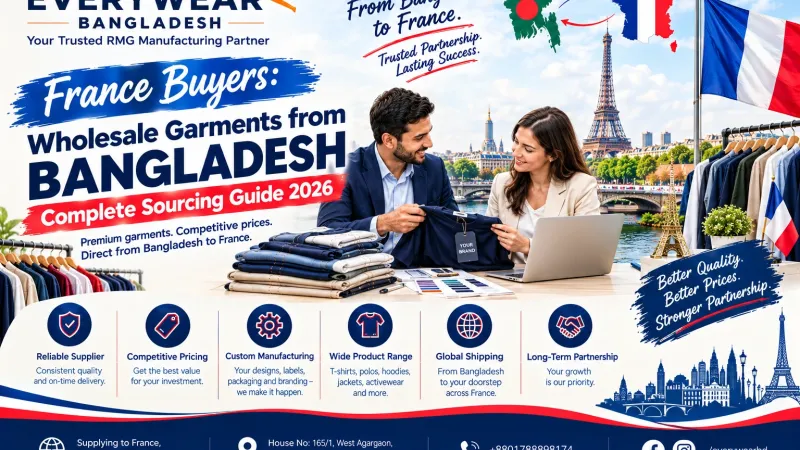
France Buyers: Wholesale Garments from Bangladesh – Complete Sourcing Guide 2026
France is Bangladesh's fifth-largest export market globally and a critical partner within the EU, with annual exports totalling approximately $2.5 billion, of which 92% is apparel, textiles, and related products[reference:0]. French buyers benefit from duty-free access under the EU's Everything But Arms (EBA) programme, giving them a significant cost advantage over competitors sourcing from non-preferential countries.
For a $1 million annual import order, duty-free access translates to approximately $90,000-$120,000 in duty savings compared to sourcing from MFN countries facing 9.6-12% tariffs. However, France's ultra-fast-fashion malus (up to €12 per item, effective September 1, 2026) and Bangladesh's LDC graduation in November 2026 are reshaping the sourcing landscape.
Bangladesh holds a 20.1% share of France's EU garment imports and remains among the top sourcing countries for French importers, supported by competitive pricing, large-scale production capacity, and reliability in bulk manufacturing[reference:1].
Quick Answer: Why should France buyers source from Bangladesh in 2026?
Bangladesh offers duty-free access under EU EBA until 2029, the fifth-largest export market for Bangladeshi garments, MOQ from 300 pieces, 290 LEED green factories, and strong compliance readiness for upcoming EU regulations including DPP and PPWR. With LDC graduation approaching and France's ultra-fast-fashion malus now in effect, French buyers who act now can secure supply chain relationships before the tariff landscape shifts.
Why Bangladesh Is One of the Best Countries for Wholesale Clothing Sourcing for France
Bangladesh is currently the world's second-largest garment exporter and France's fifth-largest export market globally. The country exports billions of dollars worth of ready-made garments every year to France, the United States, Europe, the United Kingdom, and many global markets.
The Bangladesh garment industry is highly specialized in knitwear, T-shirts, hoodies, denim products, workwear, polo shirts, and private label apparel manufacturing. Many factories already produce for globally recognized fashion brands including H&M, Zara, Walmart, and Gildan.
Compared to other sourcing destinations, Bangladesh offers strong pricing advantages while maintaining large production capacity. This makes the country ideal for French wholesalers, fashion brands, private label retailers, and e-commerce sellers.
Key Advantages for France Buyers at a Glance
| Advantage | Benefit for France Buyers |
|---|---|
| Duty-Free Access | EU Everything But Arms provides duty-free access until 2029 |
| Fifth-Largest Market | France is Bangladesh's fifth-largest export market globally |
| Low MOQ | Production from 300 pieces – perfect for startups and growing brands |
| Sustainable Manufacturing | 290 LEED-certified green factories – world leader |
| Skilled Workforce | 4 million experienced garment workers |
| Compliance Readiness | Preparing for EU DPP and PPWR regulations ahead of deadlines |
| Private Label Manufacturing | Full customization – labels, packaging, branding |
Source: Export Promotion Bureau (EPB) FY2025-26 Data; BGMEA Industry Reports; French Customs Data
France Tariff Advantage: Duty-Free Access Under EU EBA Until 2029
France, as an EU member state, provides duty-free and quota-free access to Bangladeshi garments under the EU's Everything But Arms (EBA) programme. This gives French importers a significant cost advantage over competitors sourcing from non-preferential countries.
However, the tariff landscape is shifting. Bangladesh exits the United Nations Least Developed Country (LDC) category on November 24, 2026. The EU has confirmed a three-year extended preference window after graduation, meaning EBA-style access continues until late 2029. After 2029, standard GSP tariffs of 9.6% for knitwear and 12.0% for woven garments will apply unless Bangladesh secures GSP+ status.
Tariff Comparison: Bangladesh vs. Competitors for France
| Country | EU Tariff Treatment | Effective Duty Rate | Advantage |
|---|---|---|---|
| Bangladesh | EBA (until 2029) | 0% | Base |
| Vietnam | EU-Vietnam FTA | 0% (phased) | Comparable |
| India | GSP | ~9.6-12% | Bangladesh is lower |
| China | MFN | ~9.6-12% | Bangladesh is lower |
| Turkey | EU Customs Union | 0% | Comparable |
Source: EU TARIC Database 2026; Everything But Arms Programme; LDC Graduation Impact Assessment
What Duty-Free Access Means for France Buyers – Real Savings
| Order Value (FOB) | Duty at 12% (China/India) | Duty at 0% (Bangladesh) | Savings with Bangladesh |
|---|---|---|---|
| $10,000 | $1,200 | $0 | $1,200 |
| $50,000 | $6,000 | $0 | $6,000 |
| $100,000 | $12,000 | $0 | $12,000 |
| $500,000 | $60,000 | $0 | $60,000 |
| $1,000,000 | $120,000 | $0 | $120,000 |
Total Landed Cost Calculation for France Buyers
It is important to understand that duty-free access is only one component of landed cost. French importers should also account for import VAT, customs clearance, and logistics costs.
| Component | Rate |
|---|---|
| Customs Duty | 0% (Bangladesh, EBA) |
| Import VAT | 20% |
| Customs Clearance | Varies |
| Total Landed Cost | VAT + logistics only |
Important: French importers must ensure that shipments meet the Rules of Origin requirements for EBA tariff treatment. Proper documentation, including Certificates of Origin, is essential to claim duty-free access.
France Trade Agreements – EU Framework for Bangladesh Garments
France operates within the EU's common trade policy framework, which provides preferential tariff treatment to Bangladesh through multiple mechanisms. Understanding these is critical for French importers seeking to maximize duty savings.
Everything But Arms (EBA) Programme
The EU's Everything But Arms programme grants duty-free, quota-free access to all products except arms and ammunition for Least Developed Countries (LDCs). Bangladesh has used EBA to ship approximately €24 billion of apparel into the EU, with duty savings estimated at €2.6-3.0 billion per year[reference:2].
Key Details:
- Duty-free access for all garment categories
- Requires Certificate of Origin proving Bangladesh origin
- Extended three years after LDC graduation (until late 2029)
- Provides significant cost advantage over non-preferential sources
LDC Graduation and Transition Timeline
Bangladesh exits the UN Least Developed Country category on November 24, 2026. The EU has confirmed a three-year extended preference window, meaning EBA-style access continues until late 2029.
Key Dates:
- November 2026 – Bangladesh officially graduates from LDC status
- 2026-2029 – Three-year transition period with continued EBA access
- 2029 – EBA access expires; standard GSP tariffs apply (9.6-12%)
- GSP+ Track – Bangladesh has signalled intent to apply for GSP+, which restores duty-free access in exchange for ratification of 27 international conventions
France's Ultra-Fast-Fashion Malus – Effective September 2026
France introduced its ultra-fast-fashion malus (penalty) effective September 1, 2026, imposing fees of up to €12 per item and a 50% cap on pre-tax selling price. The policy aims to curb the environmental impact of ultra-fast-fashion by penalising low-cost, high-volume apparel models[reference:3].
Key Details:
- Applies to ultra-fast-fashion products as defined by French regulations
- Penalties up to €12 per item for 2026-27
- 50% cap on pre-tax selling price
- Designed to encourage sustainable, higher-quality apparel sourcing
What this means for France buyers: The malus creates a strong incentive to shift from ultra-fast-fashion models to higher-quality, sustainably produced garments – a positioning that aligns perfectly with Bangladesh's LEED-certified manufacturing ecosystem and Everywear's quality-controlled production.
What France Buyers Need to Do
- Secure Supply Chain Relationships Now – With LDC graduation approaching, early engagement with verified Bangladeshi suppliers is essential
- Request Certificate of Origin – Ensure your supplier provides documentation for EBA claims
- Monitor GSP+ Developments – Stay informed about Bangladesh's GSP+ application progress
- Adapt to the Ultra-Fast-Fashion Malus – Shift toward quality, durability, and sustainable sourcing models
- Prepare for DPP and PPWR – EU Digital Product Passport and Packaging Waste Regulation compliance will be mandatory in the coming years
- Work with a Knowledgeable Partner – Partner with a sourcing expert who understands EU tariff rules and regulatory requirements
EU Regulatory Compliance: DPP and PPWR for France Buyers
French buyers sourcing from Bangladesh must prepare for two major EU regulatory changes: the Digital Product Passport (DPP) and the Packaging and Packaging Waste Regulation (PPWR).
Digital Product Passport (DPP) – Timeline and Requirements
The DPP is a mandatory digital record for every garment sold in the EU, introduced under the Ecodesign for Sustainable Products Regulation (ESPR). The EU DPP Registration System launched on July 20, 2026, and the textile-specific delegated act is expected by late 2027, with mandatory compliance approximately 18 months later (2028-2029).
Key Requirements:
- Product Identification – GTIN, batch IDs, model IDs, customs codes
- Manufacturer Information – Facility details, Global Location Numbers
- Environmental Data – Fiber composition, durability, substances of concern, recycled content, PEF data
- Compliance Documentation – Declarations of Conformity, test reports, certifications
Packaging and Packaging Waste Regulation (PPWR) – Effective August 2026
The PPWR (Regulation EU 2025/40) began applying progressively from August 12, 2026. It introduces binding requirements for packaging design, material use, and waste management across all EU member states.
Key Requirements:
- Substance Restrictions – Combined concentration of lead, cadmium, mercury, and hexavalent chromium must not exceed 100 mg/kg
- Packaging Minimization – Weight and volume reduced to minimum necessary
- Recyclability – By 2030, all packaging must be recyclable by design
- Recycled Content – Minimum recycled content requirements for plastic packaging
Affected Packaging Types: Hangtags, labels, stickers, dust bags, protective films, corrugated cartons, courier bags, packaging tapes, and transport packaging.
How Everywear Helps with EU Compliance
Everywear provides support for French buyers preparing for DPP and PPWR:
- Supply Chain Traceability – Comprehensive documentation for every order
- Quality Control and Testing – ISO-standard test data for durability, shrinkage, and spirality
- Certified Materials – GOTS, GRS, and OEKO-TEX certified fabrics
- Data and Documentation Support – Helping you collect and structure DPP data
- PPWR-Compliant Packaging – Sustainable packaging options for EU market access
Why France Buyers Choose Everywear Bangladesh
Everywear is positioned as Bangladesh's First RMG Wholesale Marketplace. Instead of forcing buyers to manage factories alone, Everywear helps international buyers simplify the sourcing process through verified supplier support and centralized communication.
France buyers receive support with:
- Verified Bangladesh garment suppliers – BGMEA-registered, compliant factories with proven export experience
- Low MOQ production – from only 300 pieces per design, making Bangladesh accessible for startups and growing brands
- Private label clothing manufacturing – custom labels, packaging, and branding for your unique brand identity
- Product sourcing and quotation support – fast, transparent quotes with no hidden costs
- Tech pack and sample development – professional product development from concept to sample approval
- Quality control inspection – in-line and final AQL inspections by experienced professionals
- Worldwide shipping support – sea, air, and courier options with full export documentation
- Export documentation assistance – commercial invoices, certificates of origin, packing lists, bills of lading
- EU compliance expertise – maximize duty-free benefits and prepare for DPP/PPWR through proper documentation and compliance
This system helps France buyers reduce sourcing risks while improving communication, production visibility, and shipment reliability.
Popular Garments Imported to France from Bangladesh
Bangladesh manufacturers produce a comprehensive range of garments for France buyers:
- Oversized T-Shirts – Premium heavyweight cotton, 240-280 GSM
- Streetwear Hoodies – Oversized hoodies, fleece fabric, 280-320 GSM
- Private Label Apparel – Full customization for your brand
- Blank T-Shirts – 100% cotton, perfect for customization
- Polo Shirts – Pique cotton, embroidered logos
- Denim Jeans – Premium denim, custom fits and washes
- Workwear Uniforms – Durable, functional apparel
- Children's Clothing – Quality apparel for kids
- Fashion Knitwear – Premium knitwear collections
- Etsy-Style Custom Apparel – Perfect for boutique sellers
- Streetwear Collections – Complete streetwear manufacturing
- Women's Dresses – Maxi, midi, bodycon, and casual styles
Low MOQ Clothing Manufacturing for France Buyers
One of the biggest challenges for French startups and small fashion brands is factory MOQ requirements. Most garment factories ask for 1000 to 5000 pieces per design, which creates major barriers for small businesses.
Everywear helps buyers access low MOQ production starting from only 300 pieces per design. This gives startups and independent fashion brands the ability to test products before scaling larger orders.
Low MOQ production is ideal for:
- Startup fashion brands
- Streetwear labels
- Shopify clothing stores
- Amazon private label sellers
- Walmart Marketplace sellers
- Small wholesalers
- Boutique retailers
- Corporate apparel buyers
- Faire wholesale sellers
- WooCommerce store owners
Shipping Garments from Bangladesh to France
Everywear supports worldwide shipping solutions for France garment importers. Buyers can choose between air freight and sea freight depending on budget, urgency, and order volume.
Shipping Options for France Buyers
| Shipping Method | Transit Time | Best For | Approx. Cost |
|---|---|---|---|
| Sea Freight (LCL) | 28-38 days | Larger orders (500+ pieces) | $300-500 per CBM |
| Sea Freight (FCL) | 25-35 days | Bulk orders (5,000+ pieces) | $2,500-4,500 per container |
| Air Freight | 8-12 days | Urgent smaller orders | $5-8 per kg |
| Express Courier | 3-5 days | Samples and small shipments | $15-25 per kg |
Export Documentation Support
Everywear supports full export documentation:
- Commercial Invoice
- Packing List
- Bill of Lading
- Certificate of Origin (for EBA claims)
- Export Declaration
- Shipping Coordination
- Insurance Documentation (when required)
Direct Factory vs Everywear Marketplace – Comparison for France Buyers
| Feature | Direct Factory | Everywear Marketplace |
|---|---|---|
| MOQ | Usually 1000+ pieces | From 300 pieces |
| Supplier Verification | Buyer handles alone | Verified suppliers |
| EU Compliance Expertise | Limited or none | Full DPP/PPWR support |
| Quality Control | Limited support | Managed QC inspection |
| Communication | Often difficult | Centralized support |
| Shipping Support | Depends on supplier | Worldwide shipping support |
| Private Label Support | Limited | Full support available |
| Export Documentation | Buyer manages | Full documentation support |
| Risk Mitigation | Buyer takes all risk | Shared risk management |
How France Buyers Source Through Everywear
- Submit your garment inquiry – Contact us with your product requirements, target market, and estimated order quantity
- Share design or tech pack – Provide specifications for accurate quoting – fabric, GSM, measurements, printing, embroidery, packaging
- Receive quotation and MOQ details – Transparent pricing with no hidden costs – FOB, EXW, or CIF options
- Approve samples – Review production samples before bulk manufacturing – fabric, fit, printing, embroidery, labels, packaging
- Begin bulk production – Full-scale manufacturing with quality control – in-line inspections throughout production
- Quality control inspection – In-line and final AQL inspections by experienced professionals
- Shipping and export coordination – Worldwide delivery to your door – sea, air, or courier options
Frequently Asked Questions for France Buyers
1. What is the France tariff on Bangladesh garments in 2026?
France, as an EU member state, provides duty-free access for most Bangladesh garment imports under the EU's Everything But Arms (EBA) programme. This duty-free access continues until late 2029 under a three-year transition period following Bangladesh's LDC graduation in November 2026.
2. What happens to tariffs after Bangladesh's LDC graduation?
Bangladesh exits the UN Least Developed Country category on November 24, 2026. The EU has confirmed a three-year extended preference window, meaning EBA-style access continues until late 2029. After 2029, standard GSP tariffs of 9.6% for knitwear and 12.0% for woven garments will apply unless Bangladesh secures GSP+ status.
3. What is the minimum order quantity for France buyers?
Everywear supports low MOQ garment production starting from only 300 pieces per design, depending on the product category. This makes Bangladesh accessible for startups and growing brands.
4. Can France buyers create private label clothing in Bangladesh?
Yes. Buyers can develop custom garments with logo printing, embroidery, custom labels, packaging, and private branding support. Learn more about private label manufacturing.
5. How long does shipping from Bangladesh to France take?
Air freight usually takes between 8 to 12 days, while sea freight may require 28 to 38 days, depending on destination and shipment method.
6. Can buyers order samples first before bulk production?
Yes. Sampling is strongly recommended before bulk production to verify quality, sizing, fabric, and branding details. Sample orders typically take 14-21 days.
7. Does Everywear support startup clothing brands?
Yes. Everywear specializes in helping startups, small fashion labels, and growing e-commerce businesses source garments from Bangladesh with lower MOQ requirements.
8. What is the EU DPP and how does it affect French buyers?
The EU Digital Product Passport (DPP) is a mandatory digital record for every garment sold in the EU, introduced under the ESPR. The EU DPP Registration System launched on July 20, 2026, and the textile-specific delegated act is expected by late 2027, with mandatory compliance approximately 18 months later. Everywear provides supply chain traceability, quality control data, and documentation support to help French buyers prepare.
9. What is PPWR and when does it apply?
The Packaging and Packaging Waste Regulation (PPWR), Regulation (EU) 2025/40, began applying progressively from August 12, 2026. It introduces binding requirements for packaging design, material use, and waste management. Affected packaging includes hangtags, labels, dust bags, corrugated cartons, and courier bags. Everywear provides PPWR-compliant packaging options.
10. What is France's ultra-fast-fashion malus?
France introduced its ultra-fast-fashion malus effective September 1, 2026, imposing fees of up to €12 per item and a 50% cap on pre-tax selling price. The policy aims to curb the environmental impact of ultra-fast-fashion. This creates a strong incentive to shift toward higher-quality, sustainably produced garments – a positioning that aligns with Bangladesh's LEED-certified manufacturing ecosystem.
11. Why should I choose Bangladesh over China for France sourcing?
Bangladesh offers duty-free access (0% vs China's ~12%), lower costs, lower MOQ (300 vs 500-1000+ pieces), and better sustainability (290 LEED green factories). For French importers, Bangladesh is the more cost-effective and compliant sourcing destination.
12. How does Bangladesh compare to Vietnam for France sourcing?
Both Bangladesh and Vietnam enjoy duty-free access to the EU. However, Bangladesh offers lower MOQ (300 vs 500-1000+ pieces), world-leading sustainability (290 LEED-certified factories), and competitive pricing (10-15% lower than Vietnam).
13. What types of garments can Bangladesh manufacturers produce?
Bangladesh manufacturers produce T-shirts, oversized T-shirts, hoodies, sweatshirts, polo shirts, denim jeans, activewear, streetwear, women's apparel, kidswear, corporate uniforms, and fully customized private label collections. The country is particularly strong in knitwear manufacturing.
14. Is Bangladesh a sustainable sourcing destination?
Yes. Bangladesh is a world leader in sustainable manufacturing with 290 LEED-certified factories (125 Platinum, 145 Gold). The country hosts 69 of the world's top 100 LEED-certified factories and 18 of the top 20.
15. What certifications should I look for in a Bangladesh supplier?
Look for BGMEA membership, LEED certification, GOTS (organic), OEKO-TEX (product safety), WRAP (ethical manufacturing), BSCI (social compliance), SEDEX (ethical trade), and ISO 9001 (quality management). Everywear works only with certified factories.
16. How do I verify a Bangladesh manufacturer is legitimate?
Ask for BGMEA membership, factory photos and videos, client references, certifications, and export documentation. Everywear provides verified suppliers with proven export experience to the French market.
17. What is the average lead time for garment manufacturing in Bangladesh?
Typical lead times are 45-60 days from order confirmation, depending on fabric availability and order size. Sample development takes 14-21 days. Air freight adds 8-12 days, sea freight adds 28-38 days.
18. Can I get custom packaging for my France brand?
Yes. Private label manufacturing includes custom packaging options – poly bags, hang tags, stickers, tissue paper, branded cartons, QR code labels, and care instruction cards.
19. What is the payment process for France buyers?
Common payment terms include 30-50% deposit with balance before shipment, Letter of Credit (LC), and other arrangements depending on order size and relationship history. Payment terms are clarified before production begins.
20. How do I start sourcing from Bangladesh for my France brand?
Contact Everywear Bangladesh on WhatsApp. Our team will understand your requirements, connect you with verified manufacturers, assist with product development, manage quality control, and coordinate worldwide shipping. We handle everything from concept to delivery.
Start Importing Wholesale Garments from Bangladesh
Work with Everywear — Bangladesh's First RMG Wholesale Marketplace — to source export-quality garments with low MOQ manufacturing, supplier verification, quality control, and worldwide shipping support.
Whether you are a startup fashion brand, established retailer, wholesaler, or e-commerce seller, Everywear helps you access Bangladesh's competitive advantages:
- Duty-Free Access Under EU EBA Until 2029
- Savings of Up to 12% on Import Duties
- Low MOQ from 300 Pieces – Accessible for All Business Sizes
- LEED-Certified Green Factories – World-Leading Sustainability
- DPP and PPWR Compliance Support
- End-to-End Support – From Product Development to Worldwide Delivery
References
- Export Promotion Bureau (EPB), "Bangladesh Export Data FY2025-26," July 2026
- Bangladesh Sangbad Sangstha (BSS), "Bangladesh showcases textile, apparel strength at Texworld Paris-2026," February 2, 2026
- Fibre2Fashion, "Can France's €12 fashion fee break an $11 bn sourcing model?" September 10, 2026
- Ittefaq, "RMG exports grow 5.12% to $7.5bn in July-August," September 9, 2026
- New Age, "RMG exports to major destinations post positive growth in July-August," September 10, 2026
- Ambassade de France au Bangladesh, "Relation économique France-Bangladesh," March 2024
- Bangladesh Sangbad Sangstha (BSS), "17 Bangladeshi companies showcase products at Texworld Paris fair," September 3, 2026
- Textile Today, "Bangladesh strengthens European sourcing presence at Texworld Paris 2026," September 3, 2026
- European Commission, "Digital Product Passport Registration System," July 20, 2026
- European Commission, "Packaging and Packaging Waste Regulation (PPWR), Regulation (EU) 2025/40," August 2026
- The Financial Express, "Bangladesh secures $8.02m orders at Texworld Apparel Sourcing Paris," February 7, 2026
- BGMEA, "Bangladesh RMG Industry Overview 2026"
This guide is updated regularly. Last reviewed: September 29, 2026. For sourcing solutions tailored to your brand, contact Everywear Bangladesh on WhatsApp.
Everywear Bangladesh Ltd. – Bangladesh's First RMG Wholesale Marketplace | 300 Pcs Custom Orders | Export Quality Garments
WhatsApp: +8801788898174 • Website: everywearbd.com
Leave a comment